
The B2B sales world is transforming faster than ever. In just a few short years, the way businesses buy and sell has completely shifted. Deals that once took months are now closed online in days. AI is rewriting how sellers understand their buyers.
And customer expectations? They’re higher than ever — digital, personalized, and powered by data.
If you’re still selling the way you did a few years ago, you’re already behind.
From trillion-dollar growth in B2B e-commerce to the rise of AI-powered selling and self-service buying experiences, 2026 is shaping up to be the year where efficiency meets intelligence.
Hence, understanding where the market is heading is your competitive edge.
In this article, we’ve gathered over 60 game-changing B2B sales statistics for 2026. These insights reveal how buyers are behaving, where revenue is shifting, and what top-performing sales teams are doing differently to stay ahead.
Let’s dive into the data that’s redefining success in B2B sales — and what it means for your strategy moving forward.
Top B2B Sales Statistics (Editor’s Pick)
- The global B2B e-commerce market is worth $32.8 trillion in 2025 and projected to reach $61.9 trillion by 2030 (14.5% CAGR).
- By 2025, 56% of U.S. B2B revenue will come from digital channels, up from 34% in 2021.
- 85% of B2B companies have e-commerce portals, and another 34% plan to add one within two years.
- 75% of B2B firms already offer personalized online experiences, with 61% more planning to adopt them soon.
- 41% average revenue growth for companies that launched online portals or storefronts.
- 73% of B2B sales reps missed their 2023 quota, signaling ongoing performance challenges despite digital adoption.
- 92% of sellers now use AI in their sales process, and those who do say it provides the best ROI of any tool.
- 83% of B2B buyers prioritize robust self-service tools, but still cite slow vendor response and hidden pricing as pain points.
- 75% of B2B buyers are willing to switch suppliers for a better online buying experience.
- 70% of buyers prefer online purchasing due to convenience, and 70% of executives are willing to spend $500K+ online in a single transaction.
- 92% of buyers research product sustainability, and 27% will switch suppliers if that info isn’t available online.
- AI is transforming purchasing: 30% of buyers now prefer AI interactions over human experts in the final decision stage.
General B2B Sales Statistics
1. Most sales teams consider themselves adaptable, with 67% rating themselves as “very” or “extremely” adaptable. Additionally, 76% of sellers understand the impact of macro trends on their industry, and 79% believe their organizations effectively communicate about business fluctuations. (source)

2. Revenue marketers in B2B face challenges: 45% cite economic uncertainty, 36% note unrealistic internal expectations, and 33% struggle with declining engagement metrics like email open rates and form fills. (source)
3. High-performing B2B companies are 4.8x more likely to report effective target audience reach and engagement, with a 72% success rate compared to 15% among low performers. (source)
4. There was an estimate of 700,000 open B2B sales positions in 2024. (source)
5. Only 8% of B2B businesses have a partnership channel. Top-performing B2B businesses excel by focusing on accounts and personas they have a proven track record of successfully closing, giving them a competitive edge. (source)
6. The average customer churn rate for a SaaS company is 1-5%. (source)
Market Trends for B2B Sales
7. In 2025, B2B buyers valued AI tools more than human experts in the final stage of purchasing, with 30% prioritizing AI interactions compared to 17% for product experts. (source)
8. The majority of B2B companies now have e-commerce portals, with 85% currently using them, up from 68% last year. Additionally, 34% of those without portals plan to launch one within two years. (source)
9. B2B companies with e-commerce report that customers prefer ordering directly from their website over other channels. However, marketplace orders are on the rise, with 34% of companies seeing significant orders through this channel, marking an 11% increase from the previous year. (source)
10. B2B firms are focusing on customer experience and operational efficiency to drive sales and profitability. Key investments include:
11. 75% of B2B firms already offer personalized shopping experiences online, and another 61% of non-adopters plan to implement personalization. Only 8% don’t offer personalization and have no plans to, potentially putting them at a competitive disadvantage. (source)
12. 74% of B2B sellers think AI tools like ChatGPT have made product research easier for buyers, permanently raising the bar for sellers. (source)
13. From 2024 to 2025, sellers’ ratings of “very effective” channels have increased by 30% for social media and 21% for video calls. In contrast, in-person meetings saw a 5.5% decline in “very effective” ratings. (source)
14. B2B buyers are seeking advanced AI features, including AI-powered pricing (67%), automated reordering (56%), product recommendations (40%), and API-driven procurement integration (43%), with large enterprises driving this demand. (source)
15. B2B buyers prioritize AI-powered features, with 67% seeking price optimization, 56% automated reordering, and 40% product recommendations, highlighting key areas for improvement. (source)
16. 78% of B2B sales and marketing experts consider outbound sales outreach crucial for growth, with 39% viewing it as a “core growth engine” for meeting revenue targets. (source)
17. Outbound outreach is a key driver of B2B growth, with 78% of leaders considering it essential to their strategy and 80% believing it fosters long-term relationships; 39% rely on it as a “core growth engine” for revenue targets. (source)
18. In 2023, 14% of B2B sales were expected to be digital, up from 12.2% in 2020. Online channels now play a significant role in the B2B customer journey. (source)

19. US B2B companies will increasingly rely on digital channels for revenue. By 2025, 56% of revenue is expected to come from online sources, up from 34% in 2021. Despite this, third-party platforms are still underutilized in B2B sales. In 2022, 81% of B2B companies prioritized their own websites for selling products and services. (source)
20. UK B2B organizations’ digital revenue share rose from 33% in 2021 to 46% in 2023, and is predicted to reach 56% by 2025. (source)
21. US B2B organizations’ digital revenue share grew from 34% in 2021 to 45% in 2023, and is forecasted to reach 56% by 2025. (source)
22. Norway’s B2B e-commerce sales of physical goods reached $9 billion in 2022, up from previous years, and are predicted to rise to $10.7 billion by 2025. (source)
23. Germany’s B2B e-commerce sales of physical goods totaled $104.66 billion in 2023, a decrease from the previous year, but are predicted to rise to $119 billion by 2026. (source)
24. Over 65% of companies now favor remote and digital interactions over in-person interactions. (source)
25. The B2B sales outsourcing market is projected to grow from $8.5 billion in 2024 to $15.2 billion by 2033, with a 7.4% compound annual growth rate. (source)
26. The B2B ecommerce market is valued at $32.8 trillion in 2025 and is expected to hit $61.9 trillion by 2030, growing at a 14.5% CAGR. Marketplace sales dominate with a 65% share, growing at 18% CAGR, while cross-border sales hold 44% and are expanding at 16.2% CAGR. (source)
27. B2B ecommerce sales across manufacturers, distributors, wholesalers, and retailers grew by 17% in 2023. (source)
B2B Sales Performance Statistics
28. Since implementing an online portal or storefront, firms have seen, on average, a 41% increase in sales revenue. (source)
29. 35% of sales reps generate high-quality leads from social media, while 42% achieve high response rates, underscoring the need for sales leaders to invest in this channel. (source)
30. In the Nordic countries, e-commerce was the go-to channel for B2B sales in 2024, with 24% of companies using login-based platforms and another 24% selling on open e-commerce platforms. (source)
31. Just 8% of B2B organizations are currently capable of delivering highly personalized marketing, but a striking 75% of those that do report gaining market share. (source)
32. B2B sales teams faced a challenging 2023, with a bear market prevailing. Despite some improvements in the first half, win rates ultimately declined 18% compared to 2022 and 27% compared to 2021, as budgets tightened. (source)
33. In 2023, 73% of B2B sales reps missed their quota, despite a strong start. In 2024, 69% are falling short, which seems like an improvement. However, quotas were reduced by 19%, and if they remained the same, 79% would have missed their quota. Additionally, only 15% of B2B sales teams have more than half of their reps achieving 80% or more of their quota. (source)
34. B2B reps attribute 61% of lost deals to “indecision”. For average B2B sales performers, the top reasons for lost deals are: lack of budget (22%), not a priority (20%), and competition (14%). (source)
35. However, top B2B performers are 364% less likely to lose deals due to indecision. Instead, they cite lack of features (25%) and ROI concerns (10%) as primary reasons for lost deals, indicating a more strategic approach to sales. (source)

36. 40% of B2B organizations said less than half of their sales team met their 2023 quotas. (source)
37. The average sales close rate is 29%. (source)
38. In 2023, B2B marketplace sales increased by 100% compared to the previous year. (source)
39. B2B companies with strong customer analytics are 1.5 times more likely to experience rapid growth and can boost earnings by 15-25%. (source)
B2B Sales Process Statistics
40. High-growth sales teams use advanced segmentation strategies, averaging 3 segments, based on factors like growth potential and buyer roles. In contrast, low-performing teams rely on simpler methods, like company size, and use fewer segments, averaging around 2. (source)
41. A mere 8% of sellers don’t use AI in their sales process. Those who do leverage AI report it delivers the best ROI among their sales tools. (source)
42. 83% of B2B buyers prioritize robust self-service tools when selecting suppliers. Still, common pain points persist, including slow vendor response, hidden pricing, and cumbersome workflows, portals, and reordering processes – issues that are especially significant given that 54% of these buyers hold senior-level positions. (source)
43. B2B buyers globally and across company sizes report similar pain points, including lack of pricing transparency (39%), time-consuming reordering (35%), complex approval processes (34%), poorly designed portals (33%), and slow vendor response times (24%).
B2B buyers manage numerous vendors – 41% work with 11-20 regular vendors – and 27% evaluate new suppliers monthly, amplifying frustrations. With 52% of buyers in C-level roles, these inefficiencies impact strategic priorities beyond daily operations. (source)
44. 35% of North American B2B tech marketers and decision-makers see steady communication and lead generation as key to building strong sales relationships. (source)
45. 57% of B2B sellers ignore marketing team content, finding it too generic and unengaging. (source)
46. 90% of B2B decision-makers believe marketing and sales teams should collaborate more closely to eliminate redundancy and improve efficiency. (source)
47. Hybrid and digital B2B sales roles are growing the fastest, with sales leaders increasing hybrid sales professionals, who combine field and inside sales skills, by 50%. (source)
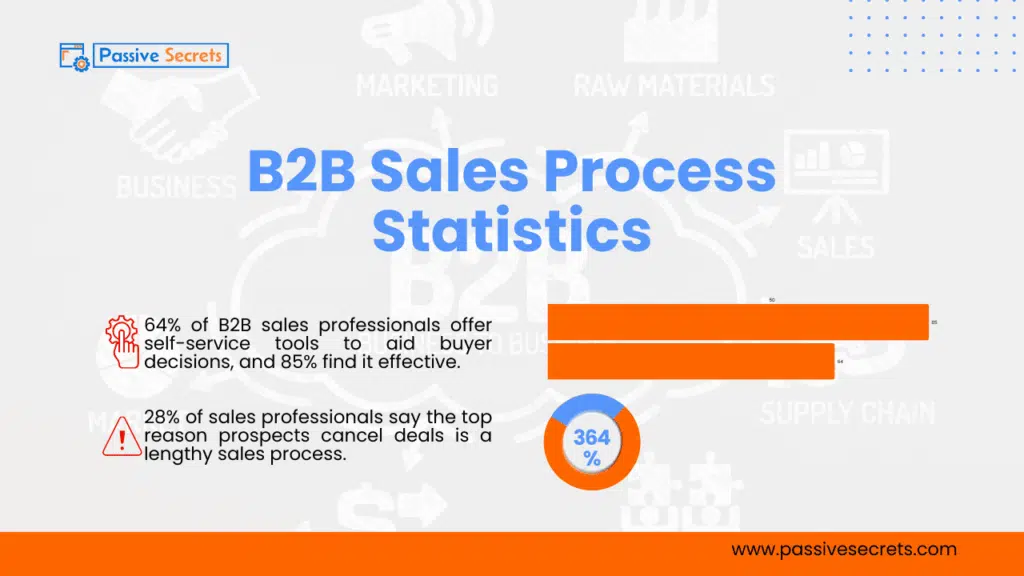
48. 64% of B2B sales professionals offer self-service tools to aid buyer decisions, and 85% find it effective. (source)
49. 28% of sales professionals say the top reason prospects cancel deals is a lengthy sales process. (source)
B2B Customer Behavior Statistics
50. Despite increased investment in outreach, 73% of B2B buyers avoid suppliers that send irrelevant communications. (source)
51. All B2B buyers purchase physical products that are integrated into their company’s offerings, with 86% buying customized/configurable products and 75% purchasing complex products with multiple components or variants. (source)
52. 75% of B2B buyers are willing to switch suppliers for a superior online buying experience. (source)
53. B2B buyers’ top frustrations with online orders:
54. 65% of B2B buyers find AI chatbots helpful for purchases, but only 48% say they provided most or all the needed information, while 40% got some information. (source)
55. 92% of B2B buyers research product sustainability, with 40% doing so on the supplier’s website. If info isn’t available online, 46% call a rep, and 27% switch suppliers. (source)
56. In the US, 67% of buyers use search engines to discover products, and 50% browse online marketplaces. (source)
57. 70% of businesses are open to switching vendors if their essential needs aren’t met or if they have a subpar buying experience. (source)
58. The number of marketing and sales touchpoints in the B2B buying experience has doubled from 5 to 10 in just 5 years. (source)
59. B2B buyers now spend approximately 33% of their time engaging with self-serve content throughout the entire buying process. (source)
60. 52% of B2B sales professionals say customers used self-serve tools more than in 2023. (source)
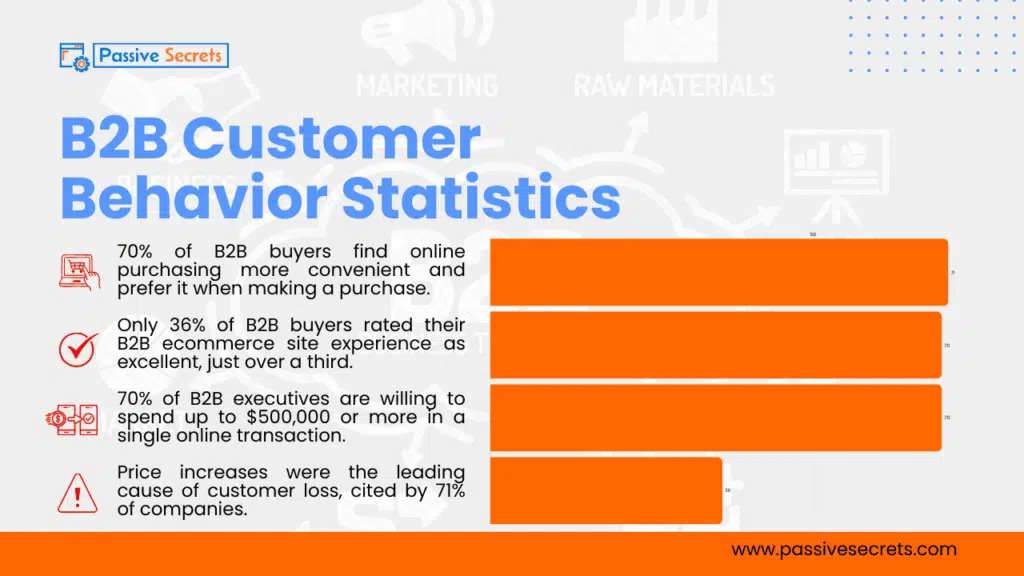
61. 70% of B2B buyers find online purchasing more convenient and prefer it when making a purchase. (source)
62. Only 36% of B2B buyers rated their B2B ecommerce site experience as excellent, just over a third. (source)
63. 70% of B2B executives are willing to spend up to $500,000 or more in a single online transaction. (source)
64. Price increases were the leading cause of customer loss, cited by 71% of companies. (source)
B2B Sales Trends 2026
1. Data-Driven Decision Making
Data-driven decision-making is a key B2B sales trend for 2026. It involves using data and analytics to inform sales strategies and interactions, helping sales teams understand customer behavior, preferences, and needs, and make informed decisions.
Statistics show that over 40% of companies globally use big data analytics, and many are now reaping various benefits from big data.
To implement this approach, businesses capture and integrate data from various sources, analyze and interpret it using analytics tools, train sales teams on data analysis and interpretation, and continuously refine sales approaches based on data insights.
This leads to improved sales conversions, enhanced customer satisfaction, increased efficiency and productivity, and better ROI measurement and optimization.
2. Artificial Intelligence in Sales Operations
This trend involves using AI technologies to streamline and optimize sales processes, enhancing efficiency, productivity, and customer engagement. AI automates repetitive tasks, such as data entry and lead qualification, and analyzes vast amounts of customer data to gain insights into behavior and preferences.
By adopting AI in sales operations, businesses can boost sales performance and revenue growth, improve sales forecasting accuracy, enhance customer satisfaction and loyalty, reduce sales cycle times and costs, and gain a competitive edge in the market.
In 2025, AI will continue to transform B2B sales, enabling sales teams to focus on high-value activities like building relationships and closing deals, while AI handles the rest.
3. Remote Selling
Remote selling is another key B2B sales trend for 2025. This trend involves using digital tools and technologies to engage with customers and close deals remotely, without the need for in-person interactions. Remote selling enables sales teams to connect with customers from anywhere, at any time, and provides a more flexible and convenient buying experience.
With remote selling, businesses can expand their reach and connect with customers across different geographies, time zones, and languages. This trend also enables sales teams to focus on high-value activities like building relationships, understanding customer needs, and providing personalized solutions.
Remote selling will continue to shape the B2B sales market, driven by advances in digital communication tools, virtual and augmented reality, and artificial intelligence. As a result, sales teams will need to develop new skills and strategies to effectively engage with customers remotely and build trust in a virtual environment.
4. Increased Account-Based Selling
This approach involves targeting specific accounts and decision-makers with personalized marketing and sales efforts, rather than casting a wide net. Account-based selling allows B2B sales teams to focus on high-value accounts, build strong relationships, and deliver tailored solutions that meet the unique needs of each account.
As businesses continue to face increased competition and complex buying processes, account-based selling enables sales teams to stand out and drive growth. By prioritizing accounts with the highest potential, sales teams can:
- Develop deeper understanding of customer needs
- Deliver targeted marketing and sales messages
- Build trust and strong relationships
- Drive higher conversion rates and revenue growth
In 2025, account-based selling will become even more crucial, as businesses seek to maximize revenue from existing customers and attract new high-value accounts. Sales teams will need to leverage data, analytics, and digital tools to identify and target the right accounts, and deliver personalized experiences that drive long-term growth.
FAQs
Other Related Statistics You Should Know
- 80+ Interesting Marketing Software Statistics & Facts (Full Industry Report)
- In-Store vs Online Shopping Statistics And Analysis
- 25+ Most Interesting Emotional Intelligence Statistics & Fun Facts
- 35 Interesting Public Speaking Fear Statistics & Fun Facts
- 20 Interesting Body Language Statistics And Fun Facts
- 45+ Interesting Communication Skills Statistics & Huge Trends
- 23 Most Interesting First Impression Statistics To Know
- 60+ Interesting Storytelling Statistics, Facts & Huge Trends
- Sales Enablement Statistics: Data You Need to Drive Sales Growth
- Amazon Book Sales Statistics: Intriguing Numbers and Facts
- 50 Revealing Call Center Statistics and Trends (NEW Update)
- Virtual Event Statistics & Benchmarks For Marketers & Organizers
- 55 Interesting Direct Mail Marketing Statistics and Trends
- B2B Lead Generation Statistics, Facts, Trends, Benchmarks, & Market Size
- 52 Valuable Trade Show Statistics and Trends
- 41+ MOST Important Copywriting Statistics To Know
- 80+ Useful Sales Funnel Statistics & Conversion Rates

