
The copywriting landscape is shifting faster than ever. While the fundamentals of persuasive writing remain timeless, the metrics that matter—and the platforms where copywriters compete—are transforming at breakneck speed.
In 2026, copywriters who rely on gut instinct alone are being outpaced by those who pair creativity with data.
But here’s what surprises most professionals: the statistics reveal that the highest-performing copy isn’t always what we expect.
Conversion rates, engagement patterns, and audience preferences have evolved in ways that challenge conventional copywriting wisdom.
This article unpacks the latest industry data to answer the questions keeping copywriting professionals up at night: What copy actually converts? Where is the profession heading? Which trends are worth your attention, and which are distractions?
Let’s dig into what the data shows and what it means for your career.
Key Copywriting Statistics (Editor’s Pick)
- Content marketing generates over three times as many leads as outbound marketing while costing 62% less.
- 93% of marketers say personalization drives leads and sales, yet only 13% use advanced personalization tactics.
- A personalized call-to-action (CTA) is 202% more effective than a generic one.
- Poor grammar or spelling on a landing page can increase bounce rates by 85%.
- Email marketing delivers the highest ROI of any digital channel — $36 for every $1 spent.
- 47% of email recipients open emails based solely on the subject line.
Why Is Copywriting Important For Business?
Copywriting is the process of creating written content to promote a product, service, or idea. Writing that aims to increase brand awareness and persuade someone or a group to take action is known as copy or sales copy.
Copywriting is important for businesses because it is the art of persuasion. A good copywriter can turn an idea into words that sell, whether it is a product, a service, or even an idea.
The ability to persuade people to take action is a valuable skill that can be used in many different situations.
Copywriting is also important because it is one of the most effective forms of marketing. A well-written piece can reach a large audience and persuade them to take action.
This can result in increased sales, more customers, and more exposure for your business.
Copywriting Statistics & Industry Trends
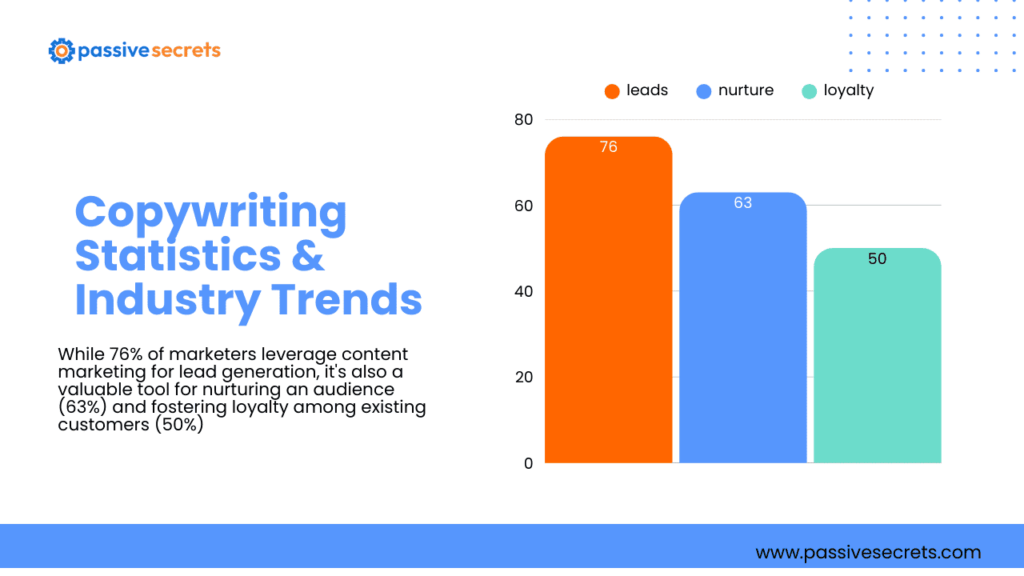
1. While 76% of marketers leverage content marketing for lead generation, it’s also a valuable tool for nurturing an audience (63%) and fostering loyalty among existing customers (50%) (AWAI).
2. Content marketing proves to be a highly effective strategy, generating more than three times as many leads as outbound marketing, while costing 62% less (AWAI).
3. 57% of marketers struggle to develop content that resonates with their audience. Consistency (54%) and standing out from the crowd (54%) are also major hurdles, while 44% find it tough to produce high-quality content in the first place (AWAI).
4. The copywriting market’s on a roll, projected to hit USD 30.29 billion in 2026 (up from USD 27.96 billion in 2025) and reach USD 45.24 billion by 2031, growing at 8.35% CAGR (Modor Intelligence).
5. With AI on the scene, 83% of marketers are under pressure to produce more content, but the good news is 80% of teams plan to keep or boost their content budgets in 2026 (HubSpot 2026).
6. Marketers are struggling with creating engaging content (35%), finding fresh ideas (28%), maintaining a consistent schedule (27%), and measuring ROI (25%) – these are the top content marketing hurdles (HubSpot 2026).
7. 71% of marketers credit AI with boosting their content output, yet they’re still struggling to create content that truly resonates with their audience (HubSpot 2026).
8. 93% of marketers see personalization driving leads and sales, but surprisingly, only 13% are leveraging advanced tactics like hyper-personalization using data or lookalike audiences (HubSpot 2026).
9. Nearly half of marketers (49%) agree that web traffic from search has decreased because of AI answers. But 58% note that AI referral traffic has much higher intent than traditional search (HubSpot 2026).
10. The Copywriting Services Market is expected to be valued at USD 29.28 billion in 2025 and is anticipated to reach USD 48.89 billion by 2032, exhibiting a compound annual growth rate (CAGR) of 7.6% from 2025 to 2032 (Coherent Marketing Insights).
11. Freelance copywriters usually charge 20-30% less than agencies, offering direct communication and quicker delivery. While junior freelancers might earn £150-£300 per day, agencies typically charge £400-£600 daily for similar work (Amelie Pollak).
12. The global AI copywriting tool market size was valued at approximately USD 1.5 billion in 2023 and is projected to reach USD 5.6 billion by 2032, growing at a compound annual growth rate (CAGR) of 15.8% between 2023 and 2032 (Data Intelo).
13. A copy with a personalized call to action (CTA) is 202% more effective than a copy without one. A clear and personalized CTA can be the game-changer for your copy. This is because it tells/shows the potential client what to do and how to do it (HubSpot).
14. Copies that use the fear-of-missing-out (FOMO) strategy are usually very effective. About 60% of surveyed buyers say they purchase within 24 hours due to FOMO (Trust Pulse).
15. SEO copywriting tactics are rapidly increasing. About 69% of marketers are investing in the power of SEO marketing. Strategic keywords are among the top SEO tactics marketers use, including SEO copywriters (HubSpot).
16. About 60% of content marketers measure their content marketing strategy success by the number of sales it generates. This shows that copywriters are very much needed to create compelling content (HubSpot).
Landing Page & Website Copywriting Conversion Statistics
17. Elements such as videos, images, and social media positively impact conversion rates when displayed on a landing page (HubSpot Blog).
18. Poor grammar or spelling in a web copy or landing page can increase the bounce rate by 85%. Bad web copy can also reduce visitors’ time on your website by 8% (Agility).
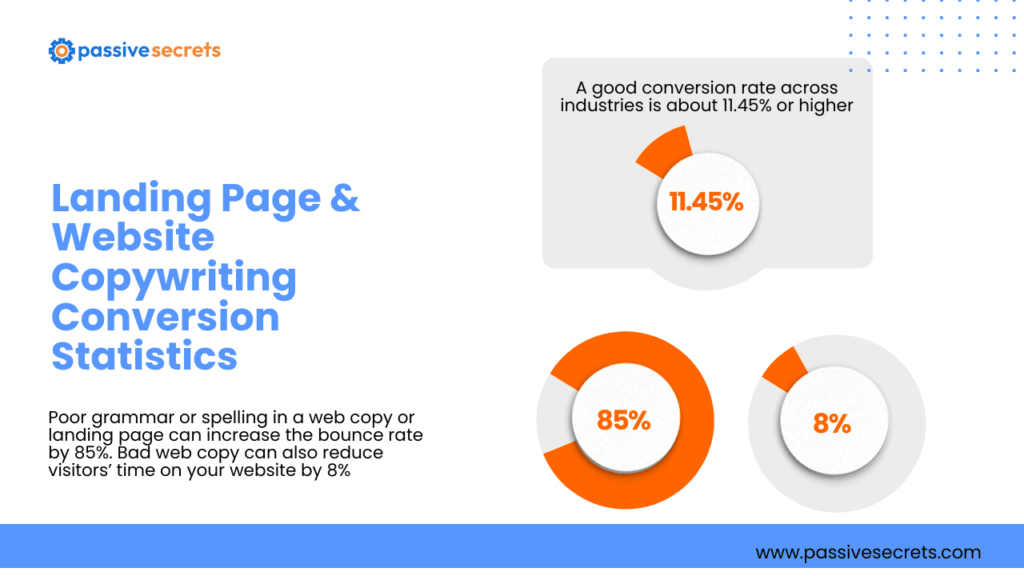
19. A good conversion rate across industries is about 11.45% or higher (Wordstream).
20. About 17% of marketers make use of landing page A/B tests to improve conversion rate (HubSpot).
Email Marketing & Email Copywriting Statistics
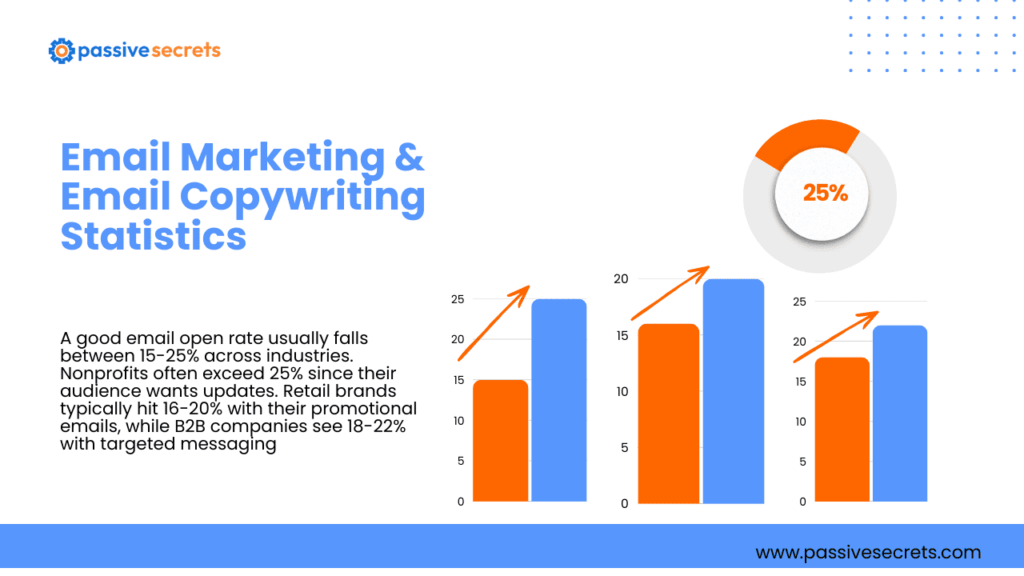
21. A good email open rate usually falls between 15-25% across industries. Nonprofits often exceed 25% since their audience wants updates. Retail brands typically hit 16-20% with their promotional emails, while B2B companies see 18-22% with targeted messaging (Monday).
22. About 64% of small businesses agree that their email copy is effective and has gotten them a bigger ROI (AWeber).
23. As of 2025, there are 4.59 billion email users globally, accounting for 56% of the world’s population. This number is projected to rise to over 4.85 billion by 2027 (Email Tool Tester).
24. Email usage is huge and growing steadily. In 2026, about 392.5 billion emails are expected to be sent daily, rising to 408.2 billion by 2027. This represents a compound annual growth rate (CAGR) of around 4% from 2024’s figure of 361.6 billion daily emails. That’s equivalent to 4.2 million emails sent globally every second. It is easy for your email copy to get lost in the crowd if it is not compelling enough to attract clients and increase conversion (Email Tool Tester).
25. 25-44 years is the age group with the most email users in the U.S (Statista).
26. Email marketing (which includes email copies) has the highest ROI of any other digital marketing strategy. For every $1 spent, there is an ROI of $36 (Litmus).
27. About 60% of consumers say they have purchased from a brand after receiving marketing mail from them (Constant Contact).
28. As headlines are so important in a regular copy or web copy, subject lines are also very important in an email copy. About 47% of email recipients open emails based on the subject line (Optin Monster).
29. Using emojis in your email copy/newsletter subject line can increase open rates by 45%. Boring copies are likely going to get a low conversion. However, those with emojis and other visual content lighten the mood and make them feel more relatable (Optin Monster).
30. Companies that A/B test all their emails see a 37% increase in their email marketing ROI compared to those that do not (Litmus).
31. In 2022, the overall average email open rate for B2B and B2C companies across various industries dropped to 16.97%, with a 10.29% CTR (Smart Insights).
Latest Copywriting Trends For 2026 And Beyond
1. The Human Element Still Wins in AI Copywriting
The narrative around AI copywriting has shifted dramatically. In 2025, many professionals feared automation would replace their craft. Instead, 2026 is revealing something unexpected: AI’s real power lies in amplifying human creativity, not replacing it.
The copywriters winning right now aren’t those trying to write like machines—they’re those using AI as a research and iteration partner while keeping the distinctly human voice front and center. Human-first AI copywriting means leveraging generative tools for speed and scale while maintaining the emotional resonance, brand personality, and nuanced persuasion that only humans can engineer.
What this looks like in practice: strategists use AI to rapid-test multiple angles and frameworks, then their human expertise determines which direction actually aligns with brand voice and audience psychology. The tool becomes a thought partner, not a replacement. This approach also addresses a critical consumer preference emerging in 2026: audiences are increasingly skeptical of purely algorithmic content and gravitating toward copy that feels intentionally crafted by someone who understands them.
For copywriting professionals, this trend validates a critical insight: specialization in understanding human psychology, cultural nuance, and persuasion principles is more valuable than ever. Your role is evolving from “person who writes” to “strategic thinker who directs AI and validates output.”
2. Clarity and Structure is the New Competitive Edge
Search engines and user behavior data in 2026 confirm what experienced copywriters have always known: clarity wins. But what’s changing is how clarity matters most.
With the rise of AI-generated content flooding the web, search algorithms are placing heavy weight on structural clarity—how information is organized, prioritized, and presented. Users scanning pages (and AI crawlers indexing them) reward copy that makes its value proposition unmissable. This means strategic use of subheadings, short paragraphs, and logical information hierarchy isn’t just good UX; it’s become a ranking factor.
The copywriters who thrive in 2026 understand that clarity is mostly about respecting your reader’s time and cognitive load. The most persuasive copy guides readers through a clear narrative path without friction. Jargon, overly complex sentence structures, and buried key points are liabilities.
Conversely, copy that makes its core argument visible within seconds, then builds supporting logic underneath, performs consistently across industries.
This trend also intersects with accessibility and inclusivity. Copy that’s structurally clear serves readers across different literacy levels, languages, and contexts. The competitive advantage increasingly belongs to copywriters who can distill complex ideas into clear, scannable, persuasive structures.
3. GEO Is Rewriting the Rules: Optimizing Copy for AI-Driven Discovery
Generative Engine Optimization is the new frontier that’s reframing how copywriters think about discoverability. As generative AI systems become the primary interface for information discovery, instead of traditional search engines, copywriting strategy must adapt.
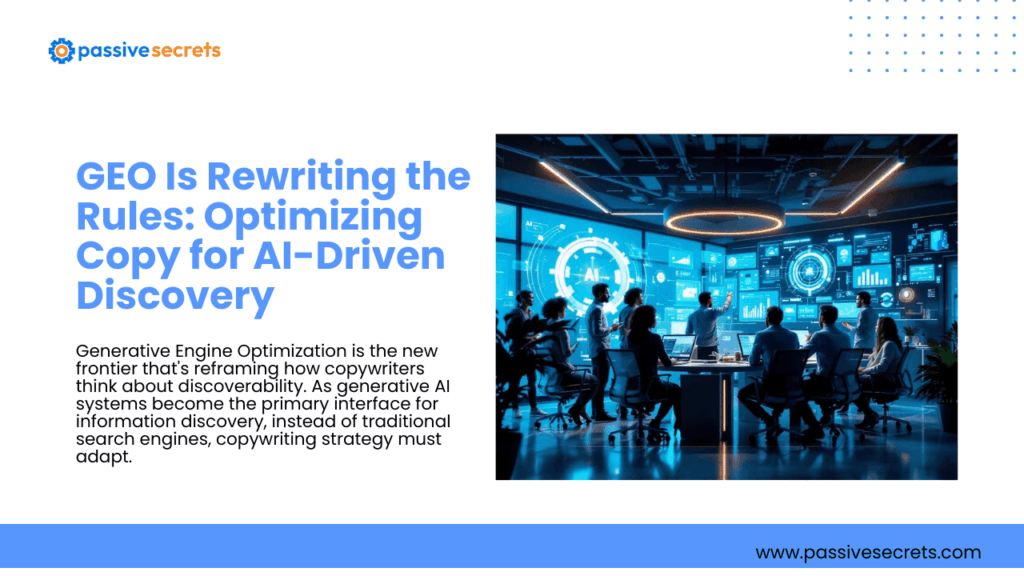
GEO is the practice of optimizing copy not just for search engine algorithms, but for how generative AI systems (like ChatGPT, Claude, and proprietary enterprise models) cite, reference, and retrieve information. These systems prioritize different signals than Google does: clarity of thought, comprehensive coverage of a topic, and direct answers to implied user intent.
For copywriters, this means structuring content to be genuinely useful to an AI system that’s summarizing and synthesizing information for an end user. It’s less about keyword placement and more about being the source an AI wants to reference.
Copy that demonstrates genuine expertise, covers topics comprehensively, and provides clear citations or data sources becomes more valuable. Similarly, a copy that answers the underlying question (not just the surface query) positions itself better for citation in generative outputs.
The strategic implication is significant: copywriters who can write content that serves both human readers and AI systems as authoritative sources will dominate visibility in 2026. This requires a different mindset—thinking about how your copy will be extracted, summarized, and attributed, not just how it ranks in a search results page.
Frequently Asked Questions
Conclusion
It’s important to remember that copywriting statistics and trends are not set in stone. This means that they can change over time. Therefore, you must stay up-to-date on what has changed.
Ultimately, the best way to write effective copy is not to get too caught up in what’s “in” and not.
Instead, pay attention to the needs of your customers and your business, and make adjustments as necessary.
That way, you’ll always be able to engage your audience and keep them returning for more.
When you keep these things in mind, you can ensure that your copywriting is up-to-date and engaging.
Recent Posts:
- B2B Sales Statistics: Latest Insights and Trends
- 50+ Essential Traditional Marketing Statistics & Trends
- 90+ Useful Marketing Jobs Statistics & Facts (Latest Report)
- Sales Enablement Statistics: Data You Need to Drive Sales Growth
- In-store vs. Online Shopping Statistics And Analysis
- Latest In-Game Advertising Statistics
- From Passion to Profit: 120+ Creator Economy Statistics
- 80+ Big Marketing Software Statistics
- 45 Interesting Healthcare Marketing Statistics & Trends
- Print Marketing Statistics: Ad Spending, Market Size, & More
- Key Short-Form Video Statistics and Trends You Should Know
- 49 Interesting Emotional Marketing Statistics
- 70+ Top Law Firm Marketing Statistics & NEW Trends
- 23 Most Interesting First Impression Statistics To Know
- 60+ Interesting Storytelling Statistics, Facts & Huge Trends
- Amazon Book Sales Statistics: Intriguing Numbers and Facts
- 61+ Useful Podcast Advertising Statistics And Trends
- 50+ Useful Call Center Statistics And Trends
- 50 Crucial Amazon Advertising Statistics & Trends
- 65+ Must-Know Pay-Per-Click Statistics
- 40+ Interesting Omnichannel Marketing Statistics & Trends
- Multi-Level And Network Marketing Statistics, Facts & Trends
- Virtual Event Statistics & Benchmarks For Marketers & Organizers
- 55 Interesting Direct Mail Marketing Statistics and Trends
- B2B Lead Generation Statistics, Facts, Trends, Benchmarks, Market Size
- 52 Valuable Trade Show Statistics and Trends
- 100+ Top Digital Marketing Vs. Traditional Marketing Stats
- 110+ Important Social Media Advertising Statistics & Trends
- 50 Interesting Organic Vs Paid Search Statistics To Know
- 80+ Useful Sales Funnel Statistics & Conversion Rates
- 40+ Latest Multi-Channel Marketing Statistics & Huge Trends

