

Here’s what most law firms won’t admit: they’re spending marketing dollars on tactics that don’t convert, misunderstanding what their potential clients actually want, and falling dangerously behind firms that have already adapted to how legal services are being discovered and evaluated in 2026.
The numbers don’t lie. Half of law firms openly acknowledge wasting money on campaigns that didn’t deliver.
Yet 98% of those same firms believe their clients are satisfied with their response speed—a disconnect that reveals a deeper problem: most law firms are operating in a data fog, making decisions based on gut feel and outdated playbooks rather than what the market is actually telling them.
The legal services market is massive ($1.03 trillion in 2025) and growing rapidly, but the firms winning aren’t the ones with the biggest names or budgets. They’re the ones paying attention to what’s changing: how clients search for lawyers (increasingly through AI), how they evaluate options, and where they expect to engage.
This article breaks down the most important law firm marketing statistics of 2026—the ones that reveal which strategies actually move the needle and which are quietly draining resources.
More importantly, it shows you where the gap is between what successful firms are doing and what yours might be missing. The firms that act on these insights will dominate their markets. The ones that ignore them will gradually lose ground to competitors who understand the new rules.
Let’s get to the brutal truths.
Key Law Firm Marketing Statistics
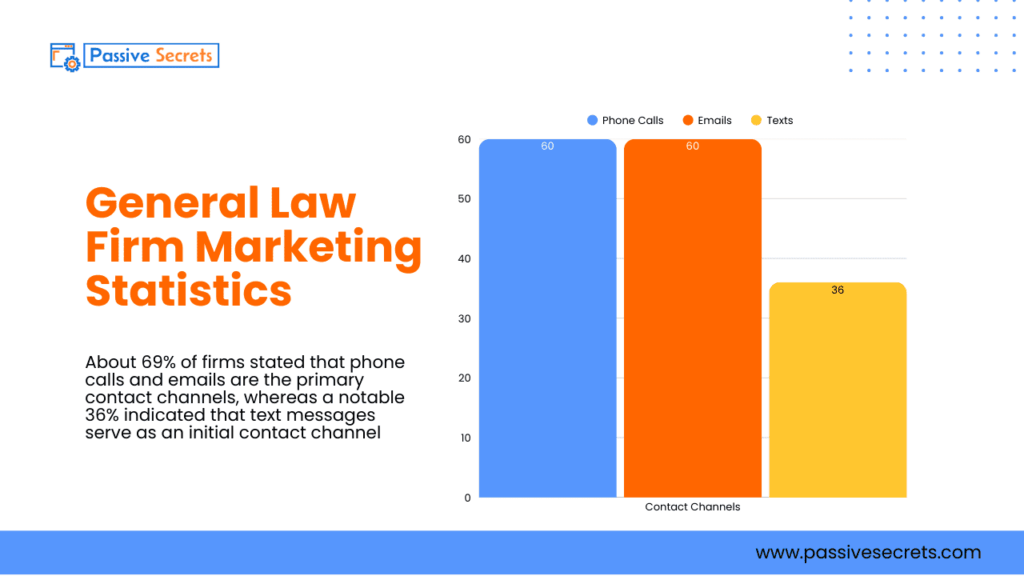
- 69% of law firms report that phone calls and emails are their primary initial contact channels with potential clients.
- 36% of firms say text messaging is used as a first contact channel with prospects.
- 68% of law firms use AI for marketing personalization efforts.
- 55% of firms apply AI to lead scoring and qualification.
- Over 50% of law firms use AI to measure marketing ROI and performance.
- Law firm marketing budgets continue to shift toward digital channels, with firms prioritizing online visibility and client acquisition.
- Client acquisition remains the top marketing priority for most law firms, ahead of brand awareness and retention initiatives.
General Law Firm Marketing Statistics
1. About 69% of firms stated that phone calls and emails are the primary contact channels, whereas a notable 36% indicated that text messages serve as an initial contact channel (Call Rail Report 2026).
2. 68% of law firms leverage AI for marketing personalization, while over half apply it to lead scoring (55%) and measuring ROI (53%) (Call Rail Report 2026).
3. In 2025, 86% of surveyed law firms anticipated a marketing budget increase, but in 2026, just 57% of firms expect the same. Still, only 11% plan to cut back, showing the industry’s overall faith in marketing’s value (Call Rail Report 2026).
4. The biggest hurdles for law firms in 2026 are mostly outside their control: keeping up with tech changes (51%), increased competition (50%), and declining demand (48%)
Internal challenges include limited staff/resources (48%) and siloed teams (34%). Marketing-wise, they’re also struggling with copy/content creation (57%) and lead gen/qualification (37%) (Call Rail Report 2026).
5. Most law firms have adopted AI in some aspect of marketing. Top uses include personalization (68%), lead scoring (55%), attribution/ROI measurement (53%), content generation (52%), and automating customer comms (39%). Personal injury firms excel at AI personalization (84% vs 68% overall) but trail in attribution/ROI measurement (36% vs 53%) (Call Rail Report 2026).
6. About 89% of firms are confident they can leverage marketing to land their ideal clients – 51% are moderately confident, and 38% are extremely confident (Call Rail Report 2026).
7. A growing number of individual legal professionals are using generative AI for work-related tasks, with 31% saying they’ve used it, compared to 27% last year (American Bar Association).
8. Larger law firms feel more confident about their marketing exposure compared to smaller ones. Firms with 26+ employees gave an optimism rating of 3.9/5, with 69% agreeing they’re more exposed than competitors. Smaller firms (1-25 employees) were less confident, rating 3.4/5, with 54% agreeing (State of Law Firm Marketing Report).
9. Most people, over 70%, prefer to make initial contact with a lawyer via phone, and half of them expect a response on the same day they make contact (Find Law).
10. About 2/3 of law firms feel pretty confident they’re effectively tracking and understanding the impact of their marketing efforts (CallRail 2025 Report).
11. Just half of law firms respond to leads within an hour, but a whopping 98% think their clients are happy with how fast they respond (CallRail 2025 Report).
12. Up to 50% of law firms don’t even know how many clients they lose due to slow responses, and a huge 90% can’t put a number on the revenue they’re losing because of it (CallRail 2025 Report).
13. 42% of law firms say attorneys are mainly responsible for their own marketing, even when they’re already juggling heavy caseloads and billing hours (CallRail 2025 Report).
14. The vast majority, 92.4%, of people with legal issues now research online before reaching out to a lawyer (Martindale 2024 Report).
15. When looking for a lawyer, people care most about reviews (almost 70%). Other big factors are pricing (61.6%), how responsive the lawyer is (58%), and the lawyer’s reputation (53%) (Martindale 2024 Report).
16. People trust lawyers more if they’re regulated (90%), specialize in a specific area (89%), and communicate clearly (88%) (Legal Services Consumer).
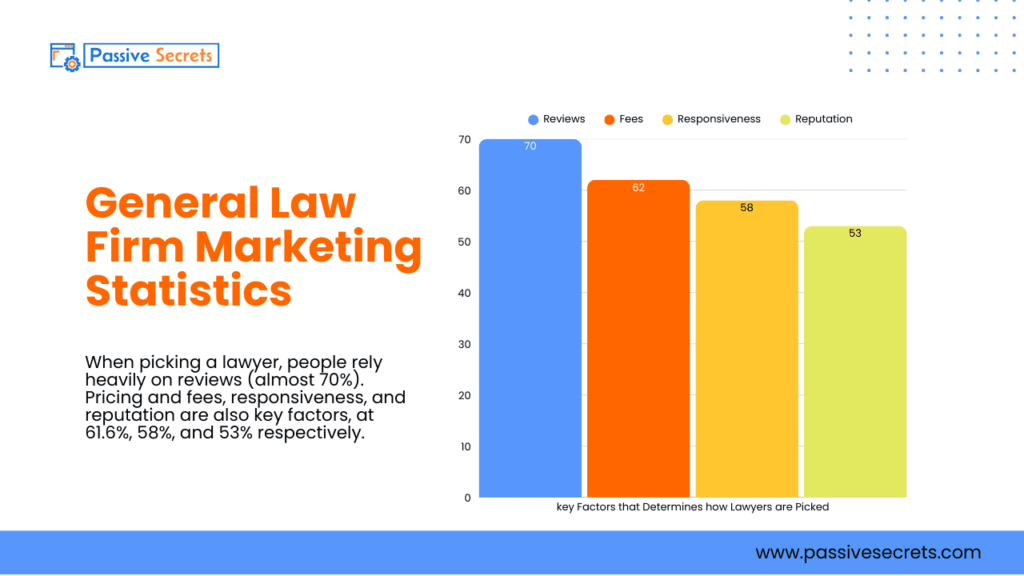
17. When picking a lawyer, people rely heavily on reviews (almost 70%). Pricing and fees, responsiveness, and reputation are also key factors, at 61.6%, 58%, and 53%, respectively. (Martindale 2026 Report).
18. The legal services market was worth $1.03 trillion in 2025 and is expected to hit $1.62 trillion by 2035, growing at 4.63% per year (Precedence Research).
Social Media Marketing Statistics For Law Firms
19. About 39% of firms will add SMS/text, 36% organic social, and 33% video to their marketing mix. Influencer marketing (29%) and email marketing (28%) are also on the agenda. They’re prioritizing short-form video (62%), automation (50%), personalization (47%), AI (38%), and SEO (37%) (Call Rail Report 2026).
20. Law firms are on social media: 89% are active, with LinkedIn (87%) and Facebook (62%) being the most popular. X/Twitter (38%) and Martindale (37%) trail behind (ABA).
SEO Marketing Statistics For Law Firms
21. Digital marketing is key for law firms, with SEO (54%), video (50%), paid search (47%), paid social (38%), and content (37%) driving new clients. Paid search is crucial for larger firms (63%) vs 53% overall (Call Rail Report 2026).
22. The average law firm experiences an impressive 526% return on investment (ROI) from its SEO efforts over a three-year period (LinkedIn).
Statistics on Other Marketing Strategies
23. Law firms planning budget boosts will focus on email (51%), influencer marketing (49%), and paid social (47%). Trade shows (25%) and traditional advertising (12%) will get the smallest increases (Call Rail Report 2026).
24. For marketing, law firms are all about LinkedIn (51%). Facebook (27%) and X (14%) lag behind. Email’s still big (40%). Traditional methods are also in play: event sponsorships (44%), direct mail (11%), radio (9%), and Yellow Pages (7%) (ABA).
Law Firm Website Statistics
25. Law firm blogging’s on the rise: 37% have blogs, up from 27% in 2020. Big firms lead the way – 60% of firms with 100+ lawyers blog, vs just 11% of solo practitioners (ABA).
26. The majority of consumers, over 75%, tend to browse through multiple websites, typically between two to five, before deciding to get in touch with a lawyer (Find Law).
Budget Statistics on Law Firm Marketing
27. Only 57% of law firms are expecting to increase their marketing budgets in 2026, representing a significant decline from the 86% that reported the same expectation the previous year (Call Rail Report 2026).
28. Larger law firms are more bullish on marketing budget increases. Firms with 26+ employees rated 4.1/5, with 79% expecting a boost. Smaller firms (1-25 employees) are less optimistic, rating 3.7/5 with 69% expecting an increase (State of Law Firm Marketing Report).
29. Law firms, regardless of size, seem somewhat underimpressed with how their marketing budget is performing, giving it a fairly average rating of 3.8 out of 5. About 65% of respondents agree that their current budget is achieving their lead generation goals, but it’s not exactly a glowing endorsement (State of Law Firm Marketing Report).
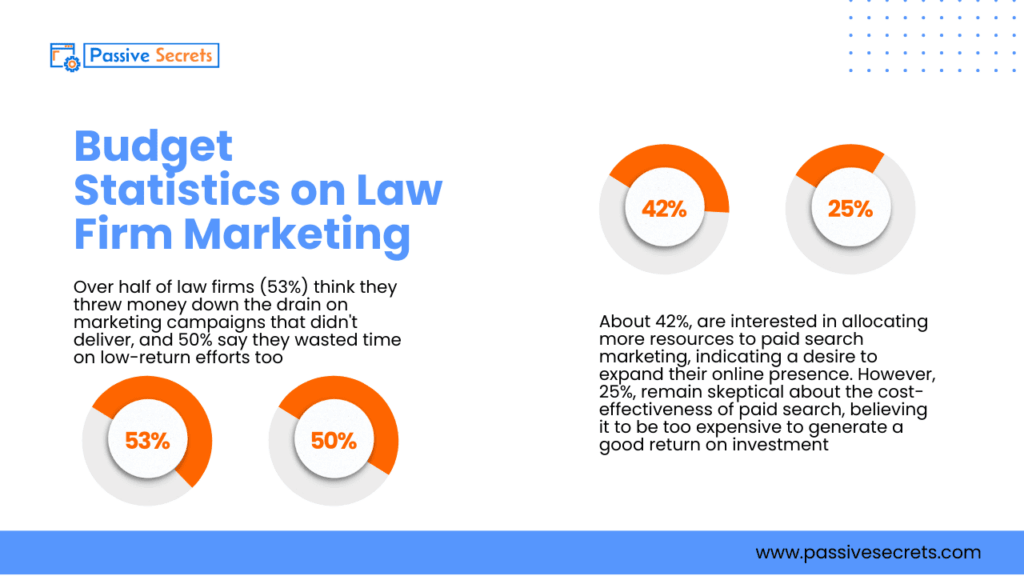
30. Over half of law firms (53%) think they threw money down the drain on marketing campaigns that didn’t deliver, and 50% say they wasted time on low-return efforts too (CallRail 2025 Report).
31. Half of law firms think they can’t compete with bigger firms because their marketing budget is too small (CallRail 2025 Report).
32. About 42% are interested in allocating more resources to paid search marketing, indicating a desire to expand their online presence. However, 25% remain skeptical about the cost-effectiveness of paid search, believing it to be too expensive to generate a good return on investment (CallRail 2025 Report).
Law Firm Marketing Trends 2026
In 2026, law firms will change how they attract clients. They will use new methods, such as online marketing, personalized content, and technology like AI, to better connect with people.
These trends help law firms stand out and build better relationships with clients. Let’s explore the exciting trends shaping legal marketing in 2026!
AI-Powered Search Optimization (GEO/AIO Dominance)
The search landscape is fundamentally shifting with the rise of Generative Engine Optimization (GEO) and AI Overviews (AIO) from Google, Bing, and other platforms.
Rather than ranking on the first page of traditional search results, law firms now need to optimize for AI-generated summaries and answers that appear above traditional listings. This means rethinking keyword strategies and content structure to provide clear, authoritative answers to client questions.
Law firms should focus on creating comprehensive, cited content that AI systems will pull from when answering legal inquiries.
Structured data, E-E-A-T (Experience, Expertise, Authoritativeness, Trustworthiness) signals, and detailed expert information become more critical than ever. Firms that adapt their SEO and content strategies to this new reality will maintain visibility in a post-traditional-search world.
Short-Form Video as a Full-Funnel Engagement Tool
For many years, short-form video content (through platforms like TikTok, Instagram Reels, YouTube Shorts, and LinkedIn Videos) has been for only brand awareness. This trajectory has changed.
In 2026, law firms are leveraging these formats across the entire client journey: from introducing practice areas and explaining legal concepts, to case highlights and client success stories, to conversion-focused testimonial videos.
These bite-sized formats work well for complex legal topics, breaking down intimidating subjects into digestible, shareable content.
The informal, authentic nature of short-form video also humanizes law firms and builds relatability—crucial for potential clients deciding whether they can trust a firm.
Firms that invest in consistent, quality short-form video production will capture attention on algorithmic feeds and build deeper engagement with prospects than traditional long-form content alone.
Human Authenticity and Trust-Building to Counter AI “Slop”
As AI-generated content floods the internet, consumers are increasingly skeptical and seeking genuine human connection and expertise.
For law firms, this trend is an opportunity: authenticity becomes a competitive advantage.
Rather than polished, corporate messaging, clients want to see real attorneys discussing real cases (within ethical bounds), sharing genuine insights, and connecting on a human level. This might mean less emphasis on perfectly produced marketing materials and more on behind-the-scenes content, attorney interviews, candid client testimonials, and transparent communication about firm values.
Building trust through demonstrable expertise, consistent communication, and genuine care for client outcomes will differentiate firms in a market saturated with automated, AI-generated content.
Firms that lean into their human element—the knowledge, personality, and values of their attorneys—will build stronger client relationships and loyalty.
Deep Niche Specialization with Targeted Thought Leadership

Instead of competing as generalist firms offering broad legal services, successful law firms in 2026 are carving out deep niches and positioning their attorneys as recognized thought leaders in those specific areas.
This goes beyond basic practice area pages; it involves publishing original research, speaking at industry events, contributing to high-authority publications, and actively engaging in conversations that shape their practice area.
A firm specializing in tech IP law, for example, might publish white papers on emerging AI regulation, appear on industry podcasts, or contribute to congressional discussions.
Right positioning and thought leadership attract highly qualified clients who are searching for expertise in specific legal domains, command premium rates, and create a sustainable competitive moat against larger generalist competitors.
In 2026, the firms gaining real market share are those deeply embedded in their chosen niches with attorney-led thought leadership.
Final Thought
The 2026 law firm marketing landscape rewards those who adapt and punishes those who delay. The statistics paint a clear picture: there’s a massive gap between how law firms perceive their marketing effectiveness and the reality of what’s actually working. Firms that think they’re doing fine are likely the same ones losing clients to competitors who understand what today’s potential clients actually need.
The trends are unmistakable. AI is already reshaping how people find lawyers. Short-form video has become a must-have. Authenticity isn’t optional—it’s a competitive weapon in a world drowning in AI-generated content.
Most importantly, niche specialization with genuine thought leadership separates the firms commanding premium rates from those competing on price.
Here’s the hard truth: you can’t afford to be average anymore. The firms thriving in 2026 are the ones making intentional shifts now. They’re investing in AI-optimized content strategies. They’re producing short-form video consistently. They’re letting their attorneys be human and build real trust. They’re becoming recognized experts in specific practice areas rather than trying to be everything to everyone.
The good news? You don’t need a massive budget to compete. You need strategy, consistency, and the willingness to do what most firms aren’t doing.
The statistics show that smaller firms with focused, authentic marketing often outperform larger, slower-moving competitors. The opportunity is there for firms ready to seize it.
The question isn’t whether these trends will shape legal services marketing in 2026. They already are. The question is: will your firm be leading the change or chasing it?
FAQs

Other Statistics Posts:
- 50+ Essential Traditional Marketing Statistics & Trends
- 90+ Useful Marketing Jobs Statistics & Facts (Latest Report)
- 80+ Big Marketing Software Statistics
- 45 Interesting Healthcare Marketing Statistics & Trends
- Print Marketing Statistics: Ad Spending, Market Size, & More
- Key Short-Form Video Statistics and Trends You Should Know
- 49 Interesting Emotional Marketing Statistics
- 23 Most Interesting First Impression Statistics To Know
- 60+ Interesting Storytelling Statistics, Facts & Huge Trends
- 61+ Useful Podcast Advertising Statistics And Trends
- 50+ Useful Call Center Statistics And Trends
- 50 Crucial Amazon Advertising Statistics & Trends
- 65+ Must-Know Pay-Per-Click Statistics
- 40+ Interesting Omnichannel Marketing Statistics & Trends
- Multi-Level And Network Marketing Statistics, Facts & Trends
- Virtual Event Statistics & Benchmarks For Marketers & Organizers
- 55 Interesting Direct Mail Marketing Statistics and Trends
- B2B Lead Generation Statistics, Facts, Trends, Benchmarks, Market Size
- 52 Valuable Trade Show Statistics and Trends
- 100+ Top Digital Marketing Vs. Traditional Marketing Stats
- 110+ Important Social Media Advertising Statistics & Trends
- 50 Interesting Organic Vs Paid Search Statistics To Know
- 40+ Latest Multi-Channel Marketing Statistics & Huge Trends

