
Did you know that over 85% of B2B marketers use content to generate leads, compared to just 60% of B2C marketers? This highlights the importance of content in B2B marketing.
Also, most B2B companies (68%) use landing pages to help turn new leads into customers.
Understanding B2B lead generation is crucial for any business looking to grow. However, it takes work. 68% of B2B businesses struggle with lead generation.
But what if you could consistently crack the code to attract and convert high-quality leads?
In this article, we’ll dive into the latest B2B lead generation statistics, revealing surprising trends, actionable insights, and data-driven strategies to help you stay ahead of the competition and fuel your business growth.
Key B2B Lead Generation Statistics (Editor’s Pick)
- 61% of B2B marketers improved their content strategies—mainly through stronger strategy (74%) and better teams (40%).
- U.S. B2B marketing spend hit $59.5B in 2024, projected to exceed $69B by 2026.
- The global B2B lead gen services market is growing 11.8% annually (2023–2032).
- Half of B2B marketers (50%) achieved or made major progress on 2024 goals.
- 55% of B2B firms are dissatisfied with their audience targeting and engagement.
- 72% of high performers reach target audiences effectively vs. 15% of low performers.
- 65% use hybrid GTM strategies, but fewer than 40% regularly track key metrics.
- Only 41% of marketers rate their lead nurturing as “very good” or “excellent.”
- 39% use intent data, yet high-growth teams use it 62% more.
- Email leads all channels, used by 88% of B2B companies, with 78% using social media.
- LinkedIn dominates B2B social, used by 97% of marketers for lead generation.
- Email marketing (66%) tops lead gen channels, followed by paid social, search, SEO, and webinars.
- Virtual events (98%) and SEO (96%) drive the highest-quality B2B leads.
- Top challenges: creating content that drives action (40%), resource limits (39%), and measuring results (33%).
- 54% of marketers say lack of resources is a persistent issue.
- 45% cite economic uncertainty, and 33% note declining engagement metrics.
- Strong lead nurturing generates 50% more sales-ready leads at 33% lower cost.
- 60% of B2B leaders plan to boost AI investment in 2025.
- 81% of marketers use AI for content creation; 66% for email, and 52% for personalization.
- 95% of B2B marketers say their companies are comfortable using AI tools.
- 59% of marketers plan more small, targeted hosted events, while large events declined 12% YoY.
- By 2025, 30% of outbound B2B messages will be AI-generated, up from 2% in 2022.
General B2B Lead Generation Statistics
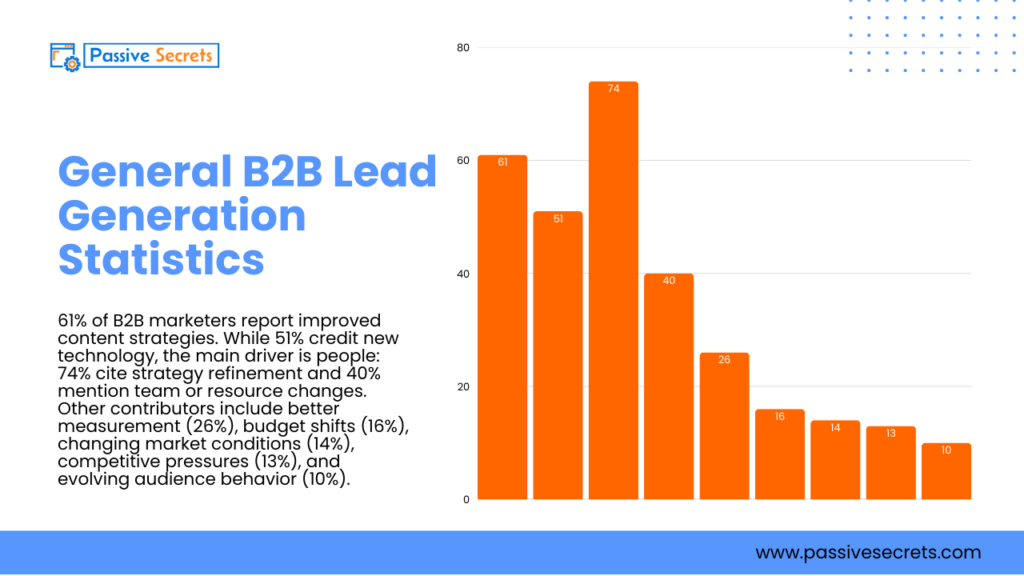
1. 61% of B2B marketers report improved content strategies. While 51% credit new technology, the main driver is people: 74% cite strategy refinement and 40% mention team or resource changes. Other contributors include better measurement (26%), budget shifts (16%), changing market conditions (14%), competitive pressures (13%), and evolving audience behavior (10%) (source).
2. In 2024, US B2B marketers spent $24 billion on events and sponsorships, which is the second-largest marketing expense after internal labor costs (source).
3. In the second quarter of 2024, the U.S. business-to-business (B2B) exhibition sector experienced a 6.6% drop in net square feet (NSF) compared to the first quarter of 2019. Additionally, every other key metric showed even greater declines, with real revenues falling by almost 16% from their levels five years earlier (source).
4. 85% of US B2B executives stated that it was very or moderately important for vendors to understand their company’s challenges and needs, while 56% emphasized the importance of a good cultural fit with their organization (source).
5. Nearly 49% of U.S. business decision-makers said that seeing more creative advertising for business-to-business (B2B) products or services would make them more likely to explore a company’s other offerings. Meanwhile, about 46% indicated they would pay closer attention to such brands (source).
6. Global ad spending was projected to surpass $1 trillion in 2024, with AI-driven reallocations shifting up to 40% of traditional budgets. Digital ad spending saw growth in retail media, paid search, and social, with notable increases (source).
7. Half of B2B marketers (50%) report significant progress or fully achieved goals in 2024 (source).
8. B2B teams are allocating budgets to core areas like digital marketing (54%), social media (43%), customer marketing (41%), and content (40%) (source).
9. Most B2B marketers (96%) have emerging or advanced GTM strategies, but less than half feel equipped to meet demands (source).
10. 74% of B2B marketers launch campaigns within 16-60 days, striking a balance between speed and strategic planning, reflecting industry standards (source).
11.US B2B advertising and marketing spending reached $59.5 billion in 2024 and is expected to surpass $69 billion by 2026, growing by nearly $10 billion in just two years (source).
12. US online B2B advertising and marketing spending hit $20.4 billion in 2024 and is forecasted to rise to $27 billion by 2026, a gain of $6.6 billion in just two years (source).
13. The global B2B lead generation services market is booming, expanding from $2.4 billion in 2023 to a projected $6.5 billion by 2032, with a remarkable 11.8% annual growth rate. The global B2B lead generation services market is divided into regions: Asia Pacific, North America, Latin America, Europe, and the Middle East & Africa (source).
14. In 2023, North America had a significant share of the B2B lead generation services market. This was due to the region’s advanced digital infrastructure, strong investments in technology, and many leading tech companies. The United States, as a major center for B2B commerce, led the way in adopting lead generation services and driving market growth (source).
Lead Generation Metrics and Benchmarks
15. US for-profit companies’ marketing leaders revealed that B2C product companies spent an average of 18.6% of their marketing budget on social media, while B2B product brands spent less than 8% on average (source).
16. Demand for gated content is growing, with 8 million first-party registrations recorded, reflecting users’ willingness to share their information for valuable B2B content (source).
17. eBooks are a powerhouse in B2B content, outperforming other formats like White Papers, generating 983 registrations per asset compared to White Papers’ 60 registrations (source).
18. In B2B content, Playbooks, Case Studies, and Infographics are strongly linked to buying decisions within 12 months, with Infographics notably 110% more likely to influence purchases. These three are the top purchase-intent formats for B2B content.
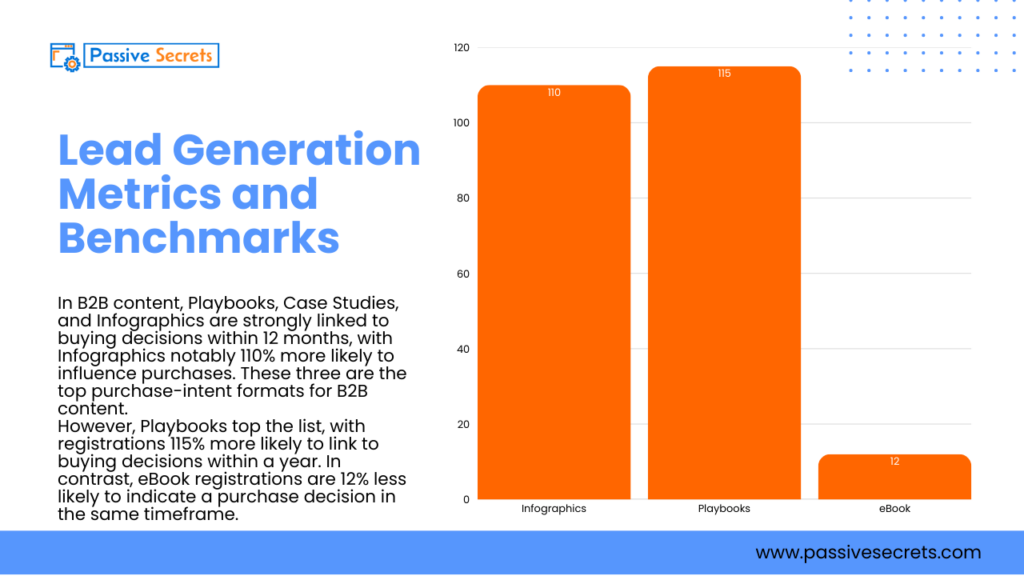
However, Playbooks top the list, with registrations 115% more likely to link to buying decisions within a year. In contrast, eBook registrations are 12% less likely to indicate a purchase decision in the same timeframe (source).
19. Over half (55%) of B2B companies are dissatisfied with targeting and engaging key audiences and buying groups (source).
20. High performers are more likely to report effective target audience reach and engagement, with 72% saying they do it well, compared to just 15% of low performers (source).
21. Most B2B marketing teams see room for improvement in lead nurturing, with only 41% rating their efforts as “very good” or “excellent,” while 59% identify performance gaps (source).
22. B2B teams struggle with measuring success, with 65% using hybrid GTM strategies, but less than 40% regularly track key metrics like qualified accounts or individual leads (source).
23. Marketers using intent data for targeting: 39%. However, high-growth marketers use intent data 62% more than their peers (source).
24. Around 33% of B2B content marketers plan to increase their budgets by 1-9% in 2025, while 13% expect a more significant boost of over 9%. Meanwhile, 41% anticipate stable budgets, 8% foresee a decrease, and 5% are uncertain about changes (source).
25. The US B2B trade show market is recovering, reaching $15.78 billion in 2024 and surpassing pre-pandemic levels. The market is expected to grow, hitting $17.3 billion by 2028 (source).
26. US offline B2B advertising and marketing spending reached $39.1 billion in 2024 and is expected to rise to $42 billion by 2026, a steady increase over the next two years (source).
27. 57% of B2B marketers say they have used “quantity of leads” as a metric to track content performance in the past 12 months. 52% reported using “quality of leads” for the same purpose (source).
28. 60% of B2B marketers say they rely most on the “quality of leads” as a metric when evaluating content performance. 34% reported the same for the “quantity of leads” (source).
29. In 2024, B2B marketers in the US increased their martech spending by 13.4%, reaching $8.71 billion, with projections to hit nearly $14 billion by 2027 (source).
30. US B2B marketing data spending is expected to rise 2.5% in 2024, reaching $3.8 billion, and then increase by nearly 4% in 2025, hitting $4 billion, showing steady growth in data-driven marketing investments (source).
31. The legal services industry has one of the highest B2B conversion rates (source).
B2B Conversion Rate by Industry
| B2B Industry | Average Conversion Rate |
| Legal services | 7.4% |
| HVAC services | 3.1% |
| Staffing & Recruiting | 2.9% |
| Higher Education & College | 2.8% |
| Real Estate | 2.7% |
| Industrial IoT | 2.6% |
| Oil & Gas | 2.5% |
| PCB Design & Manufacturing | 2.4% |
| Financial services | 1.9% |
| Heavy Equipment | 1.7% |
| Transportation and Logistics | 1.4% |
| Software Development | 1.1% |
| B2B SaaS | 1.1% |
32. B2B service providers in the US allocated 9% of revenue to marketing, while B2B product sellers spent an average of 6.4% in 2025 (source).
Most Effective Lead Generation Channels
33. B2B tech marketers create content mainly based on research and website analytics (50%), followed by PR and field marketing requests (41%), and regional sales team requests (39%) (source).
34. 73% of global senior B2B decision-makers preferred email communication from sellers, while nearly 40% favored in-person events (source).
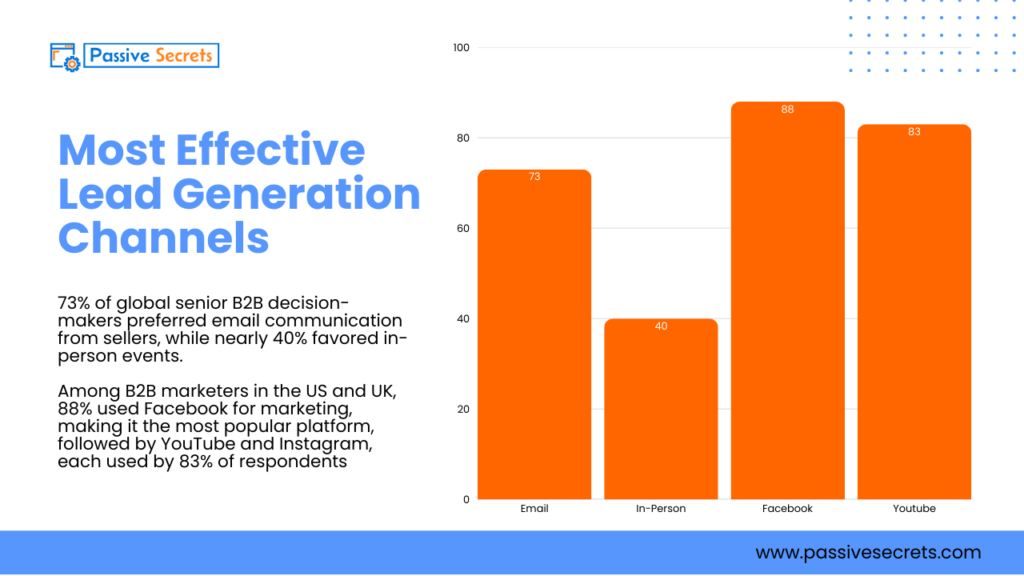
35. Among B2B marketers in the US and UK, 88% used Facebook for marketing, making it the most popular platform, followed by YouTube and Instagram, each used by 83% of respondents (source).
36. A survey of US B2B marketing professionals showed that 56% of respondents found social media posts to be the most effective content type for influencer programs. In-person events were considered effective by 39% of respondents, while only 13% thought newsletters were effective (source).
37. Globally, 28% of senior B2B marketers find thought leaders or industry analysts to be the most effective influencers, followed by company customers, at 23% (source).
38. 68% of B2B marketers ramped up their LinkedIn usage over the past year, no surprise given it’s deemed the top social media platform for delivering value to their organizations (source).
39. Email remains the most popular lead generation channel, used by 88% of businesses, but social media is closing the gap, with 78% of B2B marketers leveraging it for growth (source).
40. LinkedIn is the clear leader in B2B social media, used by 97% of B2B marketers for lead generation. Its status as the only true global B2B networking site gives it a strong advantage (source).
41. A significant number of B2B marketers use LinkedIn automation for lead generation, though the figure might be higher due to 15% uncertainty, possibly stemming from departmental overlaps. With over half of businesses yet to adopt LinkedIn automation, there’s considerable room for growth, and 55% of marketers still manually managing LinkedIn lead generation could benefit from increased efficiency (source).
42. B2B marketers’ top lead generation channels include email marketing at 66%, followed by paid social, paid search, SEO, and events and webinars, with email marketing seeing a 3% increase from July 2024 (source).
43. High-performing B2B marketers rely heavily on email at 72% and use diverse channel strategies, including referral programs and direct mail, more than average and low-performing teams (source).
44. B2B content marketers consider LinkedIn the most valuable organic social media platform, with around 84% selecting it. Facebook (33%), Instagram (26%), and YouTube (24%) follow as the top four platforms delivering value for B2B marketers (source).
45. A 2023 US survey revealed that businesses prefer shopping through supplier websites/apps (75%) and B2B marketplaces (65%), making these the most popular channels for business purchasing decisions (source).
46. In 2023, digital channels were expected to account for 14% of B2B sales, up from 12.2% in 2020. Online channels now play a crucial role in the B2B customer journey, with 67% of US buyers using search engines for product discovery and 50% browsing online marketplaces, even if the final transaction isn’t completed online (source).
47. Content marketing paid off for B2B businesses in 2023, with 58% of marketers seeing a direct impact on sales and revenue in the last 12 months – a 16% jump from the previous year’s 42% (source).
48. US B2B companies will increasingly rely on digital channels for revenue and lead generation, with online sources expected to generate 56% of revenue by 2025, a significant jump from 34% in 2021, indicating a rapid shift to digital sales (source).
49. For B2B marketers, email marketing and website/SEO are the most important channels in their current strategies, with 83% considering each one crucial. Other channels, such as content marketing (75%) and social media marketing (74%), are also highly valued by B2B marketers (source).
50. Just 31% of B2B marketers view video and podcast marketing as important channels, showing that these strategies are still not widely embraced (source).
51. B2B marketers identify virtual events (98%) and website/SEO (96%) as the most effective channels for generating high-quality leads (source).
52. Social media marketing is considered the least successful for generating high-quality leads, with 16% of B2B marketers stating that it does not yield good results (source).
Lead Generation Challenges and Solutions
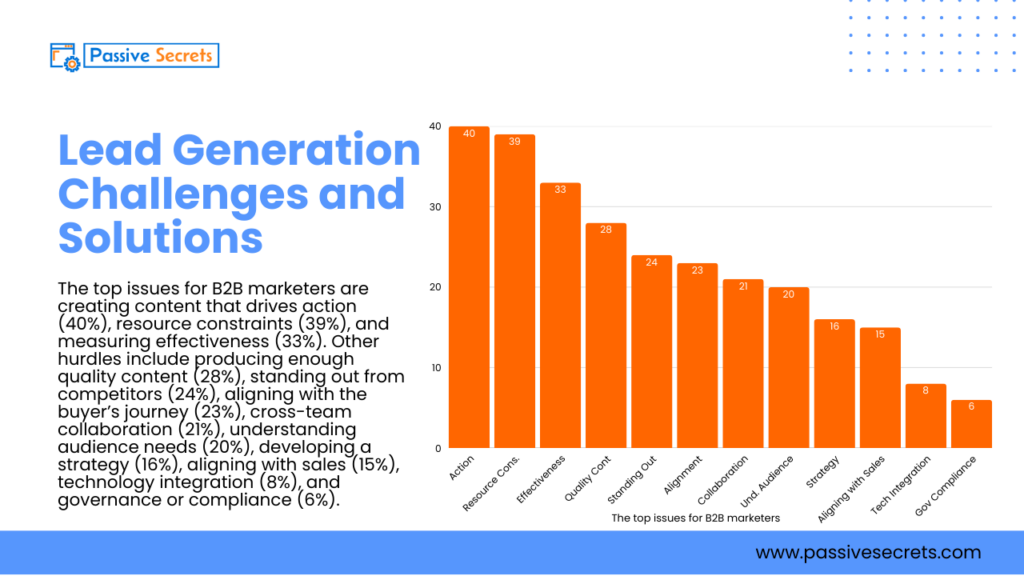
53. The top issues for B2B marketers are creating content that drives action (40%), resource constraints (39%), and measuring effectiveness (33%). Other hurdles include producing enough quality content (28%), standing out from competitors (24%), aligning with the buyer’s journey (23%), cross-team collaboration (21%), understanding audience needs (20%), developing a strategy (16%), aligning with sales (15%), technology integration (8%), and governance or compliance (6%) (source).
54. US B2B marketing professionals’ top challenge in influencer marketing is identifying suitable influencers (48%), while 23% struggle with managing payments and content (source).
55. A persistent issue for B2B marketers is the lack of resources, which 54% cite as a problem, making it a recurring challenge year after year (source).
56. B2B marketers face challenges: 45% cite economic uncertainty, 36% note unrealistic internal expectations, and 33% struggle with declining engagement metrics like email open rates and form fills (source).
57. B2B marketers want to improve lead nurturing with data-driven content personalization (52%), engagement tracking (48%), better sales alignment (45%), and enhanced lead qualification/scoring (44%) (source).
58. B2B marketing teams struggle most where sales and marketing responsibilities overlap, specifically in later funnel stages, including closing deals and retention (38%), qualifying leads (38%), and nurturing leads (34%) (source).
59. Most B2B teams (63%) lack a formal process to gather input from sales on buyer identification (source).
60. A survey of US B2B marketers found that the top challenges in implementing account-based marketing are a lack of internal expertise (40%), a lack of buyer interest (31%), and an unclear best approach (23%), highlighting the need for training, buyer engagement, and strategic clarity (source).
61. 51% of B2B professionals think their lead nurturing needs improvement, and 26% say it’s average (source).
62. Another survey of US B2B marketing decision-makers found that the top obstacles in demonstrating marketing value are misaligned marketing and business goals (53%), lack of measurement capabilities (47%), and struggle to translate marketing metrics into business insights (46%). This highlights the need for alignment, metrics, and data-driven decision-making (source).
63. A global survey found that B2B buyers reported negative experiences on B2B e-commerce sites, with 23.5% having a very negative experience and 14.9% having a somewhat negative experience (source).
64. A 2023 global survey of B2B marketers found that the top KPIs for measuring content marketing performance are conversions (73%), email engagement (71%), and website traffic (71%) (source).
65. According to a survey, B2B content marketers reported content marketing successes: 87% credited it with creating brand awareness, 74% with generating demand/leads, and 62% with nurturing subscribers/audience (source).
66. Over 35% of B2B marketers surveyed have developed a lead nurturing strategy. Despite this, 80% of new leads don’t turn into sales. Companies that are effective at nurturing leads generate 50% more sales-ready leads and do so at a 33% lower cost (source).
67. Generating more leads was the second most common priority for B2B marketers, with 49% focusing on it. The third priority was improving lead quality and conversion rates, chosen by 46% of marketers (source).
68. In 2023, the biggest challenges for marketers are improving lead quality and conversion rates, which 54% find difficult, andgenerating more leads, a challenge for 41% (source).
69. Despite 90% of B2B marketers recognizing appointment setting as effective for generating leads, only 21% consider it a crucial part of their strategies (source).
Impact of Technology on Lead Generation
70. 60% of B2B marketing decision-makers plan to invest more in AI in 2025, while half of the respondents also highlighted plans to invest in podcast advertising (source).
71. 32% of B2B marketers recently purchased a new GenAI tool for enterprise software in the past 3 months, while over 5% hadn’t added one in over a year (source).
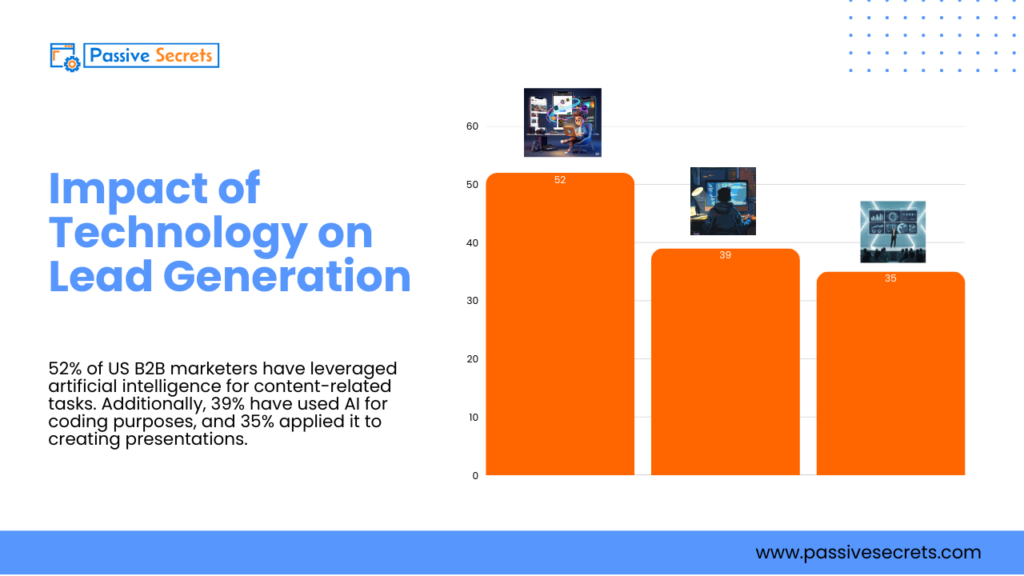
72. 52% of US B2B marketers have leveraged artificial intelligence for content-related tasks. Additionally, 39% have used AI for coding purposes, and 35% applied it to creating presentations (source).
73. In a survey of marketing decision-makers from B2B and B2B2C technology companies across five countries, 81% reported using artificial intelligence for content creation either frequently or occasionally, while 4% stated they never use AI for this purpose (source).
74. Worldwide, 44% of B2B marketers believe contact-level data and intent signals would most improve their go-to-market performance, while around 30% desire better insights into the buying committee (source).
75. 47% of B2B marketers worry about privacy and data theft when using generative AI, while about 25% are concerned about incorrect outputs or hallucinations (source).
76. Data compliance and accuracy are a top priority for 73% of B2B marketers (source).
77. AI is crucial for B2B marketing, especially for email (used by 66% of respondents and 72% of high performers) and content personalization (52% cite it as key to improving lead nurturing) (source).
78. AI bridges the gap between fragmented data and personalized experiences, crucial for lead nurturing (52% cite content personalization) and lead generation (66% use email) (source).
79. B2B marketers are shifting AI from experimentation to strategic implementation, starting with tactical applications like content creation (36%) and email optimization (36%), with emerging interest in predictive analytics, sales forecasting, and dynamic pricing (source).
80. AI is revolutionizing B2B marketing, with 95% of marketers saying their company is already comfortable using AI-driven tools (source).
81. Over half of enterprise marketers believe that AI improves efficiency and professional development, with Gen Z and Millennials seeing the most benefits: 55% (time-saving) and 57% (growth), respectively (source).
82. B2B marketers using chatbots saw significant lead generation increases: 26% saw a 10-20% boost, 25% saw a 5-10% boost, and 15% saw an impressive 30%+ increase, highlighting the effectiveness of chatbots in driving leads (source).
83. A survey found that B2B marketers use chatbots in their demand generation programs to better understand their audience (57%), generate new leads (55%), and educate prospects (43%), highlighting the versatility of chatbots in supporting various marketing goals (source).
84. The B2B lead generation services market is expected to grow with the help of artificial intelligence. Using AI, companies can analyze customer behavior in real time, customize their services for each business, and improve their overall results (source).
85. In 2023, 85% of marketers anticipated that AI would positively affect B2B marketing in the coming year (source).
87. B2B marketers see the greatest potential for generative AI-powered tools in content creation (94%) and content personalization (94%) (source).
Future of B2B Lead Generation
88. B2B marketers prioritize improving influencer marketing results, with 37% focusing on audience targeting and segmentation, while 23% emphasize budget management (source).
89. B2B marketers are shifting focus to smaller hosted events, with 59% planning more, while large events saw a 12% decline year-over-year (source).
90. Synthetic generation of outbound marketing messages is expected to rise from less than 2% in 2022 to 30% by 2025 among large organizations (source).
B2B Lead Generation Trends in 2026
1. AI moves from experiment to the revenue stack
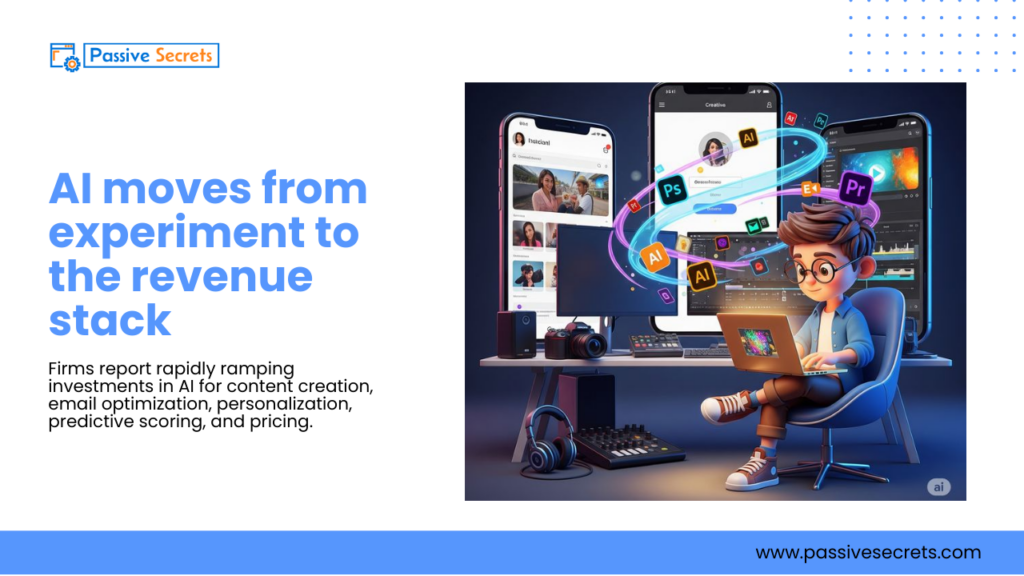
By 2026, AI will further embed across the lead funnel. Firms report rapidly ramping investments in AI for content creation, email optimization, personalization, predictive scoring, and pricing. This adoption is translating into measurable ROI: many revenue teams report faster response times and earlier ROI windows as AI-powered automation scales tasks that used to bottleneck GTM execution.
Hence, in the next year, prioritize AI use cases that shorten sales cycles (lead scoring, intent signal routing, email sequencing) rather than cosmetic efficiencies.
Also, establish governance and data-protection rules before full rollouts — concerns about privacy and hallucinations remain material risks.
2. Intent and first-party data become the signal layer for high-performing GTM teams
Intent data and first-party behavior are the glue between marketing activity and revenue. More B2B teams are using intent signals and site behavior to target audiences, resulting in higher conversion rates and shorter sales cycles.
At the same time, marketers are doubling down on first-party registration and gated content to protect against cookie loss and to build matched audiences for personalization and ABM.
In 2026, invest in a clean intent-data pipeline (collection, validation, routing to CRM/engagement systems). You should also pair intent with human verification (sales feedback loops) to avoid poor-quality signal chasing.
3. Martech budgets grow — and stacks get rationalized for AI-readiness
Martech spending is rising steadily, with forecasts showing continued growth through 2027. In 2026, marketers are focusing less on adding new tools and more on becoming AI-ready — streamlining their tech stacks, eliminating overlaps, and choosing platforms that enable machine learning, useful insights, and strong data governance.
Vendors are responding: new “AI-first” marketing platforms and major updates to established suites are accelerating adoption.
4. Email + LinkedIn remain core; virtual and smaller hosted events win for quality
Channel mix is sharpening rather than broadening. Email is still the workhorse for B2B outreach and nurture; LinkedIn remains the dominant social channel for both organic and paid lead generation; and virtual events and SEO continue to drive high-quality leads.
At the same time, B2B event strategies are shifting: large trade shows have less share while smaller, hosted, targeted events and hybrid experiences (micro-events, pop-ups, account-specific dinners) generate stronger engagement and are easier to tie to the pipeline.
5. Chatbots and conversational automation scale lead capture and qualification
Conversational tools, like chatbots, AI assistants, and virtual SDR agents, are increasingly becoming more of front-line lead capture tools. Companies are reporting double-digit lifts in leads and measurable acceleration in qualification when bots are tied into lead scoring and routing logic.
Because these tools provide an immediate response, they also raise expectations for rapid, personalized follow-up by human sellers.
To be ahead with this trend in 2026, integrate chatbots with CRM lead scoring and intent signals to ensure routing decisions match commercial priorities. Also, monitor for conversational quality and guardrails to prevent data leakage or privacy issues.
FAQs
Other Related Statistics Posts:
- B2B Sales Statistics: Latest Insights and Trends
- 90+ Useful Marketing Jobs Statistics & Facts (Latest Report)
- Sales Enablement Statistics: Data You Need to Drive Sales Growth
- In-store vs Online Shopping Statistics And Analysis
- 80+ Big Marketing Software Statistics
- Key Short-Form Video Statistics and Trends You Should Know
- 49 Interesting Emotional Marketing Statistics
- 25+ Interesting Emotional Intelligence Statistics & Fun Facts
- 35 Interesting Fear of Public Speaking Statistics & Fun Facts
- Body Language Statistics & Facts To Boost Your Communication Skills
- 45+ Interesting Communication Skills Statistics & Huge Trends
- 23 Most Interesting First Impression Statistics To Know
- 60+ Interesting Storytelling Statistics, Facts & Huge Trends
- Amazon Book Sales Statistics: Intriguing Numbers and Facts
- 50+ Useful Call Center Statistics And Trends
- Virtual Event Statistics & Benchmarks For Marketers & Organizers
- 55 Interesting Direct Mail Marketing Statistics and Trends
- 52 Valuable Trade Show Statistics and Trends
- 41+ MOST Important Copywriting Statistics To Know
- 80+ Useful Sales Funnel Statistics & Conversion Rates

