
Every 60 seconds, a brand loses $1,000 to poorly optimized Amazon ads.
Amazon’s advertising platform has quietly evolved into a $47 billion ecosystem that now rivals Google and Meta, yet most marketers are still using 2019 strategies in 2026. They’re bidding blind, targeting broad, and watching their ACoS climb while competitors seem to crack some invisible code.
The gap between Amazon advertising winners and losers has widened into a chasm. The brands dominating search results aren’t just spending more; they’re leveraging data points most marketers don’t even know exist.
What follows in this piece are vital insights that separate the top 1% of Amazon advertisers from everyone else: the hidden metrics, emerging trends, and counterintuitive insights that will change how you approach Amazon PPC in 2026.
Key Amazon Advertising Statistics (Editor’s Pick)
- Amazon holds 37.6% of the U.S. eCommerce market and generated $356B+ in U.S. revenue.
- Amazon’s global revenue reached $716.92B in 2025.
- Amazon generated $56.21B in ad revenue in 2024, up 20% YoY.
- Amazon’s U.S. ad revenue hit $12.06B in Q3 2023, a 26.3% increase YoY.
- Amazon’s ad business is growing 5× faster than Google’s.
- Amazon’s U.S. ad revenue is projected to reach $64B by 2026.
- 57% of online shoppers say Amazon is their top source of purchase inspiration.
- 80%+ of members plan to shop during Amazon Prime Day.
- U.S. Prime Day 2025 sales reached nearly $24B.
- Ads on Prime Video reach 315M monthly viewers worldwide.
General Amazon Advertising Statistics
1. A 2025 survey of 15,492 US consumers ranked online shops, with Amazon topping the list and Ikea bringing up the rear. (Statista)
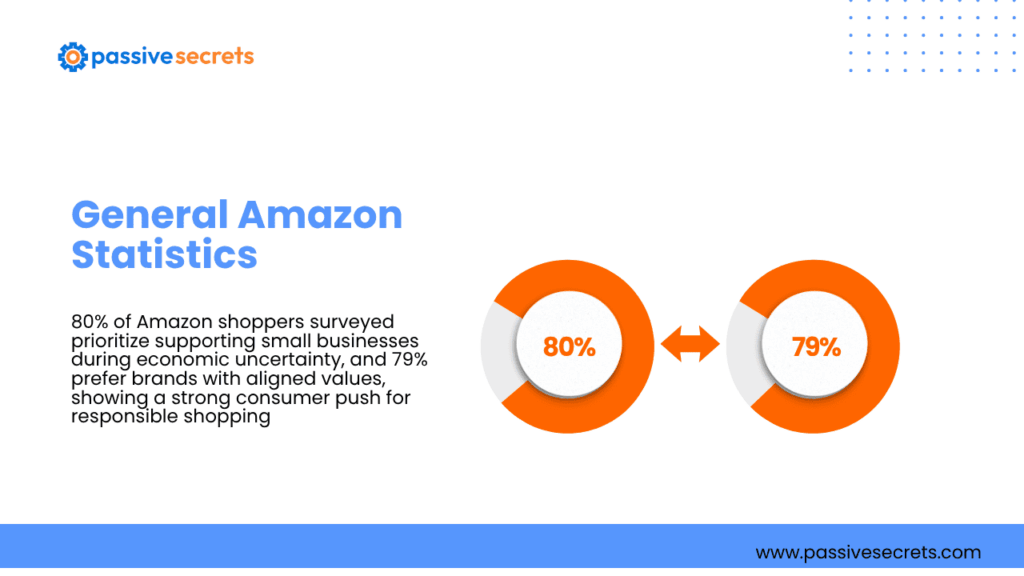
2. 80% of Amazon shoppers surveyed prioritize supporting small businesses during economic uncertainty, and 79% prefer brands with aligned values, showing a strong consumer push for responsible shopping. (Amazon Advertising)
3. 67% of shoppers prioritize supporting brands that donate to causes they care about, even with tight budgets. UK shoppers are particularly keen on this, showing strong support for socially responsible brands. (Amazon Advertising)
4. 65% of shoppers say brand matters when buying a product, and they’re looking for more than just products – they want brands to stand for something. 87% believe brands should contribute to global causes, especially in tough times, and 79% want them to act during crises. (Amazon Advertising)
5. Over half of shoppers on Amazon seek out sustainable brands, with a 14% YoY increase in the UK. Women (66%) and Gen Z (74%) are particularly keen on eco-friendly practices, showing it’s a key factor in their purchasing decisions. (Amazon Advertising)
6. Nearly six in 10 shoppers (59%) say sustainability commitment matters when choosing a company or brand. This expectation is even stronger among certain groups: UK respondents (65%), non-binary consumers (65%), women (61%), Gen Z and Millennials (65% each), and urban dwellers (64%). (Amazon Advertising)
7. Amazon’s internal analysis shows over 34 million US shoppers bought products with sustainability features in 12 months. These eco-conscious shoppers tend to be Millennials (36%, +18% vs average Amazon shopper), female (62%, +13%), have high incomes (36% earn >$150K, +21%), and are well-educated (43% have a bachelor’s degree+, +25%). (Amazon Advertising)
8. Amazon accounted for over 37.6% of the U.S. retail eCommerce market in 2023. The e-commerce giant generated over $356 billion in 2022 in its U.S. branch. (Statista)
9. Amazon’s 2025 annual revenue was $716.92 billion, marking a 12.38% growth. In the fourth quarter of 2025, Amazon generated $213.39 billion in revenue, representing a 13.63% increase. (Stock Analysis)
10. Amazon’s ad revenue in the U.S. was worth $12.06 billion in Q3 2023. It was a 26.3% increase from that of the previous year. (Search Engine Land)
11. In April 2024, Amazon’s combined desktop and mobile visits amounted to 2.2 billion. This makes Amazon the most visited eCommerce space in the U.S. (Statista).
12. Amazon’s ad revenue is said to be growing 5× faster than Google’s ad revenue. (HubSpot)
13. Amazon’s brand value surged by 50% in 2025, reaching $866 billion. Notably, 2023 was the only year it dropped since 2015. Overall, Amazon’s brand value has grown over 100 times between 2006 and 2025. (Statista)
14. Amazon reported a net loss of $2.7 billion in 2022, its first in nearly a decade. However, by the end of 2025, the company’s net income had bounced back to $77.7 billion. (Statista)
Latest Amazon Advertising Statistics
15. In Q3 2025, Electronics was Amazon’s top-performing category with $9.65 returns, slightly down from $10.34 in Q3 2024 (-6.7% YoY). It had the third-highest CPC of $1.57. (Helium)
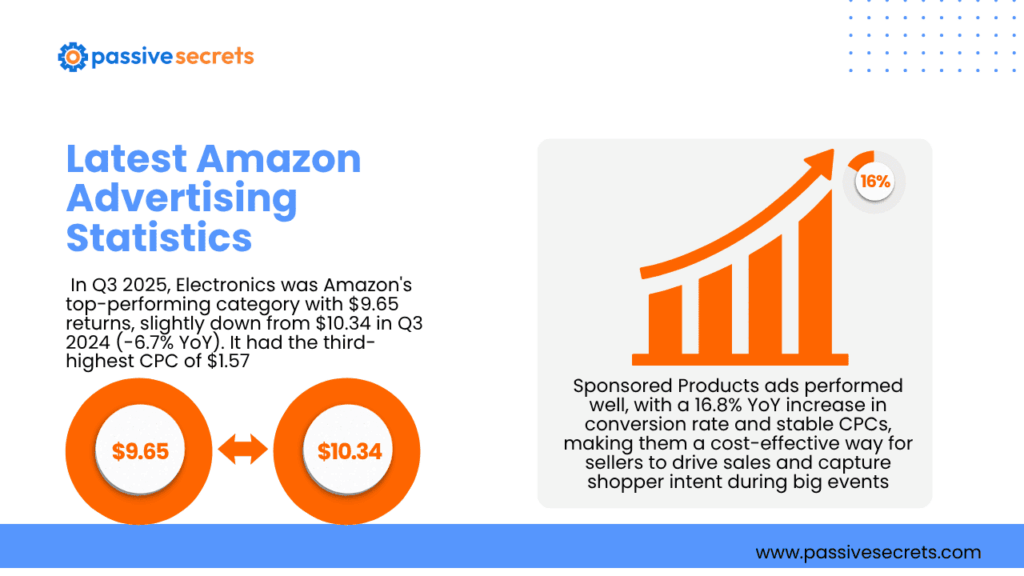
16. Sponsored Products ads performed well, with a 16.8% YoY increase in conversion rate and stable CPCs, making them a cost-effective way for sellers to drive sales and capture shopper intent during big events. (Helium)
17. The retailer saw stronger quarter-over-quarter growth in ad spend for Sponsored Brands (+2.7% QoQ, +26% YoY) and Sponsored Products (+13.2% QoQ, +20% YoY), indicating brands focused on securing market share over short-term gains. (Helium)
18. Every Amazon ad type shows positive intent investment, reinforcing enthusiasm for 2026. Media results across the retail funnel are delivering the strongest marketing clusters around video (Sponsored Brands and Sponsored TV, lead formats in Streaming and Video), with “significantly increase” responses aligning with broader industry momentum toward video advertising strategies. (Skai)
19. US advertisers will boost retail media spending to $69.33 billion in 2026, up from $58.79 billion in 2025, driven by retail media networks’ (RMNs) data and inventory. However, Amazon Ads and Walmart Connect are dominating, grabbing most of the $10.53 billion in new spending, highlighting a growing divide in the ecosystem. (eMarketer)
20. Walmart and Amazon are expected to capture more than 89% of the additional dollars spent on retail media in 2026. (eMarketer)
21. Amazon’s Prime Video advertising now reaches 315 million monthly viewers globally, a significant jump from 200 million in April 2024. This growth is driven by the platform’s expanding audience across 16 countries, including the US, UK, India, and Japan. The ad-supported tier offers brands a powerful opportunity to connect with engaged viewers, with Prime Video’s ad revenue contributing to Amazon’s $21.3 billion advertising revenue in Q4 2025. (The Wrap and Media Brief)
22. In 2024, Amazon raked in $56.21 billion from ad sales, a 20% jump from the previous year. This accounted for an estimated 11% of global digital ad spending. (Statista)
23. By 2026, Amazon’s advertising revenues in the United States are projected to reach a value of 64 billion U.S. dollars. This represents growth from a projected 42 billion U.S. dollars in 2024, indicating a continued upward trend in the company’s ad revenue. (Statista)
24. Between January and March 2022, 20% of US retailers surveyed spent over $100,000 monthly on Amazon ads. Another 20% spent $41,000 – $60,000, and 19% spent $61,000 – $80,000. (Statista)
25. As of 2025, Amazon is a household name globally. The countries with the most monthly active users are:
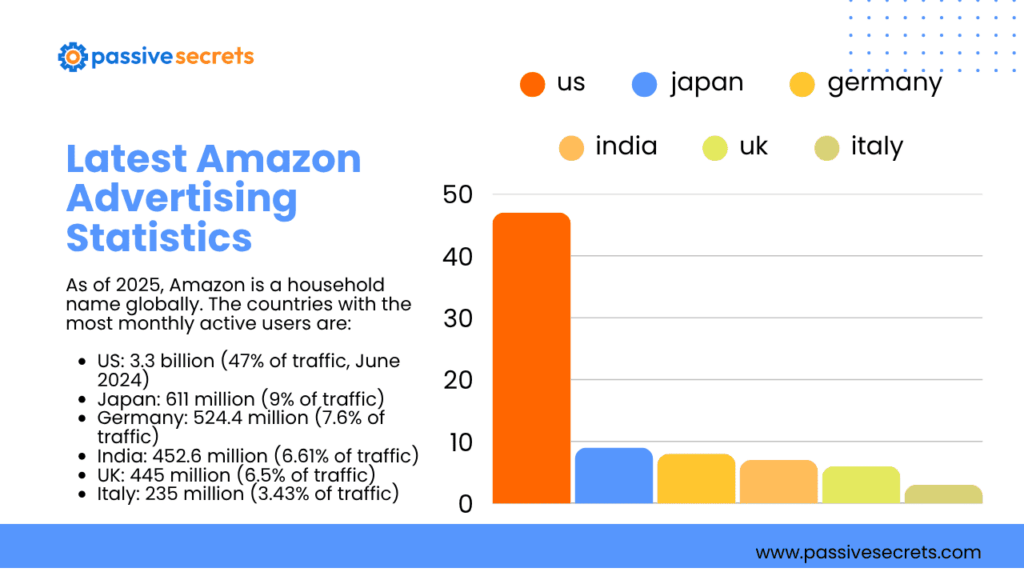
India and the US account for 67% of Amazon’s annual active users. (World Population Review)
26. Amazon ads have a growth rate of 18%. (CNBC)
27. 57% of online shoppers report that Amazon is their top source of buying inspiration. (Statista)
28. 56% of surveyed retailers cited “driving brand awareness” as their primary goal for advertising on Amazon. Additionally, 61% noted “acquiring new customers” as their primary goal, and 53% said they wanted to “drive sales“ (Statista).
29. Amazon’s ad’s average cost of sale (ACOS) is 27.17%. (AdBadger)
30. Amazon’s global advertising cost per click is $0.75 for sponsored product ads. In the U.S., it is $0.87. (Sellics)
31. Amazon’s sponsored product ads cost less than Google and Facebook ads, with 68% and 44% less, respectively. (Sellics)
32. In 2021, over 1 million new sellers joined Amazon. (Sellics)
33. The average CPC on Amazon in 2023 is $0.97, and the lowest CPC was $0.80 in February. (AdBadger)
34. The total number of sellers in the North American Amazon Marketplace (which includes the U.S., Canada, and Mexico) was more than 3 million. However, Europe just had 1.4 million sellers. (Sellics)
Amazon Prime Day Statistics
35. According to Amazon sellers, Black Friday was the top sales driver, with a third of surveyed sellers citing it as the most influential event. Prime Day came in second, with 17% of brands seeing increased sales. (Statista)
36. In July 2024, following Amazon’s Prime Day, 28% of US retailers and e-commerce sites held their own sales events, leading to a 73% jump in online transactions. (Impact Analysis)
37. Over 80% of Prime members planned to shop on Amazon during Prime Day this year, up from 68% last year. Interest is consistent across age groups, with 85% of Gen Z, millennials, and Gen X, and 84% of baby boomers planning to shop. 89% are at least as excited as last year, with Gen Z being the most enthusiastic: 62% are more excited, while 28% of baby boomers are more excited, and 9% of Gen Z are less excited. (Tinuiti)
38. Most Prime Day shoppers start researching deals early – 29% will start over a week before, and over two-thirds will start at least two days before. To capitalize, brands should build awareness and consideration ahead of time, as over half of shoppers have specific products in mind. Interestingly, 34% plan to use ChatGPT to research purchases, slightly ahead of Amazon’s Rufus (33%). (Tinuiti)
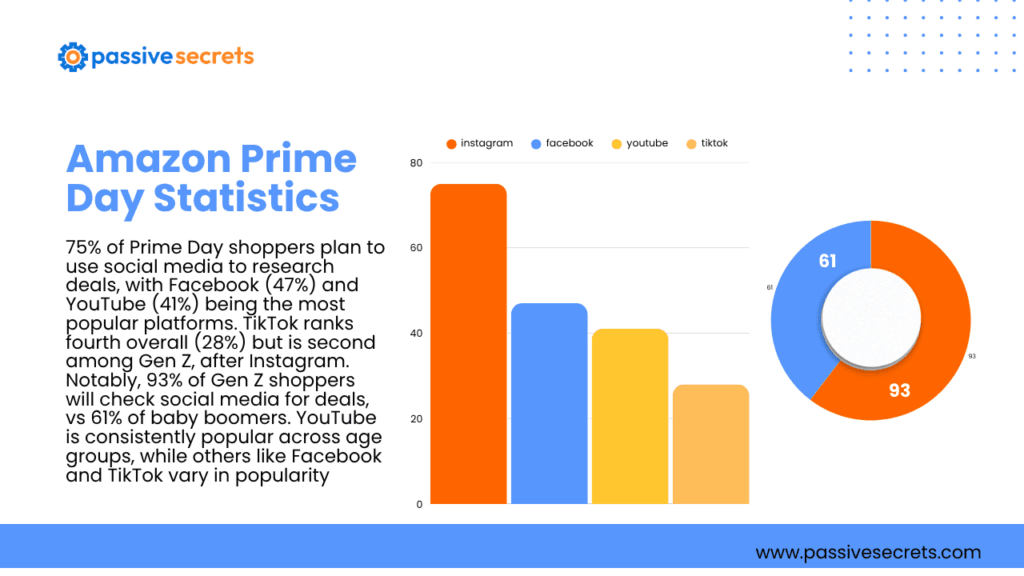
39. 75% of Prime Day shoppers plan to use social media to research deals, with Facebook (47%) and YouTube (41%) being the most popular platforms. TikTok ranks fourth overall (28%) but is second among Gen Z, after Instagram. Notably, 93% of Gen Z shoppers will check social media for deals, vs 61% of baby boomers. YouTube is consistently popular across age groups, while others like Facebook and TikTok vary in popularity. (Tinuiti)
40. During Amazon’s Prime Day sale in July 2024, about 53% of US shoppers bought stuff they’d been waiting for a sale for, while 41% grabbed other discounted items that were part of the deals. (Statista)
41. UK shoppers spent over £2.08 billion online during Amazon’s 2025 Prime Day, a jump from the previous year, which is partly driven by the event’s extended four-day duration. (Statista)
42. Amazon’s 2025 Prime Day sales in the US hit nearly $24 billion, boosted by the event’s extended four-day duration, up from two days previously. (Statista)
43. Amazon’s Prime Day sales have been steadily increasing, hitting a record $12.9 billion in 2023, with the US being the biggest contributor. (Statista)
44. During the 2022 edition of Amazon Prime Day, SMBs generated about $3 billion in sales. (Statista)
45. Advertising spending for Amazon Prime Day in the U.S. increased by 93.6%. (Statista)
46. In 2023, prime members shopped more than 375 million items worldwide, saving more than $2.5 billion in deals across the Amazon store. (Amazon)
47. Small business products like True Classic and TUSHY increased their average daily sales by 18×. (Amazon)
48. The best-selling products across Amazon were Alexa-enabled devices. (Amazon)
49. Amazon Live Prime Day Streams had more than 100 million views in the U.S and India. (Amazon)
50. Vendors who partook in Prime Day activities experienced a 10× increase in daily buys with Prime orders and saw an 8× increase in daily revenue when compared to before the event. (Amazon)
Amazon Advertising Trends and Strategies for 2026
1. AI and machine learning in PPC management
The use of AI and machine learning in PPC management became a key Amazon advertising trend in 2025, and it will continue in 2026. Advertisers will increasingly use the power of AI and machine learning to optimize their PPC campaigns, changing how they manage their ad spend, target audiences, and optimize ad creative.

AI-driven bid optimization will become the norm, allowing advertisers to maximize their ROI and reduce manual bidding efforts.
Machine learning algorithms will analyze consumer behavior, sales data, and market trends to predict which products will perform well, enabling advertisers to make data-driven decisions. AI-powered ad targeting will ensure that ads are served to the most relevant audiences, increasing conversion rates and reducing waste.
Additionally, machine learning will help optimize ad creatives, such as images, videos, and copy, to resonate with target audiences and boost performance.
AI and machine learning will provide advertisers with real-time reporting and actionable insights to refine their PPC strategies, leading to improved ad performance,
2. Social Media Advertising
Social media marketing is still growing and will not stop anytime soon. For example, it is easier for Amazon sellers to use sites such as Facebook, Instagram, and Twitter.
Also, Statista records that social media advertising spending is projected to reach $255.8 billion in 2028.
If you are not implementing social media as part of your Amazon advertising strategy, you miss out on many areas.
Marketers use social media to create brand awareness and boost engagement on their Amazon ads. These ads can help you get your products in front of existing and potential customers.
Social media provides opportunities to advertise your products and create content that drives engagement.
These contents follow trends, draw potential customers in, convert leads, and increase customer lifetime value.
Social media ads can target audiences based on gender, age, demographics, and other data-driven targets.
3. Audio Ads
Over one-third of United States consumers have smart speakers, and 85% use them to play audio at least once a week. Moreover, the percentage is expected to grow over the next few years.
Audio ads are screen-free adverts; they can connect with your audience regardless of their activity. These ads, which are ten to thirty seconds of audio, frequently play during content breaks.
For example, imagine listening to Alexa play you some songs, and an audio ad about gift cards or electronics comes on during the break. This implies that you can tell your message with premium audio content.
Interactive audio ads allow listeners to respond to an Alexa call-to-action within the ad.
4. Increased Focus on Amazon Marketplace Management
In 2026, Amazon advertisers will place a greater focus on Amazon marketplace management as a key aspect of their advertising strategies. This means they will prioritize optimizing their product listings, inventory management, and customer reviews to improve their visibility, credibility, and sales on the platform.
With Amazon marketplace management, advertisers can increase their chances of winning the Buy Box, drive more organic sales, and create a strong foundation for their paid advertising efforts.
Effective marketplace management will become a crucial differentiator for advertisers seeking to succeed in the increasingly competitive Amazon landscape.
5. Leveraging User-Generated Content
UGC content was popular in 2025, and it will definitely continue in 2026. UGC includes reviews, photos, and videos created by customers, which are perceived as more authentic than traditional ads.
Research shows that 77% of consumers are influenced by UGC when making purchasing decisions, leading to higher engagement rates—ads featuring UGC can achieve four times higher click-through rates and a 50% reduction in cost-per-click.
To encourage UGC, brands should focus on exceptional customer service, engage with customers on social media, and offer incentives for sharing content. Incorporating UGC into advertising strategies can significantly boost visibility and effectiveness.
For instance, using customer reviews in Pay-Per-Click (PPC) ads can enhance appeal and increase click-through rates. Additionally, utilizing Amazon Posts to showcase UGC can drive engagement with potential customers.
6. Ads Targeting
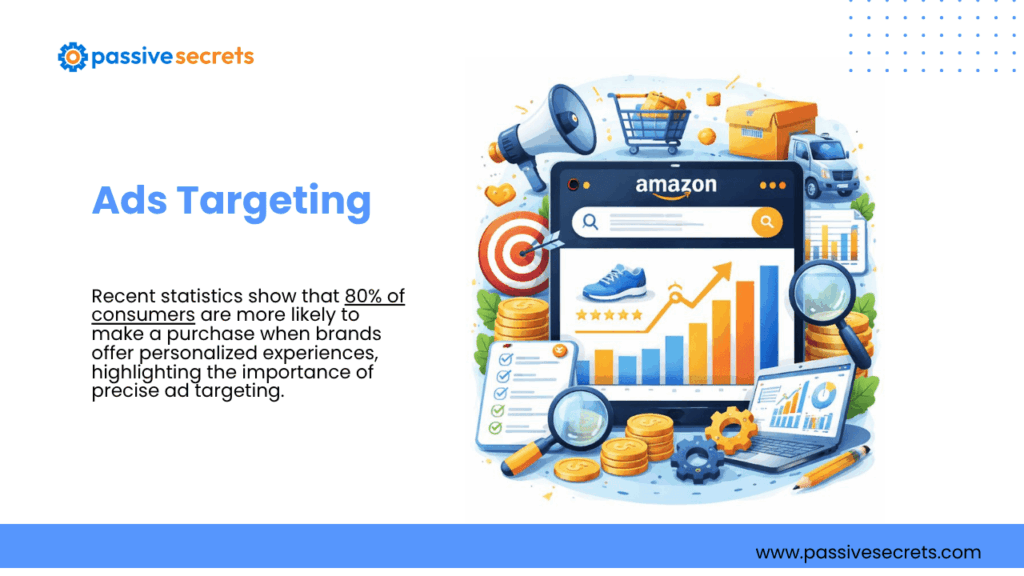
Recent statistics show that 80% of consumers are more likely to make a purchase when brands offer personalized experiences, highlighting the importance of precise ad targeting.
Amazon has significantly upgraded its targeting options for Sponsored Brands campaigns, allowing advertisers to reach specific customer segments based on demographics, purchase behaviors, and interests.
Moreover, AI-powered optimization tools will play a crucial role in refining targeting strategies.
These tools analyze large data sets to identify patterns and trends, enabling brands to engage high-value customer groups effectively.
For instance, advertisers can now create custom audiences using insights from the Amazon Marketing Cloud, which enhances their ability to reach potential customers who have shown interest in their products.
Sponsored Display ads further enhance remarketing efforts by targeting users who previously viewed products. Effective ad targeting will be essential for maximizing visibility and driving sales on Amazon in 2026.
Frequently Asked Questions
Other Advertising Statistics To Know In 2026:
- 50+ Essential Traditional Marketing Statistics & Trends
- 90+ Useful Marketing Jobs Statistics & Facts (Latest Report)
- In-Store vs. Online Shopping Statistics And Analysis
- Latest In-Game Advertising Statistics
- From Passion to Profit: 120+ Creator Economy Statistics
- 80+ Big Marketing Software Statistics
- 45 Interesting Healthcare Marketing Statistics & Trends
- Print Marketing Statistics: Ad Spending, Market Size, & More
- Key Short-Form Video Statistics and Trends You Should Know
- 49 Interesting Emotional Marketing Statistics
- 70+ Top Law Firm Marketing Statistics & NEW Trends
- 23 Most Interesting First Impression Statistics To Know
- 60+ Interesting Storytelling Statistics, Facts & Huge Trends
- Amazon Book Sales Statistics: Intriguing Numbers and Facts
- 61+ Useful Podcast Advertising Statistics And Trends
- 50+ Useful Call Center Statistics And Trends
- 65+ Must-Know Pay-Per-Click Statistics
- 40+ Interesting Omnichannel Marketing Statistics & Trends
- Multi-Level And Network Marketing Statistics, Facts & Trends
- Virtual Event Statistics & Benchmarks For Marketers & Organizers
- 55 Interesting Direct Mail Marketing Statistics and Trends
- B2B Lead Generation Statistics, Facts, Trends, Benchmarks, & Market Size
- 100+ Top Digital Marketing Vs. Traditional Marketing Stats
- 110+ Important Social Media Advertising Statistics & Trends
- 50 Interesting Organic Vs. Paid Search Statistics To Know
- 41+ MOST Important Copywriting Statistics To Know
- 80+ Useful Sales Funnel Statistics & Conversion Rates
- 40+ Latest Multi-Channel Marketing Statistics & Huge Trends

