

What if I told you the future of education isn’t arriving tomorrow, but it’s already here, quietly reshaping classrooms, boardrooms, and entire countries right now?
Whether you’re an educator trying to keep up with your students’ digital instincts, a school leader navigating AI adoption, or an EdTech founder watching the market evolve at lightning speed, one thing is clear: we’re living through the biggest transformation education has seen in decades.
From generative AI rewriting how students learn, to AR and VR redefining what “hands-on” means, to governments and districts scrambling to modernize infrastructure — the numbers behind this shift tell a story more powerful than any prediction.
This article brings you those numbers. Not the fluffy ones. Not the hype.
But the stats that actually reveal where EdTech is growing, what’s changing, and how it will shape the way we teach, train, and learn in the years ahead.
If you want to understand the real state of EdTech — the momentum, the risks, the breakthroughs, and the global forces driving it all — you’re in the right place. Let’s dive into the data that’s defining the future of learning.
Key Edtech Statistics
- Edtech + smart classrooms market: $185.78B (2024) → $213.41B (2025) at 14.9% CAGR.
- 74% of U.S. districts could be impacted by a Supreme Court ruling affecting school connectivity (E-Rate).
- 66% of remote learning platforms and 48% of vocational centers use AR for skills training.
- India’s EdTech market raised $278M in 2024, showing resilience despite funding challenges.
- Global K-12 market: $172.03B (2025) → $732.94B (2034) at 17.47% CAGR.
- 40%+ of U.S. K–12 schools used AR/VR in 2024, up from under 20% in 2022.
- K-12 EdTech market: $18B (2024) → $55.4B (2030) at 20.6% CAGR.
- 94% of EdTech leaders say AI has a positive impact; 80% have GenAI initiatives.
- Corporate e-learning: $25.22B (2024) → $57.05B (2031) at 12.6% CAGR.
- 47% of corporate training modules use AR-based simulations.
- North America leads global EdTech with 35.62% market share (2024).
- Nigeria’s EdTech industry is projected to hit $400M in 2025.
- Singapore accounts for 48% of Southeast Asia’s top EdTech startups (2024).
- GenAI in EdTech: $268M (2023) → $8.3B (2033) at 41% CAGR.
- Adaptive learning is the #1 GenAI application (39% share).
- Students represent 49% of the GenAI EdTech market.
- By 2024, 60%+ of major EdTech companies will integrate GenAI.
General Edtech Statistics
1. Edtech solutions for reskilling and upskilling are expanding quickly in the US, driven by a focus on professional growth and lifelong learning. (source)
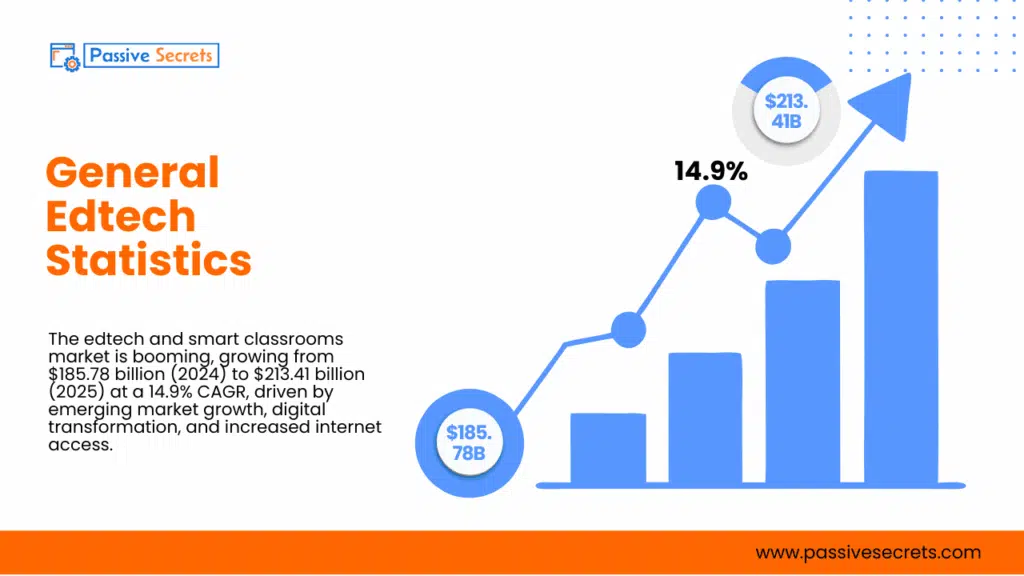
2. The edtech and smart classrooms market is booming, growing from $185.78 billion (2024) to $213.41 billion (2025) at a 14.9% CAGR, driven by emerging market growth, digital transformation, and increased internet access. (source)
3. A Supreme Court ruling against E-Rate program structure could severely impact 74% of districts, affecting students everywhere. 48% of city EdTech leaders predict catastrophe; only 2% say no impact. Off-campus broadband support drops to 66% (from 74% in 2023). (source)
4. Most districts lack dedicated cybersecurity funding, using general funds instead (61%). They’re spending on monitoring, detection, and response (78%), often outsourcing monitoring (44%). Despite this, EdTech Leaders don’t see their districts as high-risk, with phishing being the top concern (27%). (source)
EdTech Industry Statistics
The Edtech industry has grown tremendously because people crave more flexible and personalized learning methods.
Traditional education methods are having trouble keeping up with technological advancements. This is why Edtech companies have filled the gap by offering innovative solutions that cater to the unique needs of students, teachers, and schools.
5. AR adoption is gaining traction: 66% of remote education platforms and 48% of vocational centers are already leveraging AR for skills training. (source)
6. Nigeria’s edtech industry is on the rise, projected to hit $400 million in 2025. This growth is driven by increasing internet penetration, government initiatives, and a young, tech-savvy population. (source)
7. Despite funding challenges, India’s edtech sector shows resilience, raising $278 million in Jan-Sep 2024, a 3% rise from $269 million in the same period last year, according to Pie News and Inc42 analysis. (source)
K-12 Edtech statistics
8. The global K12 education market is projected to grow at a 17.47% CAGR (2025-2034), from $172.03 billion in 2025 to $732.94 billion by 2034. (source)
9. The 2025 U.S. AR/VR in education and training market is estimated to be valued at USD 5 billion, driven primarily by strong adoption across K–12 institutions and the corporate training sector. (source)
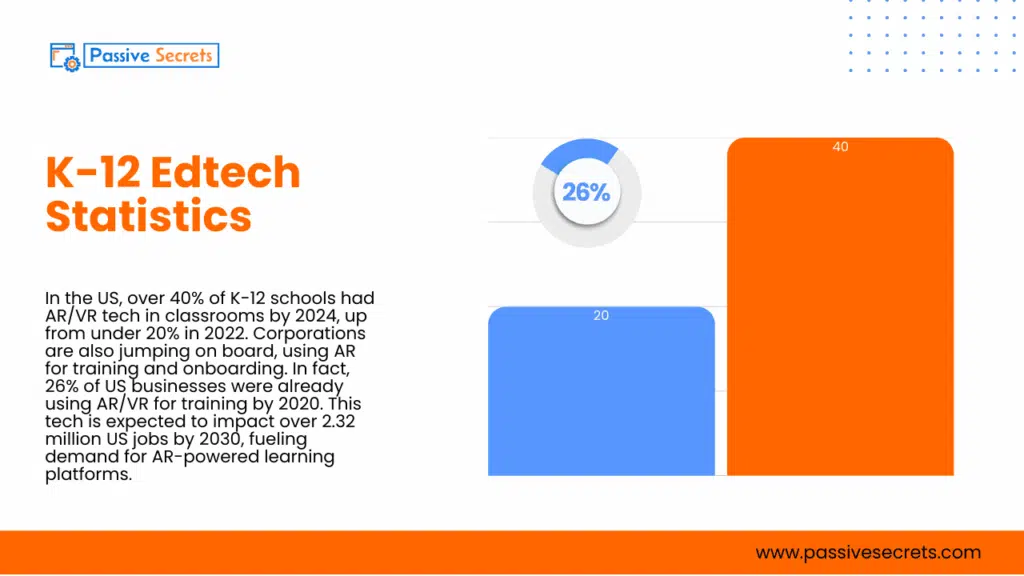
10. In the US, over 40% of K-12 schools had AR/VR tech in classrooms by 2024, up from under 20% in 2022. Corporations are also jumping on board, using AR for training and onboarding. In fact, 26% of US businesses were already using AR/VR for training by 2020. This tech is expected to impact over 2.32 million US jobs by 2030, fueling demand for AR-powered learning platforms. (source)
11. The global K-12 EdTech market is projected to grow from $18 billion (2024) to $55.4 billion by 2030, at a 20.6% CAGR. (source)
12. The global AI in K-12 education market is expected to skyrocket from $390.8 million in 2024 to $7,949.9 million by 2033, growing at a massive 38.1% CAGR. (source)
13. 94% of EdTech Leaders believe AI can positively impact education, especially productivity. Gen AI is their top tech priority, with 80% having Gen AI initiatives in their districts. (source)
14. Gen AI is making cheating harder to detect for teachers, with 25% of districts using AI-detector tools and 32% exploring them. However, 38% aren’t using or considering these tools. (source)
15. EdTech Leaders are most concerned AI will enable new cyberattacks (60%), compromise student data privacy (45%), and lack teacher training (43%). However, they’re least worried about AI replacing teachers (86%) or causing job losses (77%). (source)
16. A 2024 Canadian study found 73% of students rely on Gen AI for schoolwork. In response, 55% of EdTech Leaders say their districts are embracing AI, 26% consider it case-by-case, and 19% are still deciding how to approach it. (source)
17. The K-12 EdTech segment held the largest market share in 2023, exceeding 39.4%, driven by the increasing popularity of game-based learning in the K-12 sector. (source)
18. K-12 Edtech engagement was focused 17.5% on organization, 22.5% on educators, and 66.0% on learners. (source)
19. During the 2022-23 school year, Google Classroom was the leading learning management system used by K-12 students and teachers in the United States. (source)
Corporate E-learning Statistics
20. The global Corporate E-learning market was worth approximately US$ 25.22 billion in 2024 and is expected to expand to about US$ 57.05 billion by 2031, reflecting a compound annual growth rate (CAGR) of 12.6% over the forecast period. (source)
21. In 2024, more than 61% of educational institutions worldwide had adopted AR tools in some capacity. In the corporate sector, 47% of training modules now incorporate AR-based simulations.
The market landscape includes over 150 AR content providers, with more than 10,000 AR lesson modules deployed globally. Integration into STEM and medical curricula represents 35% of total AR usage, while soft skills training accounts for 15% of AR applications. (source)
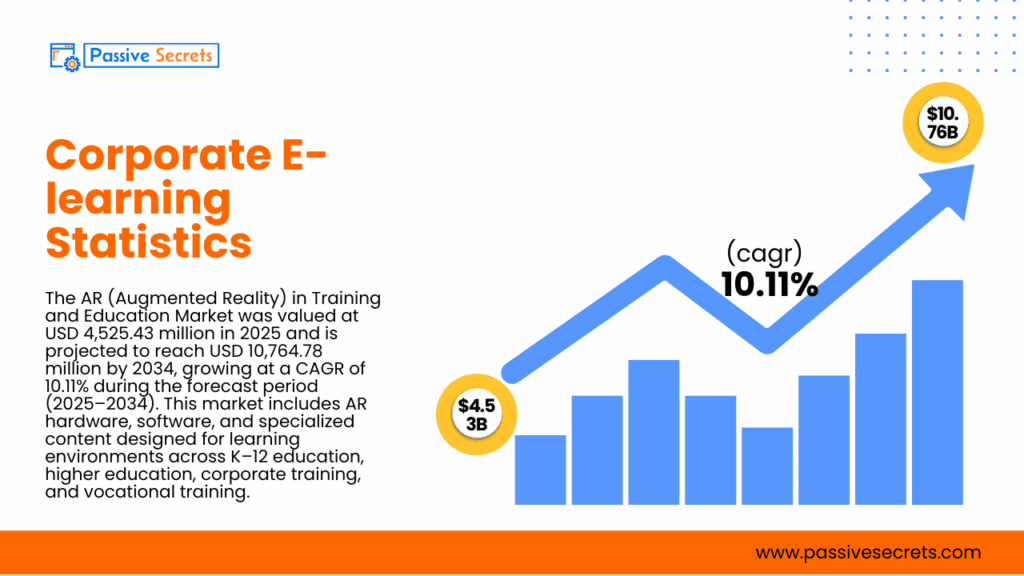
22. The AR (Augmented Reality) in Training and Education Market was valued at USD 4,525.43 million in 2025 and is projected to reach USD 10,764.78 million by 2034, growing at a CAGR of 10.11% during the forecast period (2025–2034). This market includes AR hardware, software, and specialized content designed for learning environments across K–12 education, higher education, corporate training, and vocational training. (source)
EdTech Statistics by Country
23. North America led the EdTech market with 35.62% revenue share in 2024, driven by personalized learning and digital skills adoption. (source)
24. South Africa leads Africa’s EdTech scene with nearly 40% of the 2025 list, thanks to its population, founders, and mobile users. Nigeria’s got about a third of the share, with a mix of K-12, early learning, and workforce solutions. Kenya’s presence is shrinking, while Ghana’s growing – from 4% in 2024 to 8% in 2025, driven by youth-skills and school-support models. (source)
25. Australia and New Zealand are expected to experience significant growth in the EdTech market, with a projected CAGR of 22.7% from 2024 to 2034. (source)
26. As of January 2023, ByJu, an Indian company, held the highest valuation among EdTech unicorns worldwide at US $22 billion. Among the top ten companies by valuation, five were from the United States, two were from India, and Austria and Canada each had one EdTech unicorn. (source)
27. Synergy led Russia’s edtech scene with over 12.7 billion rubles in revenue (2024), followed by Skillbox Holding (Skillbox, GeekBrains, SkillFactory), and Skyeng (Skysmart, Skypro) with over 12 billion rubles. (source)
28. As of July 2024, Indonesia saw 5 EdTech funding deals, up from 2 in the previous year. The country’s EdTech scene includes digital certification, vocational training, language courses, LMS, K-12 learning, student loans, and kids’ productivity platforms. (source)
29. In 2024, Singapore led with 48% of the top 50 Southeast Asian EdTech startups, while Indonesia’s share dropped from 35% (2020) to 14%. (source)
30. As of July 2024, EdTech funding in Indonesia totaled $4.4 million, way down from its 2019 peak of over $166 million. (source)
Generative AI Edtech Statistics
31. Adaptive Learning dominated the Generative AI in the EdTech market with a 39% share due to its ability to personalize learning experiences tailored to individual learners’ needs, pace, and preferences. (source)
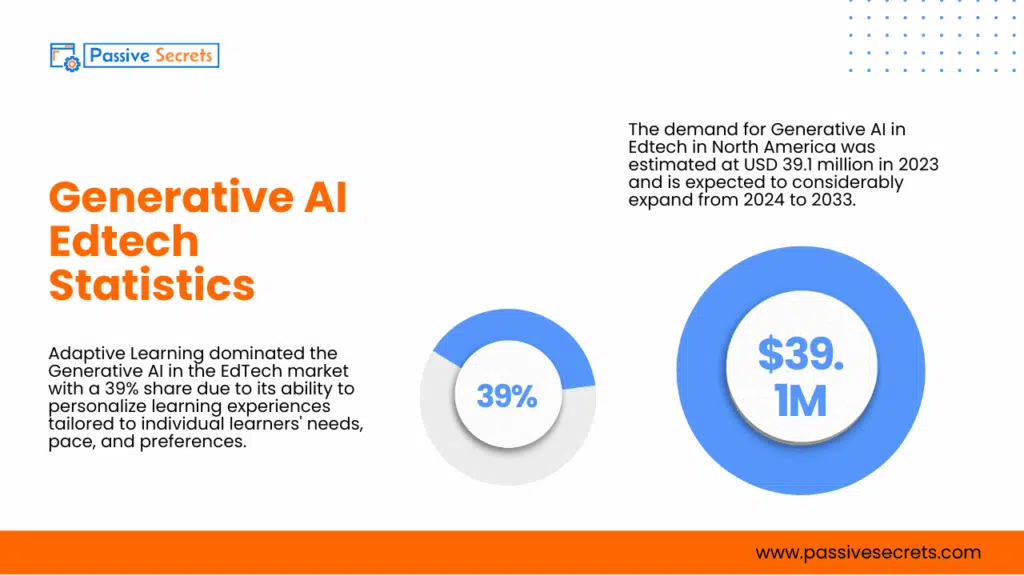
32. The demand for Generative AI in Edtech in North America was estimated atUSD 39.1 million in 2023 and is expected to considerably expand from 2024 to 2033. (source)
33. Students accounted for more than 49% of the market share in the Generative AI in the EdTech market in 2023, highlighting the impact of these technologies on enhancing the student learning experience. (source)
34. The global generative AI in the EdTech market is expected to grow from $268M in 2023 to $8.3B by 2033, at a 41% CAGR from 2024 to 2033. (source)
35. In 2023, the use of Generative AI for language learning and translation in EdTech increased by 18%, making language learning more effective and engaging. (source)
36. Educational institutions utilizing Generative AI for content creation and course development saw a 25% reduction in time and costs in 2023. (source)
37. The adoption of Generative AI for personalized learning and adaptive tutoring in EdTech increased by 32% in 2023, with 50% of organizations increasing their investments in these technologies. (source)
38. The market size for Generative AI is expected to grow from USD 13.5 billion in 2023 to approximately USD 255.8 billion by 2033, with an annual growth rate of 34.2%. (source)
39. 45% of educational institutions were exploring the use of Generative AI for administrative tasks such as scheduling and resource management. (source)
40. The application of Generative AI to make learning interactive through gamification in EdTech saw a 20% increase in 2023, enhancing student engagement. (source)
41. Experts predict that using Generative AI for personalized career advice and skill-building in EdTech will grow by 28% by the end of 2024. (source)
42. Adoption of Generative AI for grading and assessment in EdTech solutions increased by 15% in 2023, streamlining educators’ workloads. (source)
43. The integration of Generative AI in virtual and augmented reality (VR/AR) for learning purposes increased by 22% in 2023, offering immersive educational experiences. (source)
44. The use of Generative AI for language translation and accessibility features in EdTech solutions grew by 18% in 2023, promoting inclusivity in education. (source)
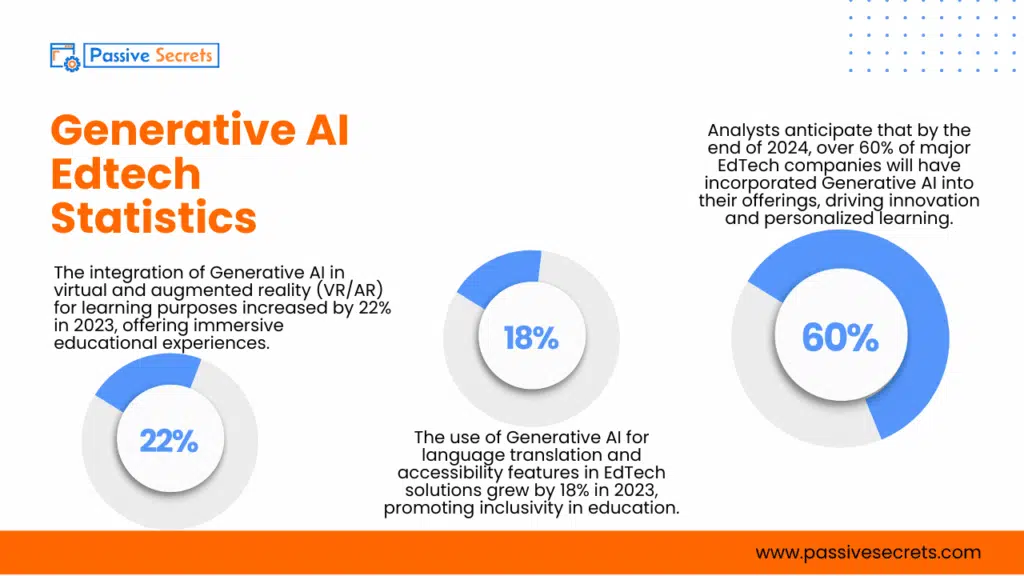
45. Analysts anticipate that by the end of 2024, over 60% of major EdTech companies will have incorporated Generative AI into their offerings, driving innovation and personalized learning. (source)
Conclusion
The Edtech statistics presented in this article paint a vivid picture of an industry on the move.
With remarkable growth rates, increasing adoption, and innovative solutions emerging, the future of education has never looked brighter.
As technology continues to reshape the learning landscape, it’s clear that Edtech will play a vital role in improving outcomes, and enhancing the overall education experience.
Whether you’re an educator, investor, or simply a curious observer, the statistics highlighted here demonstrate the vast potential of Edtech to transform lives and shape the future of learning.
FAQs

Other Industry Statistics You Should Know:
- Fiverr Statistics: Can You Still Make Money?
- 70+ Interesting Upwork Statistics & Key Facts
- Animation Statistics: The Ultimate Guide To The Industry’s Trends & Insights
- Shocking Social Media Addiction Statistics You Should Know
- 80+ Alarming Technology Addiction Statistics You Must Know
- Spotify Statistics: Latest Report on The Music Streaming Platform
- 50+ Useful Video Game Addiction Statistics, Facts & Huge Trends
- Internet Safety Statistics: Facts & Trends Every Online User Should Know
- Internet Dangers Statistics: A Look At The Internet’s Dark Side
- 60+ QR Code Statistics, Usage, Forecasts & Trends
- The Web3 Statistics Report: Trends, Insights, and Predictions
- 70+ AI in Education Statistics That Prove the Future Is Already Here
- From Passion to Profit: 120+ Creator Economy Statistics You Need to Know
- 60+ Interesting Storytelling Statistics, Facts & Huge Trends
- 90+ Interesting Film Industry Statistics (NEW Report)

