

Running a business by yourself is a strange kind of hard. There is no one to bounce ideas off at 2 a.m. when a client goes quiet. No coworker to notice you have not taken a real day off in weeks. Just you, your laptop, and a running list of questions nobody around you can answer.
Is your income normal, or are you behind? Should you be leaning on AI more, or is everyone else struggling with it too? Will this ever feel stable, or is the uncertainty just part of the deal?
You have probably gone looking for answers already and found mostly opinions. Guru advice, vague encouragement, motivational quotes that do not actually tell you anything. Not much you could really use.
This is different. Every solopreneurship statistic below comes from real 2026 research on solopreneurs, covering income, AI, burnout, and growth. Go through it, and you will finally see where you stand next to other people doing exactly what you are doing. What is normal, what is a warning sign, and what quietly separates the solopreneurs who make it work from the ones who burn out and walk away.
If you have been waiting for real numbers instead of more advice, here they are.
How Big Is the Solopreneur Economy in 2026?
1. Roughly 29.8 million solopreneurs are operating in the U.S. These are businesses run without paid employees, with the owner handling everything from strategy to delivery and invoicing. The group includes consultants, designers, developers, coaches, and creators. The size of this group shows that running a business alone has become a common way to work, not just a step before hiring employees. (Zoom: State of Solopreneurship 2026)
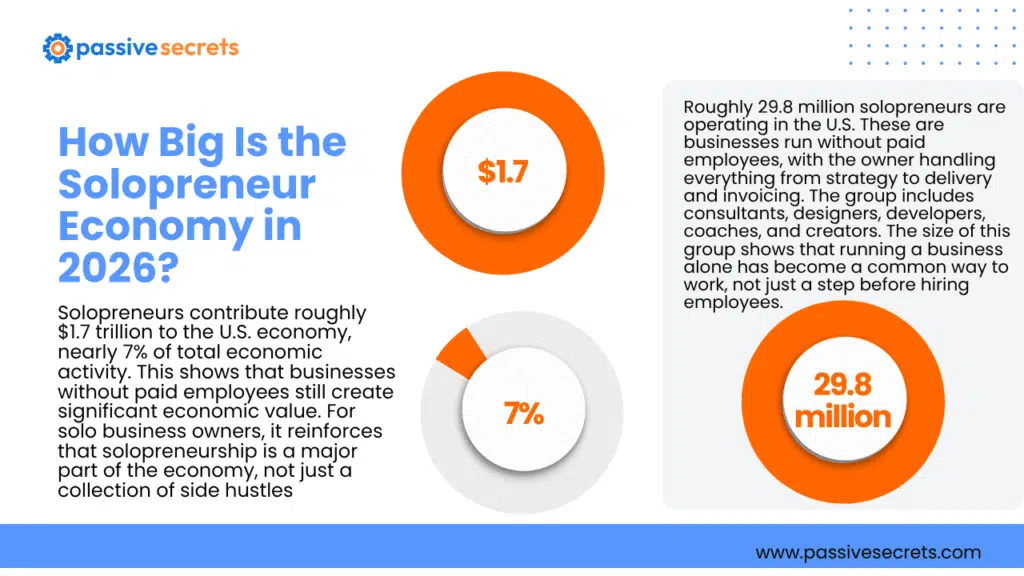
2. Solopreneurs contribute roughly $1.7 trillion to the U.S. economy, nearly 7% of total economic activity. This shows that businesses without paid employees still create significant economic value. For solo business owners, it reinforces that solopreneurship is a major part of the economy, not just a collection of side hustles. (Zoom: State of Solopreneurship 2026)
3. 82% of small businesses operate without paid employees. This shows that running a business alone is more common than many people realize. For business owners, it also suggests that software, funding, and advice designed around hiring as a business grows may not fit most small businesses. (Zoom: State of Solopreneurship 2026)
How Much Do Solopreneurs Actually Earn?
4. The average solopreneur earns $39,273 a year. But this figure can be misleading because incomes vary widely. It also doesn’t include benefits like paid time off or the security of a regular paycheck, which makes the average harder to compare with a traditional salary. (Lonely Entrepreneur: Solopreneur Income 2026)
5. 48% of solopreneurs have gone at least one full month with no income. Nearly half have faced a complete income gap, showing how unpredictable solo work can be. This makes savings and emergency cash especially important. More than a third earn under $25,000 a year. This shows how widely incomes vary and why the $39,273 average does not tell the full story. For many, solo work is closer to a side income than a primary source of earnings. (Lonely Entrepreneur: Solopreneur Income 2026)
6. A growing 20% of solopreneurs earn between $100,000 and $300,000 a year. This shows that some solo businesses can generate a high full-time income. But only 3.6% earn more than $1 million a year. That makes seven-figure solopreneurs the exception, not the norm. Together, these figures show how widely income can vary among solo business owners. (Lonely Entrepreneur: Solopreneur Income 2026)
7. Solopreneurs say they need $219,000 a year to feel successful, about $180,000 more than the $39,273 average income. This gap shows how far expectations can be from reality. For many solo business owners, success is measured against an income far above what most actually earn, which can fuel dissatisfaction and self-doubt. (Lonely Entrepreneur: Solopreneur Income 2026)
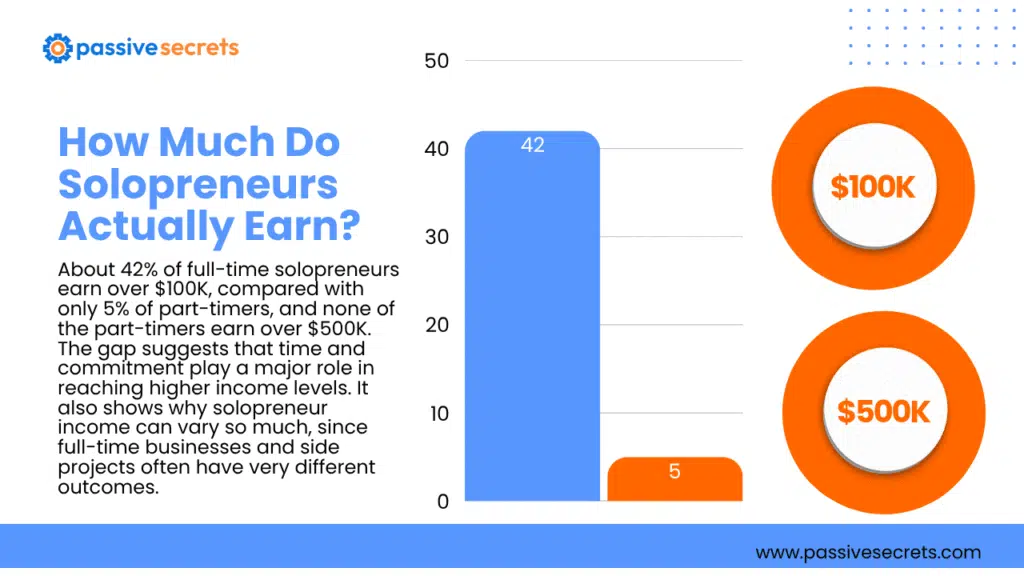
8. About 42% of full-time solopreneurs earn over $100K, compared with only 5% of part-timers, and none of the part-timers earn over $500K. The gap suggests that time and commitment play a major role in reaching higher income levels. It also shows why solopreneur income can vary so much, since full-time businesses and side projects often have very different outcomes. (Adriana Tica: State of Solopreneurship 2026)
How Are Solopreneurs Using AI to Grow Their Business?
9. 64% of solopreneurs say their business wouldn’t have grown without AI. Nearly two-thirds say AI played a key role in their growth, suggesting it has become more than a helpful tool. For many solo business owners, AI is now taking on tasks that would otherwise require another person. (Zoom: State of Solopreneurship 2026)
10. 91% of solopreneurs say AI has reduced their administrative work. AI helps cut time spent on tasks like emails, scheduling, and note-taking. For solo business owners, this means more time can go toward clients and the actual work of running the business. (Zoom: State of Solopreneurship 2026)
11. A full solopreneur tech and AI stack now costs $3,000 to $12,000 a year, potentially saving 95% to 98% compared with hiring people for the same work. This helps explain why solo businesses can compete with larger companies. Tools can now handle tasks like admin, bookkeeping, and customer service at a fraction of the cost of hiring, allowing one person to do much more with less. (Lonely Entrepreneur: Solopreneur Income 2026)
12. 73% of solopreneurs now use AI to run core business operations. This shows that AI has moved beyond experimentation and become part of the daily workflow for many solo business owners. Combined with the lower cost of AI tools, it helps explain how solopreneurs can handle tasks that once required a team and grow without hiring. (Lonely Entrepreneur: Solopreneur Income 2026)
13. Solopreneurs mainly use AI for content creation, with 91% using it for research and ideation and 78% for outlining and drafting. Far fewer use it for ad creative (10%) or fully automated publishing (2%). This suggests most solopreneurs use AI to speed up their work rather than hand over business decisions to it. (Adriana Tica: State of Solopreneurship 2026)
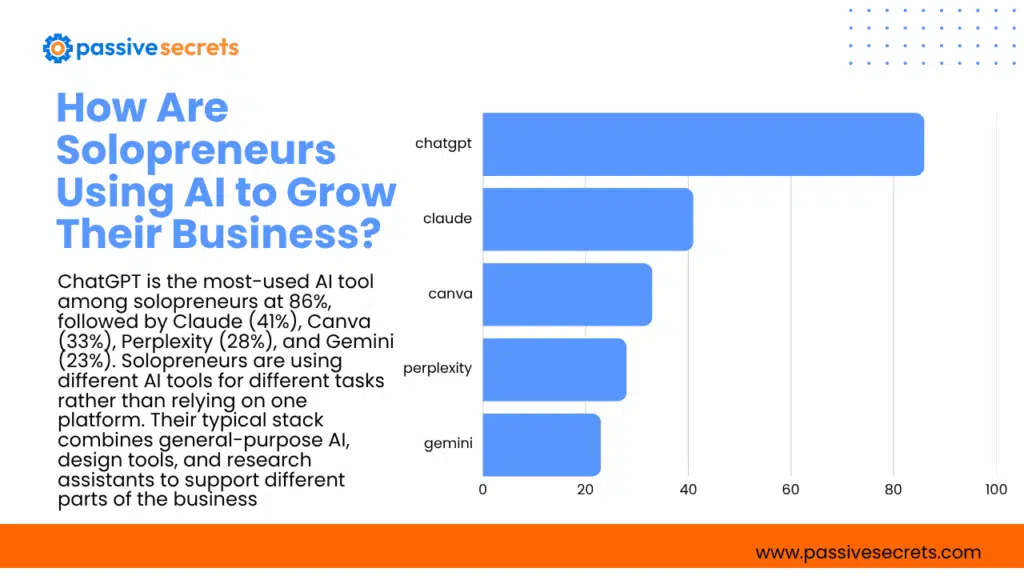
14. ChatGPT is the most-used AI tool among solopreneurs at 86%, followed by Claude (41%), Canva (33%), Perplexity (28%), and Gemini (23%). Solopreneurs are using different AI tools for different tasks rather than relying on one platform. Their typical stack combines general-purpose AI, design tools, and research assistants to support different parts of the business. (Adriana Tica: State of Solopreneurship 2026)
15. 81% of solopreneurs using AI report a positive return, mostly through time saved, while 71% say AI saves them at least four hours a week. However, 19% say they are only breaking even or seeing a negative return. This suggests AI is not automatically improving results for everyone. The report also finds a slight link between poor AI outcomes and lower revenue, showing that AI can support a strong business but may not fix underlying problems on its own. (Adriana Tica: State of Solopreneurship 2026)
Why Do Solopreneurs Consider Quitting?
16. 34% of solopreneurs have considered giving up, and 72% of those say inconsistent income is the reason. Since the 72% refers only to the 34% who have considered quitting, it shows that income instability is a major reason solopreneurs struggle to keep going. This also fits with the finding that 48% have gone at least one month without income (as stated earlier in the article). For solo business owners, creating more consistent income may matter more for long-term sustainability than simply trying to earn more. (Lonely Entrepreneur: Solopreneur Income 2026)
Do Solopreneurs Work Full-Time or Part-Time?
17. 76% of solopreneurs work on their businesses full-time, while 24% do it part-time alongside other income. This shows that solopreneurship covers both full-time businesses and side projects. It also suggests that the amount of time invested can shape income, growth, and confidence. (Adriana Tica: State of Solopreneurship 2026)
Can Solopreneurs Grow Without Hiring Employees?
18. 74% of solopreneurs have grown their businesses without hiring employees. This shows that growth no longer has to mean building a bigger team. Many solo business owners use AI and other tools to increase output while staying a one-person operation. (Zoom: State of Solopreneurship 2026)
How Many Solopreneurs Actually Succeed?
19. 77% of solopreneurs reach profitability within their first year. The article presents this as an illustrative figure, so the exact number should be treated with some caution. Still, the broader point makes sense: without payroll costs, solo businesses can reach break-even faster. But turning early profits into a reliable income is often the harder part. (Lonely Entrepreneur: Solopreneur Income 2026)
20. Only 41% of solopreneurs turn a profitable side project into a reliable primary income. This suggests the bigger challenge isn’t starting or becoming profitable, but turning that profit into a dependable income. For solopreneurs, making money from a business is only the first step. The harder part is making that income consistent enough to rely on. (Lonely Entrepreneur: Solopreneur Income 2026)
How Do Solopreneurs Get Clients and Grow Their Audience?
21. LinkedIn is the dominant channel: 75% of solopreneurs use it, 69% name it as their main social platform, and 36% say it is their primary revenue driver. That’s higher than newsletters and email at 19% and fits the group’s strong B2B focus. For solopreneurs selling to businesses, the data suggests LinkedIn may be worth more investment than consumer-focused platforms like Instagram or TikTok. (Adriana Tica: State of Solopreneurship 2026)
22. 59% of solopreneurs say time or creative bandwidth limits their main channel, compared with just 18% who blame platform or algorithm changes. This suggests that capacity is a bigger barrier to growth than reach or algorithms. For solopreneurs, the challenge is often handling more demand than one person can manage. (Adriana Tica: State of Solopreneurship 2026)
23. 73% of solopreneurs run a newsletter, but only 6% of them have a paid tier and 63% haven’t monetized it at all. This shows that while newsletters are popular, direct monetization is rare. For most solopreneurs, the newsletter works better as a way to build an audience and drive sales of other products or services than as the main product itself. (Adriana Tica: State of Solopreneurship 2026)
24. Every solopreneur earning $500K or more runs a newsletter, compared with 73% of the overall group. This is a strong association, but it does not prove that newsletters cause higher income. The sample already had a high share of newsletter users, so the finding is better viewed as a pattern worth noting rather than a guarantee of higher earnings. (Adriana Tica: State of Solopreneurship 2026)
What Do Solopreneurs’ Finances Actually Look Like?
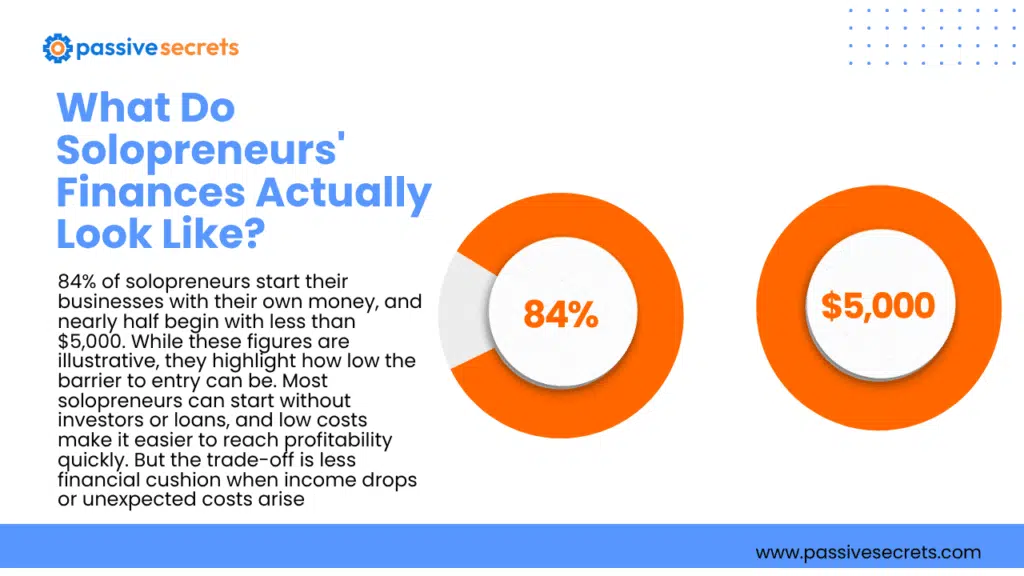
25. 84% of solopreneurs start their businesses with their own money, and nearly half begin with less than $5,000. While these figures are illustrative, they highlight how low the barrier to entry can be. Most solopreneurs can start without investors or loans, and low costs make it easier to reach profitability quickly. But the trade-off is less financial cushion when income drops or unexpected costs arise. (Lonely Entrepreneur: Solopreneur Income 2026)
26. 68% of solopreneurs have less than six months of savings set aside. This highlights how financially vulnerable many solo business owners are, especially when nearly half have experienced a month with no income. For solopreneurs, building a solid cash buffer is important before relying on the business as a primary source of income. (Lonely Entrepreneur: Solopreneur Income 2026)
Solopreneurship Statistics Key Takeaways
Put together, these 26 numbers tell one clear story: solopreneurship is not a phase anymore; it is a permanent and massive part of how business gets done. Nearly 30 million people are running companies with zero employees, generating almost $1.7 trillion a year, and most small businesses in the U.S. now look exactly like this. Going solo used to mean “not there yet.” In 2026, for a huge number of people, going solo is simply the destination.
A few patterns stand out once you step back from the individual stats:
Here is the part worth sitting with. None of the solopreneurs behind these numbers are failing because they lack ambition, talent, or hustle. The ones who make it and the ones who quietly give up mostly differ on one thing: how steady their income is, and how much cushion they have built before the slow months hit. That is not a talent problem. It is a planning problem, and it is one that can actually be fixed.
If you are running a business alone, the real question these statistics leave you with is not “am I working hard enough?” It is “am I building something steady enough to survive the months when the work does not show up?”

Other Related Statistics Posts You Should Know:
- Airbnb vs Hotels Statistics: 36 Huge Facts to Compare
- 65+ Vital Leadership Statistics: Latest Trends and Insights
- Billionaire Statistics: Surprising Insights About The World’s Wealthiest
- 89 Business Loan Statistics Every Entrepreneur Should Know
- 70+ AI in Education Statistics That Prove the Future Is Already Here
- Women in Leadership Stats: Insights into Global Gender Representation
- Soft Skills Statistics: Key Data on Demand, Training, and Impact
- 95+ Fascinating Gift Industry Statistics to Surprise and Delight
- Top Business Coaching Statistics & Trends Every Leader Should Know
- 95+ Amazing Millionaire Statistics You Cannot Miss (Update)
- 50+ Latest Life Coaching Statistics And Huge Trends
- Useful Real Estate Photography Stats and Trends You Need to Know
- Data-Driven Decision-Making Statistics: Trends, Benefits & Challenges
- 54 Incredible Goal Setting Statistics To Help You
- 80+ Franchise Statistics and Facts You Should Know
- 90+ Interesting Film Industry Statistics (NEW Report)
- From Passion to Profit: 120+ Creator Economy Statistics & Facts
- 125+ Interesting Airbnb Statistics by Country (Deep Insights)
- Important Wealth Management Statistics You Can’t Afford to Ignore
- Reputation Management Statistics and Trends to Improve Your Brand
Last updated: November 6, 2026 | Last verified: September 3, 2026 | Next review: January 2027

