
Key Reputation Management Statistics (Editor’s Pick)
- Corporate reputation drives $11.9 trillion of S&P 500 market value in 2024.
- 58% of Nvidia’s market cap—$1.8 trillion—is tied directly to its reputation.
- 92% of consumers in Brazil and China consider brand reputation crucial when making purchase decisions.
- 94% of consumers will abandon a brand after a single bad experience.
- 90% of consumers read online reviews before visiting a business, valuing them as much as personal referrals.
- 82% of consumers trust online reviews more than sales messages.
- Local reviews influence 91% of consumers’ perception of major brands.
- 69% of consumers expect businesses to respond to reviews within 24 hours.
- The Online Reputation Management software market reached $13.24 billion in 2024, projected to grow to $24.96 billion by 2035.
- The global media monitoring tools market is expected to reach $17.12 billion by 2032, growing at a 15.5% CAGR.

Reputation management is a crucial aspect of business success. With consumers relying heavily on online reviews, social media, and influencer endorsements, a company’s reputation can make or break its brand in a matter of hours.
Studies show that over 90% of consumers read online reviews before making purchasing decisions, and a single negative experience can cost businesses thousands of potential customers.
As we move into 2026, reputation management is no longer just about public relations—it’s about harnessing data and technology to monitor, protect, and enhance how your brand is perceived.
This article explores the latest reputation management statistics, revealing the true impact of online feedback, social media interactions, and customer experiences on a brand’s bottom line.
Keep reading to discover more reputation management statistics that will boost your brand and get you more loyal customers.
What is Reputation Management?
Reputation management is the process of monitoring, influencing, and managing the public perception of an individual, business, or organization.
It involves tracking and responding to online reviews, social media mentions, and other online content to maintain a positive reputation and address any negative or false information.
Effective reputation management helps build trust, credibility, and a strong reputation, which can lead to increased customer loyalty, improved brand image, and ultimately, business success.
General Reputation Management Statistics
1. As of October 2024, Bimbo, the multinational food manufacturer, topped Mexico’s corporate reputation charts with 10,000 points. Google and BBVA followed closely, scoring around 8,960 and 8,900 points, respectively (source).
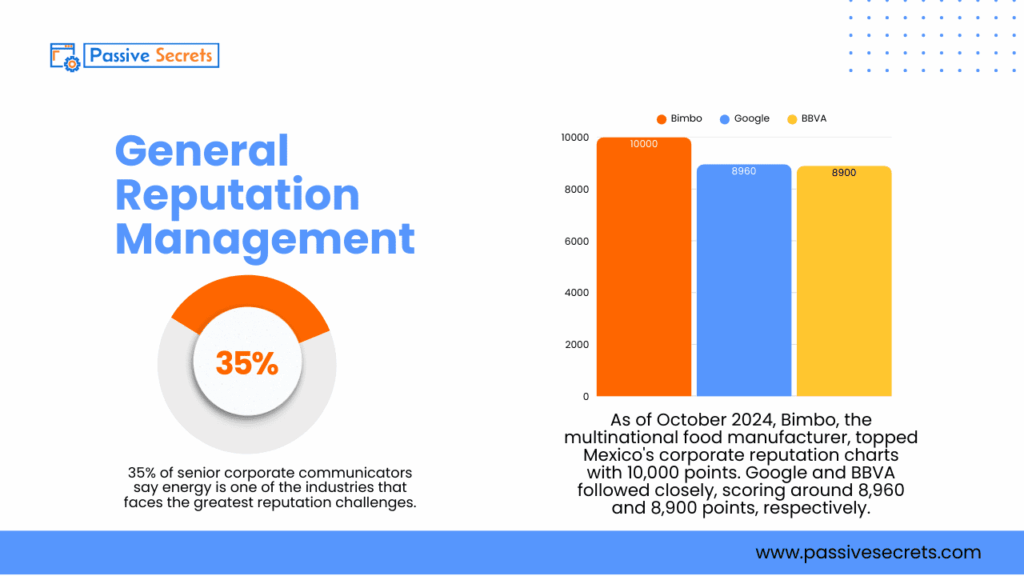
2. 35% of senior corporate communicators say energy is one of the industries that faces the greatest reputation challenges (source).
3. In 2025, Trader Joe’s led the pack as America’s most reputable corporation, scoring 82.1 points on the index. Patagonia (82) and Microsoft (80.7) rounded out the top spots, based on U.S. consumer perceptions of the most visible brands (source).
4. The global consumer ratings and reviews software market is driven by the growing importance of customer experience, the need for quality improvement, and the impact of SEO and search engine rankings. However, it faces restraints such as data security and privacy issues, fraudulent activities, and integration complexities (source).
5. As of January 2025, Natura led the corporate reputation game in Brazil, racking up 10,000 points. Mercado Livre, the local name for the online marketplace Mercado Libre, and Ambev followed with scores of around 7,970 and 7,690 points, respectively (source).
6. In a 2023 survey, most consumers in France, Britain, Germany, and Italy believed sustainable brands have a better reputation. In France, 71% of consumers strongly agreed (source).
7. A 2023 survey of marketing and communication professionals in the Asia-Pacific region revealed that 41.5% of respondents’ organizations had a social listening program in place, while 35.5% did not. This means that nearly two-fifths of organizations in the region are actively monitoring social media, while over a third are not (source).
Reputation Management Industry Growth Statistics
8. According to Market Research Future, the Online Reputation Management Software Market hit USD 13.24 billion in 2024. It’s set to grow from USD 14.03 billion in 2025 to USD 24.96 billion by 2035, at a 5.93% CAGR. The ORM software is mainly used for brand monitoring and sentiment analysis, helping businesses track and understand their online reputation (source).
9. The Customer Reviews Management Software (CRMS) market is valued at approximately $1.2 billion as of 2024, with an anticipated compound annual growth rate (CAGR) of around 15% over the next five years (source).
10. The global online reputation management services market kicks off at USD 0.37 billion in 2026, aiming for USD 1.26 billion by 2035, with a 14.69% CAGR. Regionally, the market is projected at USD 0.1091 billion (US), USD 0.08006 billion (Europe), and USD 0.08927 billion (China) in 2025 (source).
11. The global Enterprise Reputation Management Services market will grow from $4.3 billion in 2023 to $9.8 billion by 2032, at a 9.4% CAGR. This growth is driven by the need for companies to maintain a positive online presence, monitor social media and reviews, and protect their reputation from cyber-attacks and data breaches (source).
12. The Media Intelligence and PR Software market is projected to grow from $10.57 billion in 2023 to $27.51 billion by 2030, at a CAGR of 14.61% from 2024 to 2030 (source).
13. The Feedback and Reviews Management Software market is expected to grow from $10.11 billion in 2024 to $28.04 billion by 2031, at a CAGR of 13.60% (source).
14. The global market size for Enterprise Reputation Management Services is projected to grow from $4.3 billion in 2023 to $9.8 billion by 2032, at a CAGR of 9.4% (source).
15. The global social media listening market was valued at USD 9.2 million in 2024, set to hit USD 20.18 million by 2030, growing 14.3% CAGR. North America led the pack with a 39.9% revenue share in 2024 (source).
16. The market for social media monitoring tools is expected to expand from $4.85 billion in 2024 to $8.32 billion by 2031, growing at an annual rate of 8%, fueled by increasing demand for related software and services (source).
17. The global media monitoring tools market is expected to grow from $5.41 billion in 2024 to $17.12 billion by 2032, at a rate of 15.5% per year (source).
18. Additionally, the US media monitoring tools market is projected to reach $4.38 billion by 2032, driven by early adoption of advanced technologies and the presence of major players like Hootsuite, Oracle, and Salesforce, which will fuel demand for media tracking tools in the region (source).
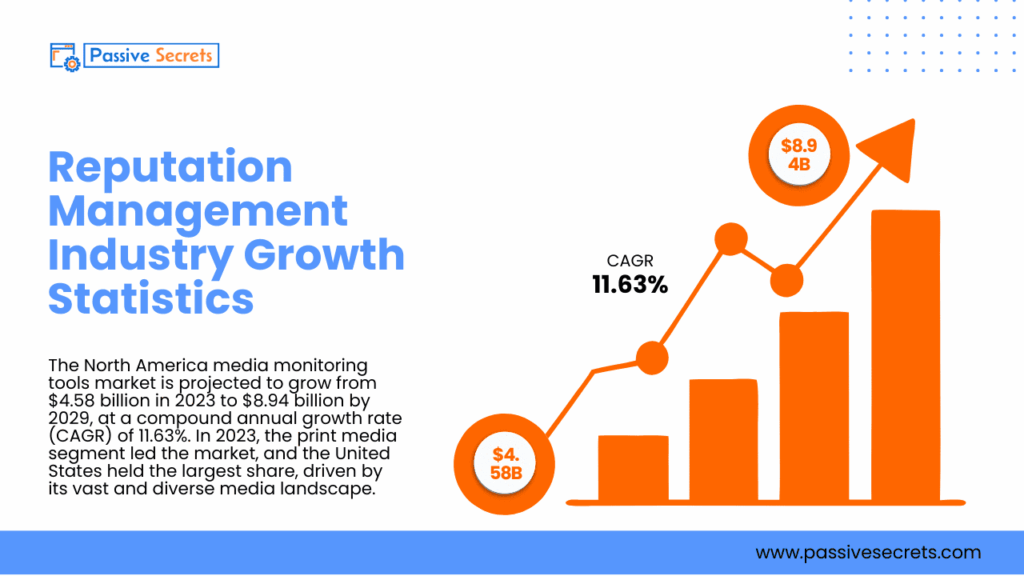
19. The North America media monitoring tools market is projected to grow from $4.58 billion in 2023 to $8.94 billion by 2029, at a compound annual growth rate (CAGR) of 11.63%. In 2023, the print media segment led the market, and the United States held the largest share, driven by its vast and diverse media landscape (source).
20. The global online media monitoring market is projected to grow from $3.2 billion in 2023 to $10.8 billion by 2032, at a CAGR of 14.6%. This growth is driven by the need for real-time data analytics, effective brand management, and the increasing influence of digital marketing, which are becoming essential for businesses to stay competitive (source).
Importance of Reputation Management
21. Corporate reputation drives market value in 2024, with $11.9 trillion of S&P 500 firms’ value tied to reputation (source).
22. Nvidia’s reputation accounts for 58% of its market cap, equivalent to $1.8 trillion in shareholder value (source).
23. Most consumers in Germany (77%), Brazil (92%), and China (92%) consider brand reputation a crucial factor when making purchasing decisions, according to a 2024 survey (source).
24. Reputation accounts for 30% of FTSE 350 companies’ market value in 2024, equivalent to £719 billion, underscoring its enduring importance (source).
Cost of Bad Reputation
25. One bad review can tank a business – 94% of consumers will ditch a brand after a single poor experience (source).
Importance of Online Reviews and Ratings
26. In our 2025 survey, 51% of U.S. respondents said they always research major purchases online first when planning to buy (source).
27. For healthcare reputation, 86% of consumers read online patient reviews. 73% require a minimum 4-star rating to consider a healthcare provider (source).
28. Healthcare providers who manage their online reputation see a 40% increase in listing actions and a 300-point Reputation Score increase annually (source).
29. Requesting reviews boosts hospital online listing engagement by 40% (source).
30. 33% of US consumers always read online reviews of local businesses, 43% say they regularly read them, and 2% never read them (source).
31. 77% of people use review sites to help them avoid making a poor purchase decision (source).
32. 82% of users trust reviews over sales pitches, finding them more influential in their purchasing decisions (source).
33. Local reviews affect 91% of consumers’ overall view of big brands (source).
34. 34% of consumers use Instagram, 23% use TikTok for local business reviews (source).
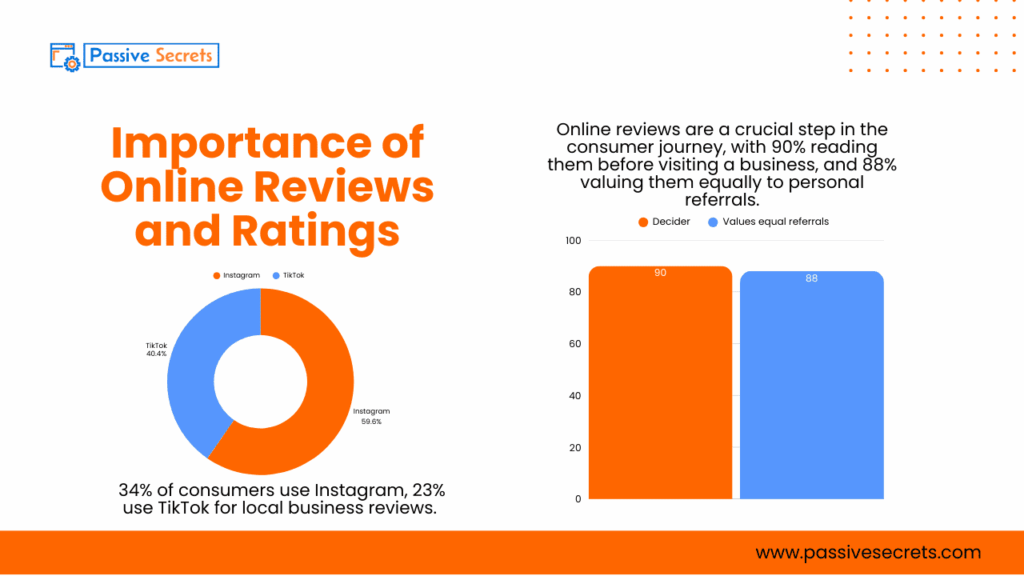
35. Online reviews are a crucial step in the consumer journey, with 90% reading them before visiting a business, and 88% valuing them equally to personal referrals (source).
36. 90% of consumers say they consider reviews when making a purchase decision (source).
37. Consumers have high expectations for brand response times, with 69% wanting a response within 24 hours and 16% demanding an even faster turnaround, seeking answers in just minutes (source).
38. 88% of consumers prefer businesses that reply to every review, while 47% would even consider using a business that fails to respond to any reviews (source).
39. Google remains the top website for online review reading, but its usage has slightly declined from 87% in 2023 to 81% in 2024. However, both Apple Maps and Trustpilot have experienced a 3% uptick in consumer usage since 2022, with Apple Maps now at 16% (up from 13%) and Trustpilot at 10% (up from 7%). This shows there is a steady growth in popularity for these services (source).
40. 59% of consumers think a business should have 20-99 reviews. This means that a moderate number is key to building trust and credibility (source).
Reputation Risk Management Statistics
41. Only 49% of US companies have a formal crisis communication plan, while 28% have an informal plan, and 23% have no plan or are unsure if they have one (source).
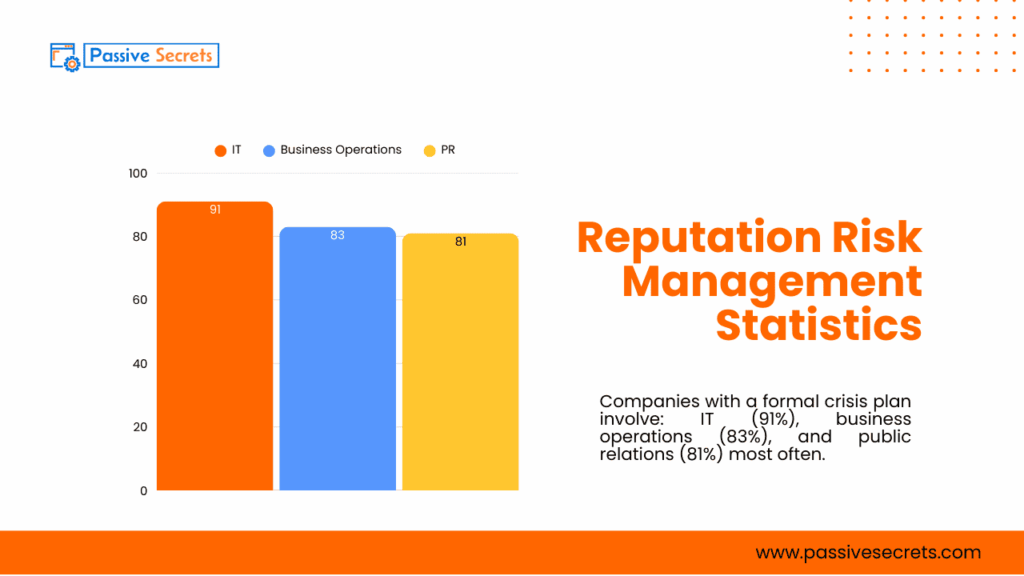
42. Companies with a formal crisis plan involve: IT (91%), business operations (83%), and public relations (81%) most often (source).
43. 50% of companies are highly concerned about the impact of brand and reputation risks, especially social media controversies, in the next 3-5 years (source).
Latest Reputation Management Trends
1. Crisis Management and Damage Control
In 2026, crisis management and damage control will remain crucial in reputation management due to the increasing speed of information sharing and demand for transparency.
Brands face the constant risk of online backlash, data breaches, and scandals, making swift and coordinated responses more crucial than ever.
Another key element of this trend is the emphasis on transparent communication. Audiences today expect brands to respond quickly during a crisis, but also to be open, accountable, and sincere.
In the next years, businesses will prioritize issuing clear and honest public statements that acknowledge the problem, take responsibility, and demonstrate a commitment to corrective action.
Alongside this, organizations are increasingly developing detailed crisis response plans, which include escalation protocols, media training for executives, and dedicated crisis teams to ensure they are fully prepared when a crisis arises.
2. AI-powered Reputation Monitoring
Companies are investing in advanced AI tools for proactive monitoring, which allows them to track mentions across social media, news outlets, and online forums. This technology enables organizations to detect potential crises before they fully escalate, providing a window for faster and more effective responses.
AI-driven tools can analyze sentiment and identify emerging trends in real-time, helping brands understand how they are perceived at any given moment.
These systems go beyond simply aggregating data—they interpret tone, context, and reach, giving businesses valuable insights into how certain conversations might impact their reputation. For example, AI can detect early warning signs of negative sentiment in online discussions, allowing businesses to respond before an issue escalates into a full-blown crisis.
3. User-Generated Content Moderation
This growing trend is driven by the increasing influence of content shared by users on social media platforms, forums, review sites, and other online communities. UGC, while a powerful tool for engagement and brand awareness, poses significant risks if left unchecked. Negative, inappropriate, or harmful content can quickly damage a brand’s reputation, especially if it goes viral.
Brands will need to invest in more sophisticated content moderation strategies, using AI and machine learning to automatically detect problematic posts, comments, or reviews.
These AI-powered systems will be capable of filtering out harmful content, such as hate speech, spam, misinformation, or offensive material, at a much faster rate than human moderators. With this, companies can prevent negative associations from spreading, helping to safeguard their reputation.
4. Influencer Reputation Management
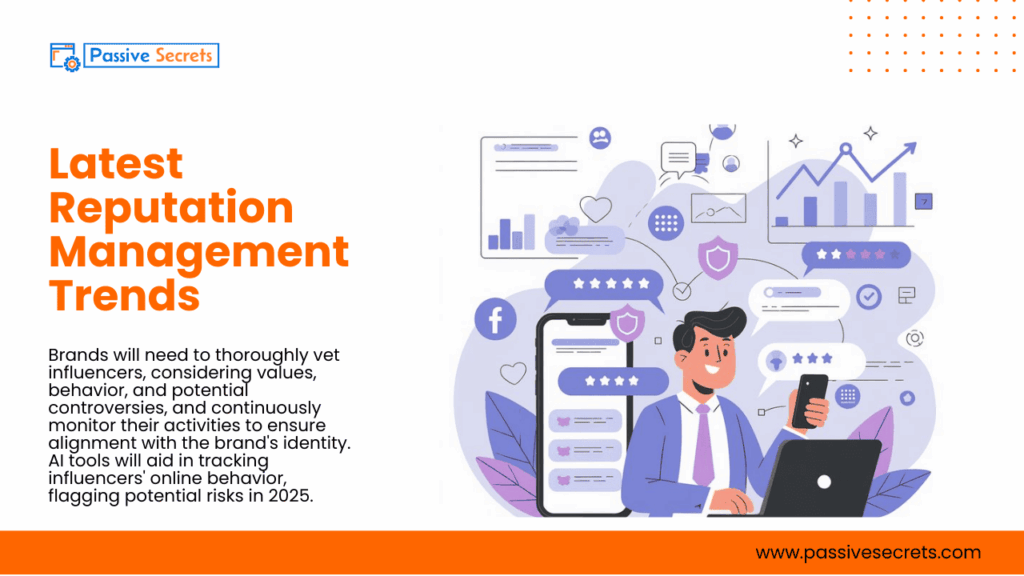
Influencer reputation management will become a key focus for companies as influencer missteps can directly impact brand reputation.
Brands will need to thoroughly vet influencers, considering values, behavior, and potential controversies, and continuously monitor their activities to ensure alignment with the brand’s identity. AI tools will aid in tracking influencers’ online behavior, flagging potential risks in 2025.
FAQs
Other Related Statistics You Should Know:
- 30+ Powerful Team Building Statistics to Boost Workplace Performance
- 87+ Training Industry Statistics & Trends for HR and L&D Professionals
- Global IT Outsourcing Statistics: Key Trends and Insights
- 90+ Interesting Marketing Jobs Statistics & Facts (Latest Report)
- 80+ Employee Benefit Statistics: Insights and Trends
- The Most Important Wealth Management Statistics You Can’t Afford to Ignore
- Enterprise Data Management: Essential Statistics and Emerging Trends
- 93 Talent Management Statistics to Help You
- 36 Helpful Social Worker Burnout Statistics To Know
- 100 Business Process Outsourcing Statistics & Facts
- Top HR Outsourcing Statistics and Trends Every Business Must Know
- The Top Outsourcing Statistics You Shouldn’t Ignore
- 47+ Shocking 4-day Work Week Statistics To Know
- 105+ Supply Chain Statistics & Facts You Can’t Ignore
- 50+ Interesting Employer Branding Statistics And Trends
- Job Seekers Statistics: Unemployment Rates, Preferences, Challenges
- 95 Interesting Job Interview Statistics and Huge Trends To Know
- 60+ Helpful Change Management Statistics & Facts
- 65+ Employee Performance Management Statistics & Trends
- Workforce Management Statistics: Trends, Insights, & Opportunities
- 73 Revealing Workplace Distraction Statistics
- Workplace Romance Statistics: How Common Is Workplace Romance?
- 40+ Top Workplace Conflict Statistics You Should Know
- The State of Workplace Communication: Key Statistics and Trends
- 55 Workplace Collaboration & Teamwork Statistics

