

Gift-giving is a booming global industry shaped by digital innovation, changing consumer behavior, and evolving cultural habits.
From digital gift cards and personalized presents to early holiday shopping and festive spending spikes, the gifting market reflects how people celebrate, connect, and express appreciation today.
As consumers prioritize convenience, flexibility, and meaning, gifting trends are shifting across regions and seasons.
This article explores key gift industry statistics to uncover what’s driving growth, where money is being spent, and how modern gifting is transforming worldwide.
Key Gift Industry Statistics (Editor’s Pick)
- Global gift cards market: Valued at $1.13T (2024), projected to reach $3.73T by 2034 (12.7% CAGR).
- Digital gift cards: Growing at 13.5% CAGR, expected to hit $1.6T by 2034.
- U.S. consumer preference: 36% say cash is their most desired Christmas gift.
- Personalization trend: 50% of Gen Z & millennials prefer personalized gifts vs 25% of baby boomers.
- E-commerce dominance: 71% of U.S. consumers plan to buy holiday gifts from online-only retailers.
- China gifting market: Reached 1.3T yuan in 2023, projected to exceed 1.6T yuan by 2027.
- India festive gifting: Diwali gifting grew from $20B (2022) to $27B (2023).
- Regifting behavior: 89% of consumers have regifted, driven by cost, convenience, and sustainability.
Market Size and Growth Trends
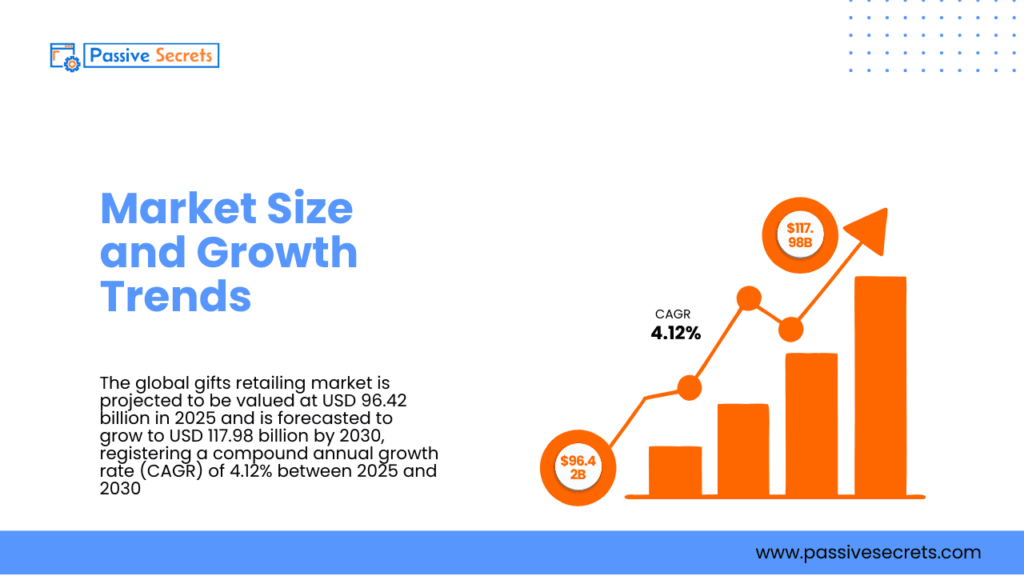
1. The global gifts retailing market is projected to be valued at USD 96.42 billion in 2025 and is forecasted to grow to USD 117.98 billion by 2030, registering a compound annual growth rate (CAGR) of 4.12% between 2025 and 2030. (source)
2. The global personalized gifts market is expected to experience robust growth, with its value rising from $23.5 billion in 2019 to an estimated $34.3 billion by 2026, driven by increasing demand for unique and customized gifts. (source)
3. According to Business Research Insights, the global gifts retailing market is valued at USD 74.99 billion in 2025 and is forecasted to reach USD 105.84 billion by 2034, reflecting a CAGR of 3.9% during 2025–2034. Regionally, the market size in 2025 is estimated at USD 23.10 billion in the United States, USD 18.52 billion in Europe, and USD 23.00 billion in China. (source)
4. The global gift cards market was valued at USD 1,128.10 billion in 2024 and is anticipated to expand at a CAGR of 12.70% between 2025 and 2034, reaching approximately USD 3,728.95 billion by 2034. (source)
5. The Personalized Gifts market was valued at $29,850 million in 2024. It is expected to expand from $31,400 million in 2025 to $52,900 million by 2035, growing at a compound annual growth rate (CAGR) of 5.4% over the forecast period from 2025 to 2035. (source)
6. The gift packaging market is projected to grow steadily from $27.5 billion in 2025 to $41.9 billion by 2035, with a year-over-year growth rate of 4.1% to 5%. Initially, growth will be moderate, reaching $28.7 billion in 2026 and $29.9 billion in 2027, driven by seasonal celebrations and e-commerce gifting trends. (source)
7. The gift boxes market is expected to reach around $2.3 billion by 2025 and will continue growing at a 6.4% compound annual rate until 2035. This industry is characterized by a fragmented landscape, with key players primarily based in developed nations like the US, and is influenced by two dominant trends: franchising and retail expansion. (source)
8. The gift paper market is projected to reach $4.9 billion by 2025 and grow at a 4.0% CAGR, reaching $7.2 billion by 2035. (source)
9. The global corporate gift market is expected to grow from $252.6 billion in 2023 to $365.8 billion by 2032 at a rate of4.2% per year, driven by increased corporate events and celebrations. (source)
10. The global hotel gift card market is projected to reach US$ 76.7 billion in 2025 and grow at a compound annual growth rate (CAGR) of 13.7%, reaching US$ 188.4 billion by 2032. In 2024, the top three countries together represented about 35% of the market value. (source)
11. According to Technavio, the personalized gifts market is expected to grow to $14.98 billion by 2028, at8.35% CAGR from 2023. (source)
12. The global floral gifting market reached $59.51 billion in 2024 and is expected to reach $91.54 billion by 2031, with a steady growth rate of 6.1% per annum from 2024 to 2031. (source)
13. The luxury gift boxes market was valued at around USD 3.8 billion in 2023 and is expected to grow to USD 5.9 billion by 2032, with a CAGR of 5.2% over the forecast period. (source)
14. The UK personalized gifts market is projected to grow by USD 1.26 billion, with a CAGR of 11% between 2024 and 2029. (source)
15. The Indian gifting market was valued at USD 75.16 billion in 2024 and is projected to grow to USD 92.32 billion by 2030, expanding at a CAGR of 3.55% between 2024 and 2030. (source)
16. The non-photo personalized gifts market is expected to expand by USD 12.02 billion, growing at a CAGR of 10.44% between 2023 and 2028. (source)
17. Australia’s online corporate and promotional gift market has experienced a 7.5% annual decline over the past five years, with revenues expected to drop to $188.6 million by 2024. (source)
18. Germany’s gift card market is expected to grow significantly, from $66.4 billion in 2023 to $171.9 billion by 2032, at an impressive 11.15% CAGR. (source)
19. According to the CMI Team’s analysis, the global digital gift card market is expected to grow at a CAGR of 13.5% from 2025 to 2034. The market is projected to reach USD 510 billion in 2025 and USD 1,596 billion by 2034. (source)
20. The US Gift Shops & Card Stores industry generated $24.5 billion in revenue in 2023, marking a 3.2% increase from the previous year and a 0.8% annual growth rate from 2018 to 2023. (source)
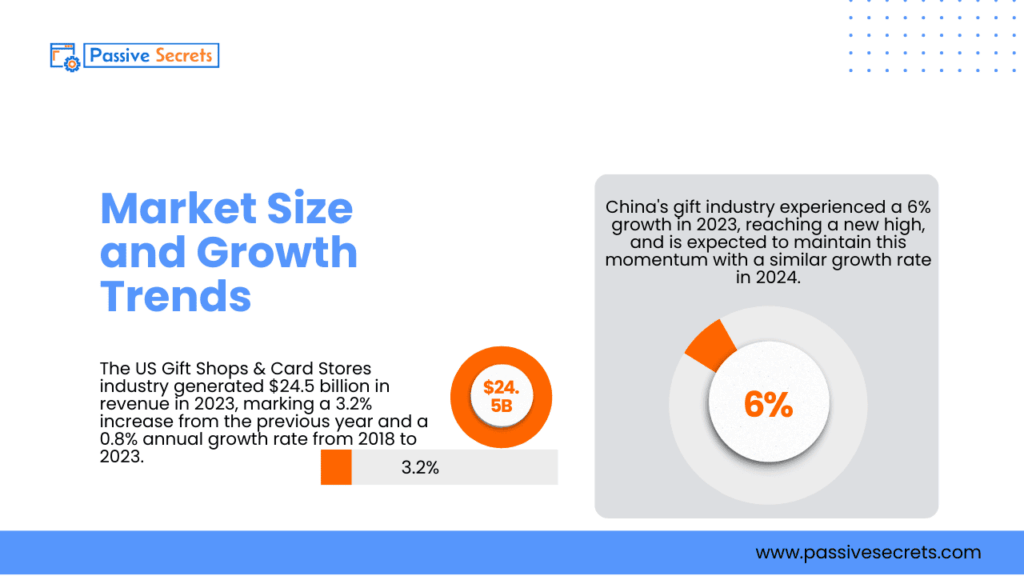
21. China’s gift industry experienced a 6% growth in 2023, reaching a new high, and is expected to maintain this momentum with a similar growth rate in 2024. (source)
22. The Wedding Gift List Service market generated USD 1.2 billion in revenue in 2024 and is projected to grow to USD 2.5 billion by 2033, expanding at a compound annual growth rate (CAGR) of 9.1% between 2026 and 2033. (source)
23. The Asia Pacific region accounts for 23% of the total revenue in the global gift retail market, equivalent to $4.4 billion. This segment is expected to expand at a CAGR of 5.6% from 2024 to 2031, driving the market’s growth. (source)
24. The gift packaging market is projected to grow from USD 27.5 billion in 2025 to USD 41.9 billion by 2035, with annual growth rates ranging between 4.1% and 5%. In the initial years, growth is steady, reaching USD 28.7 billion in 2026 and USD 29.9 billion in 2027, driven by the expansion of seasonal celebrations and the rising trend of e-commerce gifting. (source)
25. The worldwide gifts, novelty, and souvenir market was worth USD 13.79 billion in 2024 and is anticipated to increase from USD 14.28 billion in 2025 to USD 19.40 billion by 2033, growing at an estimated CAGR of 3.9% over the 2025–2033 period. (source)
26. The global gift wrapping products market is projected to grow from USD 21.77 billion in 2025 to USD 36.57 billion by 2033, up from a valuation of USD 20.4 billion in 2024, at a CAGR of 6.7% during 2025–2033. (source)
27. According to Zion Market Research, the global gift boxes market was valued at approximately USD 1.82 billion in 2024 and is expected to reach around USD 3.50 billion by 2034, growing at a compound annual growth rate (CAGR) of about 6.74% between 2025 and 2034. The increase is driven by the growing trend of gift-giving and the rise of e-commerce. The market is segmented by material, with plastics expected to lead, and by application, with cosmetic and personal care products expected to dominate. Geographically, North America is anticipated to be the largest market for gift boxes during the forecast period. (source)
Consumer Spending Patterns
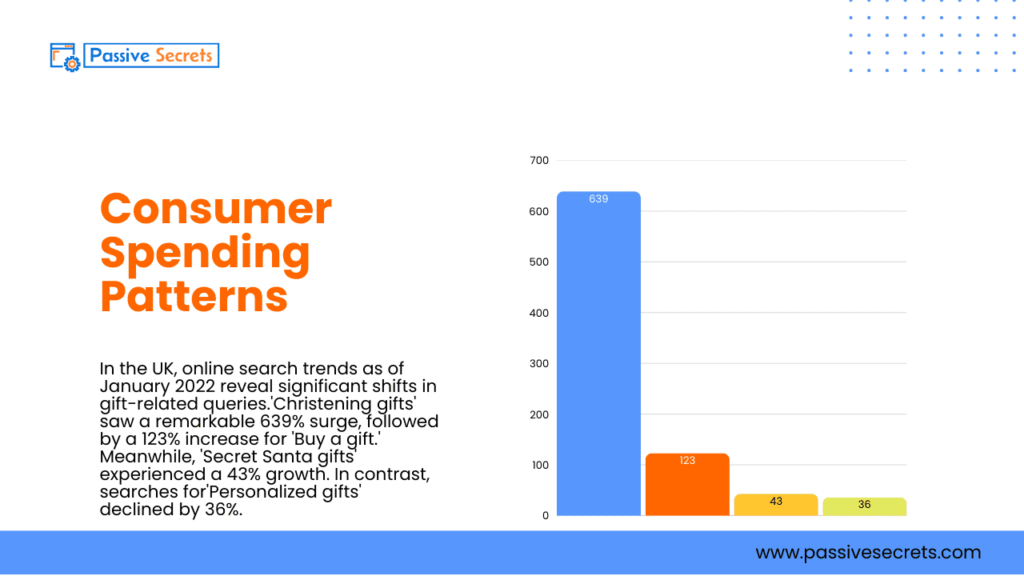
28. UK online searches for‘Buy a Gift’ soared by 123% in January 2022, followed by ‘Virgin Experience Days’ with an 83% increase, revealing a rising demand for experiential gifts. (source)
29. In the UK, online search trends as of January 2022 reveal significant shifts in gift-related queries.‘Christening gifts’ saw a remarkable 639% surge, followed by a 123% increase for ‘Buy a gift.’ Meanwhile, ‘Secret Santa gifts’ experienced a 43% growth. In contrast, searches for‘Personalized gifts’ declined by 36%. (source)
30. 47% of US adults hold unused gift cards or vouchers worth $187 each, totaling $23 billion nationwide. (source)
31. Indian OTT platforms SonyLiv and Zee5 offer gift cards with discounts of up to 50% and 25%, respectively, to incentivize users. (source)
32. On average, American consumers spent around $920 on Christmas gifts in 2022, a modest decline from the previous year’s average expenditure. (source)
33. German consumers were expected to spend €44 on Christmas gifts at department stores in 2023. (source)
34. As of 2024, there were 63,561 gift shops and card stores in the U.S., marking a 0.8% increase from 2023. (source)
35. Including a heartfelt note makes a gift more meaningful for 62% of employees and 74% of customers, while 75% of employees say they would enjoy having the chance to pick their own gift. (source)
36. 60% of employees express interest in donating the value of their gift to a charitable cause, highlighting that gifts can also serve as a way to give back. (source)
37. A large majority of consumers—86%—say receiving a gift from a brand enhances how they view that brand. Among them, 35% report that the positive impression lasts for as long as three months, while 29% say the effect extends beyond six months. (source)
38. In 2024, you can give up to $18,000 to anyone without paying federal gift tax, an increase from $17,000 in 2023. This means individuals can give up to $18,000 tax-free to each recipient in 2024, and married couples can give up to $36,000. The combined exemption allows individuals to transfer up to $13.61 million tax-free during their lifetime or at death. (source)
39. The US Gift Shops & Card Stores industry is labor-intensive, with the highest costs being Wages (15.4%), Purchases (45.3%), and Rent & Utilities (5.2%) as a percentage of revenue. (source)
40. About 60% of U.S. consumers planned to buy gifts for both their significant other and their children, with the same percentage for each recipient group. (source)
41. US consumers planned to spend an average of $170 per person on gift cards and $120 per person on clothing during the 2023 holiday season. (source)
42. In the 2023 US holiday season, 65% of female consumers prioritized price when purchasing, with convenience and fast delivery also being key considerations. (source)
43. 89% of surveyed consumers have regifted a present, with siblings and friends being the most common recipients (both at 39%). Partners and coworkers also receive regifted presents, at 38% and 34%, respectively. (source)
44. The primary motivations for regifting are convenience (38%) and environmental benefits (37%), followed by cost savings, with 30% of respondents opting for regifting as a cheaper alternative to buying new gifts.72% of respondents plan to regift this year, with53% more likely to do so due to the cost-of-living crisis. (source)
45. A US survey revealed that when it comes to gift-giving, 24% of households prioritize their children, allowing them to open their gifts first. Meanwhile, 20% of Americans don’t have a specific approach or tradition surrounding gift-giving. (source)
Seasonal and Holiday-Specific Statistics
46. About 47% of employees say they don’t receive a holiday gift from their employer, even though more than two-thirds (67%) would welcome one. (source)
47. 67% of employees say that receiving a meaningful gift boosts their job satisfaction, while 43% report feeling a stronger connection to their team and workplace culture. (source)
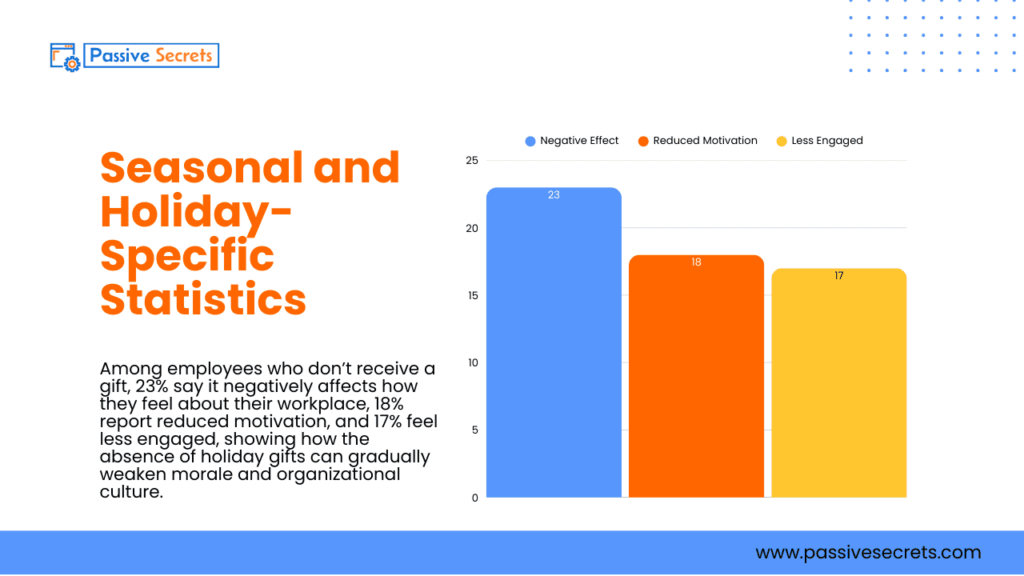
48. Among employees who don’t receive a gift, 23% say it negatively affects how they feel about their workplace, 18% report reduced motivation, and 17% feel less engaged, showing how the absence of holiday gifts can gradually weaken morale and organizational culture. (source)
49. 68% of customers in brand loyalty programs report never receiving a holiday gift, even though 58% say they would like brands to send one. (source)
50. 84% of employees and 62% of customers agree that the best time to receive gifts is in mid-to-late December, though the thought behind the gift is ultimately what matters most. (source)
51. In 2024, around 71% of U.S. consumers said they were likely to buy holiday gifts from online-only retailers. Over half planned to shop at mass merchants, while roughly a third considered off-price or department stores. (source)
52. India’s Diwali gifting market is growing rapidly, increasing from ₹1.5 lakh crore (US$20 billion) in 2022 to over ₹2 lakh crore (US$27 billion) in 2023. (source)
53. In Brazil, tech gifts top Christmas wish lists, with 40% of survey respondents in October 2023 saying they’d love to receive a smartphone, tablet, or accessory. (source)
54. A U.S. survey conducted from October to November 2025 found that 42% of consumers typically begin shopping for Christmas gifts before December. (source)
55. Japan’s year-end gifts market was worth 858 billion yen in 2023 but is forecast to dip to 842 billion yen in 2024. (source)
Popular Gift Categories and Preferences
56. The Asia Pacific region leads the global Floral Gifting market, boasting an impressive 22% market share and driving remarkable growth in the industry. (source)
57. The Asia Pacific floral gifting market reached $11.11 billion in sales revenue in 2023. (source)
58. In 2018, the US market for plastic gift-wrapping products was worth $500 million. It’s expected to grow to $790 million by 2025. (source)
59. In the UK gift industry, notonthehighstreet.com led online visibility in January 2022 with a score of 83,188, followed closely by buyagift.co.uk with a score of 34,339, making them the top two online retail websites in the sector. (source)
60. UK consumers’ top Christmas gift choice is vouchers/gift cards, preferred by 39%. (source)
61. A U.S. survey conducted in October–November 2025 asked consumers about their preferred Christmas gifts. 36% of respondents said they would be happy to receive money, making it the most desired Christmas gift in the country. (source)
62. In the US, 50% of Gen Z and millennials are more likely to give personalized gifts in 2023, up from last year, while only 25% of baby boomers feel the same way. (source)
63. In an October 2025 French survey, 30% of respondents said they’d be happiest receiving a gift card or voucher as a Christmas gift, making it the most popular choice. (source)
64. In an October 2023 Mexican survey, over 50% of respondents said they’d be happiest receiving clothes, textiles, or shoes as a Christmas gift, making it the clear top choice. (source)
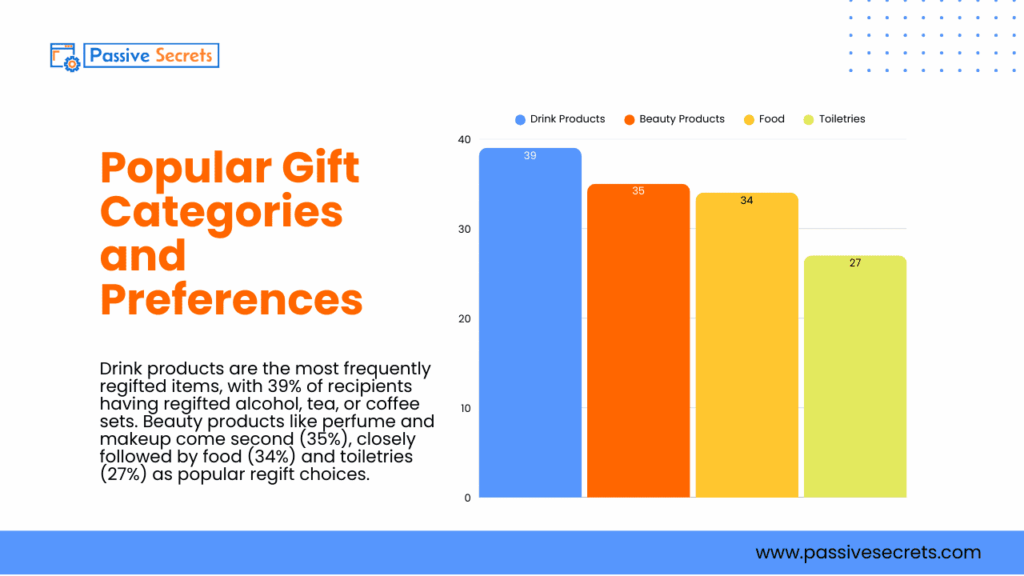
65. Drink products are the most frequently regifted items, with 39% of recipients having regifted alcohol, tea, or coffee sets. Beauty products like perfume and makeup come second (35%), closely followed by food (34%) and toiletries (27%) as popular regift choices. (source)
Global and Regional Comparisons
66. India’s gift card market is projected to surge from $13.98 billion in 2025 to $31.54 billion by 2030, with a remarkable 17.67% annual growth rate. (source)
67. The Australia Gift Card and Incentive Card market was valued at USD 13.63 billion in 2025 and is projected to grow from USD 14.61 billion in 2026 to USD 20.63 billion by 2031, representing a compound annual growth rate (CAGR) of 7.15% over the forecast period from 2026 to 2031. (source)
68. US gift, novelty, and souvenir stores generated $21.15 billion in sales in 2022, a small increase from the previous year. (source)
69. Additionally, US gift, novelty, and souvenir stores are expected to bring in around $16.6 billion in revenue by 2024. (source)
70. Italy’s gift card market is expected to grow by $3.61 billion between 2023 and 2028 at an annual rate of 9.6%. The growth is driven by the increasing popularity of gift-giving and the demand for seasonal decorations. However, the perception that gift cards are impersonal may limit the market’s growth. (source)
71. The Middle East gift card and incentive card market is expected to grow from USD 24.94 billion in 2025 to USD 27.11 billion in 2026, and is forecasted to reach USD 41.19 billion by 2031, registering a CAGR of 8.72% between 2026 and 2031. (source)
72. The Colombian gift card market reached USD 1.12 billion in 2024 and is expected to grow to USD 3.23 billion by 2033, expanding at a CAGR of 12.5% between 2025 and 2033. (source)
73. The Singapore gift card and incentive card market is projected to grow from USD 49.24 billion in 2026 to USD 70.52 billion by 2031, achieving a CAGR of 7.45%. This expansion is fueled by widespread digital payment adoption, where cashless transactions at retail stores and high PayNow registration among adults have made QR-based redemptions common in everyday spending. (source)
74. France’s Gift Card market will surge from $35.8 billion in 2023 to $86.8 billion by 2032, growing at a 10.33% CAGR. This expected increase is due to the growing digitalization trend, as more people favor digital gift cards over traditional paper gift cards. (source)
75. The Canadian gift card and incentive card market is projected to reach USD 17.95 billion in 2026, up from USD 16.96 billion in 2025, and is expected to grow to USD 23.83 billion by 2031, representing a CAGR of 5.83% between 2026 and 2031. (source)
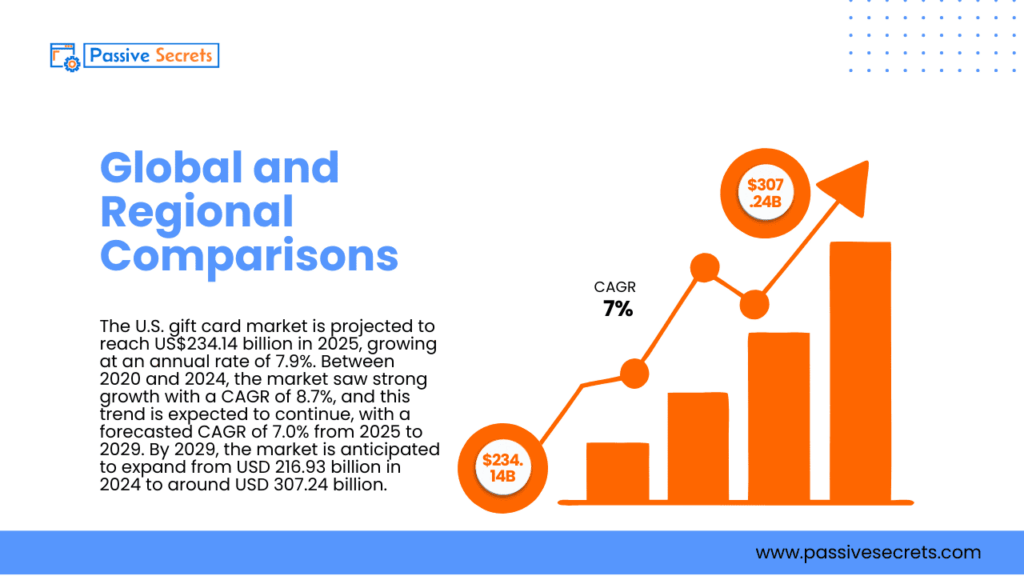
76. The U.S. gift card market is projected to reach US$234.14 billion in 2025, growing at an annual rate of 7.9%. Between 2020 and 2024, the market saw strong growth with a CAGR of 8.7%, and this trend is expected to continue, with a forecasted CAGR of 7.0% from 2025 to 2029. By 2029, the market is anticipated to expand from USD 216.93 billion in 2024 to around USD 307.24 billion. (source)
77. The US gift card market is experiencing consolidation, with major players acquiring smaller companies to strengthen their market position. Recent examples include Blackhawk Network’s acquisition of Tango Card in January 2024 and RDE’s purchase of CardCash.com, also in January 2024, expanding their presence in the industry. (source)
78. Payment companies are teaming up with gift card providers to capitalize on the increasing demand for digital payment tools. Recent partnerships include Affirm’s collaboration with Blackhawk Network in December 2023 and Venmo’s partnership with InComm in October 2023 to offer digital gift cards, further expanding the reach of gift card services. (source)
79. Canada’s Gift Shops & Card Stores market has experienced steady growth, with revenue increasing by1.2% annually over the past five years, reaching an estimated value of $3.5 billion in 2023. (source)
80. Canada’s Gift Shops and Card Stores industry is fragmented, with the top four players holding less than 40% of the market share. The industry’s concentration level is relatively low, averaging 29%. (source)
81. China’s gift industry boomed in 2023, reaching a staggering 1.3 trillion yuan, with projections to surpass 1.6 trillion yuan by 2027. Notably, curated gift sets and boxes featuring specialty foods, fashion accessories, and cultural creations are gaining immense popularity among Chinese consumers during festive seasons. (source)
82. South Africa’s gift card market is expected to grow from $1.2 billion in 2023 to $1.9 billion by 2028 at a CAGR of 10%, reaching $1.3 billion in 2024. (source)
Conclusion
Now that you’ve got the latest gifting industry statistics at your fingertips, you’re ready to take your gifting game to the next level.
The gift industry is growing smarter, faster, and more intentional.
Digital gifting, personalization, and seasonal spending continue to fuel market expansion, while consumer preferences reveal a strong demand for convenience and emotional value.
Across global markets (from North America to Asia), gifting is evolving to match modern lifestyles, economic realities, and cultural moments. For businesses, creators, and marketers, understanding these trends is essential to staying relevant in a competitive landscape.
As gifting habits continue to change, one truth remains constant: meaningful gifts—whether physical or digital—will always hold powerful value in human connection.
With these insights, you can create effective marketing strategies, make informed business decisions, and become a more thoughtful gift-giver.
Don’t let gifting trends pass you by – use these statistics to stay ahead of the curve and make a lasting impact. By applying what you’ve learned, you’ll be well on your way to gifting success!

Other Related Statistics You Should Know
- Airbnb vs Hotels Statistics (2026): 36 Huge Facts to Compare
- 65+ Vital Leadership Statistics: Latest Trends and Insights
- Billionaire Statistics: Surprising Insights About The World’s Wealthiest
- Business Loan Statistics: Trends Reshaping Funding for Millions of Small Businesses
- 70+ AI in Education Statistics That Prove the Future Is Already Here
- Women in Leadership Statistics: Insights into Global Gender Representation
- Soft Skills Statistics: Key Data on Demand, Training, and Impact
- Top Business Coaching Statistics & Trends Every Leader Should Know
- How Much Are People Saving? Personal Savings Statistics Explained
- 40+ Useful Procrastination Statistics To Help You
- 90 Amazing Millionaire Statistics & Facts You Dare Not Miss
- 50+ Latest Life Coaching Statistics And Huge Trends
- Real Estate Photography Statistics and Trends You Need to Know
- Data-Driven Decision-Making Statistics: Trends, Benefits & Challenges
- 54 Incredible Goal-Setting Statistics To Help You
- 80+ Franchise Statistics and Facts You Should Know
- 90+ Interesting Film Industry Statistics (NEW Report)
- Ultimate Creator Economy Statistics Report: Trends, Tools, and Income
- 125+ Interesting Airbnb Statistics by Country (Deep Insights)
- Important Wealth Management Statistics You Can’t Afford to Ignore
- 45+ Interesting Communication Skills Statistics & Huge Trends
- Body Language Statistics & Facts To Boost Your Communication Skills
- 35 Interesting Public Speaking Fear Statistics & Fun Facts
- 25+ Most Interesting Emotional Intelligence Statistics & Fun Facts

