
What if the biggest leadership crisis of our time isn’t about skill shortages, economic uncertainty, or AI disruption, but the fact that half the world’s talent is still missing from the top?
Every year, companies release diversity pledges, global leaders promise reforms, and headlines celebrate “progress.” Yet when you look closer, the numbers tell a very different story.
Women are entering the workforce educated, ambitious, and ready. However, something happens on the way to the top.
They’re slowed down, pushed out, or never even considered.
If you’re a leader, a policymaker, an HR decision-maker, or simply someone who cares about the future of work, this matters. Because women in leadership is more than just a fairness issue.
In this article, we reveal over 50 of the most important and eye-opening women-in-leadership statistics of 2026. These are the numbers shaping boardrooms, influencing policy, and revealing exactly where progress is stalling.
If you want to understand what’s really happening behind the glossy diversity reports, and what it will take to change the trajectory, these are the stats you need to see.
- Women hold just 30.6% of leadership positions globally, with almost no growth since 2022.
- At the current pace, the world is 130 years away from achieving gender equality in top political leadership.
- Only six countries have 50%+ women in parliament, highlighting how rare gender-balanced legislatures are.
- In 2024, 52 women were Fortune 500 CEOs (10.4%) — up from zero in 1995.
- Nearly two-thirds of female leaders report workplace bias and discrimination, unchanged for three years.
- In financial services, women’s representation drops sharply from entry-level to C-suite:
- Women hold only 12% of STEM C-suite roles, despite representing 46% of entry-level talent.
- Women of color occupy just 7% of C-suite positions, showing persistent structural barriers.
- 73% of UK energy companies have no female Executive Directors, indicating severe gaps in senior corporate leadership.
- Companies with strong DEI programs have 35% women leaders, compared to 25% in companies with weak/no DEI.
- Companies with 40:40 gender balance targets are 2.7× more likely to achieve gender equity.
- Globally, 35.5% of local elected officials are women — only two countries reach full gender parity.
Global Statistics on Women in Leadership
1. Women hold just 30.6% of leadership positions, showing minimal growth of 0.2% since 2022, indicating a slowdown in progress (source).
2. Women in older generations face bigger gender gaps: Baby Boomers see a 46% drop in representation from workforce to top roles, vs 34% for Gen Z (source).
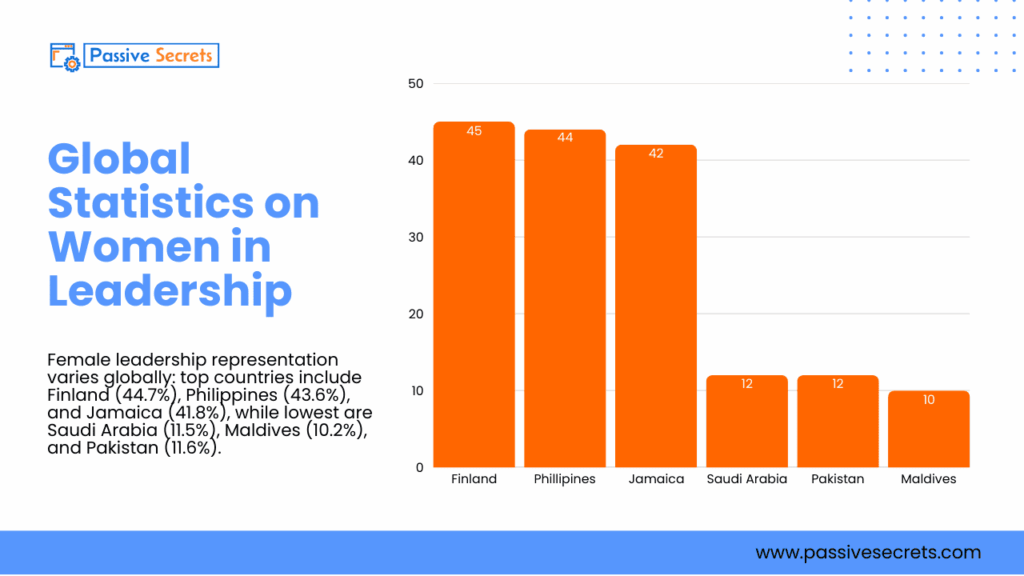
3. Female leadership representation varies globally: top countries include Finland (44.7%), Philippines (43.6%), and Jamaica (41.8%), while lowest are Saudi Arabia (11.5%), Maldives (10.2%), and Pakistan (11.6%) (source).
4. As of September 12, 2025, 32 women are serving as Heads of State and/or Government in 29 countries. Unfortunately, at this rate, it will take another 130 years to achieve gender equality in top leadership positions (source).
5. Only six countries have 50%+ women in parliament: Rwanda (64%), Cuba (56%), Nicaragua (55%), Andorra (50%), Mexico (50%), and the UAE (50%) (source).
6. Over 3 million (35.5%) of local elected officials are women. Just two countries hit 50%, and 26 more have over 40% women in local government (source).
7. Firms with a female top manager vary by income group, ranging from 13.5% in low-income countries to 21.2% in upper-middle-income countries (source).
8. The percentage of women in management increased in several regions: Europe and North America (35% to 36%), Oceania (25% to 29%), and Latin America and the Caribbean (37.3% to 40%) (source).
9. Men and women have differing perceptions on female leadership, with 25% of women and only 11% of men believing women hold more than 51% of leadership positions (source).
10. 47% of Americans believe traditional gender roles are important for success outside the home, with 53% of 18-34-year-olds (59% of men, 48% of women) sharing this view, compared to 40% of women and 50% of men aged 55 and over (source).
11. No women were CEOs of Fortune 500 companies in 1995. By 2024, 52 women held CEO positions, making up 10.4%. Katharine Graham was the trailblazer, becoming the first female CEO on the list in 1972 (source).
12. In 2024, FTSE 100 companies outperformed FTSE 250 companies in female representation, with 9.4% female CEOs vs 6.1%. Overall, FTSE 100 companies had more women in leadership roles, including executive directors and non-executive directors (source).
13. Companies with robust DEI programs have an average of 35% women leaders, compared to 25% in companies with weak or no DEI initiatives (source).
14. A gap exists in P&L experience among senior leaders: 79% of men have managed a Profit & Loss function, compared to 67% of women (source).
15. Top-performing companies (top 10%) have 29% women leaders, outpacing underperforming companies, which have 23% women leaders (source).
Women in Corporate Leadership
16. Nearly two-thirds of female leaders report experiencing bias and discrimination at work over the past three years, with no improvement from 2023. The gender pay gap remains an issue, though pay transparency has slightly improved, with 53% reporting transparency in their companies (source).
16. In India, women comprise 48% of university students, but only 33% of entry-level workers and 24% of managers. The drop-off in representation slows down significantly beyond the manager level, decreasing by just 2% per level (source).
17. In India, at entry level, women are on average 39 years old, while men are 32, creating a 7-year age gap. This suggests women may start careers later or face stagnation, staying in entry-level roles longer (source).
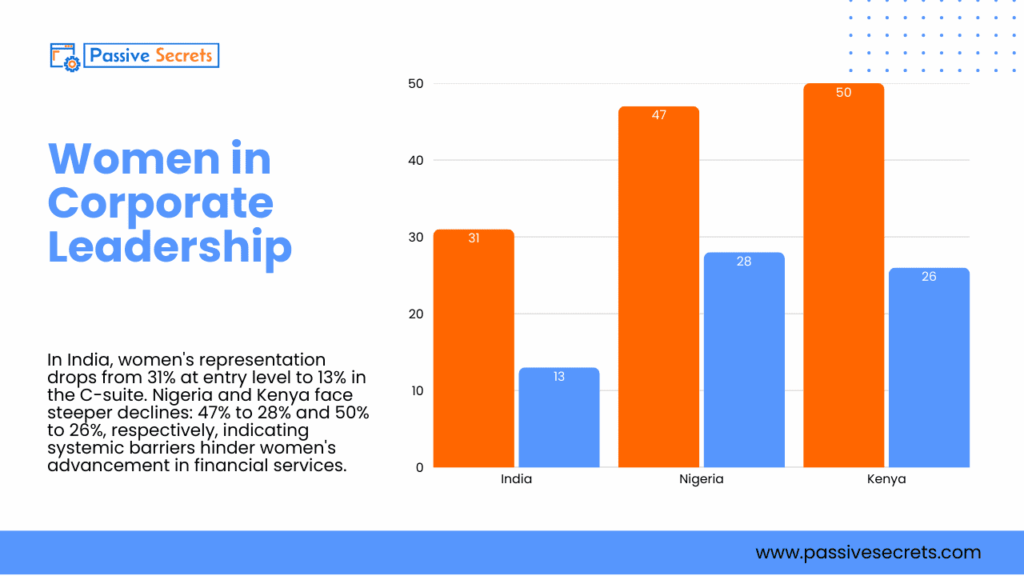
18. In India, women’s representation drops from 31% at entry level to 13% in the C-suite. Nigeria and Kenya face steeper declines: 47% to 28% and 50% to 26%, respectively, indicating systemic barriers hinder women’s advancement in financial services (source).
19. In the Middle East, 60% of female leaders reported increased investment in people over technology, and 64% anticipate company growth of 2.5-9.9% in the next three years (source).
20. Women’s workforce representation grows with education: master’s degree holders (44.9%), bachelor’s degree holders (44.5%). Leadership roles also see more women with bachelor’s (31.8%) and master’s degrees (30.6%), but fewer with high school diplomas (27.1%) or doctorates (27%) (source).
21. The UK energy sector’s female leadership representation is below 40%, aiming for 2030 to hit that target. It’s also unlikely to reach 40% women on boards by 2025, a goal already met by FTSE 350 companies (source).
22. The UK’s top 100 energy companies have 30% female board members (up 1% from 2024). To hit the 40% target, they’d need to add a woman to each board in the next six months (source).
23. As of 2025, women hold 34% of leadership roles (executive committee and direct reports), but progress has stalled, remaining flat since 2924, indicating stagnation in senior leadership opportunities for women (source).
24. About a third (32%) of companies hit 40% female board representation, over a fifth (22%) had 40% female leaders, and 16% met the goal for middle management (source).
25. Almost three-quarters (73%) of UK energy companies have no female Executive Directors – often due to a shortage of women in senior roles like CEO (source).
26. Companies with 40:40 gender targets are 2.7x more likely to achieve gender balance than those without targets (source).
27. As of 2023, women hold 10.4% of leadership positions at Fortune 500 companies, with a record 52 female CEOs leading businesses on the list (source).
28. As of 2022, women made up 58.4% of the US workforce but only 35% of senior leadership (source).
29. Companies with female executives are 30% more likely to outperform others (source).
30. Women occupy 42% of board seats in large UK companies, but only 10 are CEOs of FTSE 100 firms (source).
31. In 2024, HSBC’s board had 54% female representation, but leadership roles were mostly male-dominated: 68% of executive committee and direct reports were men, while women held 34.6% of senior leadership roles and only 21.1% of executive committee seats (source).
32. 51% of women and 41% of men report never having been promoted to a management role (source).
Women in Political Leadership
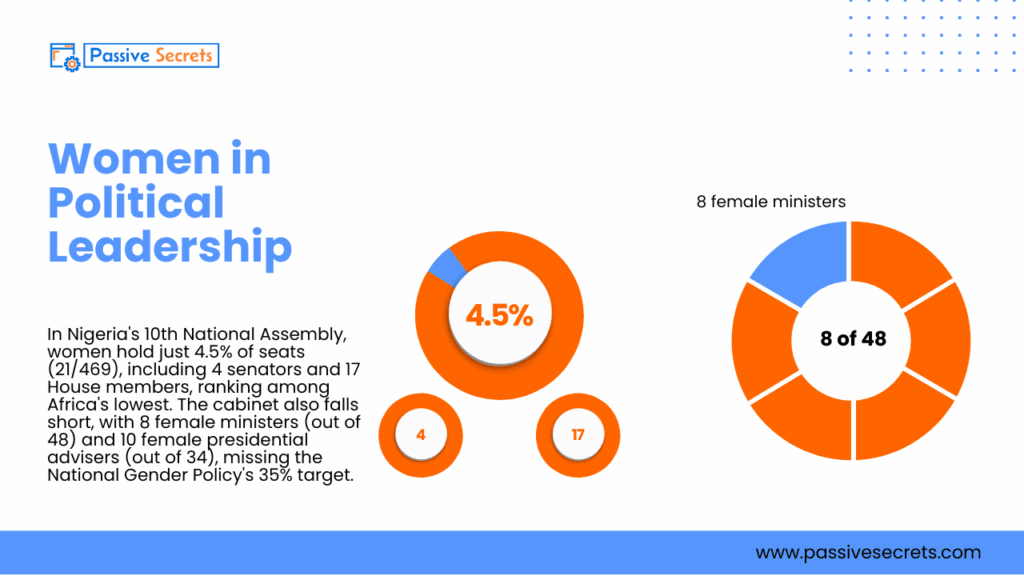
33. In Nigeria’s 10th National Assembly, women hold just 4.5% of seats (21/469), including 4 senators and 17 House members, ranking among Africa’s lowest. The cabinet also falls short, with 8 female ministers (out of 48) and 10 female presidential advisers (out of 34), missing the National Gender Policy’s 35% target (source).
34. In Nigeria’s grassroots leadership, women are scarce: 41 (5%) of 811 Local Government Chairpersons are women, and only 604 (7%) of 8,773 Councillors are female. Southern states fare better, led by Akwa Ibom (34% female councillors), while many northern states have no female representation (source).
35. 67% of US adults believe a woman can be as qualified as a man to lead the country, with 41% of men and 38% of women saying it’s “very likely” (source).
36. Women have held the highest executive power in just 65 countries since 1960, with Sirimavo Bandaranaike pioneering as Sri Lanka’s Prime Minister in 1960.
As of July 2025, 14 countries have female leaders, including Liechtenstein, Namibia, and Suriname, which elected their first female leaders in 2025. However, this number is still relatively low, representing less than 10% of UN member states (193 countries) (source).
37. The percentage of women in parliaments has more than doubled, increasing from 11% to 26%, and the number of female heads of state has risen from 4 to 17 (source).
38. Almost 60% of countries, 113 to be exact, have never had a female head of state as of 2024. This highlights the significant underrepresentation of women in leadership positions worldwide. Currently, only 26 countries are led by a woman (source).
Sector-Specific Women In Leadership Statistics
39. There is a gender gap of 20 percentage points in school leadership (source).
40. In some countries, women’s representation surprisingly increases at the Director level, with 55% of countries showing higher shares. Notable jumps occur in Spain (31%) and UAE (34%). Industries like Construction (+43%), Utilities (+40%), and Oil, Gas, and Mining (+31%) see significant gains, possibly due to alternative career paths focusing on compliance, safety, and environmental oversight (source).
41. Women hold just 25% of senior leadership positions in the healthcare sector (source).
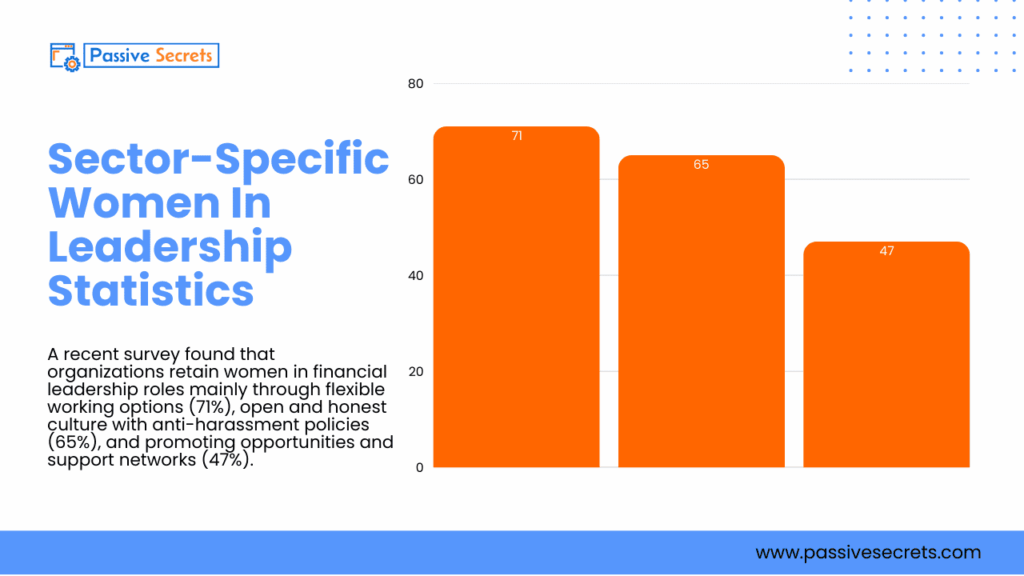
42. A recent survey found that organizations retain women in financial leadership roles mainly through flexible working options (71%), open and honest culture with anti-harassment policies (65%), and promoting opportunities and support networks (47%) (source).
43. Women hold 46% of entry-level positions, but this number drops to 25% at the C-suite level and further to 12% in STEM industry C-suite roles (source).
44. In Europe’s financial services industry, women held 22.5% of senior leadership roles in 2022, expected to rise to 22.9% by 2031. However, the share of women among next-generation employees is forecasted to decrease from 27.9% in 2022 to 25.6% by 2031 (source).
45. In the FTSE 100, women hold 25% of finance director roles and 27% of chief information officer roles. Women comprise 30% of executive committees, and the number of FTSE 350 companies with all-male executive committees has decreased from 54 in 2017 to 9 (source).
46. A 2024 UK survey found that 53.5% of marketing directors/CMOs were women, with the highest proportion (55.5%) in B2B companies (source).
Barriers/Challenges for Women In Leadership
47. Women starting businesses in Nigeria face challenges like balancing family responsibilities (41%), perceptions of lacking management competence (31%), and difficulty raising initial capital (24%) (source).
48. In 2024, for every 100 men promoted to manager, 89 White women received promotions (source).
49. Women of color only occupy 7% of C-suite positions (source).
50. It would take 48 years for the representation of White women and women of color in senior leadership to match their share of the US population (source).
51. 33% of Americans (including 42% of married women) believe balancing work and family responsibilities is the biggest obstacle for women in leadership (source).
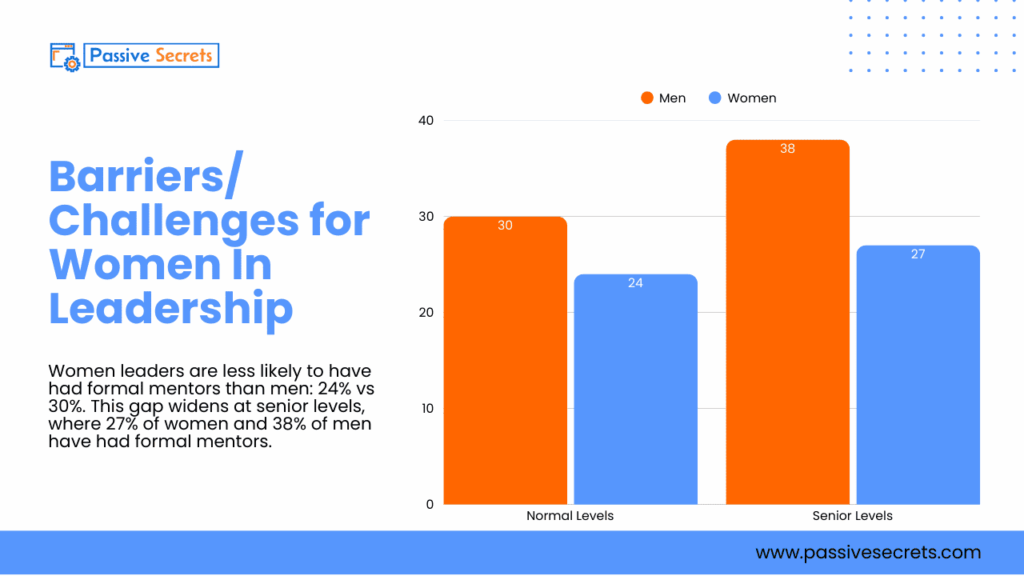
52. Women leaders are less likely to have had formal mentors than men: 24% vs 30%. This gap widens at senior levels, where 27% of women and 38% of men have had formal mentors (source).
53. Women leaders are less likely than men to receive leadership development opportunities: 12% less likely to receive leadership skills training and 15% less likely to undergo leadership assessments (source).
FAQs
Conclusion
The numbers speak, and they’re telling us something urgent. Despite decades of advocacy and undeniable progress, women are still climbing a leadership ladder that was never designed with them in mind.
The data is clear: representation is rising in some areas, stalling in others, and in too many sectors, it’s sliding backward.
But here’s the real takeaway: none of these statistics is fixed. They are not predictions, signals. And signals can be acted on.
Companies that set clear targets are already seeing results. Countries that invest in women’s political representation are reshaping entire governments. Industries that open new pathways are discovering talent they’ve overlooked for years.
Change does happen, but only when decision-makers choose it intentionally.
If you are in a position to hire, influence culture, or shape policy, your choices matter more than you realize. And if you’re a woman navigating these systems, know this: the problem is not your capability—it’s the structure, and structures can be rebuilt.
The path to equality is long, but it doesn’t have to take 130 years.
With the right actions, accountability, and a commitment to real inclusion, we can shift these numbers faster than the world expects.
Other Related Statistics You Should Know:
- Airbnb vs Hotels Statistics (2026): 36 Huge Facts to Compare
- 65+ Vital Leadership Statistics: Latest Trends and Insights
- Billionaire Statistics: Surprising Insights About The World’s Wealthiest
- 89 Business Loan Statistics Every Entrepreneur Should Know
- 70+ AI in Education Statistics That Prove the Future Is Already Here
- Soft Skills Statistics: Key Data on Demand, Training, and Impact
- 95+ Fascinating Gift Industry Statistics to Surprise and Delight
- Top Business Coaching Statistics & Trends Every Leader Should Know
- How Much Are People Saving? Key Personal Savings Statistics Explained
- 40+ Useful Procrastination Statistics To Help You
- 90 Amazing Millionaire Statistics & Facts You Dare Not Miss
- 50+ Latest Life Coaching Statistics And Huge Trends
- 30+ Useful Real Estate Photography Statistics and Trends You Need to Know
- Data-Driven Decision-Making Statistics: Trends, Benefits & Challenges
- 54 Incredible Goal-Setting Statistics To Help You
- 45+ Interesting Communication Skills Statistics & Huge Trends
- Body Language Statistics & Fun Facts To Boost Your Communication Skills
- 35 Interesting Public Speaking Fear Statistics & Fun Facts
- 25+ Most Interesting Emotional Intelligence Statistics & Fun Facts

