Think print marketing is a thing of the past? Think again.
In an age dominated by digital ads, emails, and endless scrolling, print is quietly making a powerful comeback. From direct mail that lands right in your hands to newspaper ads that people still trust more than what they see online, print marketing continues to prove its staying power even in 2026.
Recent statistics reveal something fascinating: while digital campaigns fight for attention in crowded inboxes and social feeds, print materials are building real connections, driving impressive response rates, and leaving a lasting impression that screens simply can’t match.
In this article, we’ll dive into the latest print marketing statistics that show why this “traditional” medium still delivers serious results — and why smart marketers are blending print with digital strategies for maximum impact.
Key Print Marketing Statistics & Facts (Editor’s Pick)
- Global print advertising spend is projected to hit $32 billion in 2025, showing steady resilience in a digital world.
- The print industry contributes over $310 billion to the economy, with packaging printing making up $102 billion of that total.
- The print-on-demand market is booming, expected to grow from $11 billion in 2025 to $89.4 billion by 2035 — a huge 23.3% annual growth rate.
- Personalized direct mail boosts response rates by 88%, outperforming most digital channels.
- Nearly 80% of shoppers respond to printed mail, compared to only 45% who engage with electronic ads.
- Direct mail sees an average 9% response rate, versus 1% or less for digital channels.
- Newspaper ads dominate global print marketing, reaching $21.85 billion in ad spend by 2025.
- 70% of households earning over $100,000 still read newspapers.
- 74% of Millennials report getting news weekly from traditional print sources.
- 61% of readers trust newspaper ads, compared to 42% who trust online ads.
- 47% of internet users use ad blockers, limiting digital ad reach — a problem print doesn’t face.
- Print and direct mail earn a 9% response rate, far higher than most online ads.
- 26% of print sellers say clients are increasingly concerned about environmental impact.
- 51% of marketers cite high costs, and 31% cite logistics challenges as the main drawbacks of print marketing.
- On the bright side, 91% of consumers agree that print and paper are sustainable when responsibly produced.
What is Print Marketing?
Print marketing is all about using physical materials (flyers, brochures, posters, business cards, and even postcards) to share your message and connect with customers. It’s the classic side of advertising that you can actually hold in your hands.
Even in our digital-first world, print still has something special going for it. A well-designed piece of print feels personal and real — it stands out in a way that an online ad just can’t. Whether it’s a colorful mailer that lands in your mailbox or a beautifully printed magazine ad, print marketing gives businesses a lasting way to make an impression and build trust with their audience.
General Print Marketing Statistics
1. Global print advertising spend is expected to hit $32 billion in 2025, with newspaper ads leading the way at $21.85 billion. (source)
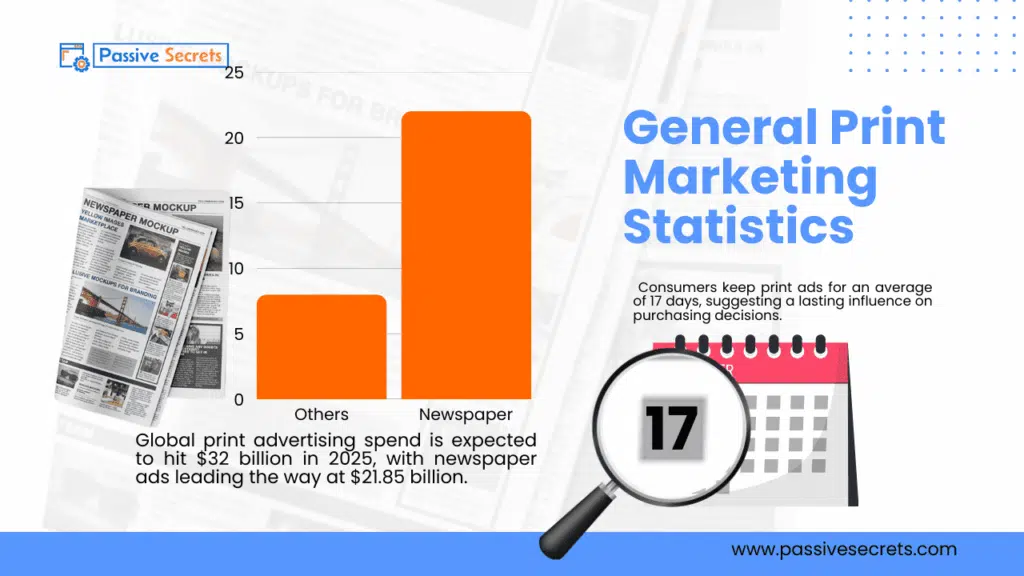
2. Consumers keep print ads for an average of 17 days, suggesting a lasting influence on purchasing decisions. (source)
3. Printing-related activities, like sign manufacturing and copy centers, contribute almost $109 billion. Add newspaper printing, periodicals, and book publishing, and that’s over $208 billion. Throw in packaging and paperboard printing, and you’re looking at over $310 billion, with packaging printing alone accounting for $102 billion. (source)
4. Print sales are holding strong! 45% of distributors saw an increase in 2024, 35% stayed steady, and only 20% reported a decrease. Not bad for an industry some say is dying. (source)
5. 61% of firms selling print and promo have been selling print forms for over 10 years, catering to industries like automotive and finance. And 40% have been selling large-format printing, like signage, for over a decade, proving that Print’s got longevity. (source)
6. The print advertising market is steadily growing, projected to increase from $31.54 billion in 2024 to $32.58 billion in 2025, representing a 3.3% compound annual growth rate. (source)
7. Print producers are embracing digital transformation, with 75% reporting a significant revenue shift and 80% seeing AI and automation as crucial for workflow efficiency and cost savings. (source)
8. AI and automation are game-changers for print producers! 80% see them as essential for workflow improvement, cost-cutting, and innovation. And 55% are already investing in automation, cloud solutions, and predictive maintenance to stay competitive. (source)
9. The print industry’s facing headwinds: talent shortages (68%), rising raw material costs (62%), and logistics challenges plus supply chain disruptions (59%) are major obstacles for producers. (source)
10. There’s a major shift to digital production, with 75% of respondents reporting significant movement in this direction – over 50% of their revenue now comes from digital printing. Web-to-print platforms are popular too, with 65% of printers using them to boost efficiency, flexibility, and meet growing demand. (source)
11. Customized print advertisements tailored for individual recipients see a 135% increase in response rates. (source)
12. The U.S. spends the largest amount on print ads, estimated to spend up to $8.98 billion in 2025. (source)
13. Recipients of print advertising purchase 28% more items and spend 28% more than non-recipients. (source)
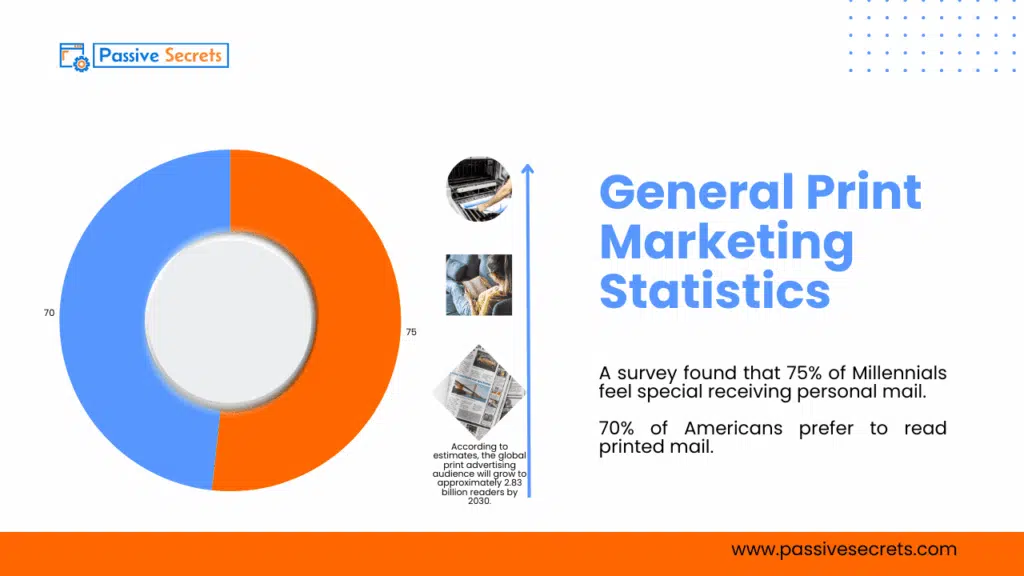
14. According to estimates, the global print advertising audience will grow to approximately 2.83 billion readers by 2030. (source)
15. A survey found that 75% of Millennials feel special receiving personal mail. (source)
16. 70% of Americans prefer to read printed mail. (source)
17. In the UK, print ad spending is expected to reach $1.27 billion in 2025, with newspaper ads dominating at $885.81 million. Also, the average ad spend per reader in newspaper advertising is projected to be around $67.10 in 2025. (source)
18. Consumers who receive print mail promoting online sites spend 13% more than those who only receive digital information. (source)
19. The print-on-demand market is rapidly growing; valued at $11 billion in 2025, it’s projected to hit $89.4 billion by 2035, growing at a crazy 23.3% CAGR. Tech advancements, e-commerce, and demand for personalized products are fueling this growth. (source)
20. 44% of customers visit a brand’s website after receiving direct mail or print marketing. (source)
21. Fundera’s research indicates that 70% of consumers find direct mail more personal than online interactions. (source)
22. Germany’s print ad market is looking strong! Ad spend is forecasted to hit $2.06 billion in 2025, with newspaper ads leading at $1.5 billion. By 2030, they’re expecting 41.51 million readers, with an average ad spend per reader of $63.46 in newspaper ads. (source)
23. Nearly 80% of shoppers respond to printed direct mail ads, while only 45% take action on electronic ads. (source)
24. 70% of households with incomes above $100,000 read newspapers. (source)
25. A study by the American Press Institute found that 74% of 16- to 40-year-olds get news from traditional sources, including print newspapers, weekly. (source)
26. Placing ads in niche magazines or local newspapers allows businesses to target specific demographics and interests effectively. (source)
27. China’s print ad market is forecasted to reach $1.87 billion in 2025, driven by newspaper ads at $1.51 billion! What’s impressive is the massive reader base – 522.31 million users by 2030. However, the average ad spend per reader is relatively low at $6.58 in newspaper ads. (source)
Direct Mail Marketing Statistics
28. Direct mail remains relevant, with 49% of consumers (55% of parents) incorporating it into their shopping routine. It’s also a key tool for grocery planning, used by 56% of consumers and 62% of parents. (source)
29. Consumers are engaging with direct mail when they’re ready to buy! 51% notice and collect it when making a purchase or scheduling a service, peaking at 60% among parents. Over half (54%) make time to read mail daily, with the rate rising to 57% for parents and 58% for Hispanic consumers. (source)
30. 48% of consumers spend over a minute reading direct mail ads, showing they’re really engaging with the content. Plus, direct mail ads outperform digital ads in grabbing attention, with 55% of consumers focusing on them versus 39% for digital ads. (source)
31. People are actually enjoying mailed ads. 54% find them pleasant to read, with millennial parents loving them even more (66%). And 49% are excited to receive regular mail from brands they like. (source)
32. Mail ads are preferred for their personal touch, with 54% of millennials and 61% of millennial parents finding them more personal than digital ads. (source)
33. Consumers find direct mail more memorable (60%) than digital ads (44%) when making a purchase. Direct mail also drives purchases, with 47% making a planned buy and 36% making impulse purchases. (source)
34. Marketers know personalized direct mail boosts response rates by 88%. However, those reaping the biggest rewards use automation software to hyper-personalize based on loyalty data, behavior, and preferences – not just basic details. (source)
35. 93% of operational mail leaders face scaling challenges due to inefficient and time-consuming workflows. (source)
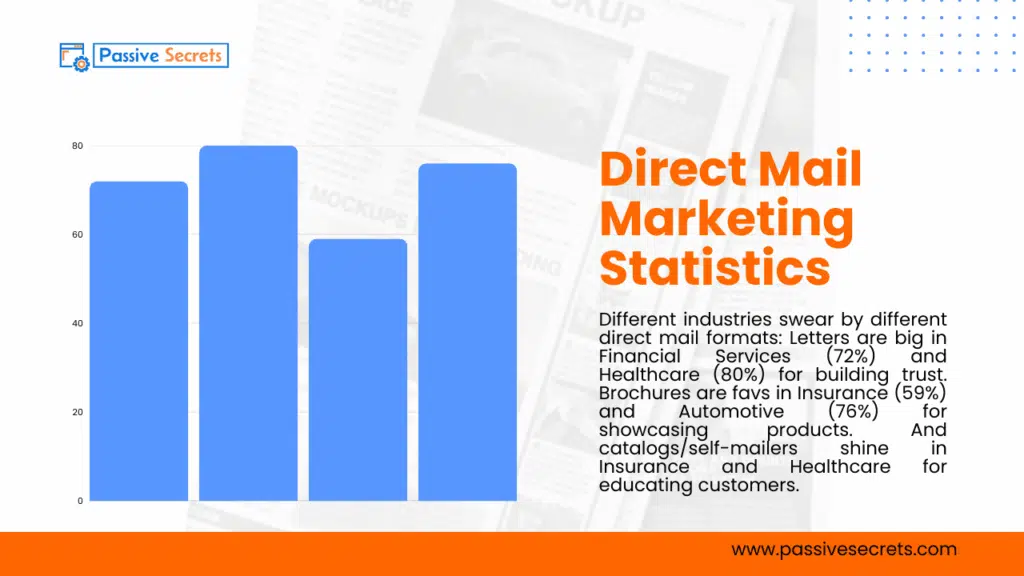
36. Different industries swear by different direct mail formats: Letters are big in Financial Services (72%) and Healthcare (80%) for building trust. Brochures are favs in Insurance (59%) and Automotive (76%) for showcasing products. And catalogs/self-mailers shine in Insurance and Healthcare for educating customers. (source)
37. Direct mail still delivers, with 79% of executives naming it their top-performing channel for ROI. However, that’s a slight dip from 84% in 2024. (source)
38. 48% of people keep direct mail for future reference. (source)
Newspaper Advertising Statistics
39. Despite a significant decline, print advertising revenue is bouncing back, driven by economic recovery and demand for physical coupons. It’s expected to reach $5.2 billion by 2024, growing at a 4.2% CAGR, with a 0.9% uptick in 2024. (source)
40. Newspaper ads are leading the global print ad market, expected to reach $21.85 billion in 2025. On average, advertisers are projected to spend $18.30 per reader in this space. (source)
41. Newspaper advertising is the largest segment in the UK print ad market, accounting for US$885.81 billion in 2025. (source)
42. In 2022, the leading advertising media were the Internet ($14.2 billion), Television ($3.3 billion), Radio ($1.1 billion), and Newspapers ($950 million). (source)
Digital Vs. Print Advertising Statistics
43. Print advertising is facing challenges, with a projected spend of $9.3 billion in 2025, down 14.4% from last year. As consumers go digital, print’s share of the ad budget is shrinking fast. However, some industries like retail are still leveraging print effectively, and certain formats are showing resilience. (source)
44. Print and direct mail marketing has a 9% customer response rate compared to 1% or less for other digital channels. (source)
45. 61% of readers trust newspaper ads compared to 42% for online ads. (source)
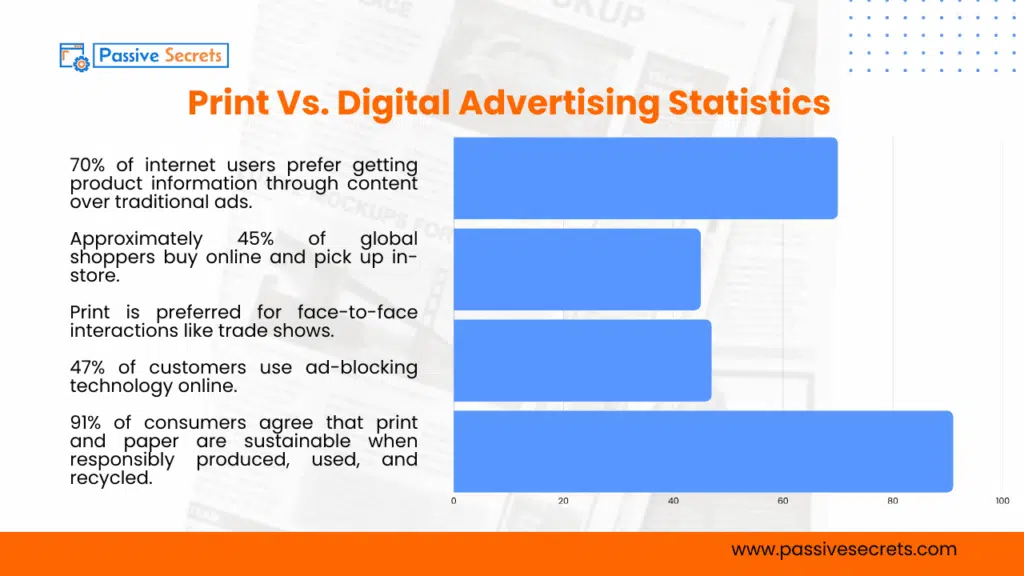
46. 70% of internet users prefer getting product information through content over traditional ads. (source)
47. Approximately 45% of global shoppers buy online and pick up in-store. (source)
48. Print is preferred for face-to-face interactions like trade shows. (source)
49. 47% of customers use ad-blocking technology online. (source)
50. 91% of consumers agree that print and paper are sustainable when responsibly produced, used, and recycled. (source)
Concerns Of Print Marketing Statistics
51. 26% of print sellers report increased client concern about environmental impact, while 67% say concern remains steady, indicating growing eco-awareness among clients. (source)
52. Marketers identify high costs (51%), limited reach (32%), distribution logistics (31%), difficulty targeting audience segments (31%), and difficulty measuring ROI (28%) as major challenges with print materials. (source)
53. The global print advertising sector is transitioning towards digital platforms, affecting traditional print media revenues and approaches. (source)
54. Advertising revenue in the printed marketing industry is projected to fall to $40 million in 2023 and $35 million in 2025. Newspaper ad revenue will decrease from $30 million to $24 million, and magazine marketing expenditure will drop from $13 million to $10 million by 2025. (source)
Conclusion
It is clear that print marketing still holds a significant place in the world of advertising. Despite the rise of digital marketing, print ads in newspapers, magazines, and direct mail campaigns continue to make a real impact.
People appreciate the tangible nature of print materials and tend to remember them more than online ads.
While digital marketing will continue to evolve, print advertising isn’t going anywhere. Smart marketers will find ways to blend the strengths of print and digital to reach their audience effectively.
The numbers show that print marketing is here to stay, offering a unique and enduring impact in today’s diverse marketing landscape.
FAQS
Other Important Marketing Statistics Marketers Should Know:
- 55 Useful Direct Mail Marketing Statistics, Trends, and FAQs
- B2B Sales Statistics: Latest Insights and Trends
- 50+ Essential Traditional Marketing Statistics & Trends
- Sales Enablement Statistics: Data You Need to Drive Sales Growth
- Latest In-Game Advertising Statistics
- 45 Interesting Healthcare Marketing Statistics & Trends
- Key Short-Form Video Statistics and Trends You Should Know
- 49 Interesting Emotional Marketing Statistics
- 70+ Top Law Firm Marketing Statistics & NEW Trends
- 23 Most Interesting First Impression Statistics To Know
- 60+ Interesting Storytelling Statistics, Facts & Huge Trends
- Amazon Book Sales Statistics: Intriguing Numbers and Facts
- 61+ Useful Podcast Advertising Statistics And Trends
- 50+ Useful Call Center Statistics And Trends
- 50 Crucial Amazon Advertising Statistics & Trends
- 65+ Must-Know Pay-Per-Click Statistics
- 40+ Interesting Omnichannel Marketing Statistics & Trends
- Multi-Level And Network Marketing Statistics, Facts & Trends
- Virtual Event Statistics & Benchmarks For Marketers & Organizers
- B2B Lead Generation Statistics, Facts, Trends, Benchmarks, & Market Size
- 52 Valuable Trade Show Statistics and Trends
- 100+ Top Digital Marketing Vs. Traditional Marketing Stats
- 110+ Important Social Media Advertising Statistics & Trends
- 50 Interesting Organic Vs Paid Search Statistics To Know
- 41+ MOST Important Copywriting Statistics To Know
- 80+ Useful Sales Funnel Statistics & Conversion Rates
- 40+ Latest Multi-Channel Marketing Statistics & Huge Trends