
The average marketing team now uses 32 different software tools. Only 8 of them actually drive results.
Over the years, the marketing technology market has exploded due to more digitization and the emergence of AI. Now, the industry is worth over $344 billion. Yet most CMOs can’t tell you which tools in their stack are generating ROI and which are just expensive digital clutter.
They’re paying for overlapping features, battling integration nightmares, and watching their teams drown in dashboards while competitors somehow do more with less.
Here’s what’s happening:
AI is making half your marketing software obsolete. Consolidation platforms are replacing entire tool stacks. And the marketers winning in 2026 aren’t the ones with the biggest MarTech budgets. Rather, they’re the ones reading signals that reveal which software investments actually move revenue.
This guide gives you the 40 statistics that separate strategic software decisions from expensive guesswork.
Key Marketing Software Statistics
- The global marketing technology market is valued at $551.96 billion in 2025 and is projected to reach $2.38 trillion by 2033, growing at a 20.1% CAGR.
- The digital marketing software market is expected to grow from $92.2 billion in 2025 to $305.9 billion by 2035, with a 14.2% CAGR.
- There are over 15,400 marketing technology (martech) solutions worldwide, more than double the 7,040 tools available in 2019.
- 61% of marketers say AI is the biggest disruption in marketing in 20 years, and 67% report saving over 10 hours per week using AI tools.
- 69.1% of marketers have already integrated AI into their marketing operations.
- 67% of marketers plan to expand their marketing tech stacks, while only 11% plan to reduce the number of tools they use.
- Global spending on marketing technology is expected to reach $215 billion by 2027, growing at 13.3% annually.
- 58% of marketers use automation for email marketing, followed by 49% for social media and 33% for content management.
Marketing Software Industry Statistics
1. In a 2025 survey, 45% of marketers said AI was being used in data management platforms (DMPs), while 43% cited customer data platforms (CDPs). A separate 2025 study found over 15,400 martech solutions available globally. (Statista)
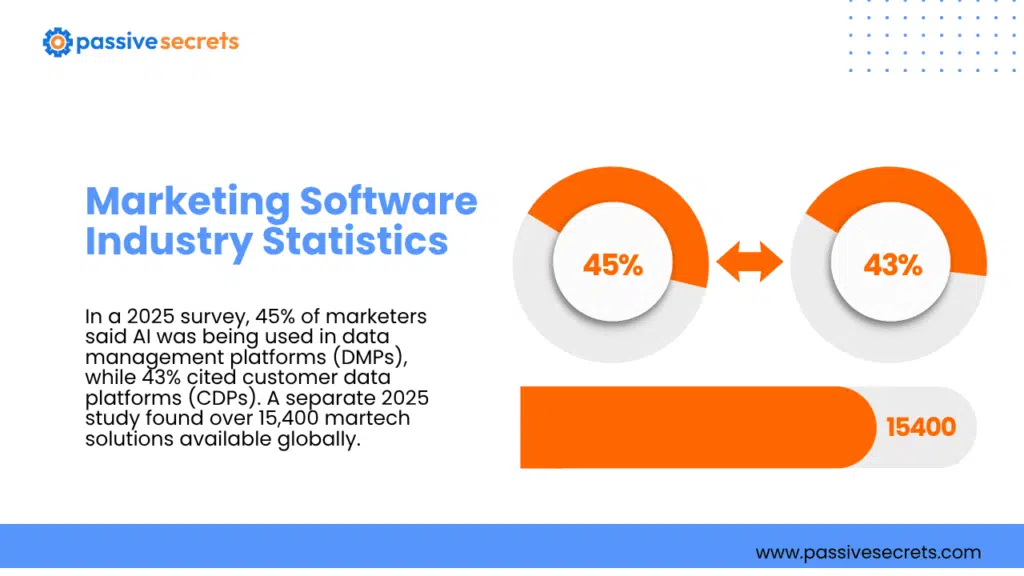
2. A 2025 global marketing technology (martech) reported over 15,400 solutions available to professionals, more than double the 7,040 recorded in 2019. (Statista)
3. Pinterest Analytics dominated the global marketing analytics software market in 2026, holding over 52.59% market share, followed by Barometric with around 6.78%. This software helps businesses assess their marketing efforts’ effectiveness. (Statista)
4. The global MarTech sector saw 47 mergers and acquisitions deals in Q3 2024, a slight increase from 46 deals in the same period the previous year. (Statista)
5. As of July 2024, HubSpot held nearly 35% of the marketing automation software industry, while Oracle Marketing Cloud, Welcome, and Adobe Experience Cloud followed with shares of 7.31%, 7.24%, and 7.05%, respectively. (Statista)
6. There were over 15,400 martech solutions available to industry professionals in 2025. This represents a more than 100% increase from the 7,040 solutions recorded in 2019, before the pandemic. (Statista)
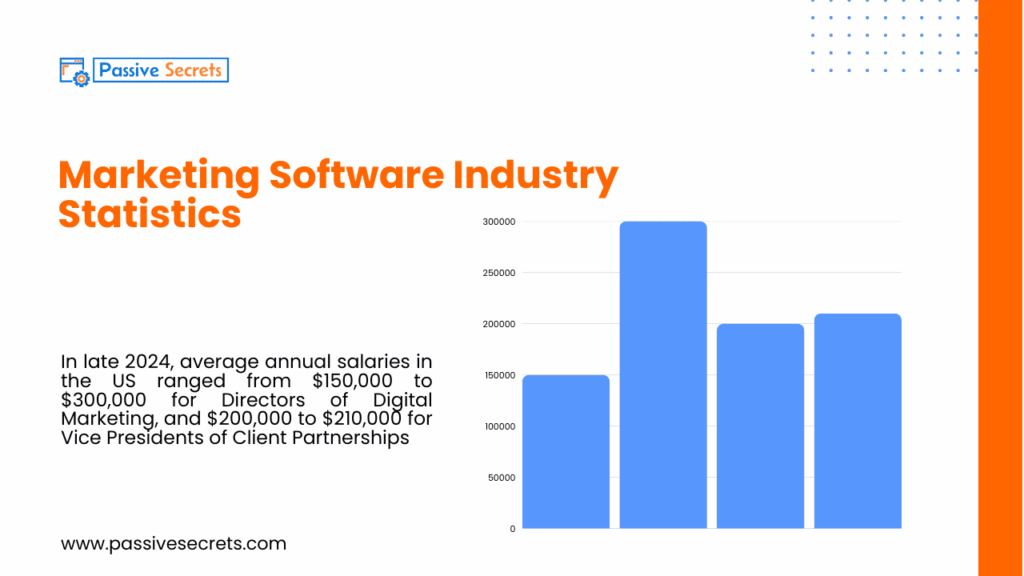
7. In late 2024, average annual salaries in the US ranged from $150,000 to $300,000 for Directors of Digital Marketing, and $200,000 to $210,000 for Vice Presidents of Client Partnerships. (Statista)
8. The global marketing technology market is booming, with an estimated size of $551.96 billion in 2025 and projected to reach $2,380.49 billion by 2033, growing at a 20.1% CAGR. This growth is driven by real-time personalization and customized digital experiences. North America leads the market with a 33.8% revenue share, while social media tools and digital marketing dominate their respective segments with 23.6% and 63.2% revenue shares. (Grand View Research)
9. As of mid-2024, HubSpot dominated the global marketing automation software market with a nearly 35% share, while Oracle Marketing Cloud, Welcome, and Adobe Experience Cloud trailed closely behind with shares of around 7%. (Statista)
10. In a survey of North American and Western European marketers, 84% of director-level or higher respondents said researching and recommending new martech products was one of their responsibilities, followed by designing and managing internal workflows and processes at 79%. (Statista)
11. The global marketing automation software market was valued at $7.23 billion in 2025 and is projected to grow from $8.14 billion in 2026 to $20.12 billion by 2034, at a compound annual growth rate (CAGR) of 12%. North America dominated the market with a 33.60% share in 2025, showcasing its strong presence in the industry. (Fortune Business Insights)
12. The global Digital Marketing Software market is expected to skyrocket from $92.2 billion in 2025 to $305.9 billion by 2035, with a staggering CAGR of 14.2%. Cloud-based solutions are leading the charge with a CAGR of 15.9%, while the retail and consumer goods industry currently dominates the market with a 34.3% share. (Future Market Insights)
Marketing Software Adoption Statistics
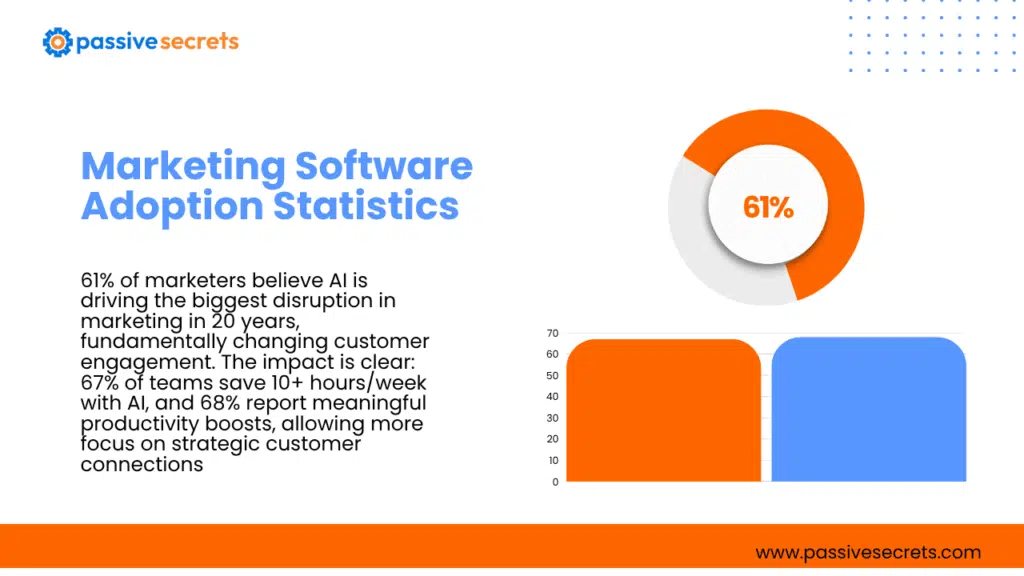
13. 61% of marketers believe AI is driving the biggest disruption in marketing in 20 years, fundamentally changing customer engagement. The impact is clear: 67% of teams save 10+ hours/week with AI, and 68% report meaningful productivity boosts, allowing more focus on strategic customer connections. (HubSpot)
14. A 2025 survey revealed that 67% of marketers plan to expand their tech stack in the coming year, indicating a focus on growth and integration of new tools. In contrast, only 11% aim to streamline their stack by reducing apps and technologies, highlighting an industry trend towards tech adoption. (Statista)
15. Approximately 29% of marketing and media leaders reported using ChatGPT for content-related tasks, while Gemini and Midjourney were each used by 3% of respondents. Notably, 52% said they don’t use any AI tools. The same study found that X and Facebook are the most widely used social media platforms for content marketing globally. (Statista)
16. 42.2% of marketers have integrated generative AI, such as GPT-4, into their strategies, streamlining content creation and campaign management. (Influencer Marketing Hub)
Marketing Software Spending Statistics
17. Global spending on marketing technology is expected to reach $215 billion by 2027, growing at an annual rate of 13.3%. (Forrester)
18. Over half of marketers (54%) expect their marketing automation budgets to grow in the coming year. In contrast, just 11% anticipate a decrease, while 30% say their budgets will remain unchanged. (Ascend)

19. CMOs and marketing leaders in North America and Europe allocated 27.9% of their budgets to paid media in 2024, the highest share since 2017. Labor and agency shares decreased, while marketing technology’s share dropped to less than 24%. (Statista)
20. B2B marketers in the US increased their martech spending by 13.4% in 2024, reaching $8.71 billion, with projections to hit nearly $14 billion by 2027. (Statista)
21. In 2022, Adobe spent the most on Google Ads (around $130 million), followed by IBM ($85.7 million) and WordStream ($80.4 million). (Statista)
22. Two-thirds (66%) of marketing decision-makers plan to increase technology spending. (Martech)
Marketing Software Usage Statistics
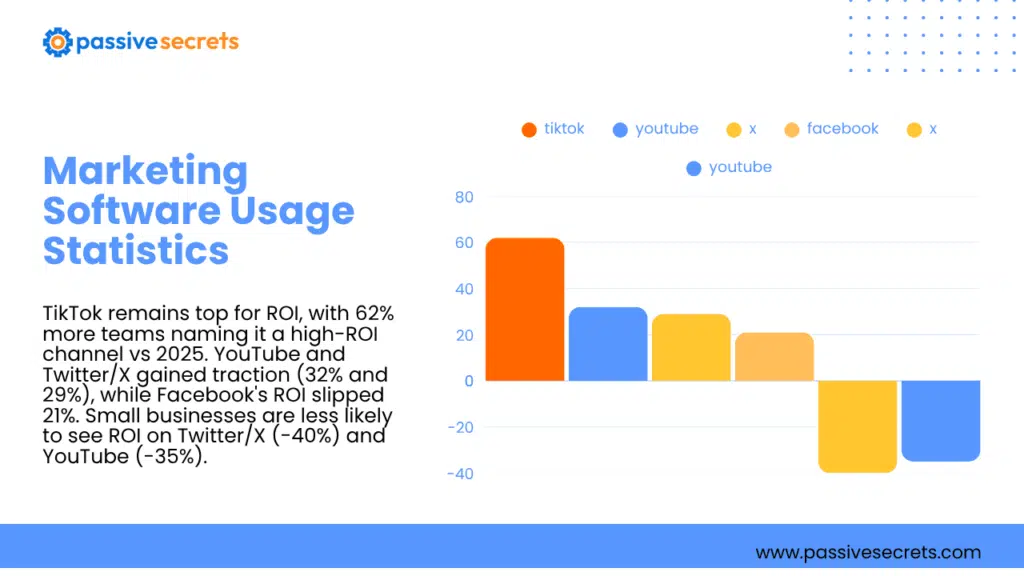
23. TikTok remains top for ROI, with 62% more teams naming it a high-ROI channel vs 2025. YouTube and Twitter/X gained traction (32% and 29%), while Facebook’s ROI slipped 21%. Small businesses are less likely to see ROI on Twitter/X (-40%) and YouTube (-35%). (HubSpot)
24. For 2026, marketers are prioritizing short-form video platforms: TikTok (19%), Instagram (19%), Facebook (18%), YouTube (18%), and Twitter/X (11%). Small businesses are leaning into Instagram and TikTok, while enterprises are focusing on YouTube. (HubSpot)
25. Around 58% of respondents use automation for email marketing, followed by 49% for social media and 33% for content management. (Statista)
26. 28% of marketing professionals, up 3% from the previous year, believe their current marketing automation strategy is top-tier in helping them meet their marketing goals. Meanwhile, 69% feel their automation efforts are somewhat effective, and just 3% consider them ineffective. (Ascend)
27. Marketing professionals are progressing in building effective customer journeys, with 89% agreeing that automation plays a helpful role—and 30% expressing strong agreement. (Ascend)
Marketing Software Challenges Statistics
28. The biggest challenges in leveraging automation to boost performance are gathering high-quality data (52%) and developing a comprehensive strategy (47%). (Ascend)
29. A survey of global marketers found that 53% cited high costs as the biggest challenge with digital marketing technologies, followed by complexity (28%) and lack of integration (25%). (Statista)

30. A US survey revealed that 44% of small business owners/marketing decision-makers cited data security as their top concern when using AI/automation for marketing, followed by implementation costs (41%). (Statista)
General Marketing Software Statistics
31. The leading priorities for enhancing marketing automation in the coming year include identifying ideal customers (47%), enhancing data quality (40%), and reducing costs (39%). (Ascend)
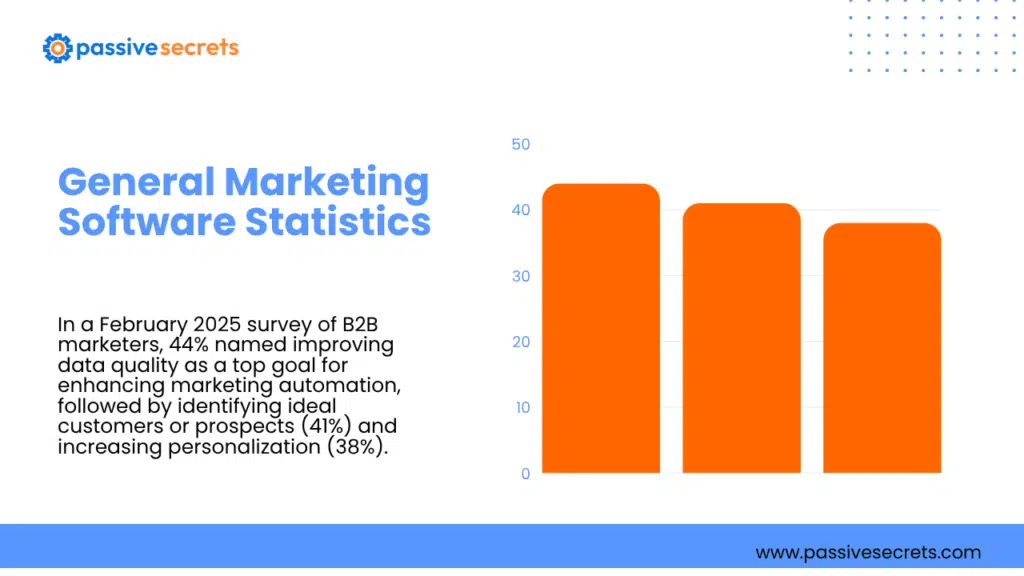
32. In a February 2025 survey of B2B marketers, 44% named improving data quality as a top goal for enhancing marketing automation, followed by identifying ideal customers or prospects (41%) and increasing personalization (38%). (Statista)
33. Approximately 41% of marketing decision-makers considered their customer journey to be mostly or fully automated, while 59% indicated partial automation. (Statista)
AI Marketing Software Statistics
34. The most common use of AI in automation is audience targeting, which supports the main goal of advancing marketing automation. Additional prominent uses include enhancing data quality (40%), reducing expenses (39%), and increasing personalization (37%). (Ascend)
35. A majority of marketing leaders (72%) have confidence in AI to enhance their marketing efforts, provided there is some level of human oversight. (Adobe Business)
36. 69.1% of marketers have already integrated AI into their marketing operations. (Influencer Marketing Hub)
37. In a February 2025 survey of B2B marketers, 43% cited audience targeting as the most effective AI use in marketing automation, followed by analytics and reporting (41%) and personalization (36%). Top goals included improving data quality and identifying ideal customers and prospects. (Statista)
38. A May 2023 survey of marketing professionals in the US, UK, and Australia found that 58% believed generative AI would revolutionize market and performance data analysis. (Statista)
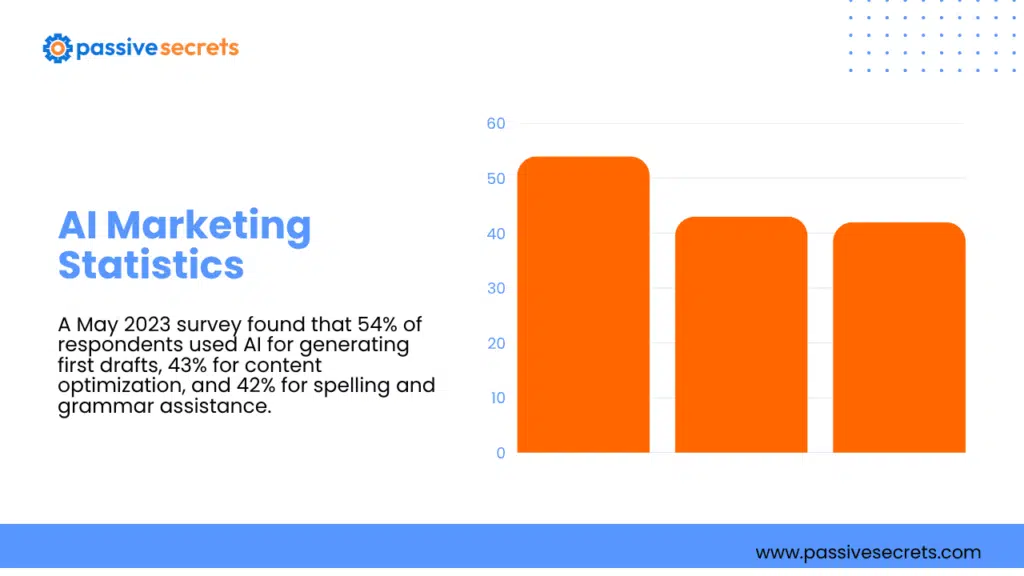
39. A May 2023 survey found that 54% of respondents used AI for generating first drafts, 43% for content optimization, and 42% for spelling and grammar assistance. (Statista)
FAQs
Conclusion
The marketing software landscape in 2026 isn’t about having every tool—it’s about having the right tools.
The statistics don’t lie: marketers using 5-8 strategically integrated tools outperform teams juggling 30+ disconnected platforms.
AI is accelerating this divide, automating workflows that used to require entire software categories while making bloated tech stacks a competitive liability.
Your move isn’t to buy more software. It’s to audit ruthlessly, consolidate strategically, and invest in platforms that actually integrate with how your team works.
The question isn’t which marketing software to add in 2026. It’s which ones you can finally eliminate.
Start by identifying your 3 highest-ROI tools. Everything else is negotiable.
Other Marketing Statistics Every Top Marketer Should Know:
- 45+ Interesting Communication Skills Statistics & Huge Trends
- 20 Interesting Body Language Statistics And Fun Facts
- 35 Interesting Public Speaking Fear Statistics & Fun Facts
- 25+ Most Interesting Emotional Intelligence Statistics & Fun Facts
- Shopping In The Digital Age: In-store vs Online Shopping Statistics And Analysis
- B2B Sales Statistics: Latest Insights and Trends
- 90+ Useful Marketing Jobs Statistics & Facts (Latest Report)
- Sales Enablement Statistics: Data You Need to Drive Sales Growth
- From Passion to Profit: 120+ Creator Economy Statistics
- 49 Interesting Emotional Marketing Statistics
- 23 Most Interesting First Impression Statistics To Know
- 60+ Interesting Storytelling Statistics, Facts & Huge Trends
- Amazon Book Sales Statistics: Intriguing Numbers and Facts
- 50+ Useful Call Center Statistics And Trends
- Virtual Event Statistics & Benchmarks For Marketers & Organizers
- 55 Interesting Direct Mail Marketing Statistics and Trends
- B2B Lead Generation Statistics, Facts, Trends, Benchmarks, & Market Size
- 52 Valuable Trade Show Statistics and Trends
- 41+ MOST Important Copywriting Statistics To Know
- 80+ Useful Sales Funnel Statistics & Conversion Rates
- 130+ Engaging Social Media Advertising Statistics You Mustn’t Miss
- 40+ Crucial Omnichannel Marketing Statistics & Trends For All Businesses
- 49 Interesting Emotional Marketing Statistics Every Marketer Should Know
- The Ultimate Creator Economy Statistics Report: Trends, Tools, and Income

