
Somebody just asked you to justify the retail media line in next year’s budget, and you didn’t have a great answer ready. Maybe it was your boss. Maybe it was a client, wondering why you want more of their money moved over.
Either way, you know retail media is huge right now. You can feel it in every planning meeting, every pitch deck, every competitor who suddenly has a retailer partnership you didn’t see coming. What you don’t have is the proof.
That’s the real problem. Retail media isn’t confusing; the proof is just scattered. It’s buried across dozens of reports from Skai, Dentsu, IAB, Bizrate Insights, and a handful of research firms, each one long, dense, and written for analysts, not for someone who needs one solid stat before a 9 a.m. meeting.
So here’s the fix. We pulled every number that actually matters and put it in one place: market size, ad spend, shopper trust, AI adoption, who’s winning and who’s losing ground. Whatever you’re trying to prove right now, whether it’s a budget ask, a strategy deck, or just that you know what you’re talking about, the exact retail media statistic you need is probably a few scrolls below.
Key Stats: Editor’s Pick
- Retail media ad spend has nearly tripled since 2021, climbing from $36.7 billion to a projected $107.6 billion in 2026 and now accounting for about 30% of all US digital ad spending.
- Global commerce media has grown into a $165.3 billion market in 2026.
- 92% of marketers and agencies now rank retail media as their single most important marketing channel, ahead of social, shopper marketing, and search.
- Only 24% of shoppers actually recognize the term “retail media,” despite the billions of dollars flowing into it.
- 61% of shoppers say they sometimes or often buy products because of retail media ads.
- Amazon alone captures 77.3% of retail media ad spend among leading players, while Walmart trails far behind at just 6.9%.
- Retail site searchers make up only 24% of visitors but generate 44% of revenue, converting at 2.5 times the rate of non-searchers.
- Brands allocate 22% of their media budget to retail media on average, a share that climbs to 32% among the most sophisticated advertisers.
- Retailers keep about 80% of total retail media spend as pure earnings, roughly $116B of the $145.5 billion spent in 2025.
- 63% of advertisers already use generative AI in their retail media programs, though only 3% describe the results as “transformative.”
- 75% of advertisers call incrementality their biggest measurement challenge, yet only 20% feel confident measuring it and acting on the results.
- The share of luxury retailers selling ad space through retail media jumped from 22% to 34% in just one year.
How Big Is the Retail Media Market, and How Fast Is It Growing?
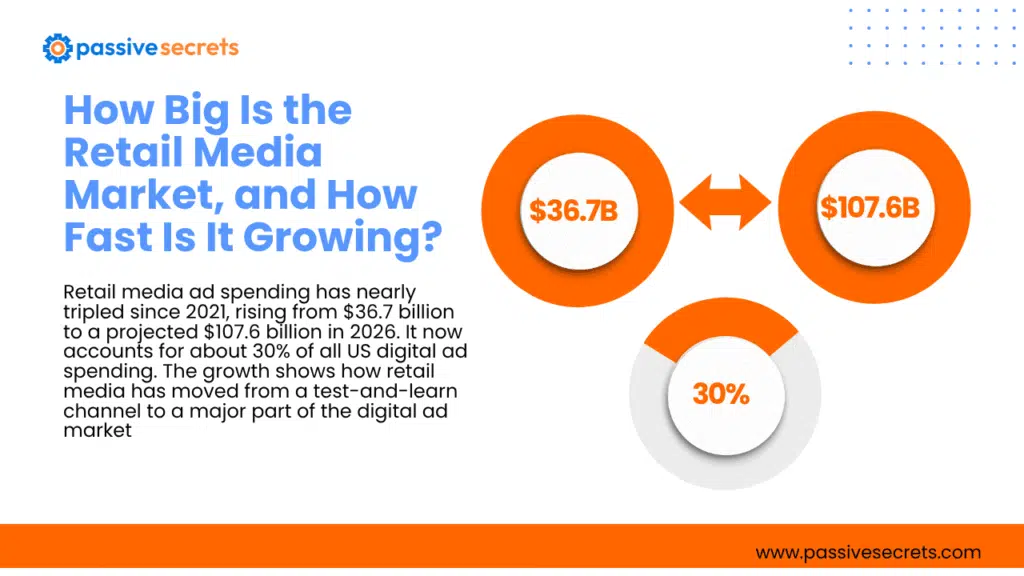
1. Retail media ad spending has nearly tripled since 2021, rising from $36.7 billion to a projected $107.6 billion in 2026. It now accounts for about 30% of all US digital ad spending. The growth shows how retail media has moved from a test-and-learn channel to a major part of the digital ad market. (Skai: The State of Retail Media Report 2026)
2. Global commerce media is now a $165.3 billion market in 2026, with dentsu forecasting double-digit growth through 2028. eMarketer also projects it will account for 20% of all US ad spend by 2030. Together, these figures show strong and sustained growth, with commerce media becoming a much larger part of global and US advertising. (DENTSU: 2026 COMMERCE MEDIA INDUSTRY REPORT)
3. European retail media spend has grown from €7.4bn in 2021 to €20.8bn in 2026 and is expected to reach nearly €29bn by 2028. This rapid growth shows Europe is catching up quickly with more mature markets, making it a region worth watching closely for retail media opportunities. (RETAIL MEDIAX Report 2026)
4. China remains the largest retail media market, accounting for 43.6% of global ad spend in 2026, down from 48.8% in 2023. The US accounts for about 36%, while the rest of the world has grown from 16.6% to 20.1%. This shows retail media is spreading beyond its traditional markets, with other regions gradually gaining share as their retail media capabilities grow. (RETAIL MEDIAX Report 2026)
*For a third global reference point: Retail MediaX’s 2025 report puts total global retail media spend at roughly $145.5 billion for 2025 (see the Retailer-Side Performance section below) — a useful cross-check that sits between last year’s and this year’s other global estimates.
Retail Media Ad Spend and Budget Allocation Statistics
5. The average brand partner now spends more than $1 million a year with a single retail media network, often across several retailers. This vital info shows how seriously brands now treat retail media as a channel. It also highlights the growing complexity of managing spend across multiple RMNs. (DENTSU: RETAIL MEDIA INDUSTRY REPORT 2025)
6. 71% of brands now assign retail media ad spend to brand marketing teams, up from 37% citing shopper marketing when Dentsu’s survey began in 2021. This shows a clear shift from shopper marketing to brand marketing. But Dentsu notes that the two teams don’t always work together well, which can make it harder to coordinate spending and strategy. (DENTSU: RETAIL MEDIA INDUSTRY REPORT 2025)
7. Brands allocate 22% of their total media budget to retail media on average, but the range is wide, from under 5% to more than 50%. About 11% of brands spend more than half their budget on retail media, while 10% spend less than 5%. Spending also varies by experience: highly sophisticated brands allocate 32.1% of their budget, compared with 15.1% for brands just getting started. (Skai: The State of Retail Media Report 2026)
8. Budget constraints are the biggest barrier to scaling Amazon Ads, cited by 54% of advertisers, while only 8% cite a lack of internal talent or resources. This suggests the main challenge is getting enough budget, not finding the right people. Brands also need to keep proving Amazon’s value against other channels, which can make it harder to fund ongoing testing and optimization. (Skai: The State of Retail Media Report 2026)
9. Brands now direct about 30% of their paid search budget and 34% of their paid social budget toward retailer sites instead of their own. The main reason, cited by 44% of respondents, is to drive traffic to product pages and boost visibility and sales. It shows that more brands are relying on retailers, rather than their own websites, to drive conversions. CPG brands are especially likely to use this approach. (Skai: The State of Retail Media Report 2026)
10. Nearly half of retail media investment has shifted fully from other channels, with another 47% partially shifted. Much of this money comes from trade budgets (50%) and traditional advertising (48%), while only 7% is new budget. This shows that retail media is growing mainly by taking share from other marketing channels rather than increasing total ad spend. (IAB Australia: Retail and Commerce Media 2026)
11. Looking ahead, 42% of brands and marketers plan to increase retail media spending, while just 4% plan to cut it. Spending is also expected to rise across social media (72%), CTV (59%), and out-of-home (29%), giving off-site retail media several strong growth opportunities. Much of this investment is also shifting away from traditional channels like TV, print, and radio. (Retail MediaX Report 2025)
12. Onsite and offsite retail media are funded differently: 24.6% of marketers plan to increase onsite spend with new budget, compared with 28.8% reallocating existing spend. For offsite, only 22.5% plan to use new money, while 33.3% will shift existing budgets. This suggests offsite is increasingly competing with other digital channels for existing ad spend, rather than attracting new money. (RETAIL MEDIAX Report 2026)
How Important Is Retail Media Compared to Other Marketing Channels?
13. Retail media is now a significant or regular part of activity for 87% of surveyed agencies and brands, with 61% calling it a “significant” part. Only 9% are still experimenting, and 4% have no experience, showing that retail media has moved well beyond the testing stage and has become a mainstream channel. (IAB Australia: Retail and Commerce Media 2026)
14. Advertisers and retailers see different top opportunities in retail media: 37% of advertisers value reaching shoppers at the point of purchase most, while 57% of retailers prioritize access to their own first-party data. This highlights a key difference in priorities, with brands focused on influencing purchases and retailers focused on monetizing their data. (IAB Australia: Retail and Commerce Media 2026)
15. 81% of ad buyers say retail and commerce media now has a clear role in their overall media planning, and 90% use retailer data to guide their strategy. This shows retail media is becoming a core part of media planning. However, 67% only use it when their products are sold on the retailer’s marketplace, limiting broader brand-building use cases. (IAB Australia: Retail and Commerce Media 2026)
16. Access to retailer first-party data is the top reason European advertisers use retail media (87%), followed by reaching shoppers at the point of purchase (74%), closed-loop attribution (57%), and improved marketing efficiency (51%). This shows brands value retail media most for better targeting, proximity to purchase, and clearer proof of results, rather than reach alone. (Retail MediaX Report 2025)
17. Brands are increasingly turning to commerce media networks for personalized communication and better shopping experiences, both rising from the mid-50s to 69%. Meanwhile, the share using them to better understand shoppers fell from 63% to 58%. This suggests brands are looking to CMNs more for personalization and experience than shopper insights alone. (DENTSU: 2026 COMMERCE MEDIA INDUSTRY REPORT)
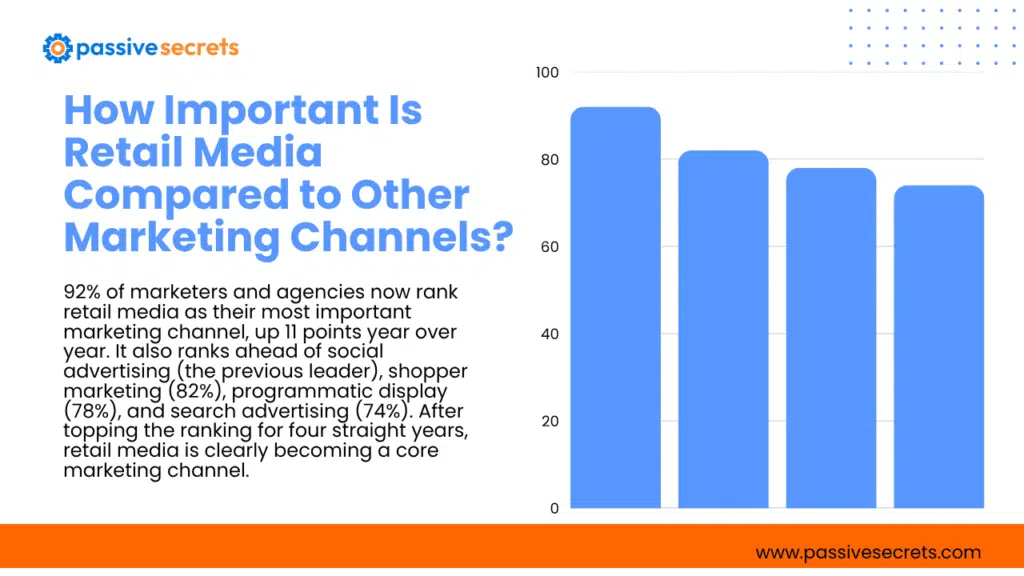
18. 92% of marketers and agencies now rank retail media as their most important marketing channel, up 11 points year over year. It also ranks ahead of social advertising (the previous leader), shopper marketing (82%), programmatic display (78%), and search advertising (74%). After topping the ranking for four straight years, retail media is clearly becoming a core marketing channel. (Skai: 2025 State of Retail Media Report)
19. Social advertising is close behind at 91% importance, up 23 points year over year, the biggest jump of any channel in the study. The report sometimes refers to this figure as “social commerce,” but the underlying table labels it social advertising, so that distinction is worth keeping clear when citing it. (Skai: 2025 State of Retail Media Report)
Which Retail Media Platforms and Ad Formats Do Brands Actually Use?
20. 69% of brands access RMNs directly through self-service tools, while another 29% say their agency does so for them. Self-service is now a standard part of retail media, rather than a key differentiator. Meanwhile, 34% of brands say slow turnaround from securing a placement to getting creative live is their biggest creative challenge, driving demand for faster self-service tools. (DENTSU: RETAIL MEDIA INDUSTRY REPORT 2025)
21. 89% of brands use an external agency for retail media, and 63% of those work with agencies that offer a broad range of services rather than retail media alone. Despite the rise of self-service tools, brands still rely heavily on agencies, likely because managing multiple RMNs can be complex. Broad agencies also help connect retail media with areas like loyalty and search. (DENTSU: RETAIL MEDIA INDUSTRY REPORT 2025)
22. According to Dentsu’s report, 53% of retail media spend now goes to offsite channels, with offsite in-store media growing the fastest. Onsite media accounts for 47%, while offsite display/social makes up 25% and offsite in-store 28%, up from 23% last year. This creates new revenue opportunities as onsite space fills up, but also raises the risk of wasted spend if targeting isn’t well coordinated. (DENTSU: RETAIL MEDIA INDUSTRY REPORT 2025)
23. However, Retail MediaX gives a different figure: Onsite retail media still accounts for about 80% of total ad spend, but off-site is growing fastest, up 18% year over year and projected to reach 25% to 30% of total spend by 2030. This shows retail media is gradually moving beyond retailers’ own sites and apps, with off-site becoming the key growth area to watch. (Retail MediaX Report 2025)
24. On-site static display ads (83%) and search or sponsored product ads (81%) remain the most widely used retail media formats. They are the proven starting points, while newer options like in-app ads, sampling, and Connected TV offer more room for growth. (IAB Australia: Retail and Commerce Media 2026)
25. Retail site search drives outsized value: searchers make up just 24% of visitors but generate 44% of revenue and convert at about 2.5 times the rate of non-searchers. Yet 68% of online shoppers say ecommerce search needs improvement, pointing to a major opportunity for retailers to improve both the search experience and retail media performance. (Retail MediaX Report 2025)
26. Just over half (52%) of commerce media networks now offer both social media and onsite display, making them the most widely adopted channels in 2025. In-store digital media saw the biggest jump, rising from 34% to 50%, while all 15 tracked channels grew or held steady. This shows commerce media expansion is broad-based, with strong growth both online and in physical stores. (DENTSU: 2026 COMMERCE MEDIA INDUSTRY REPORT)
Non-Endemic and Emerging Retail Media Network Statistics
27. The share of luxury retailers selling ad space through retail media rose from 22% to 34% year over year. This suggests retail media is expanding beyond its CPG and grocery roots as commerce becomes “everywhere, all the time. Clothing/fashion (55%) and cosmetics/beauty (42%) still lead overall, but luxury’s sharp rise is the more notable trend. (DENTSU: RETAIL MEDIA INDUSTRY REPORT 2025)
28. 44% of brands now use a dedicated retail and commerce media agency, while 53% regularly use non-endemic CMN data and media offerings even when they don’t sell products through that retailer. Together, these figures show brands increasingly see commerce media as a specialized channel and audience platform, not just a way to advertise products where they’re sold. (DENTSU: 2026 COMMERCE MEDIA INDUSTRY REPORT)
Retail Media Measurement, ROI and Incrementality Statistics
29. Marketers plan to manage 8+ retail media networks by the end of 2026, but only 12% have fully integrated media and commerce operations. Most brands report only partial integration (36%), while 22% say integration is still in progress.
Skai calls this a “coordination crisis”: adding more networks without the right systems can create more complexity, not more value. Still, 70% of brands met or exceeded their 2025 retail media KPI goals.
That includes 53% that met their goals and 17% that exceeded them. However, 27% fell into the “fair” category, which can make it harder to justify more spending and build the capabilities needed to improve performance. (Skai: The State of Retail Media Report 2026)
30. Only 15% of brands feel extremely confident in their retail media measurement. Another 75% say their measurement is only somewhat effective or effective, suggesting many still lack the clear data needed to guide budget decisions. This also helps explain why securing more retail media investment remains difficult. (Skai: The State of Retail Media Report 2026)
31. 75% of advertisers say incrementality is their biggest retail media measurement challenge, and only 20% are good at both measuring it and using the insights to guide decisions. Half of brands measure incrementality only at a basic level, while 14% don’t measure it at all.
This is a major issue because incrementality is one of the top factors brands consider when deciding where to spend, yet many still can’t clearly show whether their ad spend is driving additional sales. (Skai: The State of Retail Media Report 2026)
32. Advertisers most want incrementality or sales-lift measurement (83%) and ROAS (76%) from retail media partners. This shows a strong performance focus, with buyers prioritizing proof that ads drove additional sales and delivered measurable returns over brand or attention metrics. (IAB Australia: Retail and Commerce Media 2026)
33. In 2025, all retail media networks in the sample offered closed-loop sales attribution and ROAS, but capabilities dropped beyond that baseline: 72% offered IAB measurement compliance, 56% incrementality, 48% clean-room data, 44% media mix modelling, and just 40% self-service sales data.
This shows retail media measurement is strong on basic reporting but still uneven when data needs to connect across channels and partners. (RETAIL MEDIAX Report 2026)
34. When evaluating retail media networks, buyers prioritize reporting and transparency (82%), followed by performance (76%) and measurement capabilities (75%). ROAS is the most sought-after metric (88%), followed by incrementality sales measurement (71%). This shows buyers want clear, trustworthy proof of performance, not just strong results on paper. (RETAIL MEDIAX Report 2026)
35. Despite retail media’s growth, 78% of buyers say media measurement needs more standardization, while 69% say the same about attribution. This shows that measurement is far from solved, with different networks still using different methods that make results harder to compare and benchmark. (RETAIL MEDIAX Report 2026)
36. 82% say retail media met or exceeded their 2024 KPI goals, with 57% rating results as “good” and 25% as “excellent.” No respondents reported a negative impact. Brands were more likely than agencies to rate results as “excellent” (30% vs. 10%), while agencies leaned more toward “good” (72% vs. 51%). (Skai: 2025 State of Retail Media Report)
How Is AI Being Used in Retail Media, and How Mature Is Adoption?
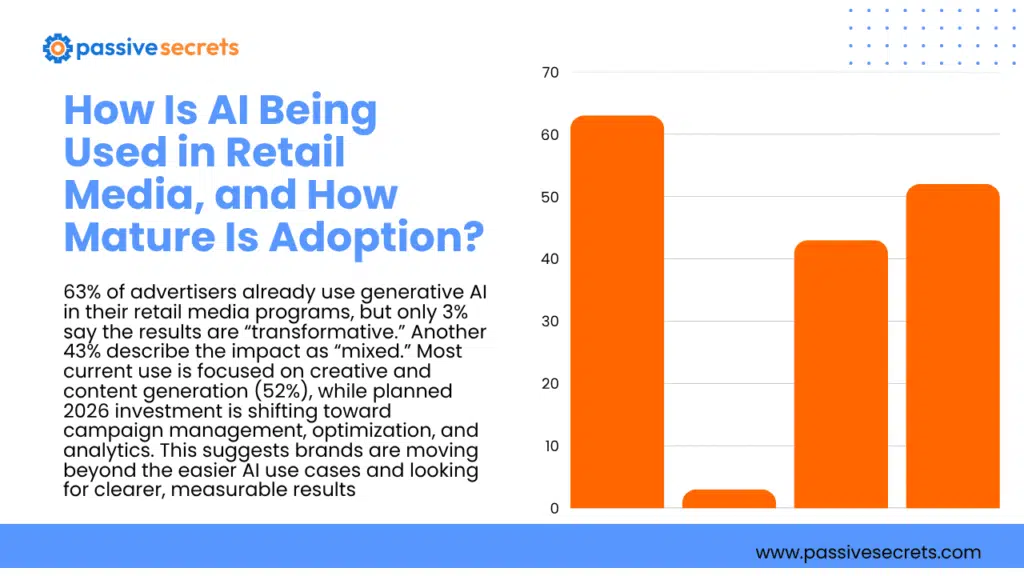
37. 63% of advertisers already use generative AI in their retail media programs, but only 3% say the results are “transformative.” Another 43% describe the impact as “mixed.” Most current use is focused on creative and content generation (52%), while planned 2026 investment is shifting toward campaign management, optimization, and analytics. This suggests brands are moving beyond the easier AI use cases and looking for clearer, measurable results. (Skai: The State of Retail Media Report 2026)
38. Only 22% of retailers and commerce media networks consider their offering “advanced,” while 47% are still developing and 31% are established. This shows that retail media still has room to mature, especially in measurement, first-party data, and audience targeting. Meanwhile, 56% plan to explore or adopt AI within the next 12 months, with data analysis and insights (68%), audience targeting (64%), and measurement and reporting (60%) leading the use cases.
This suggests the near-term focus for AI in retail media is getting more value from retailer data, rather than fully automating campaigns. (IAB Australia: Retail and Commerce Media 2026)
39. To scale efficiently, 86% of commerce media networks use AI, 72% use automation, and 41% are consolidating their vendor partners. Together, these figures show CMNs are relying on technology and simpler operations to handle growth, rather than growing headcount at the same pace. (DENTSU: 2026 COMMERCE MEDIA INDUSTRY REPORT)
40. Creative and content generation leads generative AI adoption in retail media at 52%, with another 42% planning to adopt it in 2026. Personalization is further behind at 20% today, though 36% plan to adopt it in 2026. This suggests AI is taking off first in creative production, while personalization still faces data, timing, and consent challenges. (RETAIL MEDIAX Report 2026)
41. Only 42% of marketers rate their organization’s AI maturity in retail media as above average or highly sophisticated. Consumer electronics brands lead, while food and beverage lag. This is a useful counterpoint to retail media’s rapid growth, showing that AI maturity is still catching up. (Skai: 2025 State of Retail Media Report)
Do Shoppers Notice, Trust, and Buy From Retail Media Ads?
42. Only 24% of shoppers are familiar with the term “retail media.” Despite billions in spending, most consumers don’t recognize the industry jargon. More importantly, retail media’s effectiveness depends on relevance, not on whether shoppers understand the term or how it works. (Bizrate Insights: State of Retail Media Engagement)
43. 70% of consumers say they’ve seen ads while browsing a retailer’s site or app in the past month. Despite low awareness of the term “retail media,” the channel has become a common part of online shopping, reaching seven in 10 consumers in just one month. (Bizrate Insights: State of Retail Media Engagement)
44. 61% of shoppers say they sometimes or often buy products because of retail media. The figure highlights retail media’s ability to influence actual purchase decisions, not just awareness or engagement, making it a strong indicator of measurable advertising impact. (Bizrate Insights: State of Retail Media Engagement)
45. Retail media ads drive a range of actions: 37% of shoppers research the product or brand, 34% click the ad, 23% buy immediately, 21% add it to a cart or wishlist, and 16% share it. This shows retail media influences shoppers beyond immediate clicks and purchases, with research and future purchase intent also playing a significant role. (Bizrate Insights: State of Retail Media Engagement)
46. On sentiment, 35% of shoppers don’t mind retail media ads, 32% find them helpful, and 26% find them distracting or annoying. Overall, roughly two-thirds view retail media positively or neutrally, suggesting shoppers may be more receptive to ads that appear in a relevant buying context. Still, the 26% who find them annoying shows that relevance and placement remain important. (Bizrate Insights: State of Retail Media Engagement)
47. 59% of shoppers see retail media ads as “normal and expected,” while just 28% consider them new or different. This suggests retail media has quickly become a normalized part of online shopping, signaling that the channel has moved beyond the experimental stage. (Bizrate Insights: State of Retail Media Engagement)
48. Shoppers are divided on who is behind retail media ads: 32% think they’re from the retailer, 31% see them as a joint retailer-brand effort, and 24% attribute them solely to the brand. This highlights a clear knowledge gap around how retail media works, even among shoppers who regularly see these ads. (Bizrate Insights: State of Retail Media Engagement)
49. 54% of shoppers trust retailer ads about the same as other ads, while 26% trust them more. Among daily shoppers, that figure rises to 49%. This suggests that frequent shopping builds stronger trust in retailer advertising, making repeat customer relationships especially valuable for long-term ad effectiveness. (Bizrate Insights: State of Retail Media Engagement)
50. Shoppers with positive attitudes toward retail media buy from these ads at more than twice the rate of those with negative attitudes: 77% vs. 29%. The gap shows that ad sentiment directly influences purchase behavior, reinforcing the importance of making retail media ads relevant and enjoyable rather than simply maximizing impressions. (Bizrate Insights: State of Retail Media Engagement)
51. 94% of shoppers who “like” personalized ads also have a positive overall attitude toward retail media. This strong link suggests that effective personalization can drive positive shopper sentiment, making it an important lever for brands and retailers looking to build trust and engagement. (Bizrate Insights: State of Retail Media Engagement)
52. 70% of consumers are comfortable with personalized ads based on their shopping history — 44% are okay with them and 26% actively like them—while 25% dislike them. This suggests most shoppers are receptive to personalization, though transparency and control still matter for the quarter who remain uncomfortable with it. (Bizrate Insights: State of Retail Media Engagement)
53. Only 34% of shoppers believe retail media ads are personalized for them, while 44% think everyone sees the same ads. This statistic shows a disconnect between retailers’ personalization efforts and how shoppers perceive them, pointing to a missed opportunity to make personalization feel more relevant and noticeable. (Bizrate Insights: State of Retail Media Engagement)
54. General coupons and discounts are the biggest drivers of purchases (46%), followed by personalized discounts (42%), social media posts (39%), and TV ads (35%). The finding shows that despite advances in targeting and personalization, simple offers still have the strongest influence on purchase decisions, while social media remains a major driver. (Retail MediaX Report 2025)
55. 83% of shoppers like hearing about new products when visiting physical stores, while branded in-store media can improve brand recall by up to 7% and purchase consideration by 2% to 4%. This suggests in-store retail media is both well received and measurably effective, making it useful for brand building as well as driving purchases. (Retail MediaX Report 2025)
56. Off-site retail media ads are highly noticeable: 80% of shoppers notice sponsored social posts and ads in retailer-owned magazines, while 75% notice off-platform display ads. This suggests off-site retail media is gaining attention beyond retailer websites, supporting its growth as a channel for reaching and influencing shoppers. (Retail MediaX Report 2025)
57. 58.1% of consumers are comfortable with retailers using their data for AI-powered personalization, while 41.9% are not. Although most consumers are open to it, the split shows that data use still needs to be handled carefully, since more than four in ten remain uncomfortable. (RETAIL MEDIAX Report 2026)
58. Attention varies by generation: Gen Z leads in AI interface engagement (10.2%) and social media influence (26.6%), while Boomers rely more on retailer websites (32.6%). But the bigger finding is that many consumers don’t notice retail marketing at all, ranging from 21.3% of Gen Z to 38% of Boomers. (RETAIL MEDIAX Report 2026)
How Well Are Retail Media Networks Performing for Retailers?
59. According to Dentsu, 78% of retailers expect their Retail Media Network revenue to grow over the next three years, down from 91% last year. That’s a 13-point drop in confidence in just one survey cycle. Dentsu attributes it to increased competition and the “growing pains” of scaling RMNs to meet demand. While 78% is still a clear majority, it signals that the early gold-rush optimism is starting to cool. (DENTSU: RETAIL MEDIA INDUSTRY REPORT 2025)
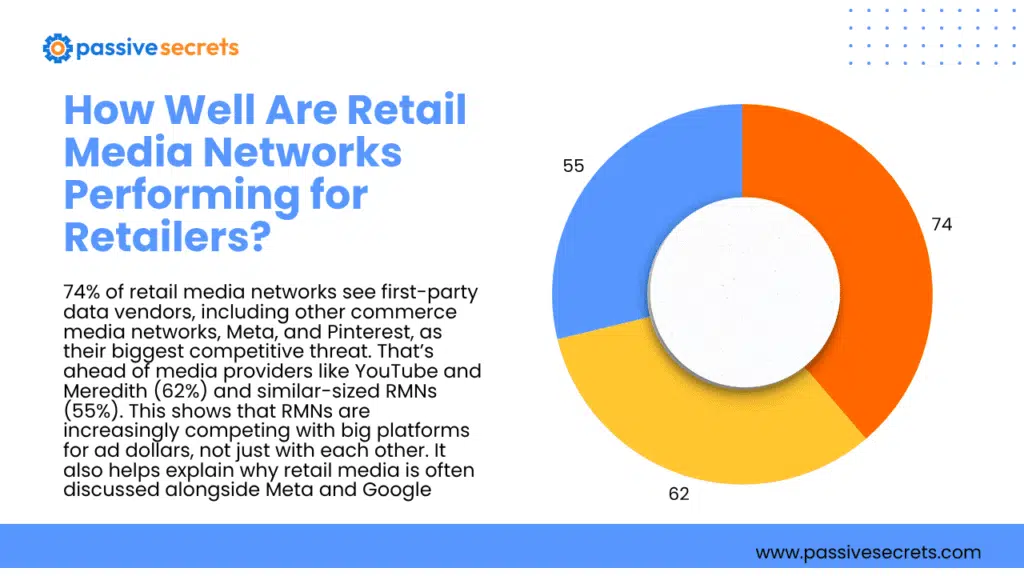
60. 74% of retail media networks see first-party data vendors, including other commerce media networks, Meta, and Pinterest, as their biggest competitive threat. That’s ahead of media providers like YouTube and Meredith (62%) and similar-sized RMNs (55%).
This shows that RMNs are increasingly competing with big platforms for ad dollars, not just with each other. It also helps explain why retail media is often discussed alongside Meta and Google. (DENTSU: RETAIL MEDIA INDUSTRY REPORT 2025)
61. For 45% of RMNs, non-media solutions now make up more than 40% of total RMN revenue, up from 33% a year earlier. Dentsu says this shows RMNs are becoming more than ad platforms, with many also acting as data and tech providers. It’s a useful stat for challenging the idea that RMN revenue mainly comes from sponsored search and banner ads. (DENTSU: RETAIL MEDIA INDUSTRY REPORT 2025)
62. Data and first-party audience insights sold without media are offered by 35% of RMNs, making them the most common non-media offering. They rank ahead of creative services and reporting tools. It shows that RMNs are finding new ways to make money from their first-party data, especially as cookies and other identity signals become less reliable. (DENTSU: RETAIL MEDIA INDUSTRY REPORT 2025)
63. Amazon Ads leads retail media network adoption at 92%, with Walmart Connect at 73%. After that, adoption drops sharply, with every other network below 65%. Many smaller networks also focus on specific categories, such as Lowe’s and Home Depot in home improvement and Ulta in beauty.
The takeaway? Brands often choose networks based on category fit rather than building broader multi-network strategies, which could become harder to manage as more networks grow. (Skai: The State of Retail Media Report 2026)
64. 65% of advertisers rate their Amazon Ads efforts as above average or highly sophisticated, compared with just 41% for other retail networks. That’s a 24-point gap. The report suggests this can hurt performance, as brands often try to apply what works on Amazon to networks like Walmart, Target, or Kroger, where the same approach may not work as well. (Skai: The State of Retail Media Report 2026)
65. 86% of advertisers and agencies now work with three or more retail media partners, up from 77% the year before (2025). This shows brands are spreading their investment across multiple networks, creating more complexity in ad management, reporting, and measurement. (IAB Australia: Retail and Commerce Media 2026)
66. 66% of advertisers and agencies now rate their experience with retail media partners as good, up from 44% the year before. This suggests that as retail media networks mature, the experience of working with them is improving alongside the industry’s growth. (IAB Australia: Retail and Commerce Media 2026)
67. Investment is rising on both sides: 63% of advertisers increased onsite spend and 65% increased offsite spend, while 93% of retailers saw higher onsite revenue and 90% saw higher in-store revenue. The growth reported by both buyers and sellers shows that retail media investment is translating into strong revenue growth for retailers. (IAB Australia: Retail and Commerce Media 2026)
68. Retailers keep about 80% of total retail media spend as earnings, roughly $116 billion of the $145.5 billion spent in 2025. The remaining 20% goes to the tech and platform companies powering these networks. This shows that retail media creates value across two layers: retailers monetizing their audiences and technology companies powering the infrastructure. (Retail MediaX Report 2025)
69. More than half of brands (54%) now use six or more retail media networks, while 36% use more than 10. This shows how fragmented the market has become and highlights the need for centralized planning and reporting as brands manage more retail partners. Fortunately, the investment appears to be paying off, with 82% of agencies and 81% of consumer goods organizations reporting good or excellent results from retail media. This suggests that despite the added complexity, most brands and agencies are seeing strong returns from their retail media efforts. (Retail MediaX Report 2025)
70. Amazon generated $56.2 billion in advertising revenue in 2024, while Walmart’s advertising revenue grew 27% to $4.4 billion. The figures show the scale and growth of retail media at the world’s largest retailers, with Amazon leading in size and Walmart showing strong growth beyond Amazon. (Retail MediaX Report 2025)
71. 80% of commerce media networks expect their revenue to grow over the next three years, up from 78% the year before. This reflects growing confidence in the sector’s future, although networks recognize that continued growth will depend on improving their operations as the market becomes more competitive. (DENTSU: 2026 COMMERCE MEDIA INDUSTRY REPORT)
72. For commerce media networks, team collaboration and keeping up with innovation are tied as the top concerns at 39% each, followed by scaling teams (38%), competition (36%), and data privacy and regulations (31%). The shift suggests that as the industry matures, internal coordination is becoming a bigger challenge than regulation and privacy. (DENTSU: 2026 COMMERCE MEDIA INDUSTRY REPORT)
73. Commerce media networks increasingly see first-party data vendors as their biggest competitive threat (80%, up from 74%), followed by media providers and platforms (66%, up from 62%). They are less concerned about competing with other retail media networks and more focused on matching the scale, ease, and measurement offered by major media platforms. (DENTSU: 2026 COMMERCE MEDIA INDUSTRY REPORT)
74. Commerce media networks work with more than 25 technology partners on average. Amazon’s usage rose from 72% to 81%, Salesforce from 42% to 53%, and Trade Desk more than doubled from 14% to 30%. The 25-plus partners highlight how fragmented the commerce media tech landscape has become, with smaller, specialized providers also gaining ground. (DENTSU: 2026 COMMERCE MEDIA INDUSTRY REPORT)
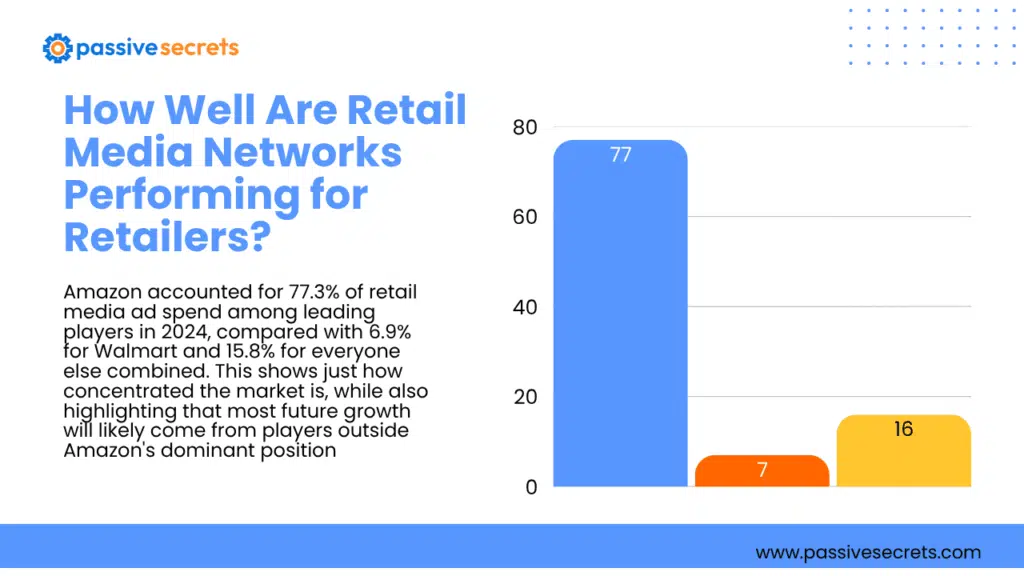
75. Amazon accounted for 77.3% of retail media ad spend among leading players in 2024, compared with 6.9% for Walmart and 15.8% for everyone else combined. This shows just how concentrated the market is, while also highlighting that most future growth will likely come from players outside Amazon’s dominant position. (RETAIL MEDIAX Report 2026)
Conclusion
Next time someone asks you to justify the retail media line in your budget, you won’t be scrambling for an answer. You’ll already have three or four numbers ready before they even finish the question.
That’s really what all these stats add up to. Retail media isn’t a side bet anymore. It’s the channel marketers now rank above social, above search, above almost everything else they spend on. Shoppers are running into these ads constantly, buying because of them, and most brands are seeing solid returns to show for it.
None of that means the work is done. Plenty of brands still can’t say with confidence whether their spend is truly driving extra sales. AI is showing up everywhere in retail media right now, but even the people using it admit the results are more mixed than magic. And juggling six, eight, or ten different retail media networks is becoming a job in itself.
So use these numbers for what they are worth. Back up your budget ask. Push back on a vendor’s pitch. Or just walk into your next meeting knowing exactly where this industry stands, because now you do.
Other Related Marketing Statistics You Have To Know:
- How to Increase Your Conversion Rate: 12 Tactics Ranked From Proven to Overhyped
- Useful Black Consumer Spending Statistics (NEW Report)
- Holiday Spending Stats: Valentine’s Day, Easter, Thanksgiving, and Christmas
- Useful Male vs Female Spending Statistics
- Useful Direct Mail Marketing Statistics, Trends, and FAQs
- Sales Funnel Statistics To Increase Conversion Rates
- MOST Important Copywriting Statistics To Know
- 52 Valuable Trade Show Statistics and Trends
- B2B Lead Generation Stats, Facts, Trends, Benchmarks, & Market Size
- Virtual Event Statistics & Benchmarks For Marketers & Organizers
- 50+ Useful Call Center Statistics And Trends
- Amazon Book Sales Statistics: Intriguing Numbers and Facts
- B2B Sales Statistics: Latest Insights and Trends
- Sales Enablement Statistics: Data to Drive Sales Growth
- 60+ Interesting Storytelling Statistics, Facts & Huge Trends
- 23 Most Interesting First Impression Statistics To Know
- 45+ Interesting Communication Skills Statistics & Huge Trends
- Interesting Body Language Statistics And Fun Facts
- 35 Interesting Public Speaking Fear Statistics & Fun Facts
- 25+ Most Interesting Emotional Intelligence Statistics & Fun Facts
- In-Store vs. Online Shopping Stats: 100+ Facts Behind Retail’s Biggest Plot Twist
- 40+ Marketing Software Statistics & Facts (Full Industry Report)
- Ultimate Creator Economy Stats Report: Trends, Tools, & Income

