
- The global IT outsourcing market is expected to surge 50.22% from 2024 to 2029, adding $271.7 billion in revenue.
- In 2023, worldwide spending on public IT cloud services reached $669 billion, with Software as a Service (SaaS) accounting for the largest share at $413 billion.
- The global IT outsourcing market reached $600.9 billion in 2024 and is projected to grow to $835.5 billion by 2033, with a 3.64% CAGR.
- 75% of executives rely on third-party vendors for cybersecurity support.
- 40% of tech experts work for IT outsourcing companies.
- 57% of executives say cost reduction is the main driver of traditional outsourcing
What if you could cut your IT costs by nearly 30% while boosting efficiency and innovation?
That’s the promise driving the explosive growth of IT outsourcing.
As technology evolves and competition heats up, businesses around the globe are turning to outsourcing as a strategic tool to stay ahead.
The numbers tell a compelling story: IT outsourcing is no longer just a cost-saving measure; it’s a growth enabler.
But what does the data reveal about its true impact, trends, and challenges?
In this article, we’ll uncover the latest IT outsourcing statistics, giving you a data-driven look at why it’s become a multi-billion-dollar industry and what it means for the future of your business.
Let’s check out the statistics.
Global IT Outsourcing Market Overview
1. Global spending on IT services reached approximately $1.5 trillion in 2023 and increased to $1.61 trillion in 2024 (source).
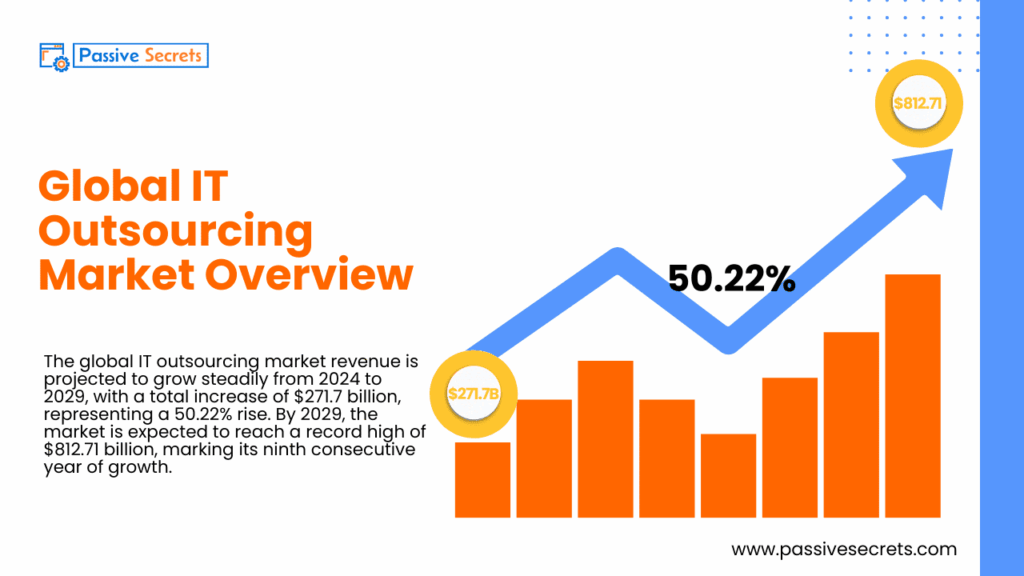
2. The global IT outsourcing market revenue is projected to grow steadily from 2024 to 2029, with a total increase of $271.7 billion, representing a 50.22% rise. By 2029, the market is expected to reach a record high of $812.71 billion, marking its ninth consecutive year of growth (source).
3. The IT consulting and implementation market is projected to grow by$18.1 billion between 2024 and 2029, a 24.17% increase, reaching a record $92.95 billion by 2029 (source).
4. The global managed services market was worth over $344 billion in 2024 and is projected to surpass $500 billion by 2028 (source).
6. Global public IT cloud services spending hit $669 billion in 2023, with SaaS being the largest segment at$413 billion (source).
7. Tata Consultancy Services was India’s top IT services company by market capitalization, valued at over 12.7 trillion Indian rupees as of November 2023 (source).
8. North America led the IT outsourcing market in 2023, while Asia-Pacific is poised to be the fastest-growing region during the forecast period (source).
9. The global IT outsourcing market reached $600.9 billion in 2024 and is projected to grow to $835.5 billion by 2033, witha 3.64% CAGR (source).
10. North America, specifically the United States, had an IT spending market value of nearly $1.30 trillion in 2023, with a projected growth to $1.8 trillion by 2032 (source).
11. Global spending on public cloud services is expected to reach over$675 billion by 2024, driven by the growing demand for scalable and flexible infrastructure (source).
12. Poland, Ukraine, Romania, and the Czech Republic are top European countries for tech talent. Poland alone has over 500,000 ICT specialists, with 40% working in IT outsourcing (source).
13. The global business process outsourcing market is expected to reach $525.23 billion by 2030, growing at a 9.6% CAGR from 2024 to 2030 (source).
14. Another report showed that the IT Outsourcing market is projected to reach $541.10 billion in revenue by 2024, indicating impressive global growth (source).
15. The IT Outsourcing market is expected to grow at a CAGR of 8.48% from 2024 to 2029, reaching a market volume of$812.70 billion by 2029 (source).
16. The average spend per employee on IT Outsourcing is projected to reach $152.00 in 2024, indicating significant investments in efficiency and cost-effectiveness (source).
17. The US will lead the IT Outsourcing market, generating$197.30 billion in revenue in 2024, showcasing its strong position and influence in the sector (source).
18. India’s IT Outsourcing market is thriving due to its highly skilled workforce and cost-effective solutions, attracting clients worldwide (source).
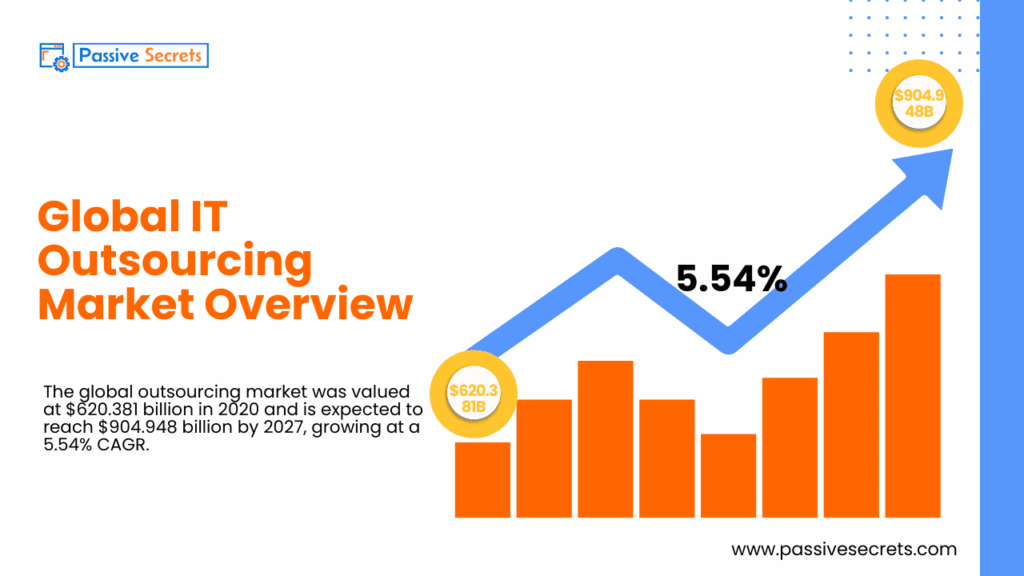
19. The global outsourcing market was valued at $620.381 billion in 2020 and is expected to reach $904.948 billion by 2027, growing at a 5.54% CAGR (source).
20. The global developer population is projected to reach 28.7 million by 2024, up 3.2 million from 2020, with significant growth expected in China (6-8% growth rate until 2023) (source).
21. The Application Outsourcing market is projected to grow significantly, reaching $118.10 billion by 2024 and $124.10 billion by 2029, with a 1% CAGR. Average spend per employee is expected to increase to $33.18 in 2024 (source).
22. The Software Outsourcing Market is expected to reach $897.9 billion by 2031, growing at a 5.49% CAGR from 2024, up from $555.03 billion in 2024 (source).
Industry-Specific IT Outsourcing Statistics
23. 64% of IT leaders worldwide outsourced software application development, making it the most commonly outsourced IT function (source).
24. 76% of surveyed executives reported using third-party models to deliver their IT services (source).
25.70% of surveyed executives cited cost as the primary reason for outsourcing (source).
26. 75% of executives rely on third-party vendors for cybersecurity support (source).
27. India’s IT sector exports reached $193 billion in FY2023, with software and services accounting for $126 billion, dominating the industry and the majority of total revenue (source).
28. 40% of tech experts work for IT outsourcing companies (source).
29. Ukraine has around 300,000 ICT professionals, with about 60% working in IT outsourcing and outstaffing (source).
30. Polish IT vendors primarily serve industries like finance, business services, ecommerce, healthcare, and IT (source).
31. Ukraine’s IT sector has shown resilience, with record-high computer services exports of $7.3 billion in 2022, and remaining strong at $6.7 billion in 2023, despite a slight drop. (source)
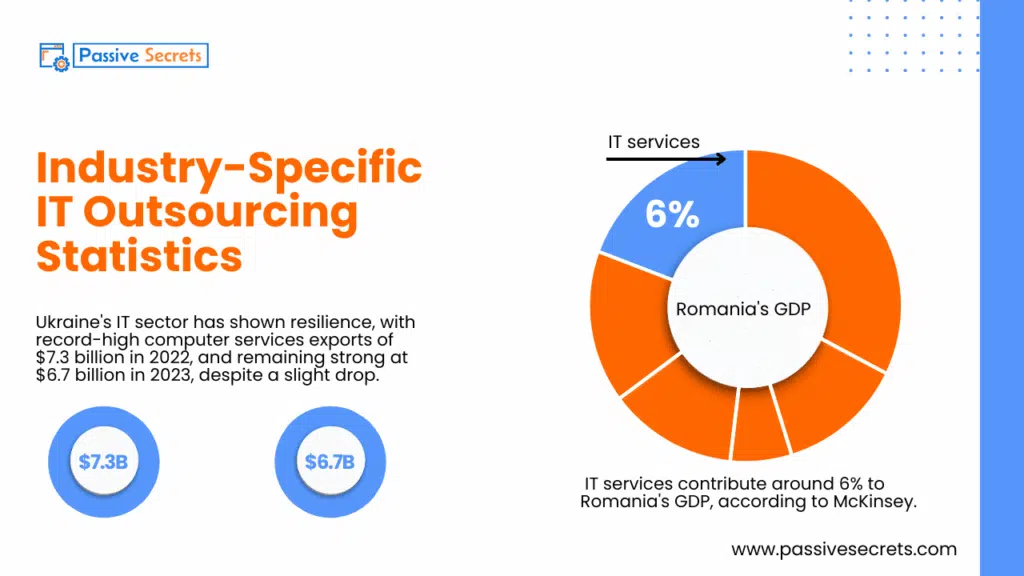
32. IT services contribute around 6% to Romania’s GDP, according to McKinsey (source).
Key Drivers of IT Outsourcing
33. 57% of executives say cost reduction is the main driver of traditional outsourcing, often achieved through staff augmentation for routine business and IT tasks (source).
34. Cost reduction is the main reason for outsourcing, with expected savings of 15%, but actual savings averaging around 9% (source).
Future Projections in IT Outsourcing
35. In 2025, IT budgets will be split mainly between hardware (19%) and software (19%), with managed services receiving 10% (source).
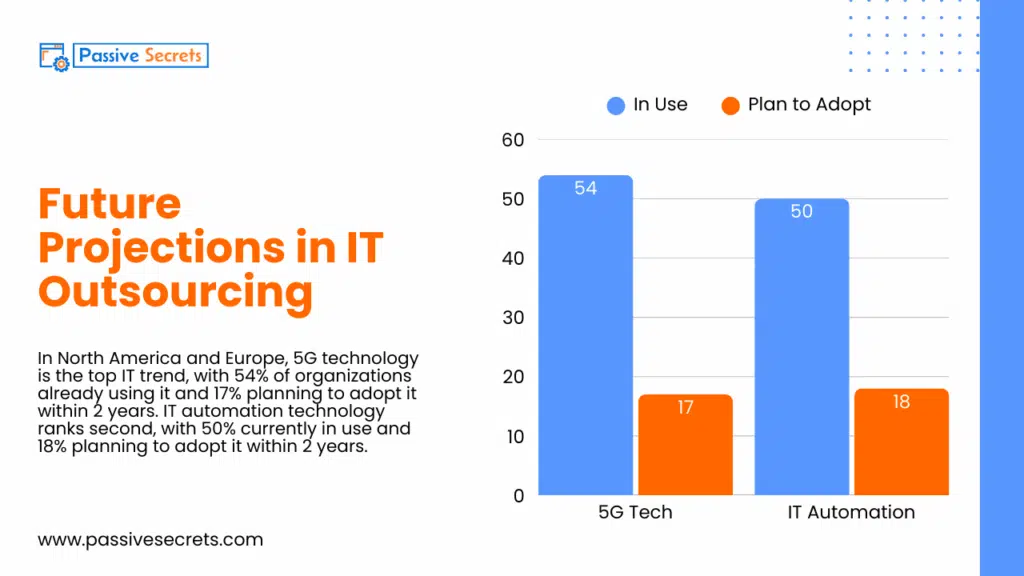
36. In North America and Europe, 5G technology is the top IT trend, with 54% of organizations already using it and 17% planning to adopt it within 2 years. IT automation technology ranks second, with 50% currently in use and 18% planning to adopt it within 2 years (source).
37. Organizations rely on tech expertise and engineering capabilities to achieve their goals, driving a growing demand for IT specialists, witha 22% increase expected from 2020 to 2030, according to the US Bureau of Labor Statistics (source).
Latest IT Outsourcing Trends
1. Robotic Process Automation (RPA)
Robotic Process Automation (RPA) is a technology that automates repetitive tasks typically performed by humans, making it a key trend in IT outsourcing for 2025.
It uses software robots to replicate human actions in digital systems, allowing them to handle tasks like data entry and transaction processing quickly and accurately.
RPA operates by programming bots to follow specific instructions, enabling them to log into applications, fill out forms, and copy data without human intervention.
Setting up RPA is user-friendly and does not require advanced technical skills.
The importance of RPA in IT outsourcing lies in its ability to reduce costs by automating routine tasks, increase productivity by freeing employees for more valuable work, and improve service delivery through faster processing.
As businesses seek efficiency and cost savings in 2025, RPA offers a powerful solution to streamline operations and enhance overall productivity.
2. Cloud-native and Multi-cloud Outsourcing services
In 2025, cloud-native and multi-cloud outsourcing services are significant trends in IT outsourcing. These approaches help organizations improve efficiency, flexibility, and resilience in a digital world.
Cloud-native applications allow businesses to respond quickly to market changes while also enhancing development.
Additionally, these solutions can reduce costs by optimizing resource use and minimizing downtime. Outsourcing these services provides access to specialized expertise that may not be available in-house.
Overall, the adoption of cloud-native and multi-cloud outsourcing services is reshaping IT strategies across industries.
This trend ensures efficiency, allowing organizations to navigate the complexities of modern technology while ensuring their IT infrastructures remain robust and secure.
3. AI-driven Experimentation
AI-driven experimentation is a significant trend in 2025, transforming how businesses approach innovation and operational efficiency.
This trend focuses on integrating advanced AI technologies into various processes, enabling organizations to explore new possibilities and enhance capabilities.
AI allows businesses to create original content and automate traditionally manual tasks, improving workflows and productivity.
Integrating these advanced technologies enhances operational efficiency and fosters a culture of innovation.
As businesses experiment with AI-driven solutions, they unlock new avenues for creativity and growth. This trend signifies a shift toward more agile business strategies that can navigate the complexities of the modern market.
4. Extended Reality (XR)
Extended Reality (XR), which includes Virtual Reality (VR), Augmented Reality (AR), and Mixed Reality (MR), is set to transform industries in 2025.
The XR market is growing quickly and is driven by advancements in technology.
Generative AI is crucial to this growth, enabling businesses to create immersive environments and virtual assets quickly. Tools like OpenAI’s Sora allow for fast generation of videos and animations from text prompts, enhancing customer engagement.
Spatial computing is also advancing, with devices like Apple’s Vision Pro blending physical and digital worlds for intuitive interactions. The addition of technologies like haptic feedback and spatial audio will make experiences even more immersive.
As XR continues to develop, it will change how businesses operate, from healthcare training to engaging retail experiences. Overall, 2026 is poised to be a pivotal year for XR, offering new opportunities for innovation and connection across various sectors.
5. Cybersecurity
Cybersecurity is very important in 2026 because cyber threats are becoming more complex. A key trend is using artificial intelligence (AI) and machine learning (ML) to help protect against these threats.
AI and ML can analyze large amounts of data to spot patterns that indicate potential security issues, allowing organizations to respond quickly.

Another focus is on securing Internet of Things (IoT) devices, like smart home gadgets. As more devices connect to the internet, they create new security risks. There’s a push for better security standards, such as encryption and certifications for these devices.
The rise of remote work also changes how companies approach cybersecurity. With many employees working from home, strong protection for sensitive information is crucial. This has led to increased use of multi-factor authentication (MFA), which adds extra steps to verify a user’s identity.
Ransomware attacks are another concern, as hackers are becoming smarter and often use AI to target their attacks effectively. As the costs of cybercrime rise, businesses must strengthen their defenses to keep their data safe. Overall, staying proactive about cybersecurity is essential in today’s digital world.
Conclusion
IT outsourcing is a proven strategy for driving innovation, scalability, and efficiency in today’s digital economy.
Businesses are using it to access specialized talent, adopt advanced technologies, and cut costs.
With the global IT outsourcing market growing rapidly, understanding key trends and challenges is crucial for maximizing ROI. A well-planned outsourcing strategy can help businesses stay competitive and achieve their goals effectively.
Other Related Statistics You Should Know:
- 30+ Powerful Team Building Statistics to Boost Workplace Performance
- 87+ Essential Training Industry Statistics & Trends for HR and L&D Professionals
- 90+ Interesting Marketing Jobs Statistics & Facts (Latest Report)
- 80+ Employee Benefit Statistics: Insights and Trends
- The Most Important Wealth Management Statistics You Can’t Afford to Ignore
- Enterprise Data Management: Essential Statistics and Emerging Trends
- 110+ Talent Management Statistics You Can’t Ignore: Market Growth, Engagement, and Upskilling Trends
- Top Reputation Management Statistics and Trends to Improve Your Brand
- 36 Helpful Social Worker Burnout Statistics To Know
- 100 Business Process Outsourcing Statistics & Facts
- Top HR Outsourcing Statistics and Trends Every Business Must Know
- The Top Outsourcing Statistics You Shouldn’t Ignore
- 47+ Shocking 4-day Work Week Statistics To Know
- 105+ Supply Chain Statistics & Facts You Can’t Ignore
- 50+ Interesting Employer Branding Statistics And Trends
- Job Seekers Statistics: Unemployment Rates, Preferences, Challenges
- 95 Interesting Job Interview Statistics and Huge Trends To Know
- 60+ Helpful Change Management Statistics & Facts
- 65+ Employee Performance Management Statistics & Trends
- Workforce Management Statistics: Trends, Insights, & Opportunities
- 73 Revealing Workplace Distraction Statistics
- Workplace Romance Statistics: How Common Is Workplace Romance?
- 40+ Top Workplace Conflict Statistics You Should Know
- The State of Workplace Communication: Key Statistics and Trends
- 55 Workplace Collaboration & Teamwork Statistics

