- 36% of managers report frequently or consistently seeing ineffective leadership within their organization.
- Only 23% of US employees strongly trust their organizational leaders.
- 67% of global L&D leaders pinpointed leadership skills as a major skills gap.
- 80% of executives believe that leadership development should be a top priority.
- 70% of L&D professionals and leaders believe it’s crucial for leaders to develop a broader range of effective leadership skills.
- Women occupy just over 10% of leadership roles at Fortune 500 companies.
- 54% of leaders see technological change as a top threat, but feel increasingly unprepared.
- 60% of surveyed L&D buyers and functional leaders plan to moderately or extensively incorporate AI into their leadership training programs.
If you want to know if an organization will be successful, check its quality of leadership. Effective leadership is the backbone of any successful organization, driving growth, innovation, and employee engagement.
But what makes a great leader, and how can businesses cultivate leadership excellence? To answer these questions, it’s essential to look at the numbers.
In this article, we’ll delve into the latest leadership statistics, exploring trends, challenges, and opportunities in leadership development, gender gap, workplace dynamics, and more.
Whether you’re a business owner, HR professional, or aspiring leader, these statistics will provide valuable insights to help you improve your leadership strategy in 2026 and beyond.
Leadership Styles and Effectiveness
1.36% of managers report frequently or consistently seeing ineffective leadership within their organization. (source)
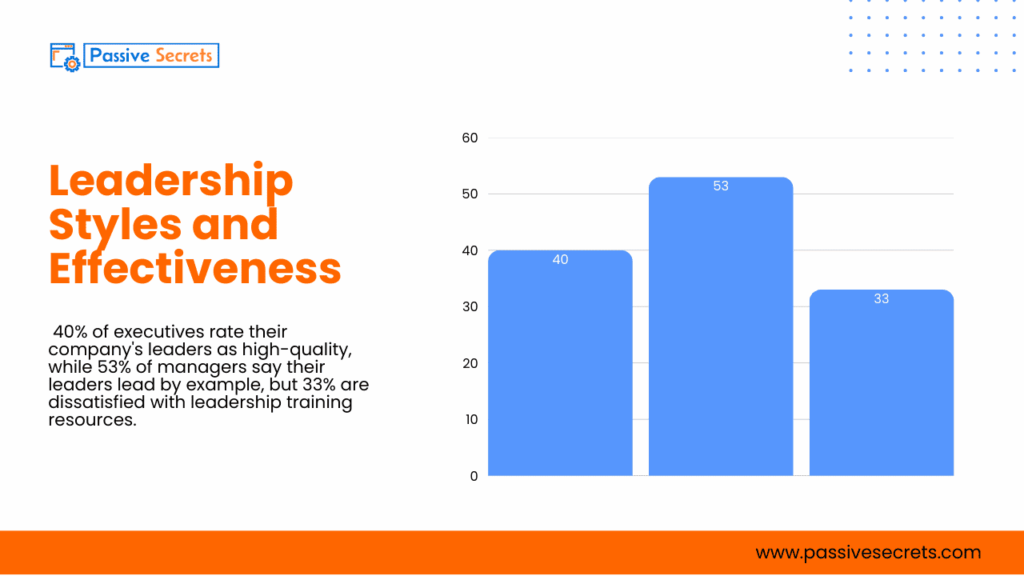
2. 40% of executives rate their company’s leaders as high-quality, while 53% of managers say their leaders lead by example, but 33% are dissatisfied with leadership training resources. (source)
3. More than half of respondents in a survey rated their leaders as “very effective”, scoring 9 or above on a 10-point scale. This positive view was more prevalent in sectors like professional services, healthcare/pharmaceuticals, and financial services, where 60% considered their leadership “very effective” (source).
4. 42% of managers believe frequent follow-ups are necessary, while 41% think their team has room for improvement (source).
5. Only 53% of surveyed L&D buyers and functional leaders believe their leaders are very effective, highlighting a gap in leadership performance (source).
Workplace Leadership Statistics
6. 33% of managers report that becoming a leader has negatively impacted their work-life balance. Additionally, 42% feel their company now prioritizes employee well-being less than during the pandemic, highlighting a need for employers to support leader well-being (source).
7. There’s a strong correlation between effective response to sexual harassment and a healthy workplace culture. 65% of those who felt leaders respond well to harassment also reported a healthy culture, whereas only 17% of those who felt leaders respond poorly reported a healthy culture (source).
8. 53% of workers feel their manager lacks the skills to support their career growth, with 55% saying their manager is unaware of their skills. Additionally, 43% cite insufficient training as a career advancement barrier, with 44% of younger workers (18-34) considering job changes due to lack of training (source).
9. Only 23% of US employees strongly trust their organizational leaders, while 45% say lack of trust in leadership is the biggest issue affecting their work performance (source).
Demographics of Leadership
10. 65% of Americans consider it highly important for younger women to have female role models in leadership positions. This sentiment is strongest among millennial women (82%), followed by women aged 35-54 (74%), and women 55+ (67%) (source).
11. Women are more likely to have female mentors (63%), especially millennial women (72%), while men predominantly have male mentors(77%) (source).
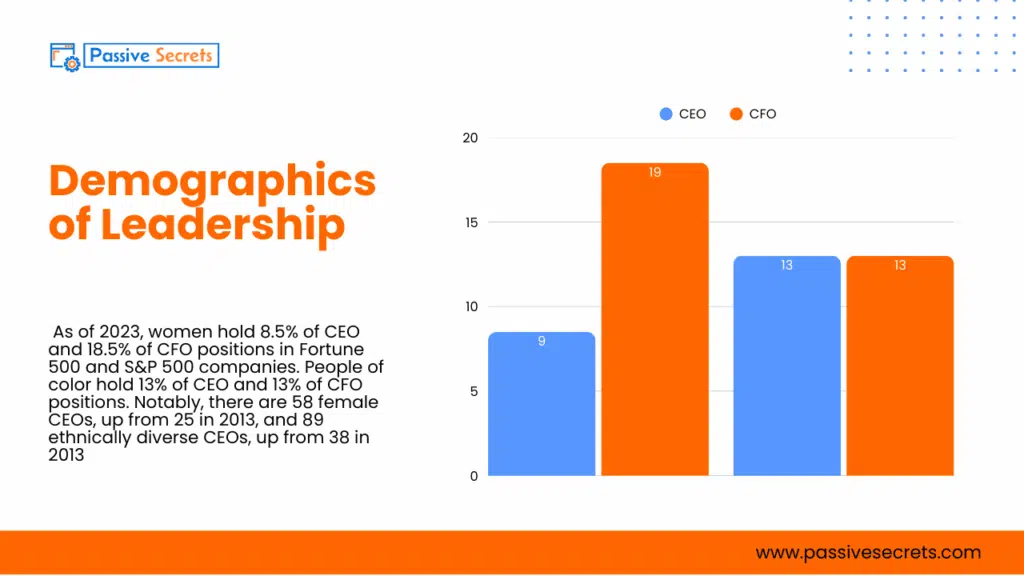
12. As of 2023, women hold 8.5% of CEO and 18.5% of CFO positions in Fortune 500 and S&P 500 companies. People of color hold 13% of CEO and 13% of CFO positions. Notably, there are 58 female CEOs, up from 25 in 2013, and 89 ethnically diverse CEOs, up from 38 in 2013 (source).
13. In a 2022 LinkedIn survey, 30% of education sector leaders in India were women, compared to just 14% in real estate (source).
14. According to the 2023 US Bureau of Labor Statistics, Latinx/Hispanic individuals hold 6.3% of chief executive positions, Black executives hold 5.2%, and Asian American executives hold 7.3%, which slightly exceeds their proportion of the US population (source).
Challenges in Leadership
15. Executives ranked economic uncertainty (59%), talent availability (57%), and technological change (54%) as top threats to organizational health in the next 12-18 months (source).
16. 57% of leaders see talent/skills availability as a top threat, but only 40% feel prepared to address it. 95% of CEOs/C-suite leaders believe their employees’ skills need updating, with 89% saying senior leaders themselves require a skills transformation (source).
17. 42% of leaders consider workforce transformation a top threat, but only 38% feel prepared, making it the threat they feel least equipped to handle, with technology being the main driver for transformation (source).
18. Increased regulation rose to a top-five concern for leaders in 2024, with 40% citing it as a major threat, particularly in financial services (58%), yet preparedness dropped to 54%, an 11-point decline in one year (source).
19. 59% of global leaders see economic uncertainty as a top threat, but only 41% feel prepared to face it, with leaders in professional services (70%) and consumer sectors (68%) being particularly concerned (source).
20. A Gartner survey of 805 HR leaders found that 75% reported managers feeling overwhelmed by increasing responsibilities, and 69% believed leaders/managers are ill-equipped to lead change (source).
21. Private equity firm leaders cite portcos’ top challenges as meeting value creation milestones (64%), achieving top-line growth (56%), and optimizing operational effectiveness/margins (42%) (source).
22. C-suite executives overwhelmingly agreed on key challenges, including adapting to constant change (89%), business reorganization (89%), and shifting to remote/hybrid work models (86%), with attracting and retaining talent being the top concern (87%) (source).
23. Executives also widely cited challenges unrelated to change, including assessing employee skills (86%), boosting motivation and productivity (86%), enhancing well-being (85%), improving teamwork (85%), and advancing diversity, equality, and inclusion (83%), all of which can be addressed through robust leadership development (source).
24. 31% of managers encounter defensiveness from their team members (source).
25. 38% of managers find it challenging to have tough conversations with their team members (source).
26. 67% of global L&D leaders pinpointed leadership skills as a major skills gap (source).
27. Americans perceive significant barriers for women in leadership in various sectors: corporate America (62%), government (55%), and business (50%). In contrast, startups are seen as more equitable, with 43% believing men and women have equal opportunities, although women still face obstacles (source).
Leadership Development Statistics
28. 45% of managers believe their company is not adequately developing future leaders (source).
29. 36% of managers are dissatisfied with leadership development opportunities, while 42% are satisfied. Additionally, 40% are satisfied with access to learning/development, but 24% are dissatisfied (source).
30. Leadership development training programs will prioritize skills like increasing productivity (44%), improving customer experience (44%), anddeveloping business acumen (43%) (source).
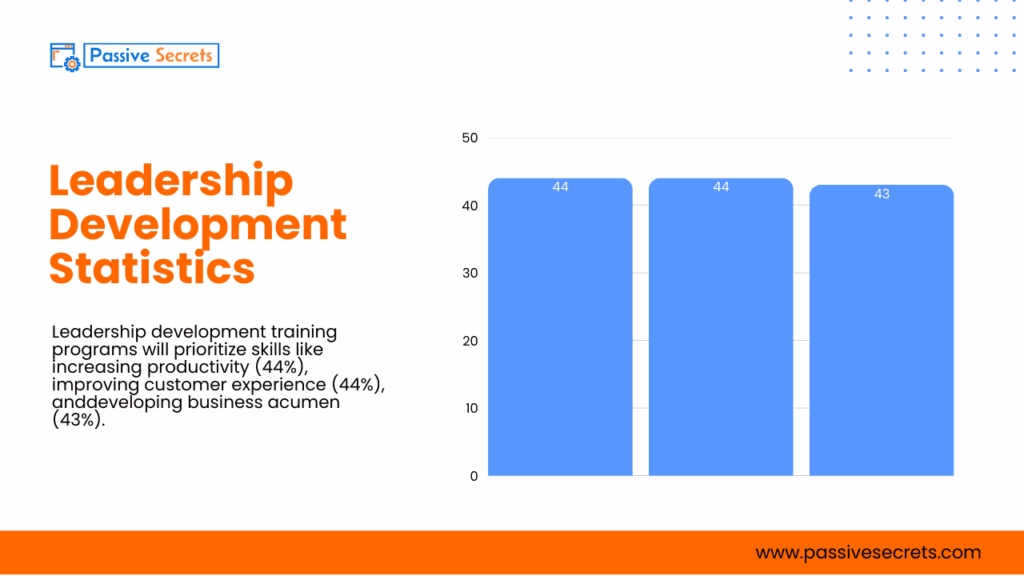
Other areas of focus include leading change (40%), promoting innovation (37%), and improving employee engagement (36%). Notably, there’s a growing emphasis on leaders’ tech savviness, with 33% planning to increase focus on this area.
31. 80% of executives believe that leadership development should be a top priority (source).
32. 39% of surveyed executives reported no change in their organization’s leadership development spending over the past year, while 18% said their organization didn’t allocate any funds for leadership development (source).
33. 89% of leaders faced difficulties implementing leadership programs, with the main obstacle being a lack of interest in participation among potential attendees (source).
34. Although C-suites face similar challenges, their approaches to leadership development vary significantly. The most common training programs used by respondents in the past year include diversity training for non-leadership roles (50%), minority representation in leadership (41%), and women in leadership development (34%) (source).
35. 71% of leaders reported that coaching positively influenced their desire to remain with their organization (source).
36. According to L&D professionals and functional leaders, leadership training programs focus on: automating projects (50%), integrating GenAI/machine learning (43%), enhancing corporate culture (40%), and fostering innovation (38%) (source)
37. 70% of L&D professionals and leaders believe it’s crucial for leaders to develop a broader range of effective leadership skills to meet current and future business demands (source)
38. 30% of employees find their training highly rewarding, but 70% want more. Meanwhile, 16% received no training in the past year, with 25% of those citing a lack of training programs (source).
39. 89% of workers would be motivated by tailored training for their role, with leadership and soft skills training being most desired. Additionally, 69% want guidance on navigating workplace dynamics, but 54% distrust HR’s ability to support their interests (source).
Women In Leadership Statistics
40. In Germany, 2023 saw the highest percentage of women leaders in healthcare (37%), trade, and publishing (source).
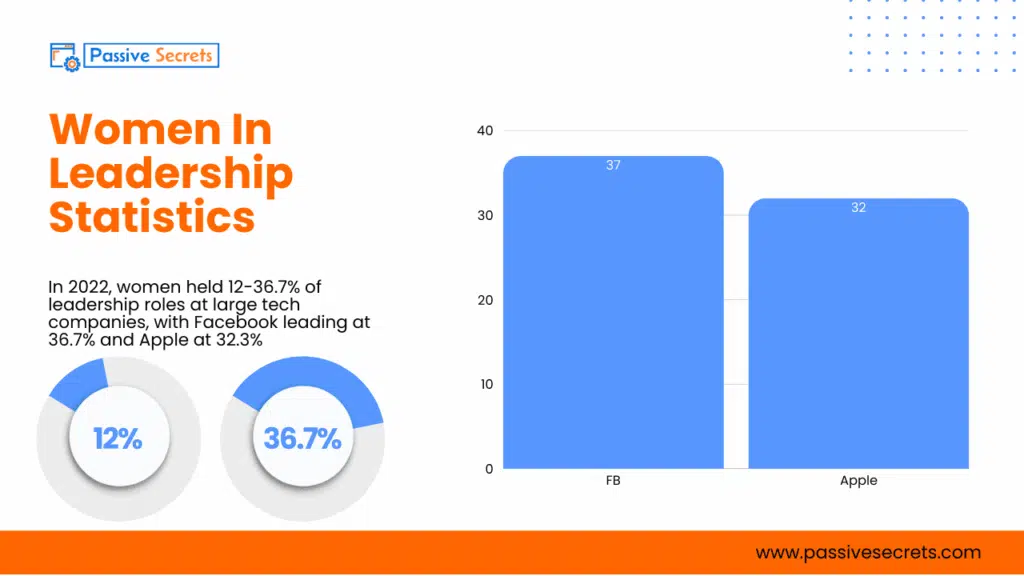
41. In 2022, women held 12-36.7% of leadership roles at large tech companies, with Facebook leading at 36.7% and Apple at 32.3% (source).
42. In a 2024 UK survey, 53.5% of marketing directors or CMOs were women, with the highest share in B2B companies at 55.5% (source).
43. In 2023, Japan’s national advisory councils and committees had the highest share of women leaders at 43%, while women held only 7% of director-level positions among national public employees (source).
44. The share of female tech leaders rose from 8% in 2015 to 14% in 2023, but remained stagnant from 2022 (source).
45. 83% of people consider equal gender representation important, with only 5% disagreeing. Additionally, 68% are satisfied with the number of women in leadership roles within their organization (source).
46. In a survey, respondents believed empathy helps women (47%) more than men (40%) advance in leadership. Attractiveness was seen as more beneficial for women (41%) than men (27%). Assertiveness was considered helpful for both, but more so for men (73%) than women (63%) (source).
47. Women occupy just over 10% of leadership roles at Fortune 500 companies, with a record-breaking 52 female CEOs at the helm of these top businesses (source).
48. 24% of Americans report no women in leadership positions at their company, and only 34% say their workplace prioritizes having women in leadership roles (source).
49. 96% of Americans believe men and women are equally qualified to lead businesses, and 82% consider it highly important for women and men to have equal career advancement opportunities (source).
50. Americans recognize that workplace culture and biases hinder women’s advancement, citing male leadership traditions (92%), expectations of prioritizing family (89%), and doubts about women’s leadership abilities (78%) as significant barriers (source).
51. Women occupy 25.1% of senior leadership roles, a slight increase from 24.0% in 2022 and 23.0% in 2021 (source).
52. Women hold 29% of revenue-generating management roles, such as sales and production, which have profit and loss responsibility, up from 27.6% in 2022 and 27% in 2021 (source).
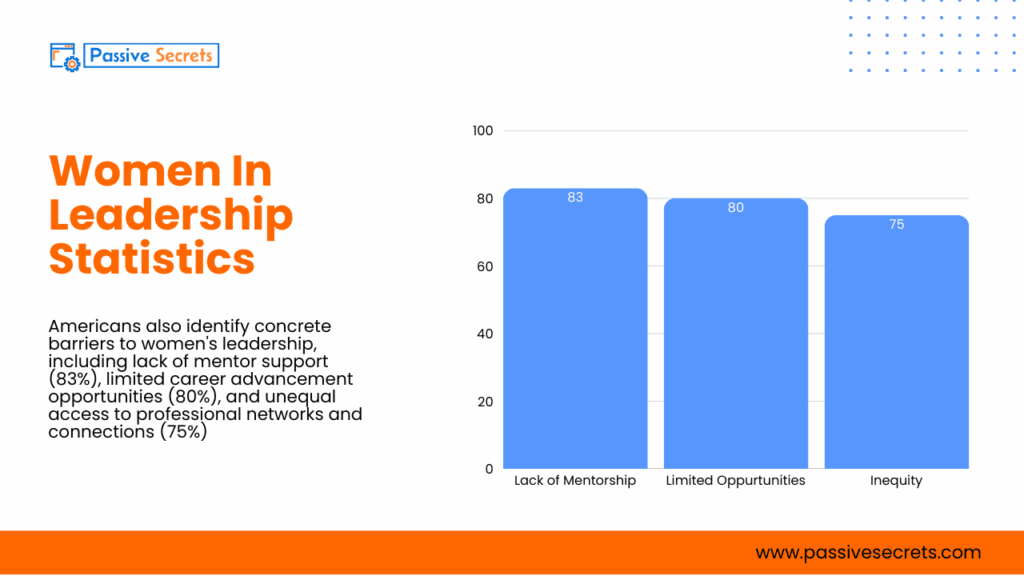
53. Americans also identify concrete barriers to women’s leadership, including lack of mentor support (83%), limited career advancement opportunities (80%), and unequal access to professional networks and connections (75%) (source).
54. 52% of men feel they have opportunities to advance to leadership, compared to 38% of women. Additionally, 85% of Americans (including 79% of men and 90% of women) believe it’s easier for men to reach top leadership positions than equally qualified women (source).
55. 81% of Americans are confident in their daughter’s ability to succeed in a leadership position, and 76% believe female role models would be helpful. However, only 60% think it’s realistic for her to actually reach a top position, acknowledging the barriers women face in business (source).
56. 88% of Americans believe businesses should provide career development resources to female employees, and 84% think businesses should actively recruit women for leadership positions, with similar views held by both men and women (source).
57. Majorities believe having more women in leadership would positively impact the workplace by: reducing the pay gap (76%), changing policies to benefit both men and women (74%), and attracting a more diverse workforce (71%) (source).
58. More Americans believe humans will colonize Mars (26%) or space travel will become routine (40%) within their lifetime than think half of Fortune 500 CEOs will be women (source).
59. 67% of Americans consider the presence of women in leadership important when choosing a workplace, rising to 76% among women, indicating that promoting female leadership can aid in recruiting and retaining top talent (source).
Impact of Technology on Leadership
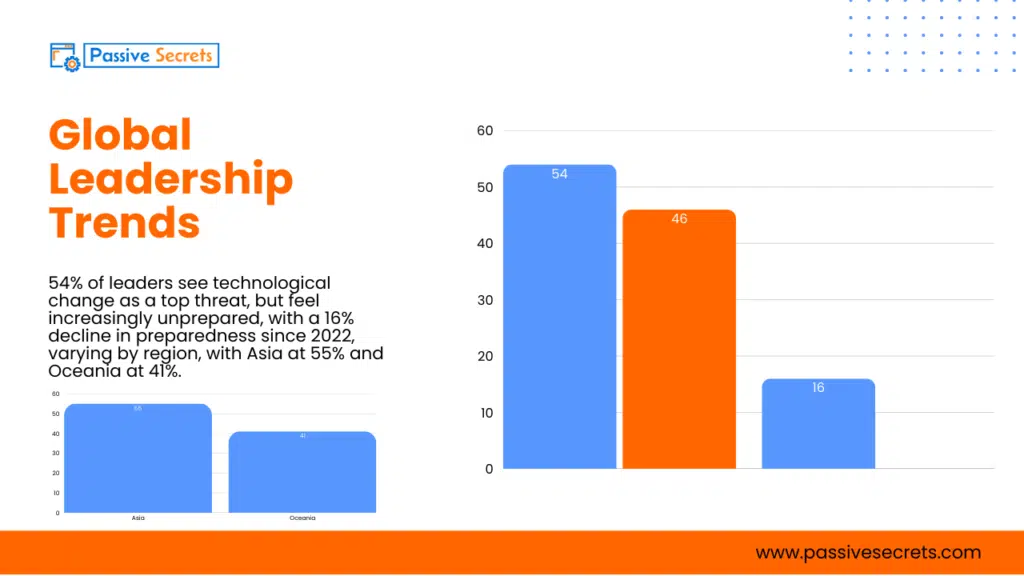
60. 54% of leaders see technological change as a top threat, but feel increasingly unprepared, with a 16% decline in preparedness since 2022, varying by region, with Asia at 55% and Oceania at 41% (source).
61. 55% of HR leaders feel their current HR tech solutions don’t meet business needs, while 46% believe these solutions actually hinder the employee experience (source).
62.60% of surveyed L&D buyers and functional leaders plan to moderately or extensively incorporate AI into their leadership training programs (source).
63. 82% of leaders recognize the need for their workforce to develop new skills to effectively collaborate with AI (source).
Global Leadership Trends
64. In 25 of 28 countries surveyed, most respondents believed their country needed a strong leader to take power back from the rich and powerful, with Romania and Indonesia showing the strongest support (source).
65. In 2022, only 34% of people felt the social climate encouraged leadership, while the same percentage considered leadership too risky due to the social climate. Additionally, 45% believed social media makes leadership more difficult, and nearly half think social media lowers expectations of leaders (source).
66. The executive coaching certification market is expanding rapidly, projected to increase from $9.2 billion in 2023 to $10.39 billion in 2024, representing a 12.9% compound annual growth rate (CAGR). By 2028, the market is expected to reach $16.16 billion, with a CAGR of 11.7% (source).
67. The Leadership Development Program market is projected to grow significantly, increasing from$3.9 billion in 2023 to $7.5 billion by 2033, at a compound annual growth rate (CAGR) of 6.3% (source).
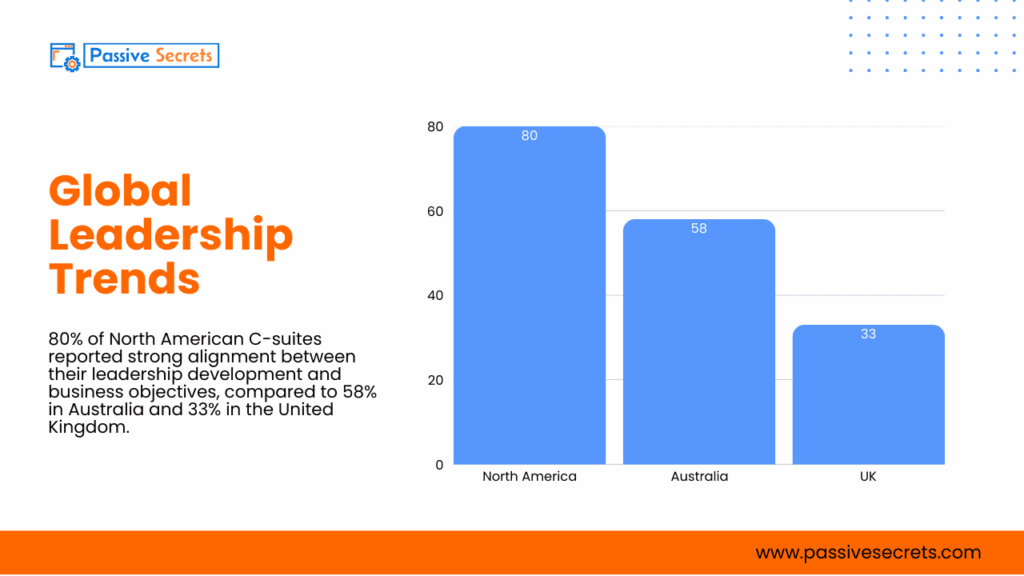
68. 80% of North American C-suites reported strong alignment between their leadership development and business objectives, compared to 58% in Australia and 33% in the United Kingdom (source).
Conclusion
As we’ve seen through these leadership statistics, effective leadership requires intentional efforts. By understanding the trends, challenges, and opportunities in leadership development, businesses and individuals can take steps to cultivate leadership excellence.
As we move forward in 2026 and beyond, one thing is certain: the organizations that prioritize leadership development, diversity, and innovation will be the ones that thrive.
Hopefully, we get to see more women in leadership positions.
By leveraging these statistics and insights, you can position yourself – and your organization – for success in an ever-changing world.
FAQs

Other Related Statistics You Should Know:
- 101 Billionaire Statistics: Surprising Insights About The World’s Wealthiest
- Business Loan Statistics: Trends Reshaping Funding for Millions of Small Businesses
- 70+ AI in Education Statistics That Prove the Future Is Already Here
- Women in Leadership Statistics: Insights into Global Gender Representation
- Soft Skills Statistics: Key Data on Demand, Training, and Impact
- 95+ Fascinating Gift Industry Statistics to Surprise and Delight
- Top Business Coaching Statistics & Trends Every Leader Should Know
- How Much Are People Saving? Key Personal Savings Statistics Explained
- 40+ Useful Procrastination Statistics To Help You
- 90 Amazing Millionaire Statistics & Facts You Dare Not Miss
- 50+ Latest Life Coaching Statistics And Huge Trends
- 30+ Useful Real Estate Photography Statistics and Trends You Need to Know
- Data-Driven Decision-Making Statistics: Trends, Benefits & Challenges
- 54 Incredible Goal-Setting Statistics To Help You
- 80+ Franchise Statistics and Facts You Should Know
- 90+ Interesting Film Industry Statistics (NEW Report)
- The Ultimate Creator Economy Statistics Report: Trends, Tools, and Income
- 125+ Interesting Airbnb Statistics by Country (Deep Insights)
- The Most Important Wealth Management Statistics You Can’t Afford to Ignore
- 45+ Interesting Communication Skills Statistics & Huge Trends
- Body Language Statistics & Fun Facts To Boost Your Communication Skills
- 35 Interesting Public Speaking Fear Statistics & Fun Facts
- 25+ Most Interesting Emotional Intelligence Statistics & Fun Facts