
Nearly two in three marketers are looking for a new job or open to one. If you lead a team or run an organization, that number should stop you in your tracks.
Yet three in four marketers say finding a job is harder than it was two years ago. So your people want out, but the market is tough. More than four in ten say their company laid off marketing staff in the past year. Most feel they are doing the work of more than one person.
Add AI changing how teams work, entry-level roles shrinking and pay climbing, and one thing is clear. Hiring, keeping, and paying marketing talent is getting harder to get right. Guess wrong, and you could lose top talent or overpay for the wrong hires.
These marketing jobs statistics for 2026 show you where demand is growing, where it is falling, and what marketers want next. Read on and make your next move with facts.
Key Marketing Job Statistics (Editor’s Top Picks)
- About 454,800 people work as advertising, promotions, and marketing managers in the US.
- Manager jobs in this group are set to grow 6% by 2035, twice the average for all occupations.
- Marketing manager jobs will grow 7% by 2035, while advertising and promotions manager jobs will fall 4%.
- Marketing managers earn a median of $166,790, over three times the median for all US workers.
- Product Marketing is the highest-paying discipline, with a median advertised salary of $162,001.
- 75% of marketers say finding a job is harder than it was two years ago.
- Marketers who found a job after a layoff took 5.2 months on average.
- 43% of marketers say their company laid off marketing staff in the past year.
- Entry-level was the only marketing job level to shrink, down 4.0% year over year.
- 47% of marketers say AI is heavily reshaping their team’s work, yet only 11% report AI replacing workers.
- 92% of marketers expect AI to become more important within five years.
- Workers with AI skills earn a 62% wage premium.
- Communication is the top skill for marketers, rated important by 88%.
- 63% of marketers are looking for a new role or are open to one.
- 76% of marketers feel they do the work of more than one person.
Marketing Job Market Statistics
1. About 454,800 people worked as advertising, promotions, and marketing managers in 2025. This included 421,600 marketing managers and 33,200 advertising and promotions managers.
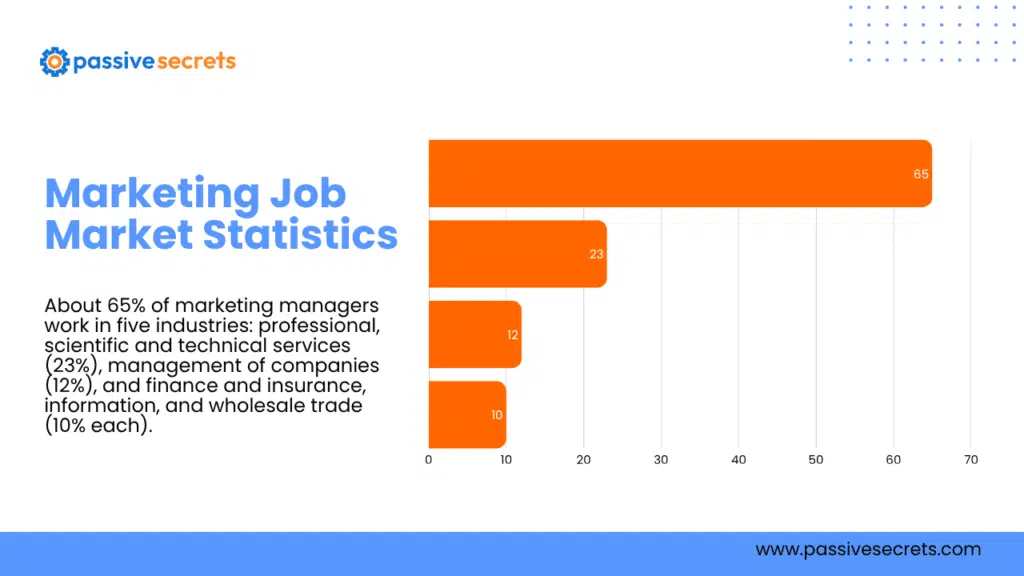
2. About 65% of marketing managers work in five industries: professional, scientific, and technical services (23%), management of companies (12%), and finance and insurance, information, and wholesale trade (10% each).
3. 35% of advertising and promotions managers are self-employed, while another 27% work in advertising, public relations, and related services. BLS salary figures exclude self-employed workers, so the $133,660 median does not cover more than a third of this group.
4. The US marketing consulting industry employs 619,530 people as of 2026, with employment growing by an average of 4.8% annually between 2021 and 2026. The average US marketing consulting business employs 1.8 people, more than it did five years ago. However, revenue per employee has declined over the same period.
5. Over 405,911 marketing specialists are currently employed in the US.
6. Marketing specialists are 48% more likely to work at public companies than private companies.
Marketing Job Growth and Outlook Statistics
7. Employment across the group is projected to grow 6% from 2025 to 2035, twice the 3% average for all occupations. This would add about 27,900 jobs, bringing the total to 482,700.
8. Marketing manager employment is projected to grow 7% by 2035, adding 29,100 jobs. BLS expects continued demand as businesses use marketing campaigns to grow market share and seek advice on pricing and reaching customers.
9. Advertising and promotions manager jobs are projected to fall 4% by 2035, a loss of about 1,200 jobs. BLS points to AI speeding up digital ad creation and testing, along with ad blockers reducing demand.
10. The field is expected to have about 36,300 job openings each year over the next decade. Many will replace workers who change careers or leave the workforce, rather than represent new jobs.
Marketing Hiring Trends in 2026
11. Active in-house marketing listings reached 86,628 in Q2 2026, up 0.4% from Q1. Listings rebounded in January, peaked in April, and declined through May and June, but remained above early-year levels.
12. Live listings reached 36,086 by June 29, up 7.1% year over year but down 3.6% from Q1-end. Hiring cooled slightly from its spring peak but remained ahead of last year.
13. 24,042 employers hired for marketing roles, up 2.3% from Q1, while new postings fell 5.1% to 53,961. More employers are hiring, but each appears to be advertising fewer roles.
14. Only 55.6% of marketing listings disclosed salaries, up 2.8 percentage points from a year earlier but slightly below Q1. Pay transparency appears to have stalled, leaving many roles without published salary ranges.
15. The average job posting remained active for 41 days at quarter-end, one day longer than both a year earlier and the end of Q1. Taligence sees this as a sign of slightly slower hiring.
16. According to the Content Marketing Institute, 75% of employed marketers say finding a job is harder than two years ago, up from 54% in 2024. Just 1% say it’s easier, showing how sharply the job market has worsened.
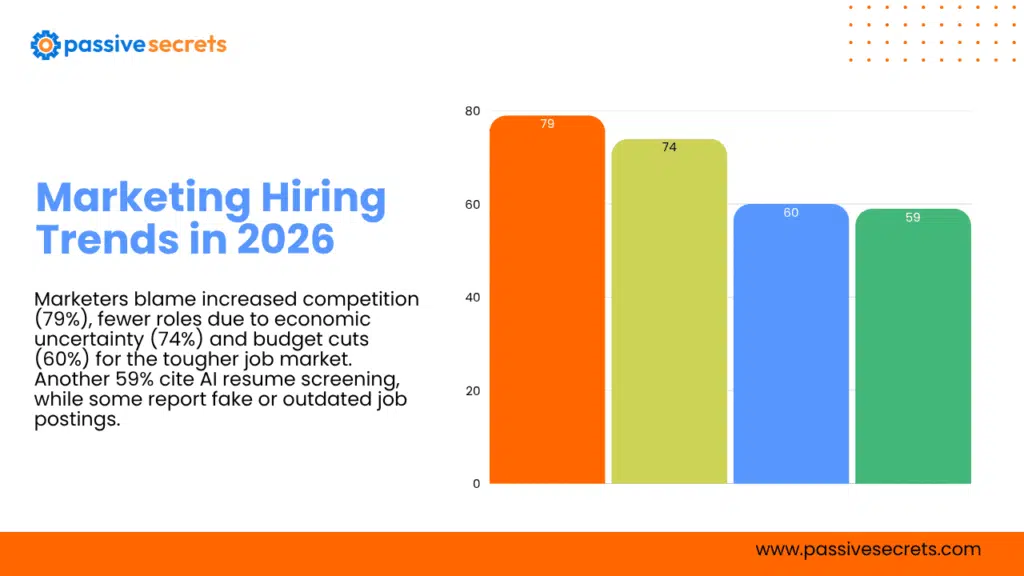
17. Marketers blame increased competition (79%), fewer roles due to economic uncertainty (74%), and budget cuts (60%) for the tougher job market. Another 59% cite AI resume screening, while some report fake or outdated job postings.
Marketing Salary Statistics
Average and Median Marketing Salary
18. Advertising, promotions and marketing managers earned a median $165,780 in 2025, or $79.70 an hour. That’s more than three times the $50,980 median for all US workers.
19. Marketing managers earned a median of $166,790 in May 2025, compared with $133,660 for advertising and promotions managers. Although BLS groups them, their pay differs.
20. The top 10% of marketing managers earned over $293,610, while the bottom 10% earned less than $90,260. For advertising and promotions managers, the figures were over $286,240 and under $63,300. Pay varies by experience, responsibility, performance, and location.
21. Marketing specialists in the United States earn an average of $67,585 per year, based on 4,700 salaries reported in Indeed job postings over the past 36 months.
Highest-Paying Marketing Jobs
22. Product Marketing had the highest median advertised salary at $162,001. Field Marketing recorded the biggest annual pay increase at 37.4%, followed by Growth Marketing (14.3%) and General Marketing (13.5%).
23. Marketing managers earn the most in information, with a median salary of $192,600. Next are management of companies ($172,580), finance and insurance ($172,350), professional and technical services ($170,050), and wholesale trade ($165,630).
24. Wholesale trade offers the highest median pay for advertising and promotions managers at $217,430. Management of companies follows at $173,780, then information at $143,110 and advertising and PR services at $133,550.
25. Marketing managers earn a median of $166,790, more than most related roles. Sales managers earn $148,270, PR and fundraising managers $136,470, art directors $114,850, and market research analysts $78,760. Financial managers come close at $166,570.
26. The average salary for a marketing research director is $122,215 in 2026. The base salary range is from $99,000 to $185,000, with between $2000 and $37,000 as a bonus.
Marketing Salary Growth
27. The median advertised salary reached $95,004, up 11.8% year over year. Salaries at the 25th percentile rose 13.1%, compared with 7.4% at the 75th. The shift toward senior roles accounts for some of this increase.
28. In CMI’s survey, average US marketing pay reached $126,175 in 2026, up about 16% from $108,380 in 2024. This outpaced cumulative inflation of roughly 5% to 6% over the same period.
29. In 2025, 67% of UK employers raised marketing salaries, and an equal percentage anticipate further pay increases in 2026.
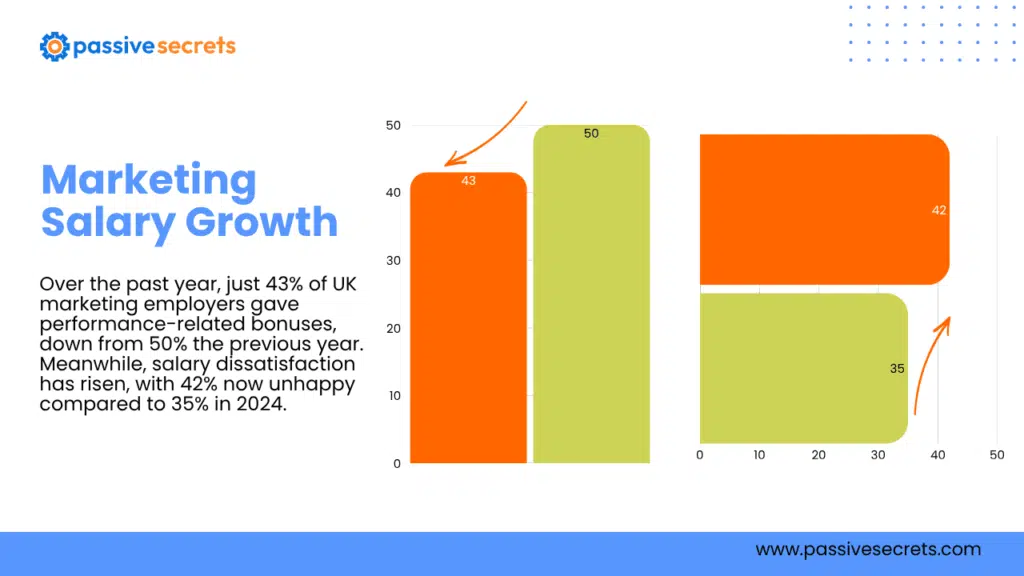
30. Over the past year, just 43% of UK marketing employers gave performance-related bonuses, down from 50% the previous year. Meanwhile, salary dissatisfaction has risen, with 42% now unhappy compared to 35% in 2024.
Most In-Demand Marketing Jobs
31. Influencer marketing roles grew 10% in 2024 and 18% in 2025, the fastest growth of any marketing role. Yet marketers ranked influencer marketing last among 37 skills for importance.
32. Partner & Channel Marketing led hiring growth at 32.5% year over year, followed by Growth (25.1%), Brand (23.8%), Content (21.8%), and Media (14.4%). Employers are favoring roles tied to customer acquisition and revenue.
33. According to a report, Account Manager, Ad Ops Specialist, and Associate Advertising Manager are Latin America’s most in-demand marketing jobs. They are followed by Community Builder, Content Manager, and Copywriter.
Entry-Level vs Senior Marketing Jobs
34. Entry-level jobs are shrinking in AI-exposed fields like marketing (Stanford, 2025). Anthropic’s CEO predicts AI could eliminate half of all entry-level jobs. With fewer internships available, the AMA recommends freelancing early and building a portfolio.
35. Active senior marketing listings rose 4.5% from Q1 2026 to 11,659, with 7,293 new senior roles posted, up 2.9%. Taligence says senior hiring has outpaced the wider market for more than a year.
36. Manager and Senior Manager roles have overtaken entry-level jobs as the largest segment of in-house marketing positions. This signals a shift toward mid-career hires.
37. Entry-level listings fell 4.0% year over year and 16.4% from Q1, making them the only level to decline. Meanwhile, EVP/SVP, VP, director, and Specialist/Senior Associate roles all grew by double digits year over year.
38. 49% of CEOs expect AI to reduce junior hiring over the next three years, compared with 12% who expect fewer senior hires (PwC Global CEO Survey). This points to greater challenges for people starting their careers.
39. One in three companies is cutting entry-level marketing hires, nearly 2.5 times the share increasing them. Meanwhile, leaders and managers expect team growth, with a net score of +22.3, pointing to stronger demand for experienced specialists.
Most In-Demand Marketing Skills
40. Marketers, in AMA’s survey, rank communication (88%), strategy (87%), critical thinking (84%), and creativity (81%) among their most important skills. Human skills have topped the list for the second year in a row.
41. AI’s importance for current marketing roles rose 14% year over year, while adaptability, collaboration, communication, and critical thinking fell by 4% to 7%. The AMA sees a mismatch: employers are reducing execution tasks, not the need for good judgment.
42. Marketers say their skills exceed job requirements in 46% of skill areas, up from 10% last year. This sharp rise may reflect overconfidence, especially in human skills that are difficult to assess objectively.
43. 92% of marketers expect AI to become more important within five years, ahead of innovation (88%), adaptability (87%) and marketing technology (87%). AI leads the list of future skills.
44. Brand management rose from 12th to 6th among today’s top marketing skills. The AMA links this rise to the flood of AI-generated content, which makes standing out more important. Email marketing fell in importance.
45. After the top three skill gaps, marketing technology and SEO tie at 0.26, followed by communication at 0.23. These are the next areas where marketers feel least prepared.
46. Customer experience and content marketing have the smallest gaps among the top 10 skills, at 0.14 each. Consumer behavior scores 0.13, while data privacy, compliance, and security score 0.12. Marketers feel better prepared in these areas.
47. AI rose from 23rd to 12th on the skills-gap list since 2024. The AMA reports that the gap score fell from 0.39 to 0.11 as confidence increased.
48. AI-related skills rank highly on the five-year list. Marketing technology ranks 4th (87%), data privacy, compliance and security 6th (84%), and data literacy and storytelling 8th (83%). As AI relies on data, these skills are becoming more important.
49. Among UK marketers, about 25% considered social media marketing to be the most overrated skill, while 20% ranked artificial intelligence second.
50. Of over 3,000 UK marketers surveyed, the primary skills shortage in marketing teams was in data and analytics, while 19.6% highlighted a lack of performance marketing skills as the next most significant gap.
51. Among UK marketers, about 33% felt that data analysis was the most undervalued marketing skill, while 16% viewed advertising and marketing technology (AdTech and MarTech) skills as the most undervalued.
52. Currently, 60% of marketing job openings require candidates to be skilled in at least one data tool, like GA4 or SQL.
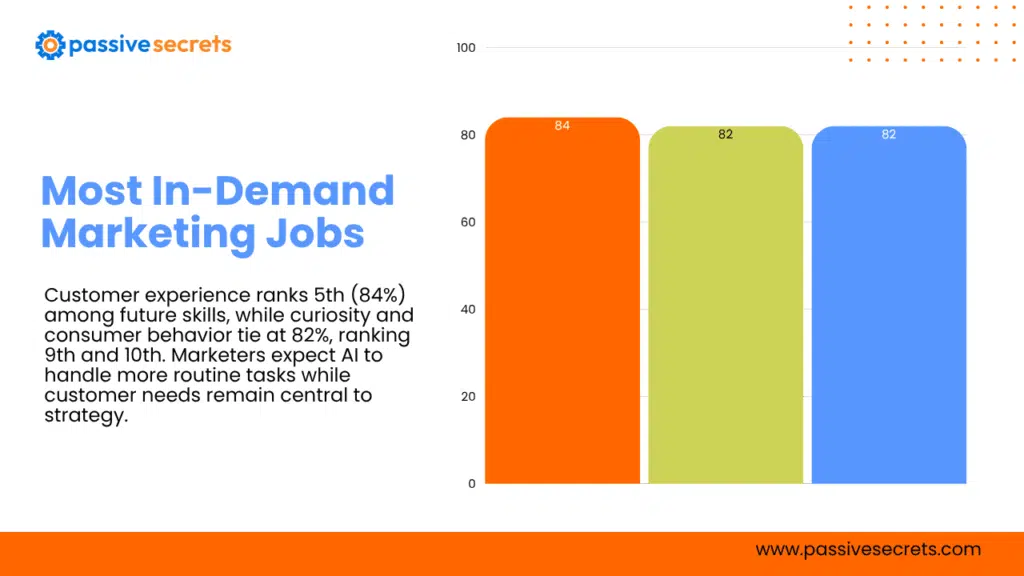
53. Customer experience ranks 5th (84%) among future skills, while curiosity and consumer behavior tie at 82%, ranking 9th and 10th. Marketers expect AI to handle more routine tasks while customer needs remain central to strategy.
54. Critical thinking ranks 7th (83%) for future importance, while leadership ranks 13th. Both sit around the middle of the skills-gap rankings, suggesting marketers value them and feel reasonably prepared.
55. In CMI’s study, 65% of marketers rank strategic and critical thinking as essential for future relevance, followed by AI skills at 59%, soft skills at 45% and creativity at 32%. Yet 85% expect to spend more time optimizing technology than doing creative work.
AI and Marketing Jobs Statistics
56. PwC classifies marketing managers as a “professionalised” job, where AI raises the level of expertise required. These roles may see growing demand, higher wages, and greater skill requirements.
57. Only 22% of advertised jobs worldwide are professionalised, compared with 52% that are “democratised” and 26% with low AI exposure. Professionalised roles use AI for basic tasks, leaving more complex work to people.
58. Professionalised job postings grew 39% between 2018 and 2025, compared with 17% for democratised roles. This suggests demand is growing faster for jobs that require greater human expertise.
59. Advertised salaries for professionalised roles rose 37% since 2021, compared with 26% for democratised roles. Pay grew 42% faster in professionalised jobs, with the gap widening after AI adoption surged in 2022.
60. Workers with AI skills earn a 62% wage premium, up from 57% in last year’s report. PwC compares advertised salaries for jobs requiring AI skills with similar roles that do not.
61. 47% say AI is significantly or extensively changing their team’s work, while only 4% report no impact. However, just 11% say their company has replaced workers with AI. Another 10% have hired AI-experienced staff, and 10% have created AI roles.
62. 75% expect greater use of AI for content creation and personalization within one to three years. Another 56% expect more demand for AI specialists, while 53% anticipate greater emphasis on data and analytics skills.
63. In companies heavily affected by AI, 45% report team cuts, compared with 30% elsewhere, and 27% are actively looking for jobs, versus 17%. AI skills are considered essential by 77% in these companies, compared with 43% in less affected organizations.
64. According to the Marketing Meetup survey, only 3% of marketers use no AI tools. ChatGPT leads at 68%, followed by Claude (49%) and Gemini (32%). The median marketer uses two tools, mainly for brainstorming (70%), writing (62%), and research (60%), rather than data analysis (42%) or strategy (29%).
65. The share of marketers who say AI saves them time rose from 38% to 46%, while those who love using it fell from 27% to 20%. Those still figuring it out more than doubled, from 10% to 22%, while those who are feeling behind fell from 15% to 5%.
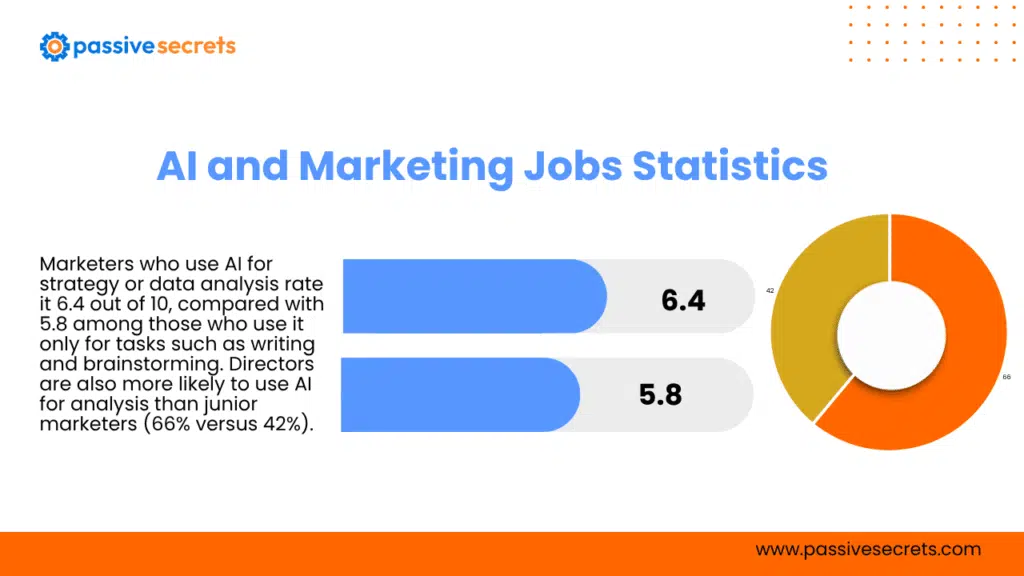
66. Marketers who use AI for strategy or data analysis rate it 6.4 out of 10, compared with 5.8 among those who use it only for tasks such as writing and brainstorming. Directors are also more likely to use AI for analysis than junior marketers (66% versus 42%).
67. There has been a 45% rise in demand for marketing professionals with AI skills, particularly in automation, analytics, and personalization.
68. 28% of clerical roles in advertising agencies are forecasted to be lost due to AI by 2030, followed by a 22% loss in sales-related roles.
Remote, Freelance, and Side Income Jobs Statistics
69. Remote jobs accounted for 13.6% of in-house marketing listings, down 1 percentage point year over year. The share peaked in early March before declining, which Taligence links to return-to-office policies and increased senior hiring.
70. Nearly one in four marketers freelance on the side, with leaders more likely to do so (26%) than individual contributors (20%). CMI’s Robert Rose says many use freelance work to stay relevant and keep their options open, not just to earn extra money.
71. 12% of leaders earn at least $30,000 a year from side work, while nearly a quarter of individual contributors earn less than $1,000. CMI suggests leaders may be earning from expertise that their full-time jobs do not fully reward.
Marketing Jobs by Location
72. North Carolina entered the top 10 hiring states, with listings up 14.3% year over year, replacing Virginia. New York led major markets at 19.0% growth, while Georgia recorded the fastest median salary growth at 25.0%.
73. San Francisco led major cities in marketing job growth at 30.9% year over year, ahead of New York (22.6%) and Boston (15.2%). Seattle was the only top-10 city to decline, down 13.4%, while Dallas led in salary growth at 18.1%.
74. Working in a major metro area brings a 14% pay premium for individual contributors and 9% for managers, but just 2% for directors and above. Individual contributors in major metros earn an average of $112,525, compared with $98,575 elsewhere.
75. In the fourth quarter of 2025, UK employment data showed that 184,000 people were employed in advertising and market research, with women generally outnumbering men in this sector.
76. The UK had approximately 975,300 sales, marketing, and related associate professionals in the second quarter of 2026, up from 964,700 in the previous quarter.
77. In June 2024, 4,226 marketing professionals were hired by various companies in India.
Marketing Workforce Demographics
78. Gen X marketers earn an average of $149,763, compared with $118,088 for millennials and $74,075 for Gen Z. Since 2024, pay has risen about 21% for Gen X, 18% for millennials, and 10% for Gen Z, widening the pay gap between older and younger generations.
79. In the U.S., male marketers earn an average of $140,213, compared with $123,488 for women, a gap of roughly 13%. Men are also more than three times as likely to earn $250,000 or more (6.8% versus 2.1%).
80. A survey of over 3,500 UK marketers highlighted several industry pay inequalities. Full-time female marketers earned, on average, 17.8% less than men, marketers from ethnic minorities earned 13.3% less than white colleagues, and those from working-class backgrounds earned 15.3% less than peers from upper-class backgrounds.
81. 64.5% of marketing specialists are women, and 35.5% are men.
82. The average age of a marketing specialist is 36 years old.
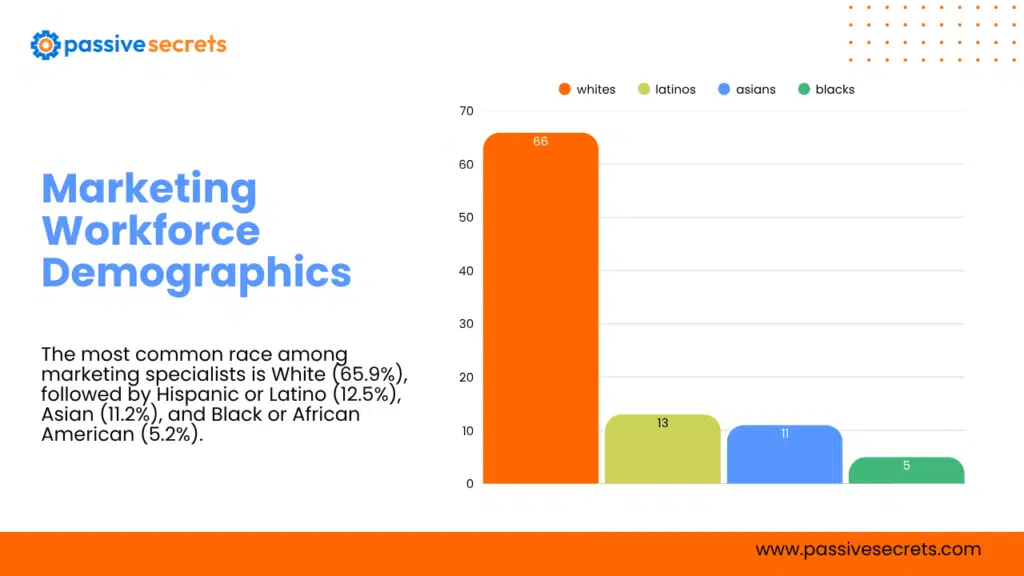
83. The most common race among marketing specialists is White (65.9%), followed by Hispanic or Latino (12.5%), Asian (11.2%), and Black or African American (5.2%).
84. 69% of marketing managers are women, while 31% are men.
Marketing Layoffs and Job Security
85. Job searches take an average of 5.2 months after a layoff, up from 3.1 months in 2024. This figure covers only 65 people who found jobs, so the actual time may be longer.
86. 43% of employed marketers say their company laid off marketing staff in the past year, up 30% in two years. Large companies are hit hardest, with layoffs reported by 62% of firms with 1,000+ employees, compared with 28% of firms with fewer than 100.
87. 45% of employed marketers worry about being laid off in the next 12 months. This includes those who are somewhat concerned, so it reflects job insecurity, not expected job losses.
88. 69% of marketers at companies that recently cut marketing staff worry about layoffs, compared with 27% at companies that haven’t made cuts. Recent layoffs appear to make job insecurity much more real.
89. 55% of marketers at companies with 1,000+ employees worry about layoffs, compared with 40% at midsize firms and 39% at small firms. This reflects the higher rate of cuts at large companies.
90. Gen X has the highest layoff concern at 50%, followed by millennials (45%) and Gen Z (35%). Baby boomers were excluded because the sample was too small. Gen X also earns the most on average. (CMI, 2026)
Marketing Team Hiring Plans
91. 62% expect their team size to remain unchanged over the next year, while 26% expect growth and 13% expect cuts. The report describes a cautious market, with most employers holding steady.
92. 45% of marketing and creative leaders say finding skilled professionals is harder than it was a year ago. Despite this, 65% planned to increase full-time hiring and 55% planned to hire more contract workers in the second half of 2026.
93. 52% of marketing and creative leaders say skills shortages delayed projects in the past year, while 40% report that projects were canceled. (Robert Half)
94. When recruiting, 72% of employers are willing to hire candidates who don’t have all the required skills, planning to train them on the job. Marketing professionals prefer this support to come in the form of employer-funded external courses (52%), structured career development with skill-building milestones (32%), and access to online learning platforms (27%).
95. Over 63% of UK marketers surveyed in 2025 said their companies outsourced some marketing activities to third parties. The figure was nearly 68% among B2B companies, compared with 60% among B2C companies.
96. A survey of content marketers in the United States found that 66.5% were frustrated with deciding where to allocate marketing resources in SEO and content marketing, while 41.9% struggled with finding skilled writers.
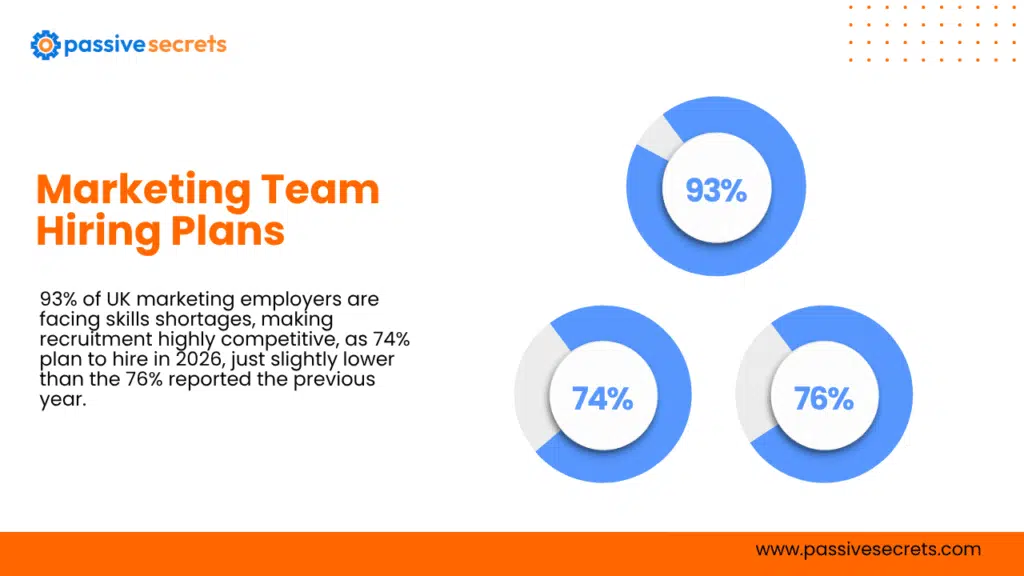
97. 93% of UK marketing employers are facing skills shortages, making recruitment highly competitive, as 74% plan to hire in 2026, just slightly lower than the 76% reported the previous year.
98. Surveying over 3,000 marketers in the UK, nearly half cited a lack of in-house skills as the primary reason for outsourcing marketing tasks, while 14% viewed it as a way to reduce costs.
Marketing Job Satisfaction and Job Switching
99. 75% of marketers are satisfied with their jobs, down slightly from 76% in 2024. However, 27% say their employer offers no career development, and only 25% are very satisfied with the opportunities available.
100. 63% of marketers are looking for a new role (26%) or open to one (37%), while just 37% are settled. The Marketing Meetup calls this a “Great Stay”: people are willing to move but struggle to find opportunities.
101. Burnout affects 39% of active job seekers, compared with 15% of settled marketers. Around a third of both senior leaders and junior marketers are actively job hunting, while agency marketers are the most settled.
102. Work-life balance (65%) and pay (60%) are the top reasons marketers would leave a job.
103. Marketers rate their pay satisfaction at 3.0 out of 5, with nearly a third unhappy with their pay. Junior marketers score 2.6 and owner-founders 2.8, while CXOs are most satisfied at 3.9.
104. One in five employed marketers has never had a pay review. They rate their pay 2.6 out of 5, compared with 3.4 among those reviewed in the past six months. The report sees regular pay discussions as a simple way for employers to improve satisfaction. (MMU, 2026)
105. Marketers rate optimism about their own roles at 5.6 out of 10 and the industry’s future at 6.1. Both scores fell from 6.3 and 6.9, respectively, in 2025. Junior marketers show the widest gap, scoring 5.3 for their own roles and 6.3 for the industry’s future.
Workload and Wellbeing
106. 76% of marketers feel they are doing more than one person’s job, 59% describe their workload as overwhelming, and 91% say they must do more without extra support. CMI calls this a “ghost workforce”. Half have taken on new duties without a raise or promotion.
107. Most advertising, promotions, and marketing managers work full time, and some work more than 40 hours a week. BLS notes that the job can be stressful, especially around deadlines.
108. The average workload score is 6.6 out of 10, with managers and directors reporting the highest at 6.9. Freelancers score lowest at 5.6, while only one in 10 marketers rate their workload at 3 or below.
109. 45% of marketers describe their working life as positively challenging, but many also report uncertainty (44%), chaos (39%), stress (38%), and feeling overwhelmed (36%). These feelings often overlap: 80% of those who feel positively challenged also report at least one difficulty.
110. 46% of marketers experience imposter syndrome. The figure rises to 62% among those with less than two years of experience and remains at 41% among those with 16 or more years. Owner-founders report a higher rate of 51%.
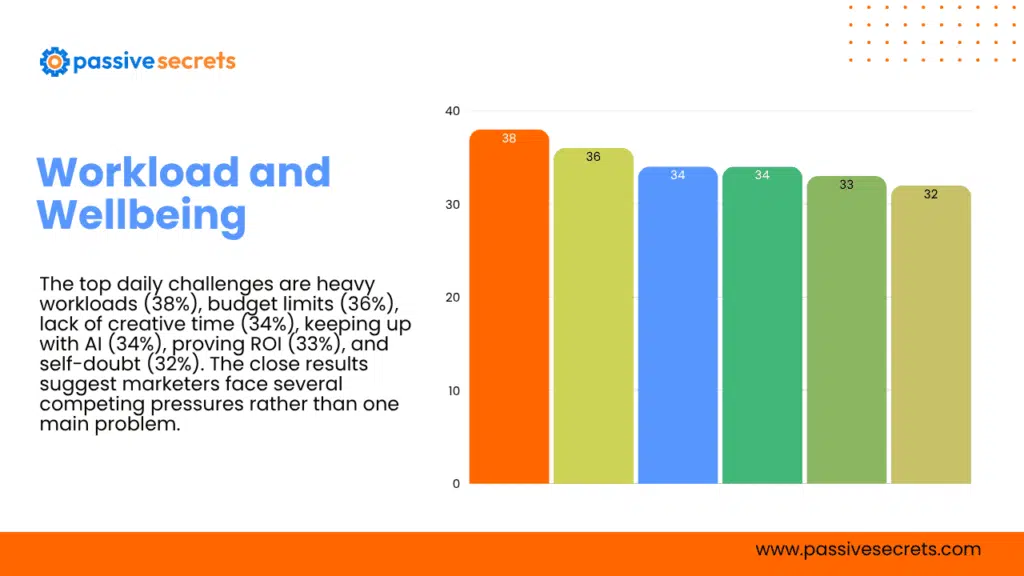
111. The top daily challenges are heavy workloads (38%), budget limits (36%), lack of creative time (34%), keeping up with AI (34%), proving ROI (33%), and self-doubt (32%). The close results suggest marketers face several competing pressures rather than one main problem.
112. Marketers rate their connection to the wider marketing community at just 4.7 out of 10, and a third score it 3 or below. Greater community connection is linked to higher career optimism, which rises from 5.0 to 6.3. Freelancers report the strongest connection at 5.5.
FAQs
Sources:
- The AMA State of Marketing Careers Report 2026
- Taligence: U.S. Marketing Jobs Report Q2 2026
- PwC: 2026 Global AI Jobs Barometer
- Content Marketing Institute: 2026 Content and Marketing Career and Salary Outlook
- U.S. Bureau of Labor: Advertising, Promotions, and Marketing Managers 2026
- The Marketing Meetup: The State of Marketers 2026
- IBISWorld: Marketing Consulting in the US – Employment
- Robert Half
- Zippia: Marketing Specialist Jobs
- Indeed: Marketing specialist salary in United States
- Payscale: Average Marketing Research Director Salary
- Hays: Highest Marketing Salary
- Hire with Near
- Statista 1
- Statista 2
- Statista 3
- Glozo: Marketing Salary Skills Report 2025
- Statista 4
- Statista 5
- Statista 6
- Statista 7
- Statista 8
- Career Explorer: Marketing manager demographics in the United States
- Statista 9
- Statista 10
- Statista 11
Other Related Statistics You Shouldn’t Miss:
- 30+ Powerful Team Building Statistics to Boost Workplace Performance
- Training Industry Stats & Trends for HR and L&D Professionals
- Global IT Outsourcing Statistics 2026: Key Trends and Insights
- 80+ Employee Benefit Statistics: Insights and Trends
- Important Wealth Management Statistics You Can’t Afford to Ignore
- Enterprise Data Management: Essential Statistics and Emerging Trends
- Talent Management Stats: Market Growth, Engagement, & Upskilling Trends
- Top Reputation Management Statistics and Trends to Improve Your Brand
- 36 Helpful Social Worker Burnout Statistics To Know
- 100 Business Process Outsourcing Statistics & Facts
- Top HR Outsourcing Statistics and Trends Every Business Must Know
- The Top Outsourcing Statistics You Shouldn’t Ignore
- 47+ Shocking 4-day Work Week Statistics To Know
- 105+ Supply Chain Statistics & Facts You Can’t Ignore
- 50+ Interesting Employer Branding Statistics And Trends
- Job Seekers Statistics: Unemployment Rates, Preferences, Challenges
- 95 Interesting Job Interview Statistics and Huge Trends To Know
- 60+ Helpful Change Management Statistics & Facts
- 65+ Employee Performance Management Statistics & Trends
- Workforce Management Statistics: Trends, Insights, & Opportunities
- 73 Revealing Workplace Distraction Statistics
- Workplace Romance Statistics: How Common Is Workplace Romance?
- 40+ Top Workplace Conflict Statistics You Should Know
- The State of Workplace Communication: Key Statistics and Trends
- 55 Workplace Collaboration & Teamwork Statistics
Written By: Diamond Okeke | Verified By: Valentine Okoronkwo
Last updated: November 12 2026 | Last verified: October 17, 2026 | Next review: July 2027

