
Love, connection, and companionship have always been at the heart of human life, yet how we form, sustain, and define relationships is evolving faster than ever.
In an age shaped by dating apps, shifting cultural norms, and growing independence, today’s relationships look very different from those of past generations.
From the rise of online dating and changing views on marriage to the growing acceptance of age gaps and the power of platonic friendships, modern love has become a fascinating mix of tradition and transformation.
The data tells a powerful story: fewer people are rushing into marriage, more are finding fulfillment in singlehood, and technology continues to redefine how people meet and connect.
This comprehensive look at relationship statistics uncovers how people around the world are navigating intimacy, friendship, and commitment in 2026, and what these numbers reveal about the future of human connection.
Key Relationship Statistics & Facts (Editor’s Pick)
- Globally, 76% of adults in 30 countries report feeling loved, with the highest rates found in Mexico (86%) and the lowest in Japan (55%).
- 82% of married or partnered adults report being satisfied with their relationship.
- One-fourth of Americans, including 35% of Generation Z individuals, state that they are not actively seeking romantic relationships.
- 80% of Americans say one can have a happy and fulfilling life without marriage.
- The global Dating Services market is anticipated to generate revenue of US$8.28 billion in 2025.
- Tinder was the world’s most downloaded dating app in April 2025, with 5.51 million monthly downloads.
- Gen Z and Millennials are showing interest in marriage, with 68% and 62% respectively, wanting to tie the knot.
- The US marriage rate is projected to decline to 5.8 per 1,000 people in 2025, down from 6.2 in 2022.
- Nearly half of US singles, 46%, are looking to settle into a long-term relationship.
- According to the US Census Bureau, 117.6 million Americans, or 46% of those aged 18 and above, are single.
- 68% of Americans perceive that the negative stigma around being single is fading, and 86% love having more time to pursue their interests.
- About two-thirds of romantic relationships begin platonically.
- Most Americans accept large age gaps in relationships—60% approve of women dating younger men, and 71% of men dating younger women.
- Less than 2% of people marry their high-school love interests.
- Loneliness increases the risk of heart attack, stroke, and premature death.
General Relationship Statistics
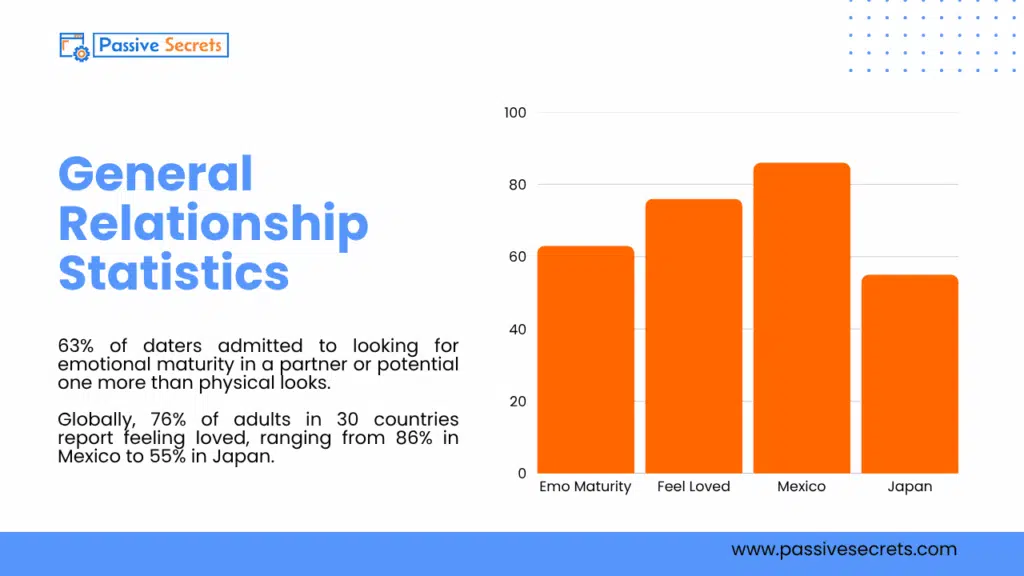
1. 63% of daters admitted to looking for emotional maturity in a partner or potential one more than physical looks. (source)
2. Globally, 76% of adults in 30 countries report feeling loved, ranging from 86% in Mexico to 55% in Japan. (source)
3. 82% of married or partnered adults report being satisfied with their relationship. (source)
4. There’s a 16% gap in satisfaction with feeling loved between high-income (83%) and low-income (67%) households. (source)
5. 76% of singles in the UK think the cost of living is pushing people to move in with partners for financial reasons. (source)
6. 77% of UK singles are open to compromising on their ideal match, prioritizing traits like shared interests (38%), job (30%), and politics (27%). However, over a third would rather wait for someone who meets all their criteria. (source)
7. One-third (33%) of daters are now more open to dating people from other cities. (source)
8. A significant majority (76%) of survey respondents reported experiencing or initiating “ghosting” in dating. Nearly 60% claimed to have been ghosted, and 45% admitted to ghosting others. (source)
9. Statistics show that 44% of men and 47% of women have engaged in ghosting behavior. Interestingly, 64% of men admitted to being ghosted themselves compared to 57% of women. (source)
10. One-fourth of Americans, including 35% of Generation Z individuals, state that they are not actively seeking romantic relationships. (source)
11. 80% of Americans say one can have a happy and fulfilling life without marriage. Also, half of single Americans explicitly say they prefer to be alone and that singlehood is the most meaningful, authentic, and fulfilling way of life. (source)
12. A significant majority (80%) of Americans consider finding a suitable romantic partner more challenging than finding the right job. (source)
13. In Germany, both men (59%) and women (almost 65%) expressed a general interest in topics related to relationships and romantic partnerships. (source)
Age Gap in Relationships Statistics
14. 39% of Americans have previously dated someone with an age difference of 10+ years. (source)
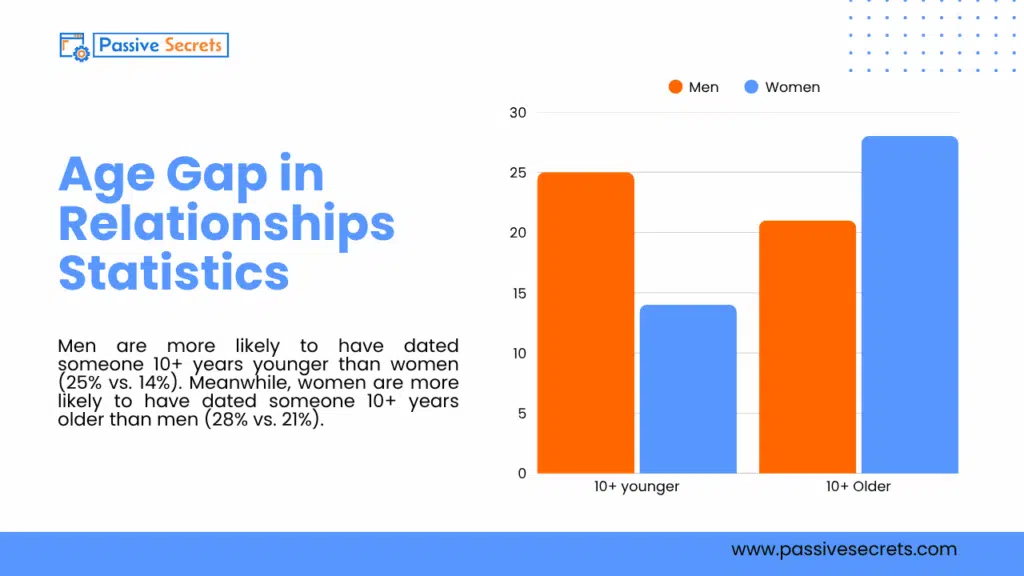
15. Men are more likely to have dated someone 10+ years younger than women (25% vs. 14%). Meanwhile, women are more likely to have dated someone 10+ years older than men (28% vs. 21%). (source)
16. Many single Americans are interested in age-gap dating, with 57% stating they would date someone 10 years older than them and 49% saying they would date someone 10 years younger. (source)
17. Unmarried Americans 35 and older are more likely than those under 35 to date someone 10 years younger than them. (source)
18. Most Americans accept large age gaps in romantic relationships, with 60% believing it is acceptable for a woman to date a younger man and 71% approving of a man dating a younger woman. Older Americans are generally more accepting of such age gaps in heterosexual relationships, with 75% of those over 35 approving of large age differences. (source)
19. Men and women hold similar views on the acceptability of men dating younger partners (72% of men and 70% of women). However, men are slightly more likely (65%) than women (56%) to find it acceptable for women to date younger men. (source)
20. Physical attractiveness (39%) and open-mindedness (37%) are the top perceived benefits of dating younger. Men (46%) are more likely to mention physical attractiveness as a major advantage than women (33%). (source)
21. Emotional maturity (55%) and financial freedom (44%) are the top perceived benefits of dating older. (source)
22. Americans cite having nothing in common (25%) as the top perceived barrier to age-gap dating. However, of the potential obstacles, nearly half (45%) said none. (source)
23. Concern over social judgment in age-gap relationships decreases with age. Younger Americans (ages 18-34) are more likely (24%) than their older counterparts (14% of 35-54 and 6% of 55+) to worry about societal perceptions. (source)
24. The average age difference in US heterosexual relationships was only 2.3 years. Many couples have a significantly wider gap. (source)
25. According to the study, neither the age at which individuals marry nor the year the marriage occurs significantly impacts marital satisfaction. (source)
High School Relationship Statistics
26. Almost three-quarters of US teens (72%) have used AI companions, and 13% of them chat with AI every day. (source)
27. Less than 2% of people marry their high-school love interests. Also, for those who do marry, only half of them mark their 10-year anniversary. (source)
28. Among teens aged 13-17, only about 1 in 3 have dated or been in a romantic relationship, and fewer than 1 in 5 are currently in a romantic relationship. (source)
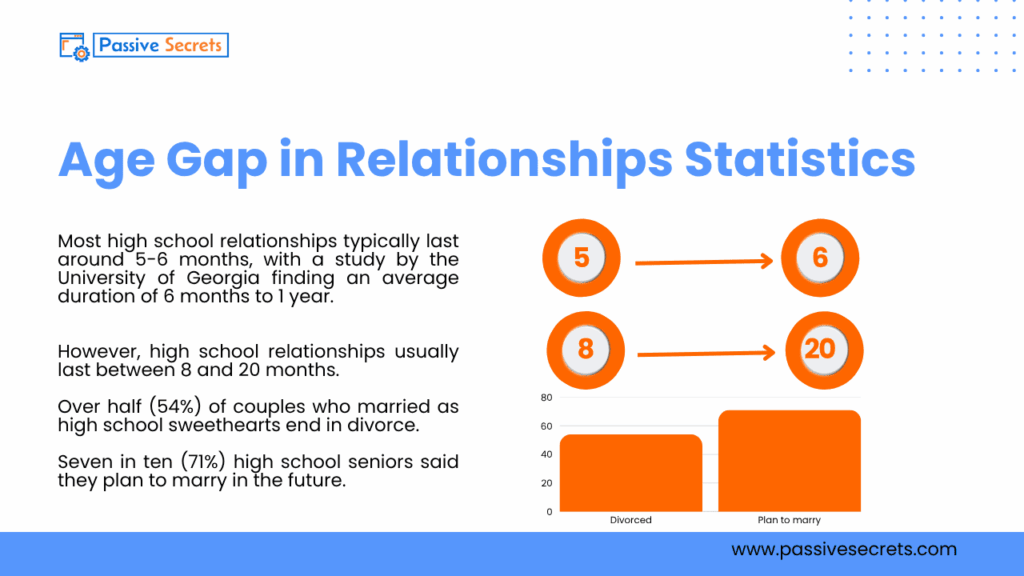
29. Most high school relationships typically last around 5-6 months, with a study by the University of Georgia finding an average duration of 6 months to 1 year. (source)
30. However, high school relationships usually last between 8 and 20 months. (source)
31. Over half (54%) of couples who married as high school sweethearts end in divorce. (source)
32. Seven in ten (71%) high school seniors said they plan to marry in the future. (source)
Platonic Relationship Statistics
33. About 80% of US teens prefer spending time with real friends over AI, and most (two-thirds) find human interactions more fulfilling. (source)
34. More than half of Gen Z teens want to see more platonic connections or friendships in movies and TV rather than romance or sex scenes. (source)
35. About two-thirds of romantic relationships begin platonically. 66% of the surveyed adults stated that their current or most recent romantic connection began as a friendship. (source)
36. Almost half of the college students preferred to begin a romantic relationship as friends. (source)
37. Strong adult friendships promote well-being and protect against mental health issues like depression and anxiety, with benefits lasting a lifetime. (source)
38. People who have no or low-quality friendships are twice as likely to die early. (source)
39. Research suggests that loneliness—among those who lack solid friendships, romantic partnerships, or other relationships—increases the risk of heart attack, stroke, and premature death. (source)
40. In 2021, 12% of U.S. adults reported not having any close friends, up from 3% in 1990. (source)
Online Dating Statistics
41. The global Dating Services market is anticipated to generate revenue of US$8.28 billion in 2025. Between 2025 and 2029, revenue is expected to grow at a compound annual growth rate (CAGR) of 1.92%, reaching an estimated US$8.93 billion by 2029. (source)
42. The U.S. Dating Services market is forecasted to generate revenue of US$2.60 billion in 2025. From 2025 to 2029, revenue is expected to grow at a compound annual growth rate (CAGR) of 1.38%, reaching approximately US$2.75 billion by 2029. (source)
43. Tinder was the world’s most downloaded dating app in April 2025, with more than 5.51 million monthly downloads. In June 2024, it also led the dating app market in revenue, generating over US$82 million in monthly in-app purchases. Bumble followed in second place with over US$43 million, while Hinge ranked third with approximately US$26.2 million during the same period. (source)
44. There has been a 15% rise in US adults viewing online dating positively. Conversely, there’s been a 6% decline in the percentage of US adults associating online dating with desperation. (source)
45. Among all internet users, 19% are engaged with online dating platforms, while 27% have previously used them. Of those who have previously used online dating platforms, 36% claim to use them daily for various activities such as messaging, finding matches, or browsing profiles. (source)
46. Recent research suggests that approximately 67% of Tinder users are men, leaving around 33% as women. (source)
47. According to 61% of people using dating apps, the primary reason for doing so is to connect with individuals who share similar interests. 44% seek those with matching values and beliefs, and 42% are looking for a partner for marriage.
Also, 26% of daters use an online dating app to meet someone just to have non-committal fun, and 21% of daters use an online dating app to meet someone because they have a challenging schedule. (source)
48. 84% of online daters want a romantic relationship, while 24% want a sexual relationship. (source)
Marriage Statistics
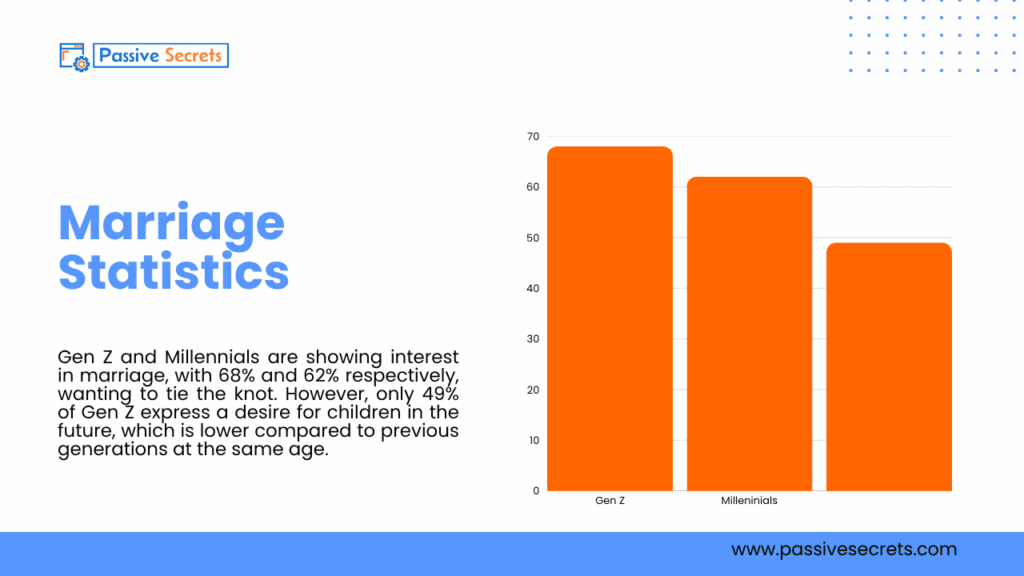
49. Gen Z and Millennials are showing interest in marriage, with 68% and 62% respectively, wanting to tie the knot. However, only 49% of Gen Z express a desire for children in the future, which is lower compared to previous generations at the same age. (source)
50. The US marriage rate is projected to decline to 5.8 per 1,000 people in 2025, down from 6.2 in 2022, with a further drop to 5.6 expected in 2026. This trend coincides with a record 20% of adults remaining unmarried. (source)
51. In 2025, Sri Lanka had the world’s lowest divorce rate at 0.15 per 1,000 people, closely followed by Vietnam and Guatemala with 0.2 divorces per 1,000 people. (source)
52. Dating app introductions are the most common way couples meet in the US (27%) and UK (33%), while mutual friends dominate in Europe and Latin America. In Mexico, work connections are key (23%), and in India, arranged marriages remain prevalent (24%). (source)
Singles Statistics
53. The stats on couples counseling are telling: 86% of women reported no lasting improvement in their marriage, with 67% seeing no improvement and 19% experiencing temporary benefits that didn’t last a year. (source)
54. 82% of surveyed women are done with “situationships” and want clarity in their romantic relationships. (source)
55. Singles are prioritizing their emotional needs: 71% are more confident in saying no to mismatched advances, and 48% avoided situationships in the following three months. (source)
56. Nearly half of US singles, 46%, are looking to settle into a long-term relationship. (source)
57. US singles spend an average of $213 monthly on dating, while active daters shell out $310. Men spend more than women on in-person dating ($97.21 vs $40.36), finding dates ($29.03 vs $13.95), and date-night attire ($76.08 vs $51.40), but men and women spend similarly on grooming ($61.22 vs $59.46). (source)
58. According to the US Census Bureau, 117.6 million Americans, or 46% of those aged 18 and above, are single. (source)
59. 68% of Americans perceive that the negative perception or stigma associated with being single is gradually disappearing in today’s society. In fact, single Americans report high satisfaction with the increased time they spend pursuing their passions, as 86% say they love “having more time to pursue my interests and passions.”
In addition, 82% of single Americans enjoy the freedom to design a fulfilling lifestyle and appreciate not worrying about a partner’s debt or financial obligations. (source)
60. Many singles view dating as increasingly costly, with 60% considering it an unaffordable luxury. (source)
61. Singles in the U.S. agree on the top three crucial factors in a healthy relationship: trust, effective communication, and mutual respect. (source)
62. 68% of singles believe they can effectively communicate their needs in a relationship. Also, 60% of singles think setting aside quality time shows your intent. (source)
63. Poor communication ranks as the top sign of an unhealthy relationship for 45% of singles, followed by lack of trust (42%), infidelity (38%), and emotional immaturity (36%). (source)
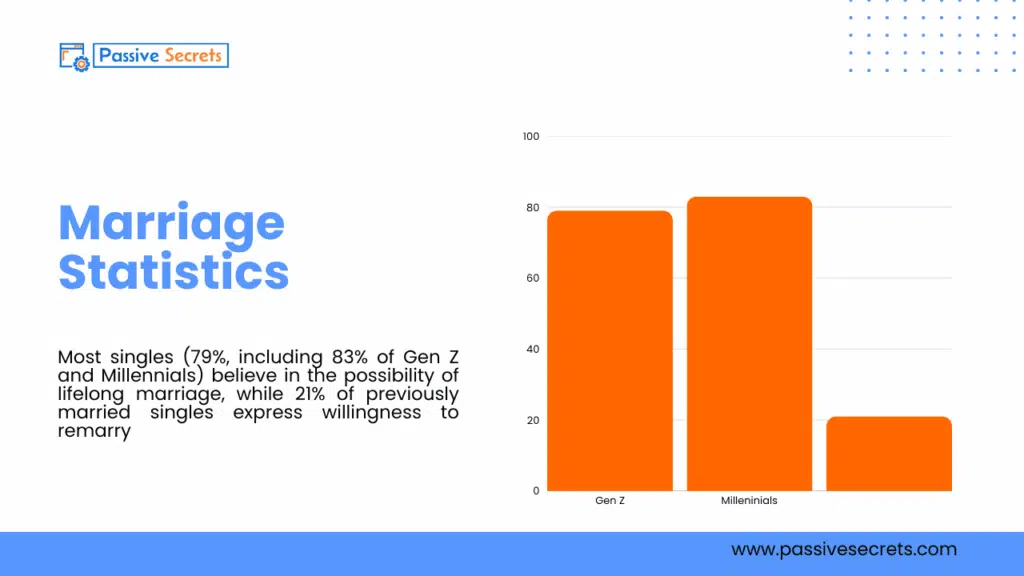
64. Most singles (79%, including 83% of Gen Z and Millennials) believe in the possibility of lifelong marriage, while 21% of previously married singles express willingness to remarry. (source)
65. 27% of online daters across all generations are positive about using AI. 63% of Gen Z singles have used artificial intelligence in some capacity, whether for dating or otherwise. (source)
66. 49% of singles express a preference for monogamy in their sexual relationships, indicating that half of single Americans are open to non-traditional sexual relationship structures. (source)
Conclusion
If there’s one thing these relationship statistics make clear, it’s that love isn’t disappearing; it’s evolving. People need each other, but in different ways now.
The way people meet, connect, and define commitment continues to shift with every new generation and technological breakthrough. Fewer people are marrying young, more are prioritizing emotional maturity over appearances, and millions are exploring relationships that don’t always fit the old mold.
Yet, at its core, the human need for connection remains unchanged. Whether through a dating app, a deep friendship, or a lifelong partnership, people everywhere are still searching for meaning, trust, and belonging.
As society redefines what love looks like in the modern age, one truth endures: relationships continue to shape who we are, how we grow, and what we value most. The numbers may tell us how things are changing, but it’s our shared humanity that keeps love timeless.
FAQs
Other Statistics Posts You Should Know:
- Single Moms Vs. Single Dads Statistics: Key Facts and Trends
- 40+ Incredible Single Father Statistics You Have to Know
- Holiday Spending Statistics: How Much Americans Spend & Shopping Trends
- Black Consumer Spending Statistics: $2.1 Trillion Buying Power Brands Can’t Ignore
- The Battle of the Sexes: Male Vs. Female Spending Statistics
- 110+ Shocking Income Inequality Data You Need to Know in 2025
- Gender Inequality Statistics: 160+Insights Across Regions
- The $1 Trillion Industry: Sharing Economy Stats That Prove It’s Just Getting Started
- Millennials on Social Media Statistics: Data Brands Must Know
- How Much Are People Really Saving? Personal Savings Statistics
- 40+ Useful Procrastination Statistics To Help You
- Gen Z vs Millennial Spending Statistics: Income, Shopping Habits, and Trends
- Gen Z and Social Media: Key Statistics, Trends, and Insights
- Intriguing Born Into Poverty Stay In Poverty Statistics
- Gentle Parenting Statistics: Is This Parenting Style Worth It?
- Dating and Love Statistics & Facts: What the Numbers Reveal About Modern Relationships
- Period Poverty by the Numbers: Shocking Global Statistics You Need to See

