
Gen Z and Millennials are two of the most influential consumer groups in today’s economy, shaping everything from online shopping trends to global spending patterns.
While Millennials currently dominate many markets due to higher incomes and purchasing power, Gen Z is rapidly emerging as the next major economic force.
Understanding how these generations earn, save, and spend money is crucial for businesses, marketers, and researchers looking to track consumer behavior.
Recent data shows major differences (and similarities) in financial realities, spending habits, and digital shopping behavior between the two groups. From living paycheck to paycheck and rising debt levels to the explosive growth of social commerce and mobile payments, these insights reveal how younger generations are redefining modern consumption.
The following Gen Z vs Millennial spending statistics highlight key trends in income, spending habits, financial priorities, and future consumer influence.
Key Statistics On Gen Z Vs Millennials Spending
- 52% of Gen Z and Millennials live paycheck to paycheck, and about one-third struggle to cover monthly living expenses.
- Over 90% of Gen Z worry about their finances, with 40% actively changing their spending to cope with inflation.
- Half of Gen Z consumers say their savings couldn’t sustain their lifestyle for more than one month.
- Gen Z’s average savings is about $2,410, far lower than Millennials’ average savings of about $23,000.
- Gen Z carries the highest average personal debt at $94,101, compared to $59,181 for Millennials.
- Millennials account for roughly 46% of global luxury goods spending, making them one of the most influential consumer groups.
- 82% of Gen Z buy cheaper “dupes” instead of luxury products, highlighting their value-focused spending habits.
- 79% of Gen Z wait for sales, and only 21% regularly pay full price.
- 85.1% of Gen Z use their phones for purchases, and 54% use buy now, pay later (BNPL) services.
- More than half of Gen Z consumers have purchased products directly through social media platforms.
- 62% of Gen Z have bought products after seeing a social media advertisement.
- Gen Z’s global spending power is projected to reach $12.6 trillion by 2030.
- Gen Z is expected to generate $36 trillion in global income by 2028, rising to $74 trillion by 2040.
Who Are Gen Z and Millennials? A Quick Generational Snapshot
Before we get right into their earning and spending statistics and realities, let’s get clear on who Gen Z and Millennials actually are. This is an important foundation to lay because while they’re often lumped together as “young people,” their experiences and worldviews are surprisingly different.
Millennials (Born 1981–1996)
Millennials are now in their late 20s to early 40s. Many of them came of age during the rise of the internet, dial-up modems, and the early days of social media. They witnessed the global financial crisis of 2008, entered a shaky job market, and are now navigating adulthood and parenthood in a world of rising rent, mortgages, childcare costs, and economic uncertainty.
They’re the generation that helped popularize side hustles, value convenience and flexibility, and were the first to truly embrace online shopping, streaming services, and the “experience economy.”
Many Millennials are now homeowners, parents, and managers. This generation is making big life decisions while still battling student loans and inflation.
Gen Z (Born 1997–2012)
Gen Z, on the other hand, are digital natives through and through. Born into a world of smartphones, social media, and instant access to information, they’re currently in their teens to mid-20s. Some are still in school, while others are just entering the workforce.
Unlike Millennials, Gen Z grew up watching influencers instead of cable TV, buying everything online, and caring deeply about issues like climate change, identity, diversity, and mental health. They’re value-driven, ultra-online, and not afraid to call out brands that don’t walk the talk.
Many Gen Zers are still figuring out their financial footing, but they’re already shaping global trends through their online presence and viral tastes.
Understanding where each generation is coming from helps explain why they spend the way they do.
Millennials are focused on stability, value, and efficiency. Gen Z is focused on self-expression, ethics, and innovation.
Now you know the differences, let’s dive right into the statistics.
Gen Z vs Millennial Spending Categories Statistics
1. First-time home buyers fell to 24% of all buyers this year (down from 32%). Gen Z and Younger Millennials are leading the charge: 62% of Gen Z and 71% of Younger Millennials buying homes are first-timers, vs 36% of Older Millennials. (NAR)
2. Millennials are outperforming the general population in key tech hubs, with median household incomes exceeding $200,000 in three cities. Sunnyvale, CA leads, with Millennials earning a median of $234,577, a 29.6% premium over the overall median of $181,022. Santa Clara and San Mateo also feature prominently, with Millennials earning $216,088 (19.6% premium) and $201,857 (24.5% premium), respectively. (Smart Asset)
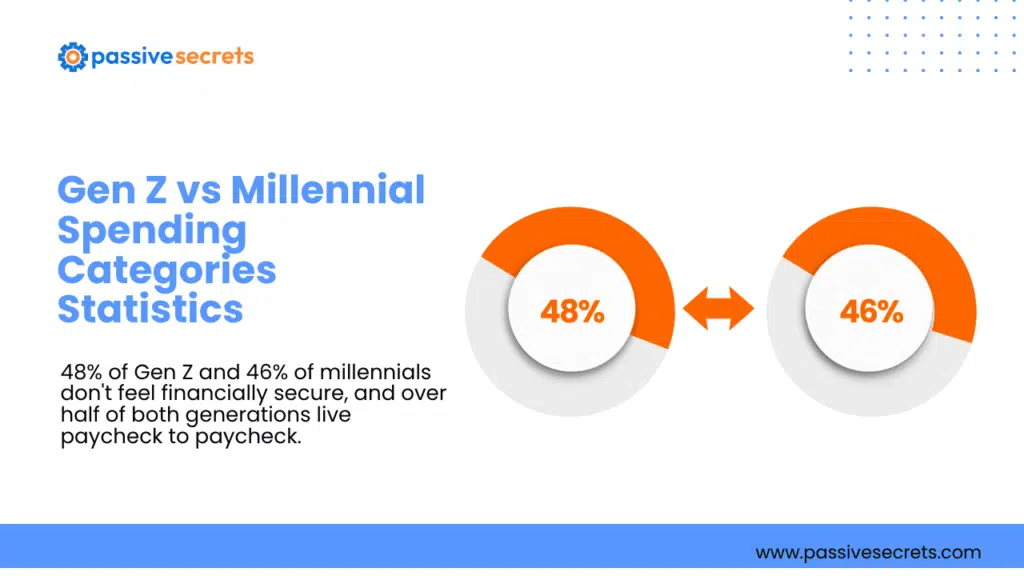
3. 48% of Gen Z and 46% of millennials don’t feel financially secure, and over half of both generations live paycheck to paycheck. (Deloitte)
4. 52% of both Gen Z and millennials live paycheck to paycheck, and 37% of Gen Z and 35% of millennials struggle to pay living expenses each month. (Deloitte)
5. Millennials in Jersey City, NJ, leverage proximity to NYC’s high-paying jobs, earning 42% more than the city’s overall median household income ($143,500 vs $100,751). This allows them to capitalize on lucrative opportunities while avoiding NYC’s additional taxes, making Jersey City an attractive balance. (Smart Asset)
6. Nearly one-third of financially secure Gen Zs (30%) and millennials (31%) still say that the cost of living is a top concern. (Deloitte)
7. Gen Z (80%) is more optimistic about their financial future, while the Silent Generation and Baby Boomers are less optimistic, with less than half sharing the same sentiment. (Statista)
8. Over 90% of Gen Z consumers worry about their financial situations, and 40% take action to cope with inflation. (Statista)
9. Millennials account for 46% of global luxury goods spending and have the second-highest disposable income in the US. (Statista)
10. California and Massachusetts dominate the top 10 cities for Millennial earnings, accounting for 60% of the list. Berkeley, CA, ranks 2nd with Millennials earning $146,987 (41.7% premium), while Boston-area influence drives Massachusetts’ 3rd-place showing ($140,661, 38.2% premium). Other top cities include San Francisco, Brockton, New Bedford, and Jurupa Valley. (Smart Asset)
11. The average 25-year-old Gen Zer has a household income of over $40,000, surpassing Millennials’ income at the same age and exceeding Baby Boomers’ income by 50%+. (NIQ)
12. Up to 50% of Gen Z currently has a job, and they’re about to surpass Baby Boomers as the largest full-time workforce group. By 2030, Gen Z will comprise 30% of the global workforce. (NIQ)
13. Half of US Gen Z consumers said they couldn’t sustain their lifestyle beyond a month due to insufficient savings, yet they still prioritize spending. (McKinsey)
14. A majority of young UK adults felt confident managing their finances, with 43% reporting confidence and 17% very high confidence, while 31% were somewhat confident and 9% lacked confidence. (Statista)
15. Gen Z is struggling with affordability concerns, particularly around having kids: 29% cite children as a top concern, second only to buying a house (46%). This anxiety is more pronounced than among Millennials, where 16% worry about having kids and 31% about buying a home, suggesting Gen Z feels broader financial pressures. (Northwestern Mutual)
16. In the US, the average annual expenditure for Millennial-led households is around $81,589. This is lower than Gen X-led households, which spend approximately $95,692 per year. (Statista)
17. On average, Gen Z believes they need to earn around $587,797 annually and have a net worth of $9.47 million to achieve financial success. (Forbes)
18. 71% of Gen Z respondents are optimistic about achieving financial success in their lifetime, slightly surpassing Millennials’ optimism rate of 70%. (Forbes)
19. Gen Zers are struggling with debt, with nearly 10% more of them falling 60+ days behind on auto and credit card loans compared to Millennials at the same age a decade ago. (Business Insider Africa)
20. Among homebuyers, Gen Z had the highest percentage of single female buyers at 31%, while Younger Millennials led in unmarried couple purchases at 19%. Overall, 30% of buyers had children under 18, with 65% of Older Millennials having at least one child at home. (Nar Realtor 2024 Report)
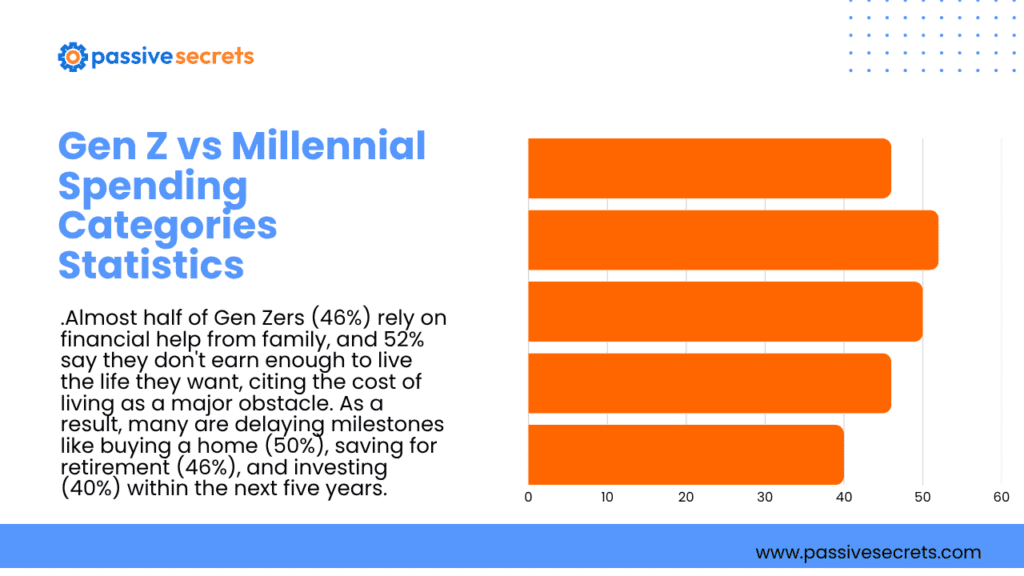
21. Almost half of Gen Zers (46%) rely on financial help from family, and 52% say they don’t earn enough to live the life they want, citing the cost of living as a major obstacle. As a result, many are delaying milestones like buying a home (50%), saving for retirement (46%), and investing (40%) within the next five years. (Bank of America)
22. Gen Z often relies on others financially, with 54% not paying for their own housing. Among those who do, 64% spend over 30% of their income on housing, and 20% spend over 51%. (Bank of America)
23. 90% of millennials say they face obstacles that prevent them from reaching their financial goals. The most common issues include not having enough money to cover expenses, save, or pay off debt. Nearly 47% cite excessive expenses as a major barrier, while 36% have little to no savings, 34% carry substantial debt, and 32% say their income isn’t enough to meet basic living costs. (CFP)
24. Financial stress is a common concern for Gen Z, with one-third worrying about money daily and 61.3% worrying at least weekly. In contrast, only 3.7% never worry about money, and 8.3% worry only a few times a year. (Self)
25. Gen Z in Australia is more financially stressed than non-Gen Z Australians, with 82% citing the rising cost of living as a major concern, compared to 70% of non-Gen Z. Additionally, 68% of Gen Z consider their finances a major cause of concern, versus 57% of non-Gen Z. (ASIC)
26. The average savings for Gen Z is approximately $2,410.57, significantly lower than Millennials’ average savings of $23,000 and Baby Boomers’ average savings of $156,000. (Self)
27. Gen Z spends nearly twice as much as they have in savings, with a spending-to-savings ratio of 1.93. (Bank of America 2)
28. In the UK, nearly 30% of Gen Z bank account holders worry about their financial future. Meanwhile, a slightly higher percentage feel informed about their finances, and only 17% are interested in learning about new financial topics like crypto or NFTs. (Statista)
![130+ Gen Z vs Millennial Spending Statistics: Income, Shopping Habits, and Trends (2026) [2026] ᐈ Passive Secrets](https://passivesecrets.com/wp-content/uploads/2025/08/Income-Levels-and-Financial-Realities-2-1024x576.png "130+ Gen Z vs Millennial Spending Statistics: Income, Shopping Habits, and Trends (2026)")
29. In 2024, young UK adults showed varying levels of confidence in managing their finances. A total of 60% felt either confident (43%) or very confident (17%), while 31% were somewhat confident, and 9% lacked confidence. (Statista)
30. About half of Gen Zers run out of money each month, and fewer than one in four consider themselves financially stable. (Newsweek)
31. A significant portion of Gen Zers struggle financially, with 25% unable to afford essentials like rent, food, and bills for over a week. Many also report depleted funds by month’s end, with 29% having nothing left and 34% having less than $100. To cope, 20% of respondents work multiple jobs. (Newsweek)
Key Gen Z and Millennials Spending Categories
32. Gen Z is most willing to pay for streaming video (81%), followed by streaming music (64%) and gaming subscriptions (43%). In contrast, just 6% would pay for news/magazines, highlighting a strong preference for entertainment over traditional media. Netflix leads viewing (75% weekly), followed by Hulu (45%), Amazon Prime, and Disney+ (38%). (Attest 2)
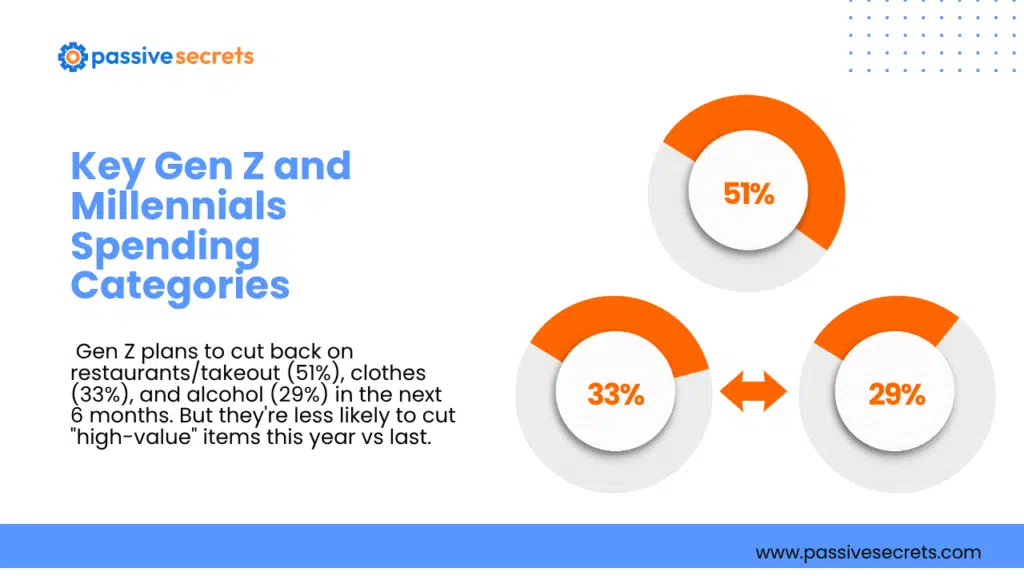
33. Gen Z plans to cut back on restaurants/takeout (51%), clothes (33%), and alcohol (29%) in the next 6 months. But they’re less likely to cut “high-value” items this year vs last. (PwC)
34. As of August 2024, Gen Z spent an average of $97.70/month on media, while the overall average across generations was $66.60. (Statista)
35. A 2024 survey found that food accounted for nearly 70% of Gen Z’s monthly expenditures in Indonesia, followed by beauty products at around 14%. (Statista)
36. Gen Z consumers in the US and UK prioritize spending on groceries, followed by clothes and car payments, excluding rent/mortgage and household bills. (Statista)
37. Gen Z’s average monthly spending on concerts ($38) and festivals ($23) exceeded the overall average spending across all generations ($31 for concerts, $13 for festivals). (Statista)
38. US millennials spent an average of $66 per month on pet food, slightly outspending Gen Z. (Statista)
39. Gen Z (52%) and Millennials (47%) are more likely to splurge on experiences while traveling, compared to Baby Boomers (29%). (Statista)
40. In the UK, Gen Z and millennials were expected to spend the most on Halloween 2024, with both generations projected to spend over £40 per person. (Statista)
41. A global survey found that 13% of Gen Z and millennials are most interested in attending sports stadiums and events while traveling, while 8% want to visit famous filming locations. (Statista)
42. About 25% of US adults prefer using social media for online searches. Gen Zers are particularly inclined towards this method, with around 46% opting for social platforms over traditional search engines. (Statista)
43. Two-thirds of US millennials prefer buying children’s products online, while just over 10% prefer shopping in physical stores. (Statista)
44. In the US, over 40% of Gen Z consumers prefer doing their grocery shopping both online and offline. In contrast, millennials tend to lean towards mostly online grocery shopping. (Statista)
45. Gen Z’s biggest expense is household bills and expenses, with 52.3% allocating most of their budget to these costs. Additionally, 17.2% of Gen Zers are pessimistic about their ability to afford a home, believing they’ll never have enough money for a down payment. (Self)
46. Gen Z spends an average of $157.07/month ($1,884.84/year) on entertainment, including streaming, music, and gaming. Most (61.3%) spend between $1-110, while a small percentage (0.8%) spend over $1,000/month. (Self)
47. Gen Z prioritizes experiential spending, allocating leftover income to dining out (36%), shopping (30%), and entertainment (24%) at higher rates than other generations. (Bank of America: Newsroom)
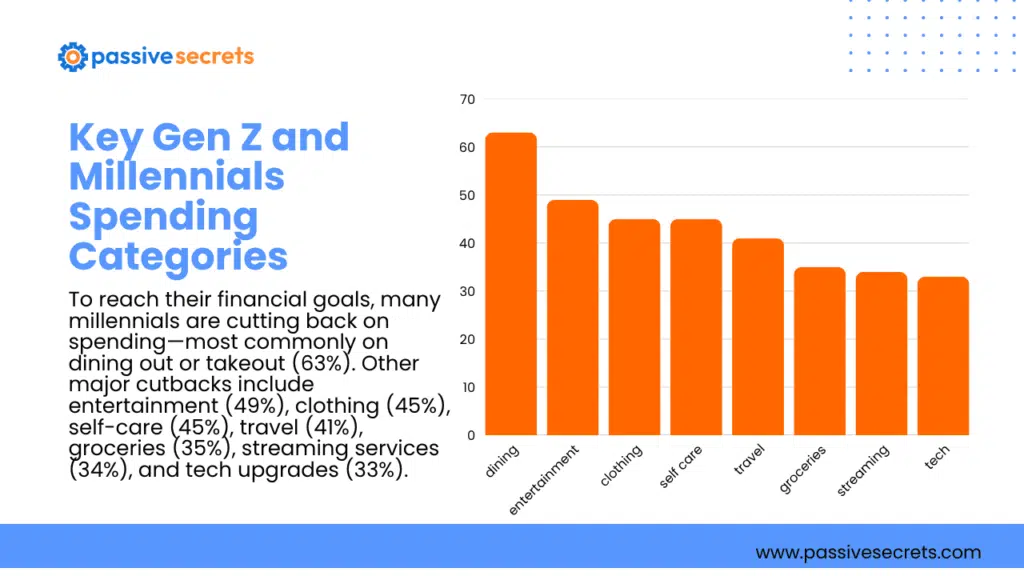
48. To reach their financial goals, many millennials are cutting back on spending—most commonly on dining out or takeout (63%). Other major cutbacks include entertainment (49%), clothing (45%), self-care (45%), travel (41%), groceries (35%), streaming services (34%), and tech upgrades (33%). (CFP)
49. More than half of Gen Z use fitness or exercise apps, and 17% use fitness bands to track their health and fitness. (NIQ)
Gen Z vs Millennials Spending Habits Statistics
50. Gen Z and millennials prioritize payment security when buying luxury goods online (58% and 64%). Over half are hesitant to make big purchases due to fear of payment issues (56% Gen Z, 52% millennials). In response, 68% of high-end merchants will upgrade payment systems. Key demands: no hidden fees (36% Gen Z, 42% millennials) and fraud protection (34% Gen Z, 38% millennials). (Tink)
51. When it comes to luxury, 62% of Gen Z and 68% of millennials say it’s not just about the item – the buying experience matters just as much. They’re looking for a holistic experience that matches the quality of the product. (Tink)
52. 54% of Gen Z and younger millennial buyers said that they had increased their spending on luxury watches during the previous 24 months, citing increased ease of buying and selling and more investment opportunities as their top reasons. (BCG)
53. A survey of Gen Z in Indonesia revealed that 66% of respondents spent less than 500,000 IDR (~ $33 USD) on monthly online purchases. Also, only 2% of respondents spent over 2,000,000 IDR (~ $133 USD) on online shopping monthly. (Statista)
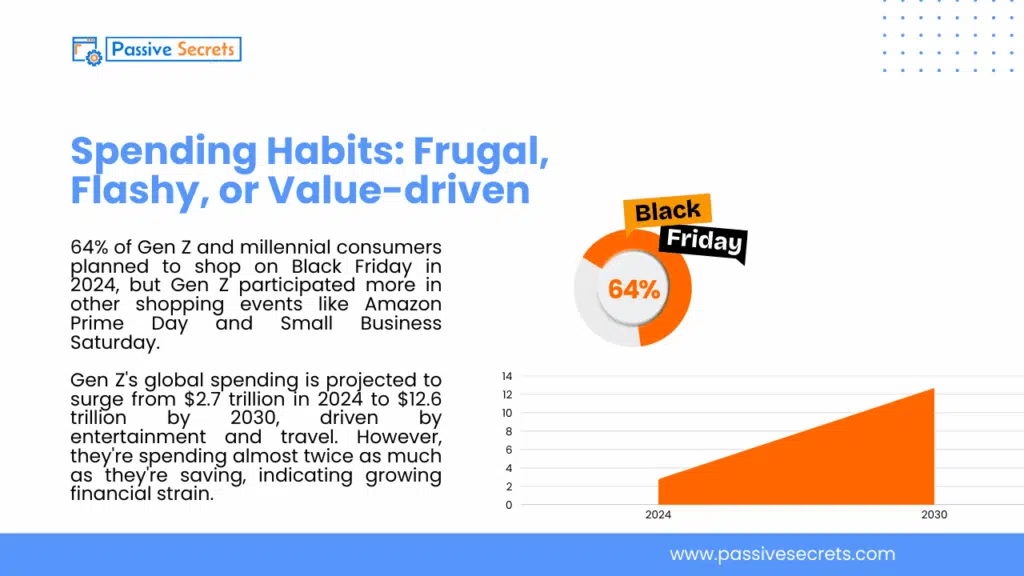
54. 64% of Gen Z and millennial consumers planned to shop on Black Friday in 2024, but Gen Z participated more in other shopping events like Amazon Prime Day and Small Business Saturday. (Statista)
55. 82% of Gen Z are ditching pricey luxury items for more affordable “dupes”. Dupes are cheaper alternatives to luxury items that give a similar style or functionality. (PwC)
56. Gen Z’s all about being intentional with their cash – 79% wait for sales, and only 21% pay full price. Deal hunting’s on the rise (discount code searches up 14%, browsing up 17%), but it’s more about making thoughtful purchases than just being cheap. (PwC)
57. 79% of Gen Z wait for sales, and only 21% pay full price regularly. They’re hunting deals (discount codes up 14%, browsing up 17%) – it’s about being intentional, not just cheap. (PwC)
58. Gen Z’s global spending is projected to surge from $2.7 trillion in 2024 to $12.6 trillion by 2030, driven by entertainment and travel. However, they’re spending almost twice as much as they’re saving, indicating growing financial strain. (eMarketer)
59. Gen Z’s spending power is expected to grow rapidly, with a 4.02% compound annual growth rate (CAGR) over the next decade, doubling the growth rate of previous generations. (NIQ)
60. Only 10% of Gen Zers are from North America or Europe, and Western countries account for just 44% of their total spending, marking a historic shift. (NIQ)
61. In Australia, Gen X has the highest average monthly online spend ($1,420), while Gen Z has the lowest ($892). (Statista)
62. 34% of Spanish Gen Zers and millennials typically spend between 50 to 100 euros on individual fashion items, making this the most popular price range across all surveyed European countries. (Statista)
63. About one-third of Gen Zers in the UK, France, Spain, Italy, and Germany would pay up to 10% more for sustainable products, while around 25% wouldn’t pay a premium. (Statista)
64. Over 25% of Gen Z and Millennial shoppers avoid second-hand shopping because they don’t like wearing clothes worn by others. Another 9% say it’s because there are no physical second-hand stores in their area. (Statista)
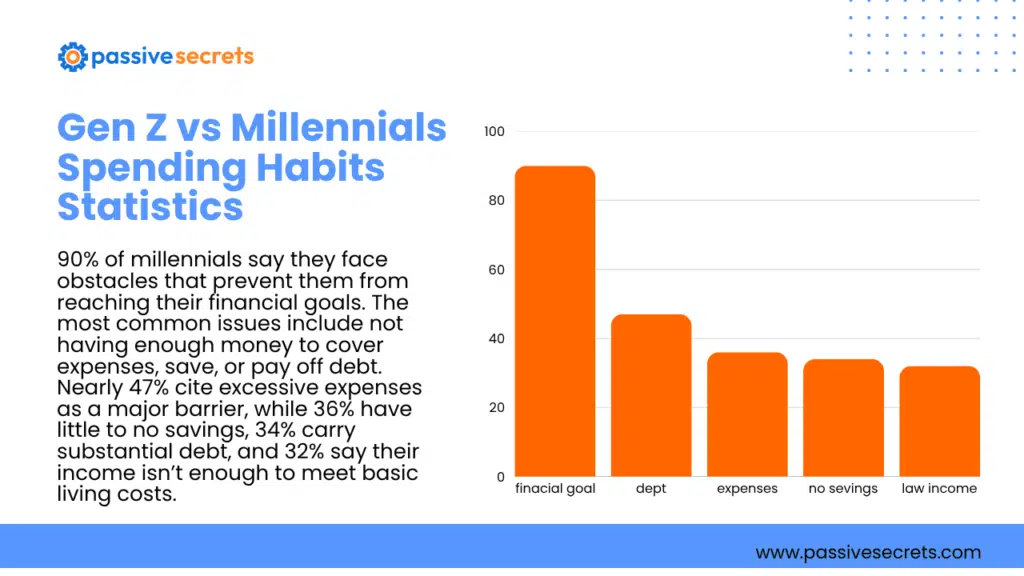
65. 90% of millennials say they face obstacles that prevent them from reaching their financial goals. The most common issues include not having enough money to cover expenses, save, or pay off debt. Nearly 47% cite excessive expenses as a major barrier, while 36% have little to no savings, 34% carry substantial debt, and 32% say their income isn’t enough to meet basic living costs. (CFP)
66. About two-thirds of Gen Z are making lifestyle adjustments, such as reducing dining out and social events, due to economic concerns. However, the short-term economic impact is expected to be minimal, as Gen Z currently accounts for less than 20% of total US consumer spending. (Bank of America 2)
67. A majority of Gen Zers, 63%, don’t feel pressured by friends to overspend, suggesting they’re setting clearer financial boundaries than previous generations at the same age. (Bank of America: Newsroom)
68. Gen Z prioritizes financial stability, with 46% choosing long-term financial stability over romantic love, surpassing millennials at 41%. (Newsweek)
69. In 2024, the combined wealth of Gen Z and Millennials grew by 17.33%, significantly outpacing the 4.62% growth seen among Gen X and Baby Boomers. (The Currency)
70. In 2024, Gen Z’s net worth rose by 21.92%, growing from \$71,312 to \$86,945. Millennials saw a 12.74% increase, with their net worth rising from\$295,456 to \$333,096. (The Currency)
71. Gen Zers tend to distrust traditional financial institutions, with only 28% seeking advice from professionals. Instead, they turn to family, friends, and social media influencers for financial guidance. (Yahoo Finance)
72. About 1 in 5 members of Gen Z and Millennials (19%) believe that pretending to be successful (“faking it until you make it”) is a key to actually achieving success. (The Currency 2)
Gen Z vs Millennial Saving, Debt, and Investing Statistics
73. Gen Z (81%) and Millennials (82%) largely agree they need to improve financial planning. Over a quarter of both groups (28% Gen Z, 26% Millennials) sought professional financial advice for the first time in the last year, indicating growing engagement. (Northwestern Mutual)
74. A survey across 14 countries found that only 3 in 10 Millennials use cryptocurrency for transactions, mainly to buy other crypto. In countries like Canada and the US, crypto owners prioritize investments over transactions. (Statista)
75. Most Gen Zers want banking apps to offer financial transparency, cost-of-living support, tailored goal-achieving support, and spending management tools. (Statista)
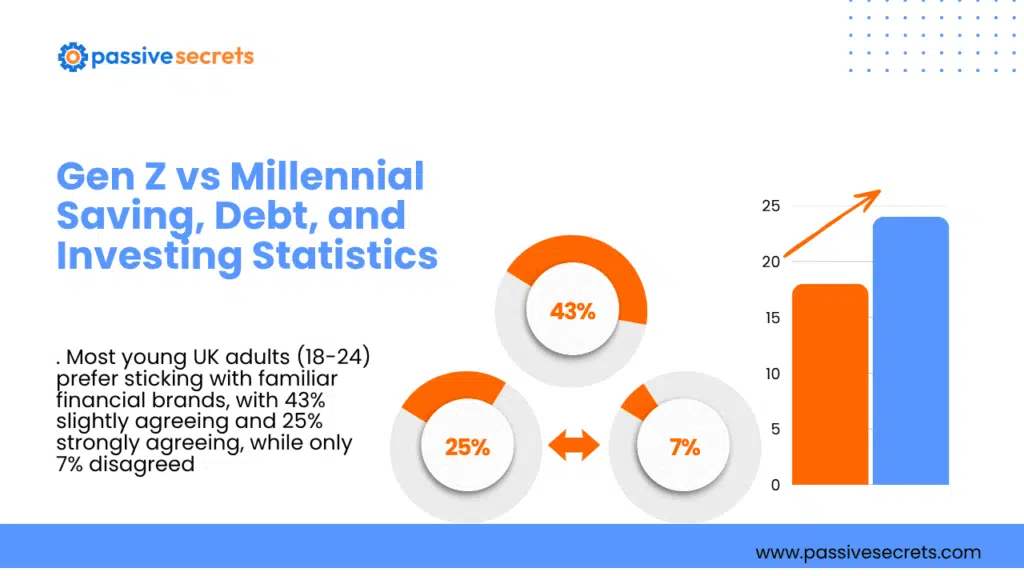
76. Most young UK adults (18-24) prefer sticking with familiar financial brands, with 43% slightly agreeing and 25% strongly agreeing, while only 7% disagreed. (Statista)
77. In the UK, 73% of Gen Zers are in debt, with 13% owing over £10,000. Meanwhile, 58% can only save 20% or less of their monthly income, and 41% can’t save anything. (Statista)
78. Gen Z buy now, pay later (BNPL) users in the US are more likely to miss payments. 30% of Gen Z and 27% of millennials admitted to overspending with BNPL, while 14% of Gen X users missed payments. (Statista)
79. Among Gen Z and millennial investors in 2024, stocks were the most popular investment choice, with 55% of millennials preferring stocks. Retirement investment accounts, such as 401(k) and IRA, ranked second in popularity among millennials, while REITs received the lowest level of engagement from both groups. (Statista)
80. In the UK, Gen Z had the highest number of participants in the investment market, while the Silent Generation came in second, with over 65% having invested in financial securities. (Statista)
81. In Q2 2025, survey insights found that about one-third of Gen Z bank account holders in the US worried about their financial future, while around 29% felt well-informed about their financial situation. Additionally, there was relatively low interest in new financial topics like crypto and NFTs. (Statista)
82. Gen Z struggles with saving and retirement planning. Over half (57%) lack enough emergency savings, 30% feel they don’t earn enough to save, and only 15% set aside a fixed percentage of their income each month. Just 1 in 5 contribute to a retirement account or 401(k) plan. (Bank of America: Newsroom)
83. 58% of millennials feel optimistic about their finances, while 27% are neutral and 16% feel pessimistic. Men are notably more confident, with 67% reporting a positive outlook, compared to just 50% of millennial women. (CFP)
84. Younger millennials are more financially optimistic, with 63% expressing a positive outlook, compared to 53% of older millennials. (CFP)
85. Almost half of millennials (46%) say that reaching financial independence or stability is a key life goal. (CFP)
86. Nearly 60% of millennials consider financial independence or stability a top priority. Specifically, 57% prioritize having a savings or emergency fund, while 50% value being financially self-sufficient and keeping debt low. (CFP)
87. Younger generations are more open to going into debt for travel: 30% of Gen Z and 35% of Millennials, compared to 23% of Gen X and 22% of Baby Boomers. (Newsweek)
88. Younger generations are more willing to go into debt for experiences like dining out and live entertainment. For dining out, 22% of Gen Z and 23% of Millennials are willing to take on debt, compared to 9% of Gen X and 8% of Baby Boomers. For live entertainment, 22% of Gen Z and 23% of Millennials are willing to take on debt, compared to 7% of Gen X and 4% of Baby Boomers. (Newsweek)
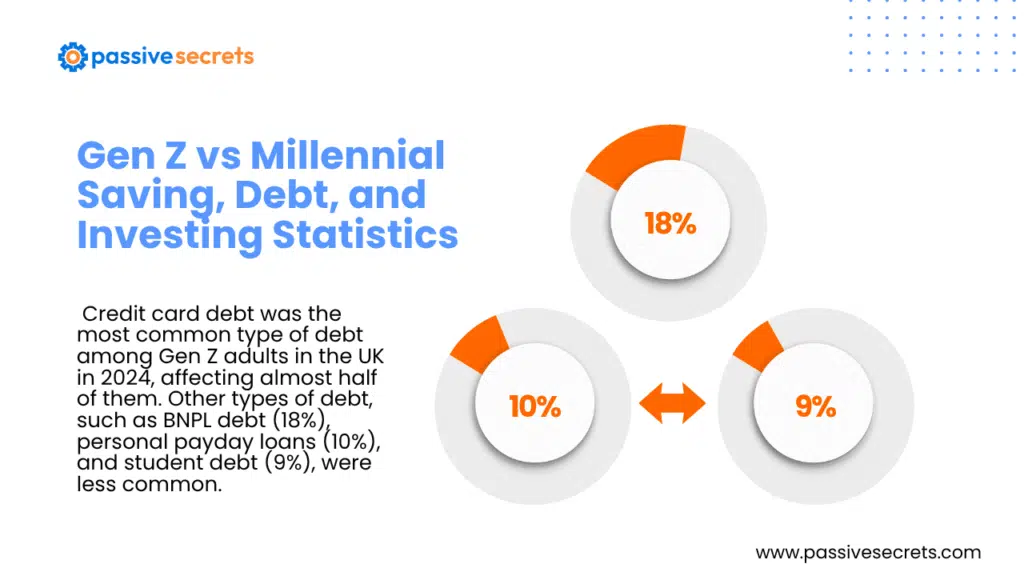
89. Credit card debt was the most common type of debt among Gen Z adults in the UK in 2024, affecting almost half of them. Other types of debt, such as BNPL debt (18%), personal payday loans (10%), and student debt (9%), were less common. (Statista)
90. Gen Z carries the highest average personal debt, totaling $94,101, which surpasses the debt of millennials ($59,181) and Gen X ($53,255). (Newsweek)
91. Gen Z’s average savings amount stands at $2,410.57. In comparison, Millennials have a median savings amount of $3,500, excluding retirement accounts like 401(k) plans. (Self)
Gen Z vs Millennial Digital Spending and Online Shopping Statistics
92. Gen Z’s media consumption is heavily skewed toward video-sharing platforms like YouTube and TikTok, which have become their media hub. 43% spend 2+ hours daily on these platforms, with 21% dedicating 4+ hours. In contrast, live TV has seen significant abandonment, with 38% of Gen Z not watching it at all and only 14% watching over two hours daily, highlighting a shift away from traditional broadcast formats. (Attest 2)
93. Gen Z shows moderate engagement with interactive content: 46% participate in polls/quizzes/Q&As, 32% in choose-your-own-adventure, and 30% in interactive livestreams. Adoption of immersive tech like AR (28%) and VR (24%) is lower. Over half (55%) are willing to pay for enhanced immersive experiences, but 40% are undecided, indicating potential if the experience is compelling. (Attest 2)
94. Gen Z shoppers (18-27 years old) prefer debit cards (40%) for online purchases, followed by credit cards (29%). (Statista)
95. In 2024, Australia’s total online spending reached almost $69 billion AUD. Millennials spent the most ($25 billion), followed by Gen X, while the Silent Generation spent the least. (Statista)
96. Gen Z is leading the shift to mobile payments and buy now, pay later (BNPL) services, with 85.1% using phones for purchases and 54% using BNPL over the holidays. (eMarketer)
97. Gen Z’s use of buy now, pay later (BNPL) services is increasing, with Gen Zers expected to make up 30.2% of US BNPL users by 2025. (eMarketer)
98. Gen Z prefers on-demand streaming services, with 82% willing to pay for platforms like Netflix, Hulu, and Disney+, and 67.6% willing to pay for streaming music services. (Attest)
99. Gen Z uses social media as a shopping platform, with 53% having used “buy” buttons. Online reviews from fellow shoppers are their top consideration when making purchases. (NIQ)
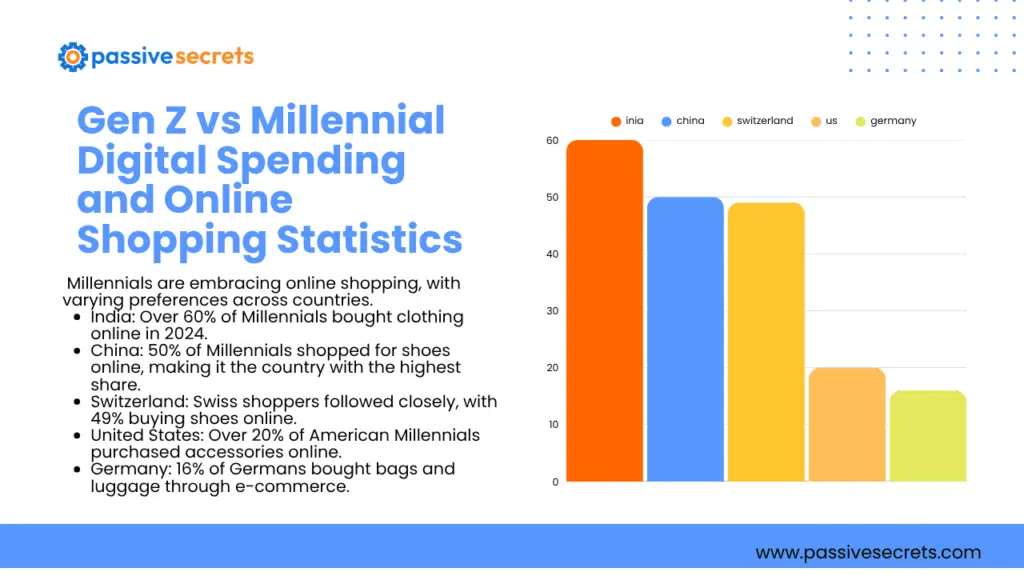
100. Millennials are embracing online shopping, with varying preferences across countries.
101. Despite starting their shopping journey online and being influenced by social media, Gen Z spends a significant portion of their dollars in-store, with nearly 50% going to brick-and-mortar mass merch and grocery purchases, making them the ultimate “omni-channel” shoppers. (NIQ)
102. In Spain, over half of Gen Z and Millennial shoppers have used AI as part of their shopping process, compared to much lower rates in Italy and Germany. (Statista)
103. Gen Z in Australia relies heavily on social media for financial information, with 56% using platforms like YouTube, TikTok, and Instagram for guidance, compared to 23% of non-Gen Z. The top social media sources for Gen Z’s financial information are YouTube (33%), TikTok (23%), Instagram (19%), Facebook (15%), and X (5%). (ASIC)
104. A 2025 survey found40% of China’s Gen Z buyers wanted same-day delivery, compared to 35% in the US and 29% in Germany. (Statista)
Gen Z vs Millennial Social Media Influence on Buying Decisions Statistics
105. Gen Z’s daily social media habits are dominated by YouTube, with 63% using it daily and only 2% saying they never use it. Instagram (58%) and TikTok (56%) follow closely, forming the top tier of platforms. On the other hand, Twitch and Pinterest have higher rejection rates, with 53% and 33% of Gen Z saying they never use them, respectively. (Attest 2)
106. A 2024 survey found that over half of Gen Z consumers made purchases on social media platforms, while almost a third of all consumers did the same. (Statista)
107. 40%+ of Gen Z consumers and 38% of Millennials used social media for customer service, while 1 in 5 Baby Boomers participated in live shopping events on social media. (Statista)
108. In 2025, millennials will account for 1/3 of global social media shopping spend, followed by Gen Z shoppers at 29%. (Statista)
109. Health and beauty is the top category for Gen Z on social media, with 81% of TikTok’s dollar sales expected to come from this category. (NIQ)
110. Gen Z’s daily social media habits are led by YouTube, with 63% using it daily and only 2% saying they never use it, showcasing its broad appeal. Instagram (58%) and TikTok (56%) form a top tier of platforms with high engagement. In contrast, Twitch (53% never use) and Pinterest (33% never use) have higher rejection rates, indicating they’re more niche among Gen Z. (Attest 2)
111. Around 43% of US adults made a purchase after seeing a social media ad or watching a TV commercial. However, age groups varied: 62% of Gen Zers bought something after seeing a social ad, while 47% of Gen Xers made a purchase after watching a TV commercial. (Statista)
Gen Z vs Millennial Brand Loyalty and Consumer Value Statistics
112. Around 75% of Gen Z (76%) and millennials (75%) prioritize brand reputation, willing to pay more for trusted brands, especially regarding payment security. (Tink)
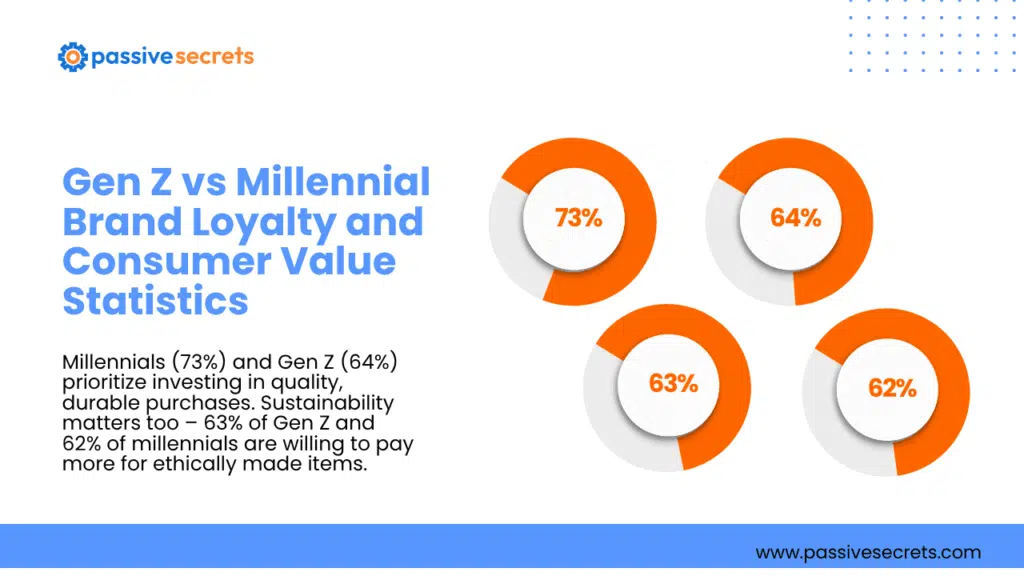
113. Millennials (73%) and Gen Z (64%) prioritize investing in quality, durable purchases. Sustainability matters too – 63% of Gen Z and 62% of millennials are willing to pay more for ethically made items. (Tink)
114. Up to 60% of European Millennials and Gen Z prioritize transparent product descriptions when choosing a favorite website, while nearly 40% consider free delivery a key factor. (Statista)
115. 52% of Gen Z consumers prioritize healthy nutrients and ingredients. Additionally, 42% prefer natural ingredients, and 40% seek eco-friendly and sustainable products. (NIQ)
116. 25% of Gen Z consumers consider animal-friendly manufacturing when making purchasing decisions. (NIQ)
117. Sustainability plays a significant role in purchasing decisions for both Millennials and Gen Z. 80% of Millennials consider sustainability a key factor, while 66% of Gen Zers share this view. (Statista)
Gen Z vs Millennial Spending During Inflation and Economic Uncertainty Statistics
118. By 2030, Gen Z’s spending power will hit $12 trillion, but this holiday season, they’re tightening belts – expect 23% less spending. They’re prioritizing sustainability, quality, and value, favoring brands that match their values of authenticity, diversity, and digital experiences. (PwC)
119. A significant gap exists between Gen Z men and women, with 61% of women citing the high cost of living as a barrier to financial success, compared to 44% of men. (Bank of America: Newsroom)
120. Nearly half (42%) of young adults in Gen Z (18+) reside with their parents, largely due to financial strain from increasing housing costs, inflation, and student loan debt. (Yahoo Finance)
121. Gen Z (80%) and Millennials (79%) report high levels of financial insecurity, though slightly less than Gen X, which leads at 84%. Baby Boomers follow with 69% expressing similar concerns. (Bankrate)
122. Gen Zers are paying 31% more for housing, adjusted for inflation, compared to what their peers paid a decade ago at the same age. (Business Insider Africa)
Future Spending Trends Among Gen Z and Millennials (Statistics & Projections
123. Gen Z and millennials are driving luxury sales, buying 16 and 14 items/year on average. With cost pressures rising, they’re prioritizing quality + ethics in their purchases – a key opportunity for high-end merchants. (Tink)
124. Gen Z’s love for in-store experiences is real – 61% prefer discovering products this way, highlighting their desire for tangible, engaging shopping experiences. (PwC)
125. Gen Z is skeptical about AI-generated content: 41% dislike it, saying it lowers content quality, and 31% are wary, citing authenticity concerns. Only 28% find it entertaining, meaning 72% have negative or cautious views, highlighting trust issues. (Attest 2)
126. In 2024, Gen Z made up nearly 25% of the global population and accounted for 17% of global consumer spending. By 2030, their spending is expected to increase to 19%. (Statista)
127. In 2024, Millennials accounted for 22.5% of global spending, while Gen Z is projected to reach 18.7% by 2030. (Statista)
128. Gen Z’s spending will surge from $9.8 trillion to $12.6 trillion by 2030 and add nearly $9 trillion by 2034, exceeding any other generation. (NIQ)
129. In 2024, most Gen Z consumers in the US spent more on gardening than in 2023. For 2025, over 40% planned to spend the same, while more than 46% expected to spend more. (Statista)
130. Gen Z in Australia is eager to improve their financial literacy, with 90% wanting to gain confidence in managing their finances, surpassing non-Gen Z (72%). They’re also proactive, with 39% learning about finance at least weekly, compared to 23% of non-Gen Z. Additionally, 44% of Gen Z research wealth growth strategies weekly, outpacing non-Gen Z (24%). (ASIC)
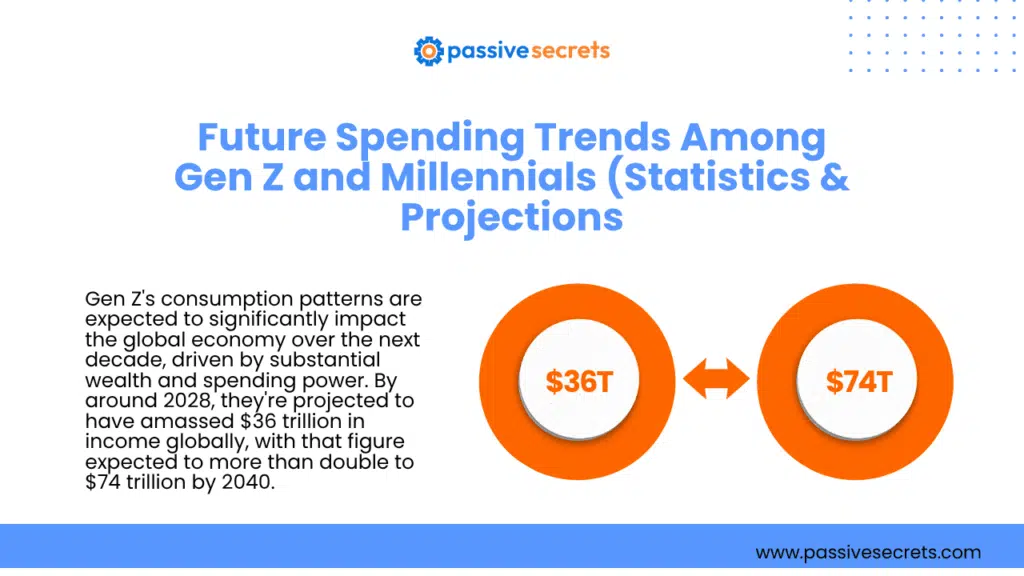
131. Gen Z’s consumption patterns are expected to significantly impact the global economy over the next decade, driven by substantial wealth and spending power. By around 2028, they’re projected to have amassed $36 trillion in income globally, with that figure expected to more than double to $74 trillion by 2040. (Bank of America 2)
132. Gen Z’s expectations for a partner’s salary are lower, at $80,000, compared to millennials ($100,000), Gen X ($115,000), and baby boomers ($115,000). (Newsweek)
133. When it comes to their ideal partner’s income, Gen X and baby boomers expect the highest average salary at \$115,000, followed by millennials at \$100,000, and Gen Z at \$80,000. (Tawkify)
Conclusion: What Gen Z vs Millennial Spending Statistics Reveal
The latest Gen Z vs Millennial spending statistics highlight two generations navigating very different financial realities while shaping the future of consumer behavior.
Millennials currently hold stronger purchasing power due to higher incomes and more established careers, but many still face significant financial pressures such as debt and rising living costs.
Meanwhile, Gen Z is emerging as a powerful consumer group, strongly influenced by technology, social media, and value-driven purchasing decisions.
These statistics also reveal key trends, including the rapid growth of mobile shopping, the rising influence of social commerce, and a growing focus on affordability and brand values.
As Gen Z’s income and spending power continue to grow in the coming years, businesses and marketers will need to adapt their strategies to meet the expectations of both generations.
Understanding these trends offers valuable insights into how the next era of consumer spending will evolve.
Other Related Statistics You Should Know:
- Single Moms Vs. Single Dads Statistics: Key Facts and Trends
- 40+ Incredible Single Father Statistics You Have to Know
- Holiday Spending Statistics: How Much Americans Spend & Shopping Trends
- Black Consumer Spending Statistics: $2.1 Trillion Buying Power Brands Can’t Ignore
- The Battle of the Sexes: Male Vs. Female Spending Statistics
- 110+ Shocking Income Inequality Data You Need to Know in 2025
- Gender Inequality Statistics: 160+Insights Across Regions
- The $1 Trillion Industry: Sharing Economy Stats That Prove It’s Just Getting Started
- Millennials on Social Media Statistics: Data Brands Must Know
- How Much Are People Really Saving? Personal Savings Statistics
- 40+ Useful Procrastination Statistics To Help You
- Gen Z and Social Media: Key Statistics, Trends, and Insights
- Intriguing Born Into Poverty Stay In Poverty Statistics
- Gentle Parenting Statistics: Is This Parenting Style Worth It?
- Dating and Love Statistics & Facts: What the Numbers Reveal About Modern Relationships
- Relationship Statistics That Reveal How Love, Dating, and Marriage Are Changing
- Period Poverty by the Numbers: Shocking Global Statistics You Need to See

