
The global shortage of skilled workers is projected to reach over 85 million by 2030.
Imagine a big office with lots of people working together. Workforce management is like the glue that keeps everything stuck together. It makes sure everyone is doing their job at the right time.
Workforce management is similar to a big orchestra with lots of different instruments. The conductor is the workforce manager, and their role is to ensure all the instruments play together at the right time. If they don’t, the music won’t sound good.
Workforce management is super important for companies. It helps them work better and make more money. It’s the heart of every company, and if the heart doesn’t work, the whole body won’t work either.
Most companies lack the right workforce management strategy to integrate their workflows, which affects their outcomes.
By examining the latest workforce management statistics, organizations can gain a deeper understanding of the trends, challenges, and opportunities that lie ahead.
In this article, we’ll examine the most up-to-date workforce management statistics, providing valuable insights to help you optimize your workforce management practices and drive your organization forward in today’s competitive landscape.
Key Workforce Management Statistics (Editor’s Pick)
- The global workforce analytics market is projected to grow from $2.37 billion in 2025 to $5.94 billion by 2032, at a CAGR of 14.0%, driven by the rise of data-driven HR and performance optimization.
- The overall workforce management market is valued at $9.62 billion in 2024 and expected to reach $20.03 billion by 2035, expanding at an 8.01% CAGR.
- Around 36% of employees in Europe and the U.S. are unhappy with their current employer, reflecting growing challenges in employee engagement and retention.
- Only 12% of HR leaders in the U.S. take a long-term approach (3+ years) to strategic workforce planning — highlighting a gap between short-term needs and future skills strategy.
- Global employee engagement dropped from 23% to 21% in 2024, costing the global economy an estimated $438 billion in lost productivity.
- Nearly 32% of employees lack the skills required for their current roles, while automation and AI may replace up to 27% of work hours in Europe by 2030.
- Only 44% of global managers receive formal training — yet those who do see team performance improve by up to 28%.
- The hospital workforce management market is set to grow from $1.66 billion in 2024 to $4.16 billion by 2035, achieving a CAGR of 8.7% amid rising staffing and operational demands.
- C-suite leaders underestimate AI use — believing only 4% of employees use generative AI for at least 30% of their work, while the actual figure is 12%. Nearly 47% of employees expect to use AI for 30% or more of their tasks within a year.
- Over half of HR leaders (53%) have chosen not to backfill roles due to AI integration — reshaping how teams are structured.
- The European workforce management software market will climb from $2.66 billion in 2025 to $4.03 billion by 2030, marking an 8.67% CAGR.
- The workforce analytics market is expected to grow by USD 2.56 billion between 2023 and 2028, at a rapid CAGR of 17.74%.
Global Workforce Management Software Market Overview
The global workforce management software market is projected to expand from $9.35 billion in 2025 to $11.67 billion by 2030, registering a CAGR of 7.12%.
In 2024, the software segment led the market with a 62% share, while the services segment is expected to grow the fastest at a 12.5% CAGR.
By function, Time & Attendance solutions accounted for 27% of total revenue in 2024, whereas Workforce Analytics is anticipated to grow at a 14% CAGR through 2030.
From a deployment perspective, cloud-based solutions represented 65% of the market in 2024 and are expanding rapidly at an 11.8% CAGR.
When segmented by organization size, large enterprises contributed 68% of total revenue in 2024, while small and medium-sized enterprises (SMEs) are projected to advance at a 12.2% CAGR.
Regionally, Europe held the largest share in 2024 with 30% of the market, but Asia Pacific is expected to record the fastest growth at a 16.1% CAGR through 2030.
Across industries, the Banking, Financial Services, and Insurance (BFSI) sector led with a 22% market share in 2024, while the Healthcare sector is forecast to post the strongest growth, at a 13.9% CAGR during the forecast period.
General Workforce Management Statistics
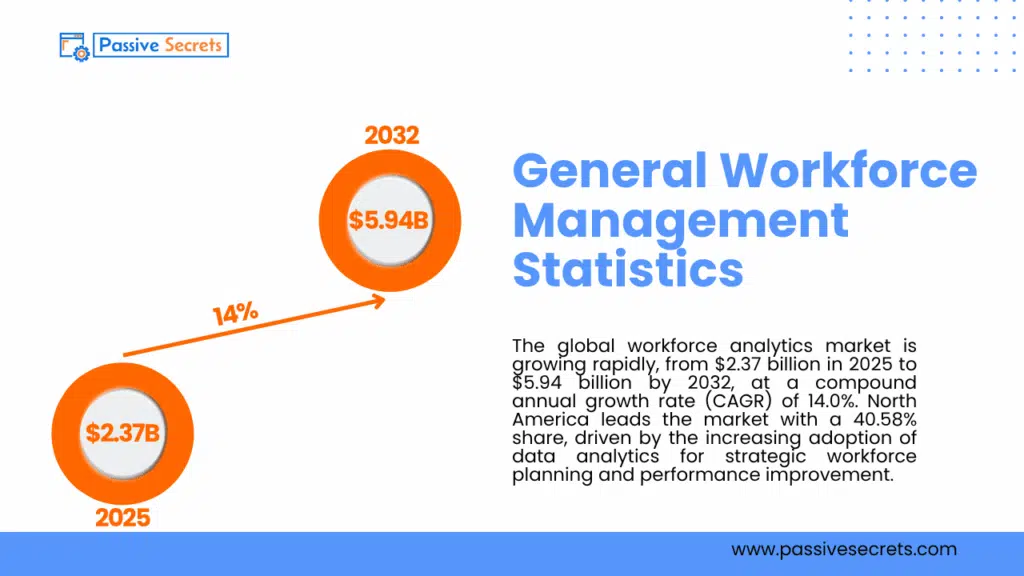
1. The global workforce analytics market is growing rapidly, from $2.37 billion in 2025 to $5.94 billion by 2032, at a compound annual growth rate (CAGR) of 14.0%. North America leads the market with a 40.58% share, driven by the increasing adoption of data analytics for strategic workforce planning and performance improvement. (source)
2. North America led the workforce analytics market in 2024, holding a 40.5% global share. (source)
3. The workforce management market is set for significant growth, driven by technological advancements and rising demand for operational efficiency. Valued at $9.62 billion in 2024, it’s projected to reach $20.03 billion by 2035, growing at an 8.01% CAGR from 2025 to 2035. (source)
4. About 36% of employees in Europe and the US are unhappy with their current employer, highlighting a significant challenge in enhancing employee experience. (source)
5. Many organizations engage in operational workforce planning, but few connect their strategies to future skill needs. In the US, just 12% of HR leaders take a long-term approach, with a focus of at least three years, to strategic workforce planning. (source)
6. In Europe, 67% of organizations have both workforce planning and comprehensive skills documentation. The rates vary by country, with Poland at 47% and France at 54%, while 80% of organizations in the US report having both workforce planning and comprehensive skills documentation in place. (source)
7. For 2024, HR pros are focusing on recruiting (43%), employee experience (31%), and leadership development (27%) as their top priorities. (source)
8. Only 56% of HR pros think their organization’s recruiting efforts are effective, while 63% of HR execs agree. However, just 41% of US workers share this optimism. This inefficiency leads to heavier workloads (36%) and increased burnout (61% vs 18% for those without extra workload). (source)
9. US workers cite lack of recognition (34%), insufficient team collaboration/support (25%), and unfair performance evaluations (15%) as key issues. (source)
10. Only 42% of US workers think their organizations excel at leadership development, while just 37% of HR pros agree. About 35% of workers experience poor management, and 34% cite ineffective senior leadership. (source)
11. Labor and employee relations got the highest effectiveness ratings, with 70% of HR pros, 74% of HR execs, and 48% of US workers saying their organizations excel in this area. This domain is considered the strongest HR practice area overall. (source)
12. HR strategy and management is considered effective by 57% of HR professionals and 70% of HR executives, but only 41% of US workers share this view. (source)
13. Employee disengagement hurts performance, according to 60% of HR leaders and managers, and also leads to increased burnout (48%) and fuels conflict and toxic behaviors. (source)
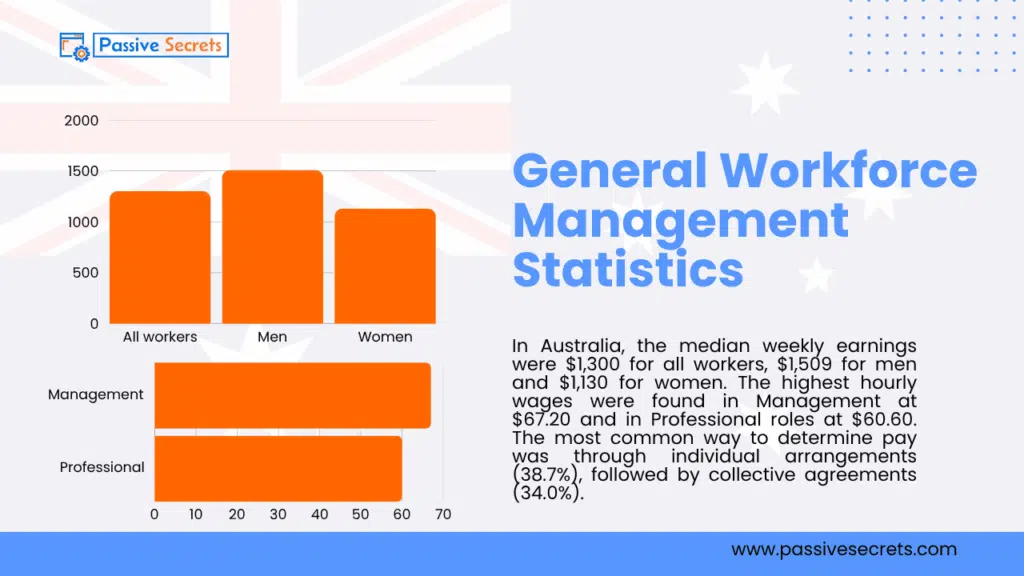
14. In Australia, the median weekly earnings were $1,300 for all workers, $1,509 for men and $1,130 for women. The highest hourly wages were found in Management at $67.20 and in Professional roles at $60.60. The most common way to determine pay was through individual arrangements (38.7%), followed by collective agreements (34.0%). (source)
Workforce Size and Composition
15. About 32% of employees lack the necessary skills for their current role, with significant variation across countries, from 39% in Italy to 25% in Poland. (source)
16. HR professionals in Europe prioritize skills like problem-solving (35%) and data analytics/AI (30%) for the future. Meanwhile, automation and AI may replace up to 27% of work hours in Europe by 2030, affecting tasks like data processing and customer communication. (source)
17. Most HR professionals (93%) say employee skills are documented in HR systems. (source)
18. In Europe, HR professionals report that about two-thirds of positions are filled through external hiring (37% direct recruitment, 14% headhunters, 12% external service providers), while internal mobility fills the remaining one-third. Notably, external hiring surged in Germany from 48% in 2023 to 67% in 2024. (source)
19. Millennials are leading AI adoption at the workplace, with 62% of 35-44-year-olds claiming high AI expertise, surpassing Gen Z (50%) and baby boomers (22%). (source)
20. About 38% of employees doubt their company will provide the necessary training for their roles. (source)
21. 33% of employees are uncertain that their skills will meet new job requirements due to rapid AI-driven changes. (source)
22. North America is projected to maintain the largest market size in the global workforce management market, while the Asia Pacific region is expected to grow at the highest CAGR. (source)
23. Key companies in the global workforce management market include Oracle (US), Kronos (US), ADP (US), SAP (Germany), Ultimate Software (US), and Workforce Software (US). (source)
24. North America is a key region contributing to market growth, and data analytics solutions are used to assess workforce performance, manage staffing, and enhance employee collaboration and engagement. (source)
25. 84% of participants indicated they plan to hire new permanent employees with skills related to emerging technologies. (source)
Productivity and Performance
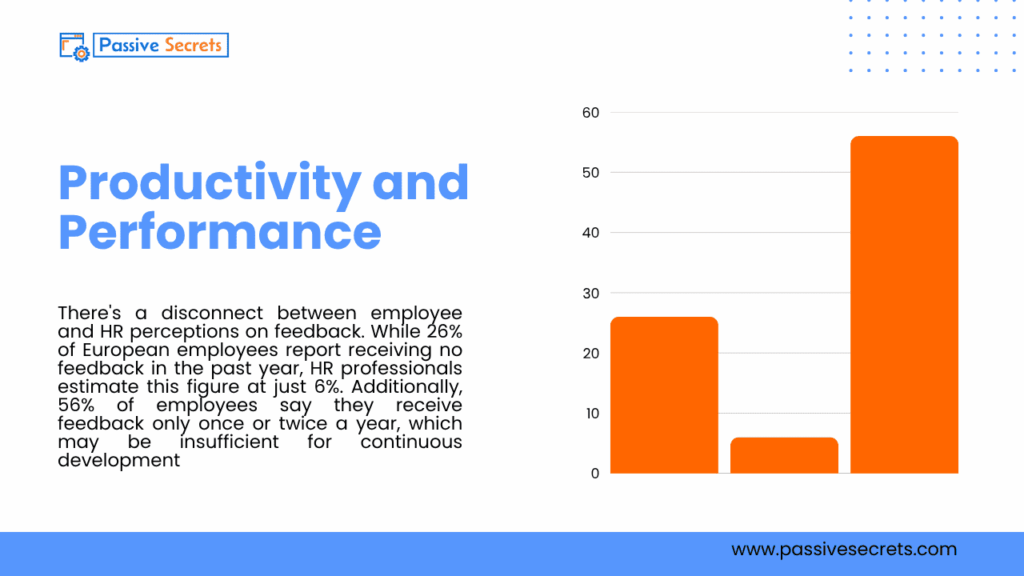
26. There’s a disconnect between employee and HR perceptions on feedback. While 26% of European employees report receiving no feedback in the past year, HR professionals estimate this figure at just 6%. Additionally, 56% of employees say they receive feedback only once or twice a year, which may be insufficient for continuous development. (source)
27. About 34% of European organizations are currently utilizing Internet of Things (IoT) technology for their business processes, with an additional 12% planning to adopt it soon. This growing trend is expected to drive efficiency and performance in workforce management. (source)
28. Global employee engagement took a hit in 2024, slipping from 23% to 21%, and costing the global economy a staggering $438 billion in lost productivity. (source)
29. Global employee life evaluations have dropped to 33% after a period of steady improvement over the past two years. (source)
30. Only 44% of global managers report receiving training. However, managers who participated in training saw engagement boosts of up to 22% and their teams up to 18%, .with performance metrics improving 20-28%. (source)
Hospital Workforce Management
31. The Hospital Workforce Management market is expected to grow from $1,661.3 million in 2024 to $1,801.2 million by 2025 and $4,162.1 million by 2035, at a CAGR of 8.7%. (source)
32. Hospitals face financial strain mainly due to workforce costs, with 34% of executives citing recruitment, retention, and staffing issues. Supply costs (24%) and operating room efficiency (21%) are also significant concerns, prompting hospitals to adopt cost-management strategies while maintaining quality patient care. (source)
33. Hospitals face significant staffing gaps, particularly in specialists (49%), nursing (46%), mental and behavioral health providers (45%), and advanced practice providers (45%), highlighting the need to recruit beyond physicians. (source)
Workforce Management Technology
34. The European Workforce Management Software Market is expected to grow from $2.66 billion in 2025 to $4.03 billion by 2030, at a compound annual growth rate (CAGR) of 8.67%. This growth is driven by the need for improved productivity and compliance with workforce-related standards. (source)
35. Gen AI can boost talent acquisition tasks, which make up 20% of HR’s value potential, by streamlining processes like job description creation, potentially cutting costs by up to 70%. (source)
36. Only 21% of European employees have received formal training on gen AI tools, varying from 17% in France to 30% in the UK. Meanwhile, 45% of US employees have received similar training. (source)
37. The Middle East and Africa Workforce Management Software market is expected to grow from $0.44 billion in 2025 to $0.66 billion by 2030, at a CAGR of 8.38%. (source)
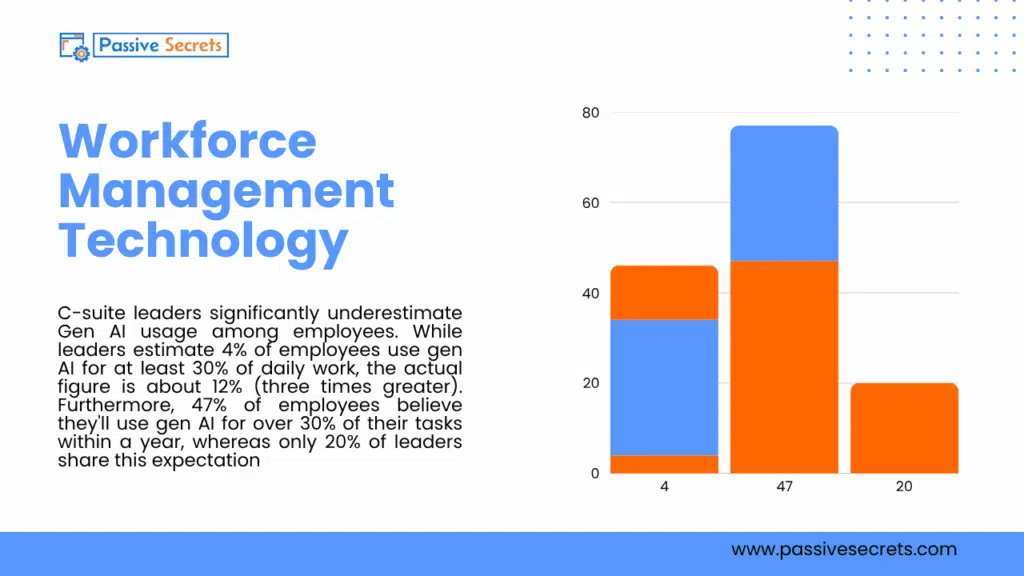
38. C-suite leaders significantly underestimate Gen AI usage among employees. While leaders estimate 4% of employees use gen AI for at least 30% of daily work, the actual figure is about 12% (three times greater). Furthermore, 47% of employees believe they’ll use gen AI for over 30% of their tasks within a year, whereas only 20% of leaders share this expectation. (source)
39. Over half of HR leaders, 53%, have decided not to backfill certain roles due to AI. (source)
40. Two-thirds of managers report getting AI-related questions from their teams at least weekly, and also recommend AI tools to solve problems. (source)
41. The focus on workforce optimization is anticipated to drive the workforce software market through 2032. (source)
42. The time and attendance management segment accounted for 25% of the workforce management software market share in 2023, driven by the need for greater efficiency. (source)
43. In 2023, the cloud segment held approximately 35% of the workforce management software market share. (source)
44. The workforce analytics market is projected to grow by USD 2.56 billion at a CAGR of 17.74% between 2023 and 2028. (source)
45. North America accounted for 30% of the workforce management software market revenue in 2023 due to its advanced technological infrastructure and early adoption of digital solutions. (source)
46. The top three companies in the workforce management software industry are Oracle Corporation, SAP SE, and ADP, Inc. (source)
Workforce Management Trends in 2026
1. Workplaces As Connected Ecosystems
Workplaces in 2026 are evolving into connected ecosystems, where technology integrates physical and digital environments to encourage collaboration and efficiency. Organizations are using IoT, cloud platforms, and real-time communication tools to create seamless interactions among employees, devices, and systems.
For example, Smart offices equipped with sensors optimize space usage, monitor environmental conditions, and enhance employee well-being. Hybrid work models are now standard, with platforms enabling real-time data sharing and virtual collaboration to ensure teams remain cohesive across geographies.
These ecosystems prioritize interoperability, breaking down silos between departments and enabling a unified approach to project management and decision-making.
Employees benefit from personalized workspaces that adapt to their preferences, boosting productivity and engagement.
2. AI And Data-Driven People Management
AI is transforming people management by enabling data-driven decision-making. In 2026, HR teams use AI to analyze employee performance, engagement, and well-being metrics with unprecedented precision.
Predictive analytics identify talent gaps, forecast turnover risks, and recommend personalized development plans.
AI-powered tools streamline recruitment by matching candidates to roles based on skills, cultural fit, and potential. Real-time feedback systems provide managers with actionable insights, reducing bias in performance evaluations.
However, ethical considerations are critical, with organizations prioritizing transparent AI algorithms and data privacy to maintain trust. This trend empowers HR to move beyond intuition, aligning workforce strategies with business goals.
3. Soft Retirement
Soft retirement is gaining traction in 2026 as older workers seek flexible transitions into retirement. Instead of abrupt exits, employees are opting for phased reductions in hours, part-time roles, or consulting arrangements.
This trend addresses labor shortages and retains institutional knowledge while allowing seasoned professionals to balance work with personal pursuits.
Companies are designing mentorship programs where retirees guide younger employees, fostering knowledge transfer.
Tax incentives and revised pension policies in some regions support this shift, encouraging workers to remain engaged longer. Soft retirement benefits both employees, who gain flexibility, and employers, who maintain experienced talent in a competitive market.
4. AI Workflows
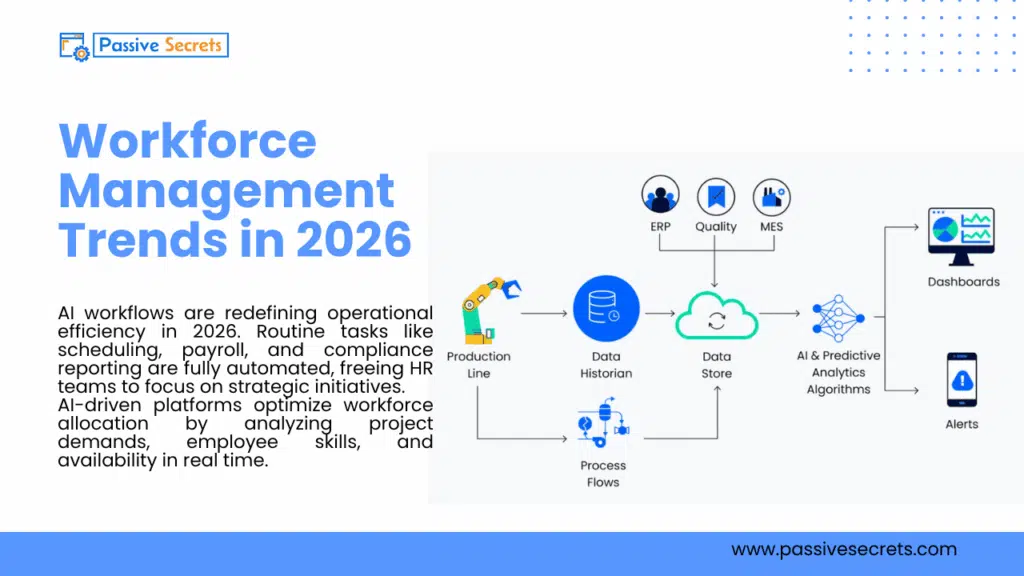
AI workflows are redefining operational efficiency in 2026. Routine tasks like scheduling, payroll, and compliance reporting are fully automated, freeing HR teams to focus on strategic initiatives.
AI-driven platforms optimize workforce allocation by analyzing project demands, employee skills, and availability in real time.
Chatbots and virtual assistants handle employee queries, from benefits inquiries to career development resources, improving responsiveness.
These workflows integrate with enterprise systems, creating end-to-end automation for onboarding, training, and performance tracking.
While AI streamlines processes, organizations emphasize the importance of human oversight to ensure that workflows align with company culture and employee needs, thereby avoiding over-reliance on technology.
5. Employee Experience
Employee experience (EX) is a cornerstone of workforce management in 2026, with organizations prioritizing holistic well-being and engagement. Companies invest in personalized EX platforms that offer tailored learning paths, wellness programs, and flexible benefits.
Feedback loops, powered by AI and pulse surveys, allow real-time adjustments to workplace policies.
Inclusive cultures are fostered through diversity-focused initiatives and equitable career opportunities.
Physical and virtual workspaces are designed to enhance collaboration, creativity, and mental health, with features like quiet zones and VR team-building activities.
EX strategies are tied to business outcomes, with data showing that high engagement correlates with improved productivity and retention.
Conclusion
The workforce management statistics presented in this article offer valuable insights into the shifting landscape of modern work.
As the global market grows, organizations recognize the importance of investing in workforce management technology, analytics, and strategies to optimize productivity, engagement, and retention.
With the rise of remote and hybrid work, the need for effective workforce management has never been more pressing.
By understanding these workforce management statistics, businesses can make informed decisions to future-proof their workforce management practices, drive growth, and stay competitive in an increasingly dynamic market.
Stay ahead of the curve and leverage these workforce management statistics to transform your organization’s approach to managing its most valuable resource – its people.
FAQs
Other Similar Statistics That Will Interest You:
- 30+ Powerful Team Building Statistics to Boost Workplace Performance
- 87+ Training Industry Statistics & Trends for HR and L&D Professionals
- Global IT Outsourcing Statistics: Key Trends and Insights
- 90+ Interesting Marketing Jobs Statistics & Facts (Latest Report)
- 80+ Employee Benefit Statistics: Insights and Trends
- The Most Important Wealth Management Statistics You Can’t Afford to Ignore
- Enterprise Data Management: Essential Statistics and Emerging Trends
- 93 Talent Management Statistics to Help You
- Top Reputation Management Statistics and Trends to Improve Your Brand
- 36 Helpful Social Worker Burnout Statistics To Know
- 100 Business Process Outsourcing Statistics & Facts
- Top HR Outsourcing Statistics and Trends Every Business Must Know
- The Top Outsourcing Statistics You Shouldn’t Ignore
- 47+ Shocking 4-day Work Week Statistics To Know
- 105+ Supply Chain Statistics & Facts You Can’t Ignore
- 50+ Interesting Employer Branding Statistics And Trends
- Job Seekers Statistics: Unemployment Rates, Preferences, Challenges
- 95 Interesting Job Interview Statistics and Huge Trends To Know
- 60+ Helpful Change Management Statistics & Facts
- 65+ Employee Performance Management Statistics & Trends
- 73 Revealing Workplace Distraction Statistics
- Workplace Romance Statistics: How Common Is Workplace Romance?
- 40+ Top Workplace Conflict Statistics You Should Know
- The State of Workplace Communication: Key Statistics and Trends
- 55 Workplace Collaboration & Teamwork Statistics

