
Supply chains have never been more critical or more complex. From global market shifts and trade tensions to talent shortages and new sustainability rules, the way goods move from production to customers is constantly being reshaped.
At the same time, technology is creating both opportunities and challenges: companies are experimenting with artificial intelligence, automation, and advanced analytics, but many still struggle to see clear returns on those investments.
For supply chain leaders, executives, and practitioners, understanding the numbers behind these changes is essential.
The supply chain statistics go beyond surface-level trends. They highlight where businesses are investing, where risks remain high, and where innovation is starting to make a measurable impact.
These insights give you a clearer picture of what is in the supply chain industry, whether you’re leading strategy, overseeing operations, or simply trying to benchmark your organization against industry peers.
What emerges is a clearer picture of the state of supply chains today, and the forces shaping their future.
Key Supply Chain Statistics
- The global supply chain management market is expected to grow from $35.3B in 2025 to $89.6B by 2034 (CAGR 10.9%).
- As of September 2025, the average U.S. Supply Chain Manager earns $130K annually ($63/hour), with salaries ranging from $117K–$143K.
- Over half of retail (58%) and consumer goods (55%) executives are focusing on greater agility to respond quickly to shifting demand.
- 60% of companies are prioritizing supply chain and inventory optimization to boost efficiency.
- AI-enabled supply chains are 67% more effective than non-AI ones, thanks to lower risks and costs.
- 80% of leaders say their supply chain technology projects failed to deliver expected returns.
- 94% of supply chain leaders already use AI for inventory, quality control, product design, operations, and logistics.
- Fewer than 10% of companies have achieved near-full automation, leaving significant room for digital adoption.
- 59% of companies are investing in generative AI, despite 43% facing budget limits.
- An overwhelming 93% of companies plan to integrate AI into supply chain operations.
- Workforce shortages affect 76% of supply chains, with 37% reporting severe gaps in transport and warehousing.
- Supply chain disruptions cost organizations an average of $184M annually worldwide.
- Fewer than 8% of businesses feel fully in control of supply chain risks, while 63% report greater-than-expected losses.
- 94% of companies say raw material procurement is the most disrupted area of their supply chains.
- Nearly 90% of companies report disruption in manufacturing, and 76% in warehousing and aftermarket services.
- 69% of respondents say new sustainability regulations are highly impactful, and 85% struggle more with compliance.
General Supply Chain Statistics
1. The global supply chain management market is projected to expand from $35.30 billion in 2025 to $89.57 billion by 2034, growing at a compound annual growth rate (CAGR) of 10.92%. (source)
2. The U.S. supply chain management market size was $8.81 billion in 2024 and is projected to reach $26.16 billion by 2034, growing at a CAGR of 11.50% from 2025 to 2034. (source)
3. The North American supply chain management market was valued at $12.71 billion in 2024 and is expected to grow at a CAGR of 10.95% from 2025 to 2034. (source)
4. The Asia Pacific region is the fastest-growing market in the supply chain management sector. (source)
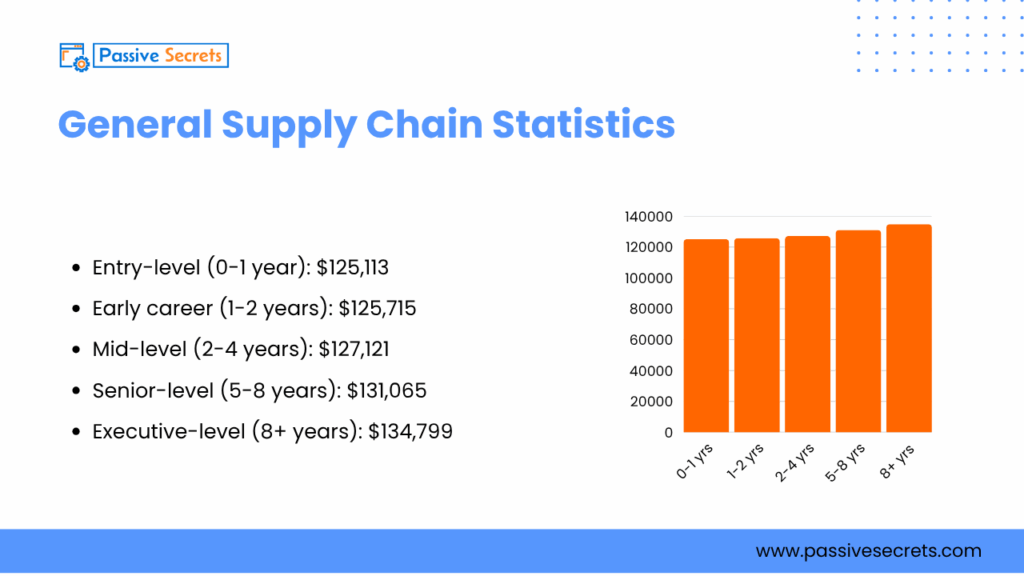
5. As of September 1, 2025, the average annual salary for a Supply Chain Manager in the US is $130,161, with an hourly rate of $63, and a range of $116,706 to $142,639. (source)
6. Supply Chain Manager salaries vary by experience level:
7. Companies with an extensive supply chain distribution plan take only two days for order fulfillment. (source)
8. Companies without a supply chain distribution plan can take up to 10 days for order fulfillment. (source)
9. Measures imposed during the COVID-19 pandemic affected the retail supply, leading to higher rates of out-of-stock and overstocked consumer goods. (source)
10. While retailers struggled with inventory distortion costs at the store level, manufacturers faced even higher costs due to disrupted demand. (source)
11. More than half of retail (58%) and consumer products (55%) executives are focused on building agility to adapt faster to changes in demand. (source)
12. Australia’s supply chain management market was valued at $857.2 million in 2024 and is projected to reach $2,149.2 million by 2033, growing at a compound annual growth rate (CAGR) of 10.75% from 2025 to 2033. (source)
13. According to Gartner, Schneider Electric ranks as the top supply chain company, followed by NVIDIA in second place and Cisco Systems in third. (source)
14. According to Gartner, Walmart ranks as the top retail supply chain company, followed by JD.com in second place and Inditex in third. (source)
15. When selecting suppliers from outside the EU, 75% of companies prioritize quality, while 67% also consider price as a key factor. (source)
16. A significant majority, 68%, of firms plan to boost their exports to EU countries within the next two years, whereas a smaller proportion, 47%, intend to increase exports to countries outside the EU. (source)
17. Most companies (81%) believe their supply chains provide a competitive edge. Meanwhile, 43% of organizations are focusing on cutting costs over the next one to two years. (source)
18. Half of organizations (50%) expect their supply chain costs to improve within the next year. Additionally, a significant majority (81%) are confident in the skills of their supply chain team, rating them as highly to adequately skilled. (source)
19. There was a 13% year-over-year increase in goods financed from international suppliers between January and April 2025, compared to the same period in 2024. (source)
20. According to the U.S. Census Bureau and the Bureau of Economic Analysis, the U.S. trade deficit decreased to $86.0 billion in June, a $10.4 billion drop from May’s $96.4 billion. This reduction was driven by a steeper decline in imports ($11.5 billion) than exports ($1.1 billion) in June. (source)
Key Performance Metrics
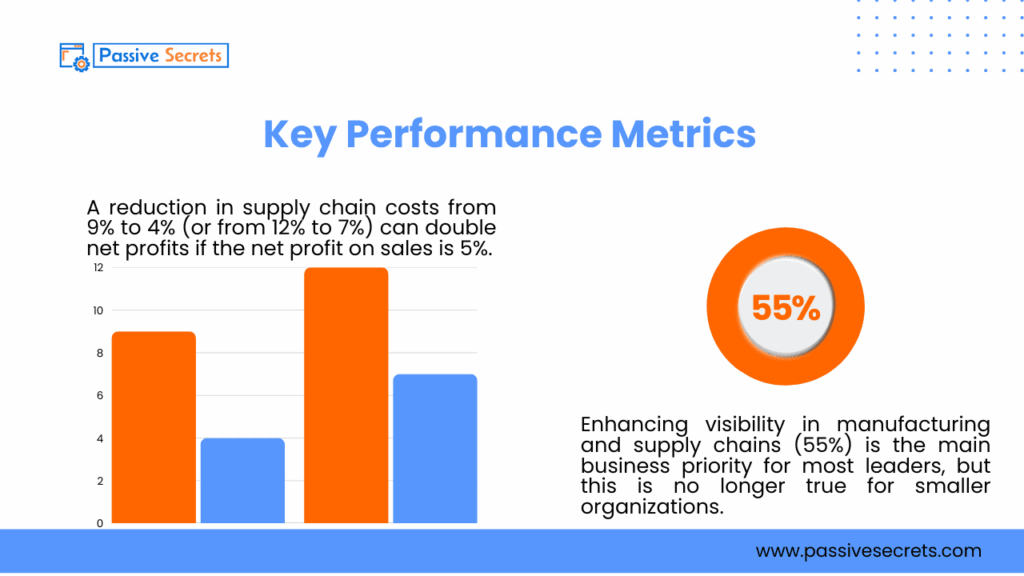
21. Enhancing visibility in manufacturing and supply chains (55%) is the main business priority for most leaders, but this is no longer true for smaller organizations. (source)
22. A reduction in supply chain costs from 9% to 4% (or from 12% to 7%) can double net profits if the net profit on sales is 5%. (source)
23. Almost half of businesses in a survey stated they were enhancing their manufacturing capacity, collaboration with supply chain partners, or supply chain speed. (source)
24. The global supply chain pressure index dropped to -0.85 points in April 2024, down from -0.3 points the previous month. After the COVID-19 pandemic, the supply chain pressure index has returned to pre-pandemic levels. (source)
25. Supply chain pressure shocks positively contributed to inflation throughout the post-2020 period. (source)
26. Global supply chain pressures peaked at almost 4.5 standard deviations in late 2022 during the pandemic. (source)
27. Supply chain pressures eased in the first half of 2021 but gradually increased from July 2021, reaching an all-time high in June 2022. (source)
28. Collaboration with retailers has yielded significant benefits for delivery performance, with 88% of organizations reporting improvements. However, only about half (44%) of these organizations have also seen a reduction in supply chain costs. (source)
29. 60% of companies are prioritizing supply chain and inventory optimization, aiming to streamline operations and improve efficiency. (source)
30. 43% of companies are prioritizing data and analytics-driven decision-making, recognizing its key role in driving business growth. (source)
31. To address cost pressures, CPG manufacturers are taking various approaches, with 35% using demand-driven forecasting to optimize inventory and 30% maintaining lean inventory while increasing safety stock as needed.
However, 45% cite supply variability as a major challenge affecting production and fulfillment. In response, companies are adjusting pricing and promotions, with 70% increasing discounts and 40% introducing value-tier product lines to compete with private labels. (source)
Supply Chain Technology and Innovation Statistics
32. Artificial Intelligence is projected to be worth about $17.5 billion in the global supply chain management software market by 2028. (source)
33. Artificial Intelligence-enabled supply chains are 67% more effective than non-AI counterparts due to reduced risks and lower overall costs. (source)
34. The digital supply chain market is expected to double in size, growing from $21.13 billion in 2025 to $42.22 billion by 2034, with a compound annual growth rate (CAGR) of 7.99%. (source)
35. The global supply chain management software market is forecast to grow at a CAGR of 3.8% from 2023 to 2028. The market is projected to reach over 16 billion U.S. dollars by 2028. (source)
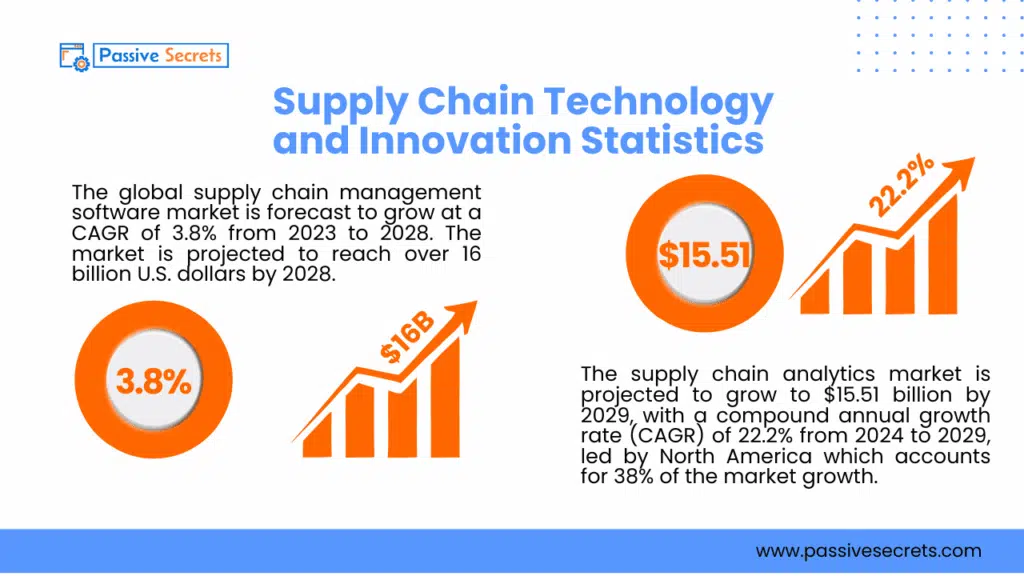
36. The supply chain analytics market is projected to grow to $15.51 billion by 2029, with a compound annual growth rate (CAGR) of 22.2% from 2024 to 2029, led by North America which accounts for 38% of the market growth. (source)
37. The first-ever Pan-African landscape assessment revealed 350 innovators digitizing African health supply chains. (source)
38. Innovators are based in 27 African countries, with a concentration in Nigeria, South Africa, Kenya, and Egypt. (source)
39. 25% of innovators work in more than one category. (source)
40. Nearly 50 partnerships have been formed to provide governments with technology-enabled supply chain solutions. (source)
41. 80% of leaders surveyed by PWC say their supply chain tech projects have not delivered the expected returns. (source)
42. Technological advancements are being embraced by 78% of companies to enhance operational efficiency in product development, paving the way for more practical and economical production of smaller product batches. (source)
43. The UK Supply Chain Management Software market is projected to grow from $1.03 billion in 2025 to $1.28 billion by 2030, at an annual growth rate of 4.53%. (source)
44. The average spend per employee in the Supply Chain Management Software market in the UK is projected to reach $28.50 in 2025. (source)
45. Australia’s Supply Chain Management Software market is expected to reach $349.98 million by 2025 and continue growing at a 3.25% annual rate until 2030, when it will reach $410.71 million. (source)
46. China’s Supply Chain Management Software market is projected to expand from $0.79 billion in 2024 to $1.22 billion by 2029, growing at a CAGR of 9.08%, with an average spend per employee of $1.01 in 2024. (source)
47. The Global Retail Supply Chain Management market was valued at $31.11 billion and is expected to grow to $58.87 billion by 2030. The market is anticipated to grow at a CAGR of 9.54% from 2024 to 2030. (source)
48. The cloud-based deployment phase of the retail supply chain management market is expected to experience high demand, with a CAGR of 14.2% over the coming years. (source)
49. The U.S. is predicted to account for over 79% of the North American supply chain management market share by 2030. (source)
50. Nigeria’s Supply Chain Management Software market is expected to generate $10.49 million in revenue by 2025 and grow at a CAGR of 2.09% from 2025 to 2030, reaching $11.63 million by 2030. (source)
51. The average spend per employee in Nigeria’s Supply Chain Management Software market is projected to be $0.13 in 2025. (source)
52. 56% of senior manufacturing leaders say AI influences their company strategy, while 41% cite increased competition and 41% mention labor costs and shortages. (source)
53. 94% of supply chain leaders rely on AI in their operations, applying it to areas such as inventory management, quality control, product design, machine operations, and logistics. (source)
54. Fewer than 10% of supply chain companies have achieved near-full automation, indicating a significant opportunity for implementing digital solutions. (source)
55. 70% of supply chain leaders identify cultural resistance and unclear ROI metrics as significant obstacles to further digital transformation. (source)
56. Over 35% of supply chains are utilizing or testing automated compliance tools, including digital passports and document scanning, to detect anomalies in wage records and worker documentation. (source)
57. 18.5% of supply chain companies use collaborative planning and AI-powered dashboards to monitor supplier performance. (source)
58. 7% of supply chain companies don’t see immediate AI value, while 21%+ worry about data security and privacy. Mid-sized firms (66% of respondents) struggle to invest in digital tools due to competing compliance demands, thin margins, and retailers’ reluctance to share costs. (source)
59. Supply chain companies face significant hurdles on their path to technological advancement, citing top challenges as finding qualified talent (44%), financial constraints (43%), and ensuring data quality and accessibility (39%). (source)
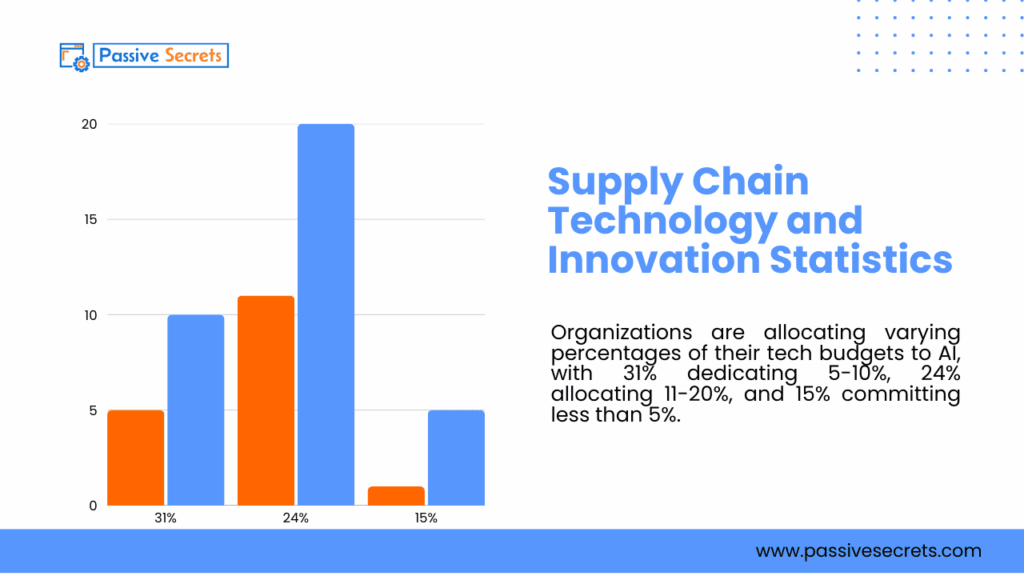
60. Organizations are allocating varying percentages of their tech budgets to AI, with 31% dedicating 5-10%, 24% allocating 11-20%, and 15% committing less than 5%. (source)
61. 59% of companies are investing in generative AI, despite 43% facing budget constraints, highlighting the priority placed on this emerging technology. (source)
62. Despite the importance of supply chain resilience, only 22% of companies have substantially increased their investment in supply chain technology, and these investors tend to be more confident in their ability to handle disruptions. Meanwhile, 43% of brands will continue to rely on manual processes and outdated systems, which can hinder their response to disruptions. (source)
63. An overwhelming majority, 93%, of companies plan to integrate Artificial Intelligence (AI) into their supply chain operations. (source)
64. The global Supply Chain Management Software market is anticipated to reach $20.97 billion by 2025 and expand further to $24.70 billion by 2030, growing at a compound annual rate of 3.33%. (source)
65. By 2025, the average spend on Supply Chain Management Software per employee is expected to be $5.59. (source)
66. The United States is expected to generate the highest revenue in the Supply Chain Management Software market, reaching $11.32 billion by 2025. (source)
Supply Chain Challenges, Risks, and Disruptions
67. Workforce shortages affect 76% of supply chains, with 37% reporting significant deficits, especially in transportation and warehousing roles. (source)
68. About 42% of automotive and assembly industry business leaders considered demand variability the most critical factor making their businesses vulnerable to supply chain disruptions. (source)
69. 37% of global consumers reported switching to online shopping due to supply chain issues. (source)
70. Six out of ten online shoppers in Indonesia reported changing their shopping habits due to supply chain problems. (source)
71. Supply chain disruptions cause significant economic hardship, costing organizations worldwide an average of $184 million annually. (source)
72. Regionally, the financial burden is highest in the United States, where respondents’ organizations faced an estimated average annual cost of $228 million. (source)
73. 96% of manufacturing leaders expect the US President’s policies to affect their supply chain, mainly increasing costs and reducing profitability (57%). (source)
74. 93% of senior manufacturing and supply chain leaders expect trade wars to escalate, with 42% “very concerned”. (source)
75. 77% of manufacturing and supply chain leaders cite workforce shortages and inadequate budgets as their biggest challenges. (source)
76. Manufacturing leaders face multiple challenges: 52% struggle with supplier quality and compliance, 38% lack supply chain visibility, and 37% face rising labor costs and workforce shortages, hindering production standards, logistics, and time-to-market. (source)
77. 95% of manufacturing and supply chain leaders say weather and climate events affect their supply chain strategy in 2025. (source)
78. 95% of supply chain executives say tariffs are a major disruptor, causing them to adjust their sourcing strategies. (source)
79. 95% of supply chain executives say tariffs are a major disruptor, leading to swift changes in sourcing from China to alternative locations like Vietnam, Cambodia, and nearshore destinations. (source)
80. Less than 8% of businesses feel they have complete control over their supply chain risks, while 63% report losses exceeding expectations, highlighting the persistent uncertainty and intricacy of global supply chains. (source)
81. Inflation is driving supply chain strategy changes. Retailers are taking a balanced approach, with 31% focusing on operational efficiencies and 31% implementing strategic price hikes. Additionally, 59% of retailers are expanding private label offerings to protect margins and offer affordable alternatives. (source)
82. Just 21% of brands are extremely confident in their ability to manage supply chain disruptions, while a larger portion, 41%, express only moderate confidence. (source)
83. While 66% of brands consider real-time visibility crucial for recovering from disruptions, a majority of 59% still struggle to achieve reliable and accurate visibility, highlighting a significant gap between aspiration and reality. (source)
84. Trade tensions have far-reaching effects, impacting not only importing firms but also those that don’t import. In 2024, over 10% of EU non-importing firms reported significant challenges due to limited access to raw materials and logistics disruptions. (source)
85. A significant 75% of firms that made supply chain adjustments in 2024 had also made changes the previous year, suggesting that implementing such strategies is a time-consuming process. (source)
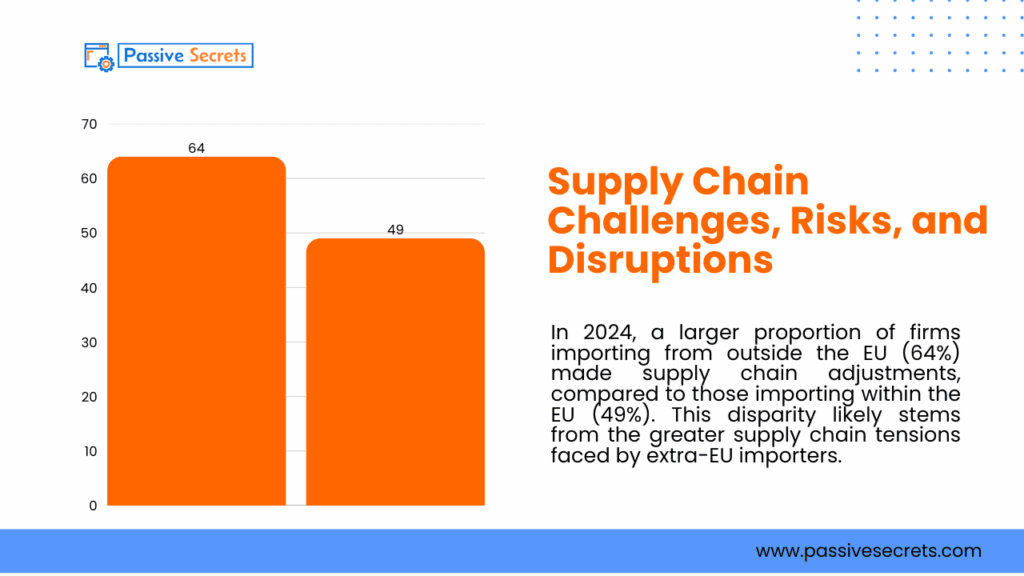
86. In 2024, a larger proportion of firms importing from outside the EU (64%) made supply chain adjustments, compared to those importing within the EU (49%). This disparity likely stems from the greater supply chain tensions faced by extra-EU importers. (source)
87. 79% of Australian supply chains continue to feel moderate to large-scale disruption impacts. (source)
88. A substantial 79% of supply chains faced significant disruptions, with 68% of respondents specifically citing international shipping delays as a major issue. (source)
89. A notable proportion of companies, 21%, lack formal risk planning or scenario analysis to address supply chain disruptions, while an additional 14% are still in the process of developing these strategies. (source)
90. The 25% tariff on imported cars and parts is causing temporary supply chain disruptions as manufacturers relocate production of popular models to US-based plants to avoid tariff impacts. (source)
91. A significant majority (94%) of companies reported disruptions in raw material procurement as the area most impacted by supply chain challenges. (source)
92. Supply chain disruptions have extensively affected companies, with nearly 90% experiencing impacts on manufacturing and production capacity, 76% on warehousing, and 76% on aftermarket services like repairs. (source)
93. According to a survey, 30% of companies have noticed their supply chain partners scaling back their operations. (source)
Sustainability in Supply Chains
94. Almost half of companies (48%) are feeling the pressure to make their supply chains more sustainable. (source)
95. 75% of supply chain retailers believe sustainability influences purchasing decisions, but fewer than 10% think consumers are willing to pay more for eco-friendly products. (source)
96. More than 60% of suppliers say retailers pass on compliance and environmental upgrade costs to them, at least partially. (source)
97. 75%+ of supply chain respondents believe environmental and social compliance factors significantly impact consumers’ purchasing decisions. (source)
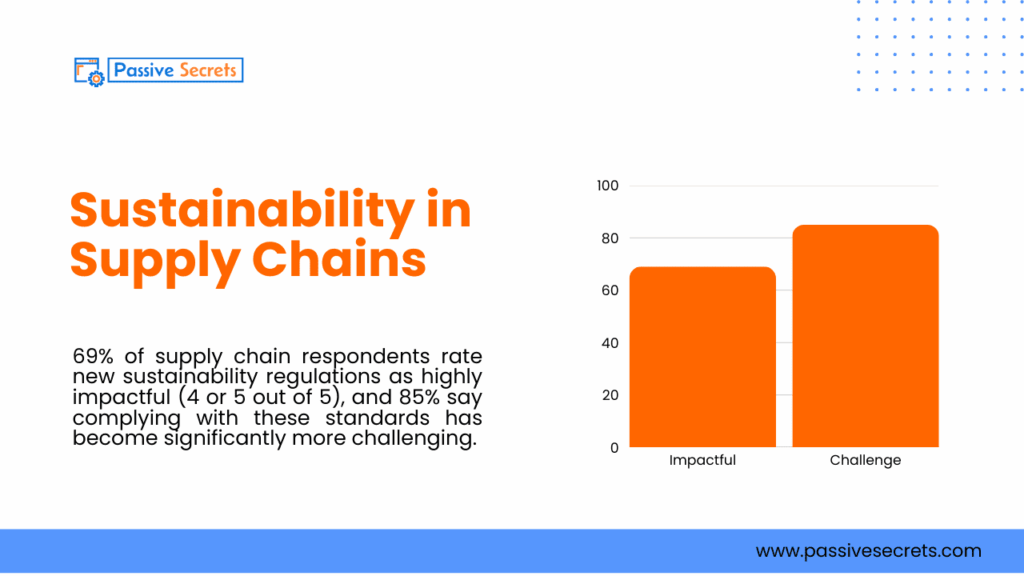
98. 69% of supply chain respondents rate new sustainability regulations as highly impactful (4 or 5 out of 5), and 85% say complying with these standards has become significantly more challenging. (source)
99. Around half of EU traders currently track their carbon emissions, and an additional 30% plan to implement emission-reduction measures within the next three years. (source)
Future Outlook of the Supply Chain Industry
100. Despite vulnerabilities to external disruptions, an overwhelming majority of organizations (94%) feel moderately to highly prepared to tackle future supply chain challenges. (source)
101. About 50% of organizations use scenario planning to anticipate and prepare for potential supply chain disruptions. (source)
Latest Supply Chain Trends 2026
1. Artificial Intelligence in Operations
Artificial intelligence (AI) advances are occurring at an unprecedented rate and offering numerous immediate returns, particularly in intelligent sourcing, inventory management, and logistical route planning.
Cobots drive warehousing efficiency through picking and packing, loading and unloading, and moving heavy objects; computer vision supports defect detection and object recognition; robotics enable safer assembly and welding; and augmented reality advances training, maintenance, and quality control.
Meanwhile, machine learning (ML), a subset of AI that allows computers to learn without being explicitly programmed, will be used to make predictions and decisions about demand forecasting, quality control, new product development, and much more.
Through 2024, 50% of supply chain organizations will invest in applications that support artificial intelligence and advanced analytics capabilities.
2. Investment in Systems and People
As the adoption of supply chain technology escalates, investing in people through training and development on the latest technology will continue to create a culture of innovation and encourage employees to share ideas that lead to supply chain success.
3 Transparency and Visibility Beyond Tier 1 and 2
Breaking the visibility barrier beyond Tier 1 allows organizations to look across their extended supply chain into partners, build greater and deeper insights into root causes, identify new risks that occur further into the supply chain, and drive ESG goals through better traceability and transparency.
Technology tools such as control towers and digital twins can surface critical sub-tier supplier relationships, highlight common sub-tier suppliers, factory locations and provide clear insight into the depth of an organization’s supply chain.
Less than half (43%) of organizations have limited to no visibility of tier-one supplier performance.
4. Low-code Platforms
Most supply chain tasks can be fully or partly automated through low-code platforms, which use a wide range of Application Programming Interfaces (APIs) and pre-packaged integrations to link previously separate systems.
These cut development time, enabling companies to swiftly react and adapt their applications to new market conditions, disruptive events, or changing strategies. They also enable business users with little technical knowledge to quickly build, test, and implement new capabilities.
More than two-thirds of enterprises have already adopted low-code to their supply chains.
5. Electric Vehicles, Transport, and Logistics
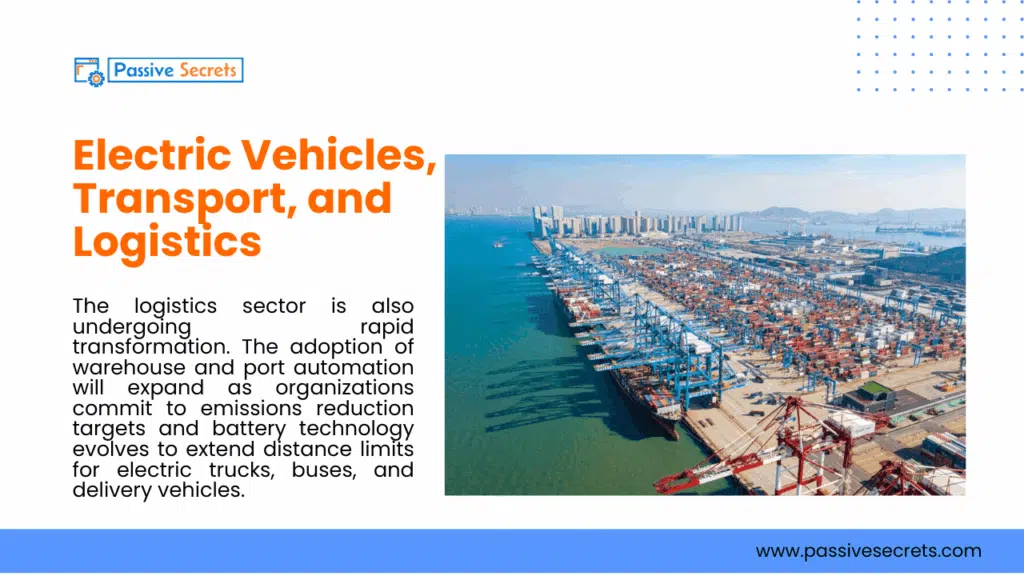
The logistics sector is also undergoing rapid transformation. The adoption of warehouse and port automation will expand as organizations commit to emissions reduction targets and battery technology evolves to extend distance limits for electric trucks, buses, and delivery vehicles.
Conclusion
The supply chain has become a fundamental component of success in today’s ever-changing corporate environment.
The figures we’ve examined present a clear picture: the supply chain is a complicated, dynamic system that necessitates meticulous planning, collaboration, and optimization.
To remain competitive, firms must embrace data-driven decision-making and implement new solutions.
Understanding and acting on supply chain statistics can help businesses position themselves for long-term success and better serve their customers in an ever-changing global economy.
FAQs
Other Related Statistics You Shouldn’t Miss
- 30+ Powerful Team Building Statistics to Boost Workplace Performance
- 87+ Training Industry Statistics & Trends for HR and L&D Professionals
- Global IT Outsourcing Statistics: Key Trends and Insights
- 90+ Interesting Marketing Jobs Statistics & Facts (Latest Report)
- 80+ Employee Benefit Statistics: Insights and Trends
- Enterprise Data Management: Essential Statistics and Emerging Trends
- 93 Talent Management Statistics to Help You
- Top Reputation Management Statistics and Trends to Improve Your Brand
- 36 Helpful Social Worker Burnout Statistics To Know
- 100 Business Process Outsourcing Statistics & Facts
- Top HR Outsourcing Statistics and Trends Every Business Must Know
- The Top Outsourcing Statistics You Shouldn’t Ignore
- 47+ Shocking 4-day Work Week Statistics To Know
- 50+ Interesting Employer Branding Statistics And Trends
- Job Seekers Statistics: Unemployment Rates, Preferences, Challenges
- 95 Interesting Job Interview Statistics and Huge Trends To Know
- 60+ Helpful Change Management Statistics & Facts
- 65+ Employee Performance Management Statistics & Trends
- Workforce Management Statistics: Trends, Insights, & Opportunities
- 73 Revealing Workplace Distraction Statistics
- Workplace Romance Statistics: How Common Is Workplace Romance?
- 40+ Top Workplace Conflict Statistics You Should Know
- The State of Workplace Communication: Key Statistics and Trends
