Ever wonder why some companies attract top talent effortlessly, while others struggle no matter how many job ads they post? The secret isn’t luck. It’s employer branding.
Over the years, the battle for talent is fiercer than ever. Job seekers are no longer just concerned about the paycheck; they’re researching reputations, judging cultures, and choosing workplaces that align with their values.
Meanwhile, organizations are racing to adapt, balancing authenticity with AI, and turning every employee interaction into a branding moment.
To help you stay ahead in 2026, we’ve gathered over 70 game-changing employer branding statistics that reveal exactly where the talent market is headed. These insights show what truly drives candidate decisions, and how leading companies are setting themselves apart.
Key Employer Branding Statistics (Editor’s Top Picks)
- 90% of HR professionals and 80% of executives consider employer branding a strategic priority.
- 77% of organizations say employer branding is important to their HR strategy, and nearly half (49%) have increased budgets for it in the past two years.
- 60% of companies have a formal employer brand strategy, while 10% are developing one.
- 76% of job seekers research a company’s employer brand before applying.
- 96% of employees are more likely to apply to a company with a positive employer brand.
- 87% of job seekers won’t apply if they see negative reviews about the company.
- 92% of employees would switch jobs for a company with a better reputation.
- 61% of workers say salary and benefits are their top factor when choosing an employer, followed by 57% who value work-life balance.
- There’s been a shift from engagement to experience — 77% of job seekers say employee experience strongly influences their decisions.
- 76% of employees value reskilling and upskilling opportunities from employers.
- Over 50% of workers view AI’s impact on job satisfaction positively.
- 42% of candidates prefer video content to learn about a company’s culture — a 60% rise since 2021.
- 72% of employer brand teams use real employees as brand advocates.
- One in six employees feels they lack growth opportunities — those employees are 42% more likely to consider leaving.
- 38% of employer brand professionals worry AI could reduce the “human touch” in branding, even as 70% believe authenticity can be maintained.
- 44% of companies measure the ROI of their employer brand efforts.
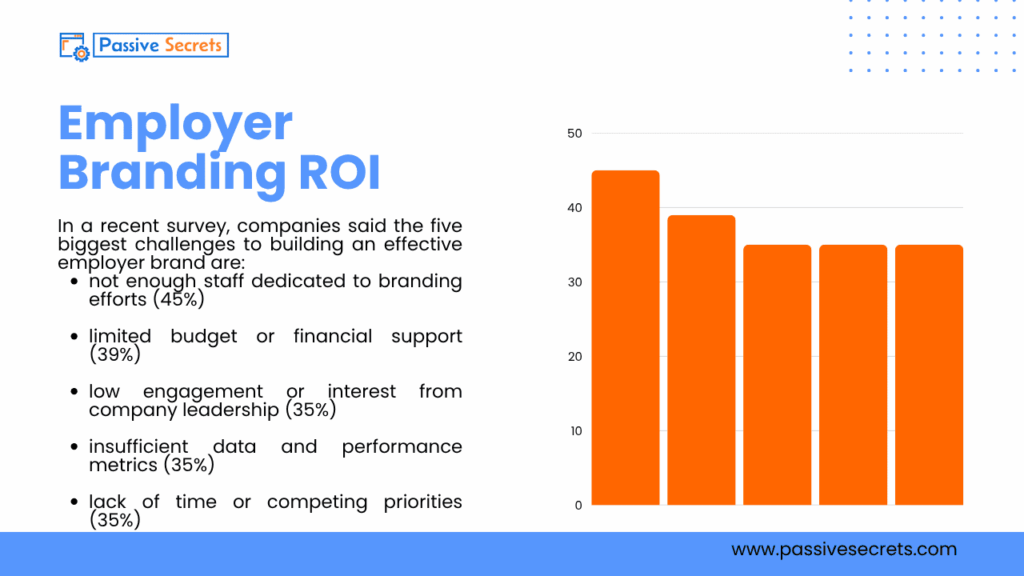
- The top challenges in employer branding are lack of staff (45%), limited budget (39%), and low leadership engagement (35%).
- 49% of organizations update their employer branding strategy only when needed — showing a reactive approach.
- Employee retention (45%) and engagement (45%) are the top metrics used to measure success.
- 87% of employer brand professionals report productivity gains from AI tools, and 73% say AI saves them time.
General Employer Branding Statistics
1. Employer Brand professionals face challenges with talent scarcity, with 40% reporting difficulties, particularly in acquiring top talent. Furthermore, 30% reported having difficulties with identifying top talent. (source)
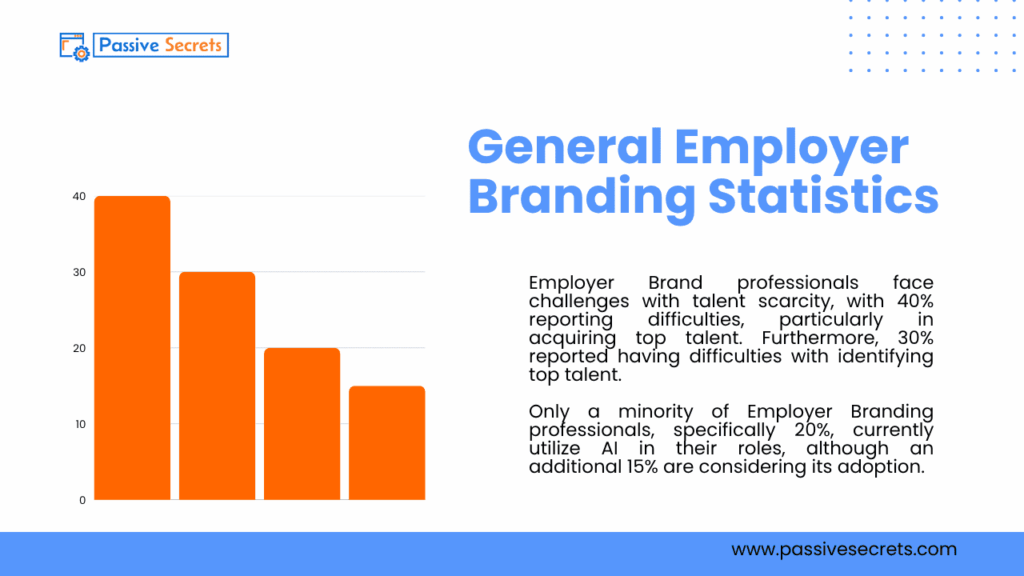
2. Only a minority of Employer Branding professionals, specifically 20%, currently utilize AI in their roles, although an additional 15% are considering its adoption. (source)
3. Employers meet employee expectations on equity, especially equal pay (64% men, 52% women). Women and baby boomers are more critical of employers’ performance on equity. (source)
4. Half of workers who identify as belonging to a minority group perceive obstacles in their career progression due to their identity. (source)
5. Employers fare well regarding job security, with 68% of employees satisfied. Millennials and those with higher levels of education exhibit a more positive view across all aspects. (source)
6. Retail remains the sector where the highest percentage of the global workforce believes they have the necessary skills to work, with 46% expressing confidence. This sentiment is even stronger in North America, where 52% feel they have the required skills. (source)
7. Hospitality ranks second (43%), particularly in North America (50%), followed by ITC at 42% globally. Conversely, the chemical sector is perceived as less accessible, with only 28% of the global workforce feeling adequately skilled. This sentiment is even lower in APAC, where only 23% feel prepared. (source)
8. White-collar talent is more inclined to consider their skills sufficient for any sector than blue-collar workers (41% vs. 34%). (source)
9. The chemical and life sciences industries are perceived as less compatible with the workforce’s skills, with just over 20% of blue-collar workers and 33% of white-collar workers believing they possess the necessary skills for these sectors. (source)
10. Most executives (80%) and HR professionals (90%) consider employer branding a priority. (source)
11. Global recruitment needs for knowledge workers are holding steady, with only 21% expecting a decrease in hiring compared to 2024. (source)
12. 72% of employees feel engaged in their current roles, and over half report being more motivated than they were a year ago. (source)
13. About 75% of employees have a positive view of their employer’s job security offerings. (source)
14. Most organizations (77%) consider employer branding important to HR strategy, and nearly half (49%) have increased their employer branding budget over the past two years. (source)
15. 60% of organizations have a formal employer brand strategy, and 10% are working on developing one. (source)
16. About 78% of organizations see employer branding as at least moderately important to HR strategy. (source)
17. 78% of organizations consider employer branding an important part of their HR strategy, using it to align workforce goals with overall business objectives—leading to better hiring, engagement, and culture. In contrast, the 23% who deem it less important risk losing competitiveness and missing the long-term benefits of a strong employer brand. (source)
18. Well-branded organizations are twice as likely to prioritize employer branding in their HR strategy (66% vs 37%). (source)
Employer Branding and Talent Attraction
19. Most (76%) of potential employees research and consider a company’s employer brand before applying for a job. (source)
20. 96% of employees reported that they would be more inclined to apply for a job at a company with a positive employer brand, representing a 39% rise compared to previous years. (source)
21. A growing number of employees, now at 87%, are hesitant to apply for a job if they come across negative reviews, up from 58% previously, indicating a shift in prioritizing their own well-being and workplace quality. (source)
22. A considerable majority of employees, 84%, contemplated leaving their current positions in favor of organizations with better reputations. (source)
23. 92% of employees would consider switching jobs if another company has a more impressive reputation. (source)
24. Despite being the most widely used job portal, the rate of individuals finding jobs through Indeed has decreased this year. However, it remains more effective for women (73%) than for men (58%). Men generally find all social media platforms more fruitful than women, except for TikTok and LinkedIn, where success rates are equal. (source)
25. Recruitment agencies are the most widely used resource among job seekers, particularly among older generations (51%). However, Gen Z job seekers prefer using Google for Jobs (43%). Younger generations are less likely to use recruitment agencies (42%). (source)
26. Job switching has increased steadily since 2021, with men (23%) and Gen Z (28%) leading the trend, compared to women (16%) and other generations. Looking ahead, men (30%), Gen Z (35%), and highly educated individuals (32%) are more likely to switch jobs soon. (source)
27. 76% of people stated they would actively search for or be open to a new job if their company reverted to flexible work policies. (source)
28. About 43% of people are more inclined to apply to a job posting with a salary range, while 21% are less likely or unwilling to apply to a role lacking one. (source)
29. 42% of candidates will not apply for a role if it doesn’t offer their preferred working model.
(source)
30. 56% of people express interest in applying to a job that offers a four-day workweek. (source)
31. The percentage of individuals who have changed jobs has risen from 12% to 16%, indicating a growing desire for higher earnings, meaningful work, or better job opportunities. (source)
32. The trend of job change is particularly strong in North America, where voluntary job changes have been unusually high (23% of respondents). Globally, almost one-quarter (24%) of individuals plan to change employers in the first half of the year, with intentions highest in Latin America (31%) and lowest in the Asia Pacific (21%). (source)
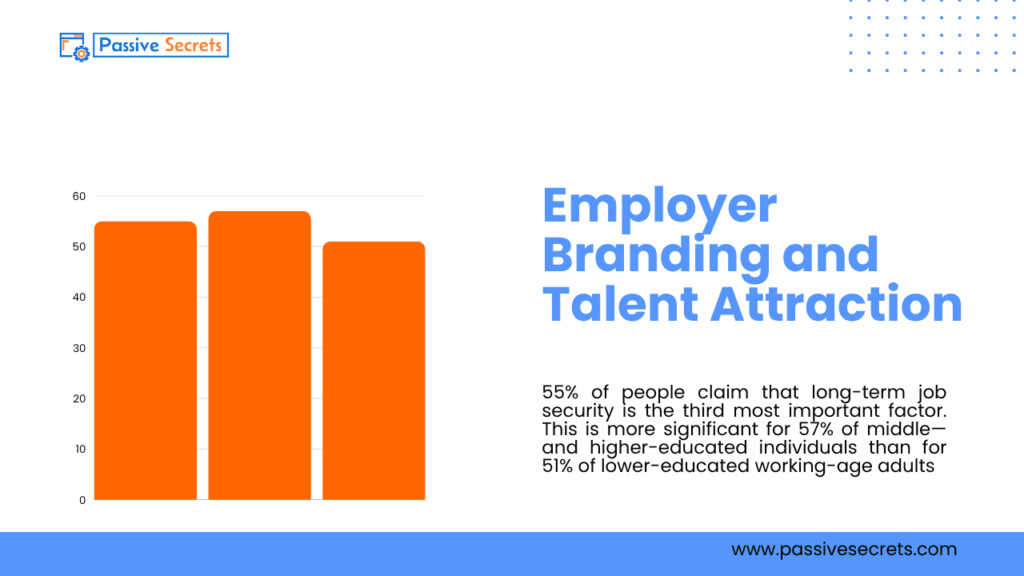
33. Wages remain the most important factor in workers’ choice of job offers, according to 61% of people. (source)
34. 57% of people prioritize a good work-life balance, with 55% of people considering job security critical. (source)
35. The top three most important drivers are rated equally important in Latin America. A good work-life balance is important globally, in North America, and APAC. Job security holds slightly more importance in APAC and North America, while a pleasant work atmosphere is Europe’s second most important factor. (source)
36. Globally, an attractive salary and benefits are the top priority when choosing an employer (61%), especially among women (63%), middle-educated individuals (64%), and to a lesser extent, men (58%) and those with lower (56%) or higher (60%) education levels. (source)
37. 60% of women express a stronger sentiment towards having a work-life balance compared to 54% of men. In comparison, 52% of lower-educated individuals prioritize it less than 58% of mid- to higher-educated working-age adults. (source)
38. 55% of people claim that long-term job security is the third most important factor. This is more significant for 57% of middle—and higher-educated individuals than for 51% of lower-educated working-age adults. (source)
39. 54% of people consider a pleasant work atmosphere crucial. 59% of women tend to value this more than 50% of men. (source)
40. 22% of individuals desire their employers to offer more perks, including salary protection and fair compensation, to enhance their work-life balance. (source)
41. With AI on the rise, employers are shifting their priorities. “Learning agility” is becoming increasingly valuable, with 45% of talent leaders considering it a top priority – a 14-point jump from the usual 31%. (source)
42. The World’s Most Attractive Employers prioritize internal career mobility, with 50% considering it a major priority – more than double the rate of other companies. (source)
43. Employers often prefer “go-getters” (43%) – ambitious and performance-driven employees. However, there’s a mismatch: 24% of young professionals identify as “balance seekers”, but only 7% of employers prioritize hiring them, compared to 21% for “go getters”. (source)
44. Companies are scaling back on diversity, equity, and inclusion (DEI) messaging, especially in the US. Globally, the percentage of companies considering DEI very important in recruitment policies dropped from 67% in 2024 to 57% in 2025. The US saw an even sharper decline, from 77% to 51%. (source)
45. 62% of HR pros think their employer brand boosts their organization’s rep, but only 28% have a solid, consistent employer branding strategy. (source)
Candidate Experience and Employer Reputation
46. In recent years, there has been a notable shift from a focus on employee engagement to a growing emphasis on employee experience. 55% of professionals recognize it as a prevailing trend, and 77% of job seekers acknowledge it as a decisive factor in their job search. (source)
47. Women (19%) are more likely to perceive a lack of opportunities and consider this a stronger reason to seek new employment. (source)
48. Most workers (69%) consider reskilling important, especially men, younger generations, and the highly educated. (source)
49. A quarter of male employees report engaging in constructive discussions about AI’s potential opportunities, contrasting with only 13% of female workers. Despite this, most receive no training on adapting to AI in the workplace. However, individuals between 25 and 34 benefit the most from regular AI training sessions, with 32% participating, compared to only 5% of the Baby Boomer generation. (source)
50. Gen Z respondents are more likely to believe that physical presence fosters career advancement, with 69% holding this belief compared to just half of Baby Boomers.
(source)
51. Most workers (70%) consider career growth very or somewhat important. 89% of Latin Americans consider it important. In the APAC region, 86% consider it important, and in Europe, 59% do so. (source)
52. In the past year, the importance of work meaning has increased more among white-collar workers (43%) than blue-collar workers (33%), with a global average of 39%. Additionally, career growth is significantly more important to white-collar workers (76%) than blue-collar workers (59%). (source)
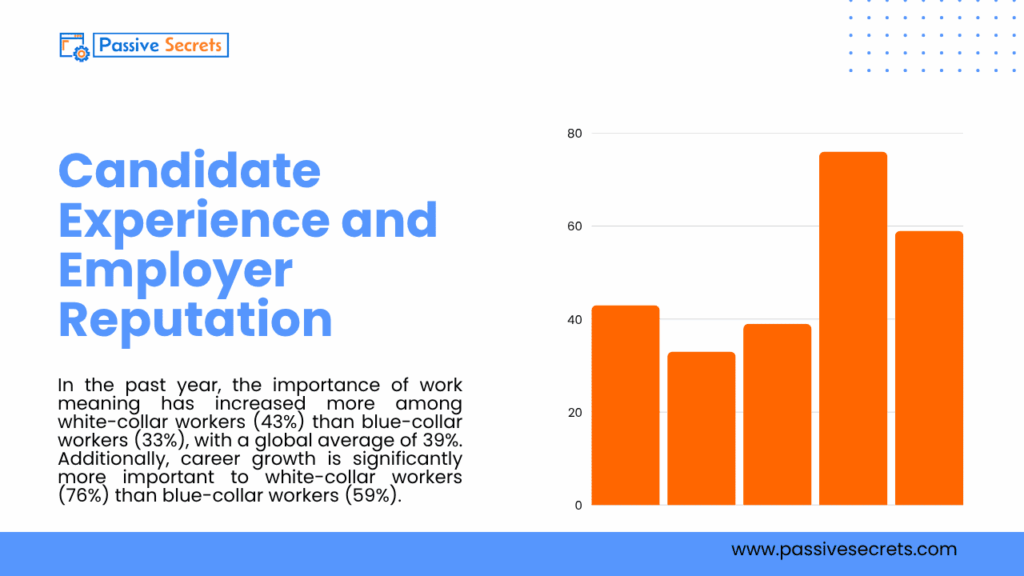
53. Most workers (76%) consider it important for their employer to offer reskilling/upskilling opportunities. This sentiment is more prevalent among white-collar workers (80%) than blue-collar workers (69%). (source)
54. Gen Z and Millennials are leading the AI adoption, with over 50% of global workers seeing AI’s impact on job satisfaction as positive, while about a third remain neutral. (source)
Social Media and Digital Presence
55. A growing number of employees, now at 42%, prefer video content to gain insights into a company’s culture, leadership, and daily operations, marking a 60% increase from 2021. (source)
56. 34% of Employer Brand professionals use AI for content creation, and 21% for content personalization. (source)
Internal Employer Branding and Employee Advocacy
57. A significant percentage, 72%, of Employer Brand teams leverage real employees to promote their Employer Brand. (source)
58. One in six workers feels they don’t receive adequate opportunities for growth and development in their role. These workers are more likely to consider leaving their organization (42% vs 25%). (source)
59. About a quarter (28%) of workers globally use flexible schedules for better work-life balance, with younger (32%) and more educated (33%) individuals more likely to have this benefit. Over a third (37%) of workers want their employer to offer additional benefits, such as salary protection and fair compensation, to enhance their work-life balance. (source)
60. 70% of Employer Brand professionals think it’s possible to remain authentic with AI, while 12% believe it’s impossible. (source)
61. Most Employer Brand professionals are concerned about losing the human touch due to over-reliance on AI, with 38% being very concerned and 34% somewhat concerned. (source)
Employer Branding ROI
62. Just 36% of organizations feel they dedicate enough resources to building their employer brand, while 34% say they dedicate some resources, but not enough. (source)
63. 49% of organizations update their employer branding strategies on an as-needed basis, indicating a reactive approach. (source)
64. In a recent survey, companies said the five biggest challenges to building an effective employer brand are:
65. 24% of organizations update their employer branding strategy annually or more often, while 49% update as needed, indicating a reactive approach. (source)
66. While 36% of companies have adequate resources to build a deliberate employer brand, 34% have dedicated resources but find them insufficient. Another 11% lack both a defined brand and the resources to develop one. (source)
67. 49% of organizations with employer branding budgets saw an increase (35% slight, 14% significant) over two years, while 41% reported stable budgets. (source)
68. HR professionals are split on measuring employer brand success, but two key metrics tie for top spot: employee retention rates and employee engagement surveys, both at 45%. (source)
69. Well-branded organizations are more likely to use data-driven strategies, like employee retention rates (51% vs 33%), to refine their employer branding efforts. (source)
70. 65% of employer brand professionals have utilized AI in their role within the last year. (source)
71. AI tools have saved time for 73% of employer brand professionals, while 87% have seen productivity gains. (source)
72. AI is mainly supporting Employer Brand teams in recruitment, particularly in candidate searching (48%) and talent assessment (44%). (source)
73. 44% of companies measure the ROI of their employer brand efforts, likely due to budget constraints requiring HR leaders to demonstrate effectiveness. (source)
Latest Employer Branding Trends 2026
Employer branding is key to attracting and retaining quality employees, especially in today’s competitive job market.
Most companies are beginning to recognize the importance of creating a strong employer brand that showcases their unique culture, values, and benefits.
Here are some of the trends in 2026 that are expected to influence and shape employer branding greatly:
1. Emphasis on Employer Value Proposition and Employee Retention
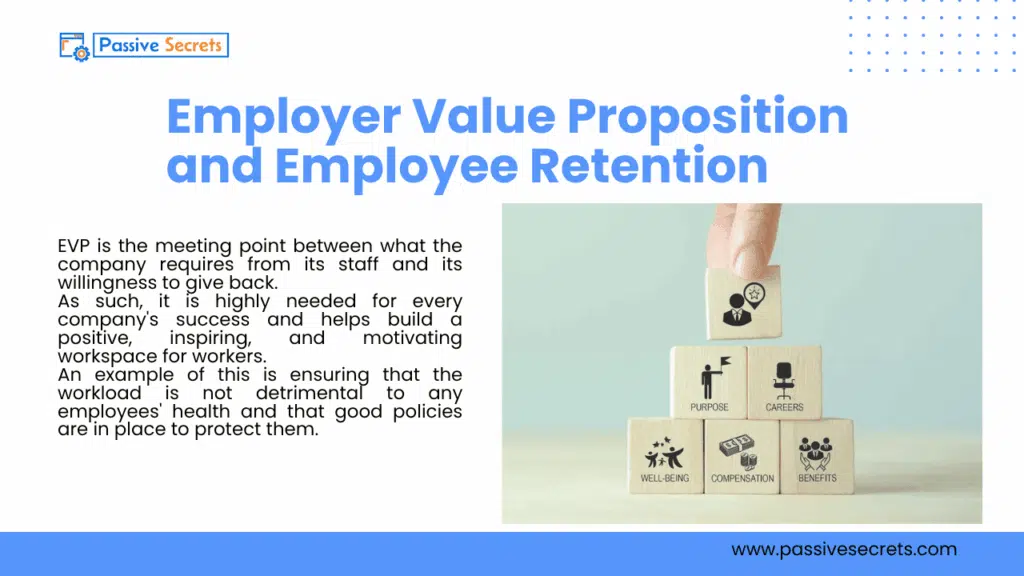
This trend is particularly important because it is a unique quality of every company. It is simply the values and benefits that a company seeks to add to its employees.
EVP is the meeting point between what the company requires from its staff and its willingness to give back.
As such, it is highly needed for every company’s success and helps build a positive, inspiring, and motivating workspace for workers.
An example of this is ensuring that the workload is not detrimental to any employees’ health and that good policies are in place to protect them.
Generous annual leave, sick pay, employee assistance programs, and other benefits are other ways to ensure staff well-being is considered.
Lastly, companies could develop webinars, seminars, and conferences to support employee well-being.
2. Diversity and Inclusion
Diversity and inclusion (DEI) initiatives are crucial for effective employer branding, and their role cannot be overemphasized in every workplace.
This has become a long-lasting trend that offers huge and diverse benefits to companies.
The first is that it helps to build a brand reputation. Every company should be especially known for a particular characteristic.
This information should be adequately passed on to the company’s staff to ensure that they benefit the company regardless of people’s unique qualities.
Diversity and inclusion also help companies gain the trust of their customers because commitment is incorporated into a strategy that is reflected in every staff member’s operation.
Lastly, it helps maintain a good relationship between the employees and the employers because there is clarity on how they could uniquely add their inputs to the company in an appreciated way.
3. AI in Employer Branding
Artificial Intelligence (AI) is a trend significantly impacting employer branding.
It offers many benefits to every company, such as helping to craft compelling campaigns, enhancing employee experiences, and improving communication of the employer’s brand message.
Artificial Intelligence (AI) is changing the way companies approach recruitment. AI can help companies find the best candidates for the job, personalize their recruitment messages, and even help with the interview process.
These trends show that companies are really focusing on creating amazing workplaces that attract and keep the best talent.
By prioritizing employee well-being, celebrating diversity and inclusion, and using AI to help with recruitment, companies can build strong employer brands that stand out in a competitive job market.
Conclusion
Employer branding in 2026 is about building real trust, purpose, and connection. The statistics make one thing crystal clear: people don’t just want jobs anymore; they want belonging.
Candidates are researching, reviewing, and comparing employers more deeply than ever, while companies that invest in authenticity, employee advocacy, and transparent culture are reaping the rewards, like stronger engagement and higher retention.
As AI and technology continue to reshape how we attract and communicate with talent, the human side of branding becomes even more critical.
So, as you reflect on these incredible employer branding statistics, ask yourself: Is your company evolving fast enough to stay irresistible in the eyes of worthy talent?
FAQs
Other Professional Industry Trends Reports You Should Know:
- 30+ Powerful Team Building Statistics to Boost Workplace Performance
- 87+ Training Industry Statistics & Trends for HR and L&D Professionals
- Global IT Outsourcing Statistics: Key Trends and Insights
- 90+ Interesting Marketing Jobs Statistics & Facts (Latest Report)
- 80+ Employee Benefit Statistics: Insights and Trends
- The Most Important Wealth Management Statistics You Can’t Afford to Ignore
- Enterprise Data Management: Essential Statistics and Emerging Trends
- 93 Talent Management Statistics to Help You
- Top Reputation Management Statistics and Trends to Improve Your Brand
- 36 Helpful Social Worker Burnout Statistics To Know
- 100 Business Process Outsourcing Statistics & Facts
- Top HR Outsourcing Statistics and Trends Every Business Must Know
- The Top Outsourcing Statistics You Shouldn’t Ignore
- 47+ Shocking 4-day Work Week Statistics To Know
- 105+ Supply Chain Statistics & Facts You Can’t Ignore
- Job Seekers Statistics: Unemployment Rates, Preferences, Challenges
- 95 Interesting Job Interview Statistics and Huge Trends To Know
- 60+ Helpful Change Management Statistics & Facts
- 65+ Employee Performance Management Statistics & Trends
- Workforce Management Statistics: Trends, Insights, & Opportunities
- 73 Revealing Workplace Distraction Statistics
- Workplace Romance Statistics: How Common Is Workplace Romance?
- 40+ Top Workplace Conflict Statistics You Should Know
- The State of Workplace Communication: Key Statistics and Trends
- 55 Workplace Collaboration & Teamwork Statistics