

Workplace romance has long been a topic of fascination and concern for both employees and employers.
With employees spending a significant portion of their time at the office and other professional environments, it is natural that personal relationships often develop within those places.
While some of these relationships lead to lasting commitments, others introduce complications such as favoritism, conflicts of interest, and ethical dilemmas.
As work environments evolve, particularly with the rise of remote and hybrid models, the dynamics of workplace romance are also shifting.
This report examines current statistics on workplace romance, exploring their prevalence, impact on employees and organizations, and the role of company policies in navigating this complex reality.
Top Workplace Romance Statistics & Facts (Editor’s Pick)
- Over 60% of employees have had at least one workplace romance.
- 47% of surveyed employees admitted to changing jobs just to date an employee.
- 40% of U.S. workers believe workplace romances are unprofessional.
- 18% of U.S. workers who have been in a workplace romance say it negatively impacted their career.
- 24% of male employees are more open to considering workplace relationships than 16% of their female counterparts who feel the same way.
- More remote employees (84%) have had workplace romances than on-site workers (75%).
- One in four employees met their spouse at work.
- Gen Z workers (11%) are more likely to have dated their manager than Millennials (7%) and Gen X/older (5%).
- Nearly a third (29%) of employees have quit, and over a fifth (22%) have been fired, due to workplace romances.
- 57% of employees would rather quit their job than end a workplace romance.
- 91% of employees admit to using flirting or charm to advance their careers.
- 88% of workers have seen workplace romances lead to conflicts or problems.
- 92% of employees with workplace romances broke company policy.
Prevalence of Workplace Romance
1. Over 60% of employees have had at least one workplace romance before. (source)
2. About 43% of workplace romances have led to marriage. (source)
3. 50% of surveyed U.S. employees said they would consider a workplace fling or affair. 15% also said they would admit to having a crush on a colleague. (source)

4. Also, about 7% admitted to meeting their spouse at work. (source)
5. 73% of employees know someone who met their spouse at work. (source)
6. In the U.K. The West Midlands is the top office romance hotspot, with more than one in three respondents (34.6%) admitting to workplace romantic encounters. (source)
7. Over a quarter (27%) of U.S. employees are in a workplace romance or have been in one before. 57% indicated love was the primary motivation for starting their romance, while 1% said it was work-related. (source)
8. 40% of workers in the United States have flirted with someone from their office. 24% have gone on a date with someone from their workplace, and 17% have had an official relationship with someone from their workplace. (source)
9. In-person dates/meetings 79% were the most common way they used to develop workplace romances.
Other ways include phone calls, 55 %, direct messaging, 46 % and work-related events such as happy hours and work parties, 27 %. (source)
10. Of those who began a romantic relationship at work, 46% claimed they were in a relationship with one colleague, while 41% said they were in a relationship with two colleagues. 14% claimed to have dated three or more people they met at work. (source)
11. 47% of employees surveyed say they saw no potential for romance at work. (source)
12. About 1 in 10 heterosexual couples in the U.S. admitted they met at work. (source)
13. According to a SHRM survey, 74% of employees who were previously in a relationship with a co-worker said it was worth it. (source)
14. Nearly half (44%) of US workers have either started a romantic relationship with a coworker or attempted to do so. (source)
15. A survey by Zety found that 80% of employees admit to having had a romantic relationship, dated casually, or had a sexual encounter with a coworker. (source)
16. Baby Boomers have the highest rate of workplace romances, with 90% reporting they’ve had one, followed by Gen X (81%), Millennials (76%), and Gen Z (70%). (source)
17. 36% of employees report having had a workplace romance with a colleague, with 32% saying it was a long-term relationship and 23% admitting to a one-night stand. (source)
18. A higher percentage of remote employees (84%) have had a workplace romance compared to on-site workers (75%). (source)
19. A quarter of employees (1 in 4) have found love and met their spouse through their workplace. (source)
20. A significant majority of employees (79%) confess to having had a long-term romantic relationship with a coworker, with 15% admitting to having had multiple workplace romances. (source)
Demographics and Trends
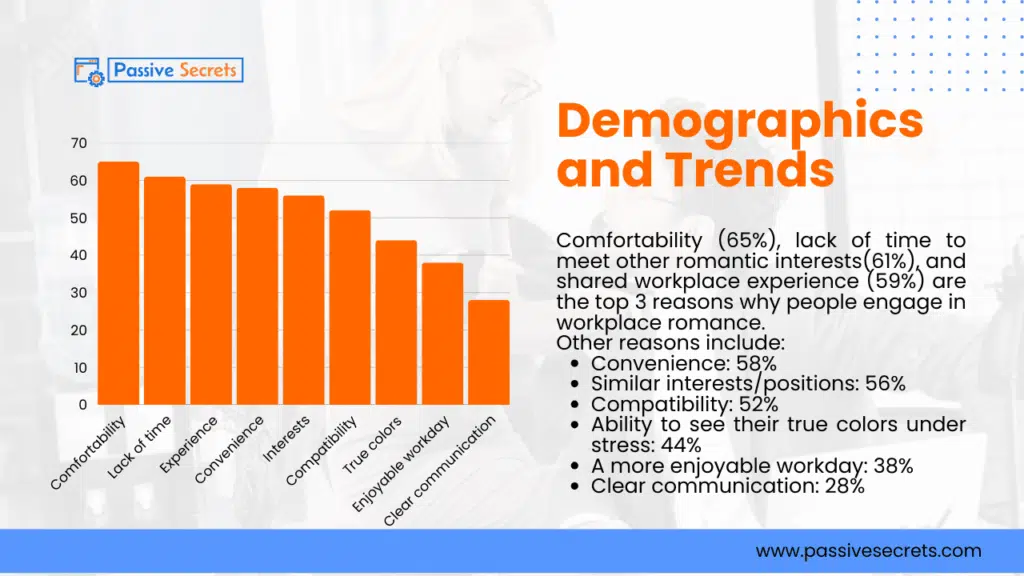
21. Comfortability (65%), lack of time to meet other romantic interests(61%), and shared workplace experience (59%) are the top 3 reasons why people engage in workplace romance. (source)
Other reasons include:
22. 47% of surveyed employees admitted to changing jobs just to date an employee. (source)
23. 67% of U.S. employees aged 18 to 24 are the most open to workplace relationships. 10% also admitted to currently being in a relationship with a colleague.
Only 47% of the older employees (65+ years) approve of workplace relationships. (source)
24. The science and pharmaceutical industry is the top industry setting for finding workplace romance. 50% of the employees in this industry are open to workplace romance. (source)
Other industries with a high possibility of workplace romance include:
25. 44% of employees agree they have a work best friend. (source)
26. 75% of American workers are okay with coworkers being in romantic relationships, and 83% respect or would respect those who are. (source)
27. 79% of U.S. workers who are currently or have previously been in a workplace romance have dated their peers. However, 10% have dated their subordinates, and 18% have dated their superiors. (source)
28. 24% of U.S. workers have had a “work spouse,” and 20% of these workers have romantic feelings for this person. (source)
29. Younger Millennial and Generation Z workers are 33% more likely to say they’d be open to a workplace relationship than Older Millennial workers (15%), Generation X workers (27%), and Baby Boomer and Traditionalist workers (23%). (source)
30. 50% of those who reported workplace romance following the pandemic claimed it was with a superior, while 46% said it was with a subordinate. (source)
31. 24% of male employees are more open to considering workplace relationships than 16% of their female counterparts who feel the same way. (source)
32. Also, 40% of male employees admitted to crushing on a colleague. 10% said they have feelings for their boss. Compared to women, the numbers are lower. Only 8% of female employees admitted to crushing on their boss, and one-third will consider workplace romance. (source)
33. In the U.K., men (27.6%) are more likely to engage in a romantic relationship with a colleague than women (21.5%). (source)
34. Younger generations are more likely to have dated a coworker, with 44% of Gen Z and 45% of Millennials reporting they’ve done so, compared to 37% of Gen X and 29% of Baby Boomers. (source)
35. Gen Z workers are more likely to have dated their manager, with 11% reporting they’ve done so, compared to 7% of Millennials, 5%. (source)
36. Gen X is the most discreet about office romances, with 86% keeping them private. In contrast, Baby Boomers (82%), Millennials (64%), and Gen Z (52%) are increasingly more open about their workplace relationships. (source)
37. Baby Boomers were less likely to be required to disclose workplace romances, with 51% saying their company didn’t require disclosure. In contrast, fewer Gen X (26%), Millennials (25%), and Gen Z (10%) employees reported the same. (source)
38. Gen Z employees (63%) are more likely than Millennials (39%), Gen X (28%), and Baby Boomers (12%) to say a workplace romance influenced their long-term career. (source)
39. The majority (86%) of workers feel that remote work has made it easier to form romantic connections with coworkers, and a significant 94% believe that emojis and GIFs play a role in facilitating flirtation in the workplace. (source)
40. More than half (51%) of workers often observe romantic tension or flirtatious behavior between coworkers during virtual meetings. (source)
41. 62% of employees have sent a romantic or flirtatious message to a coworker through a remote work platform, while 27% have received such a message, and 6% have experienced both sending and receiving. (source)
Impact on Work and Productivity
42. Workplace romances increase the fear of breaking up by 17%. (source)
43. Over 50% of employees say that a workplace romance has influenced their sense of individuality. (source)
44. 29% of employees have quit their jobs, and 22% have been fired due to romantic involvement at work. (source)
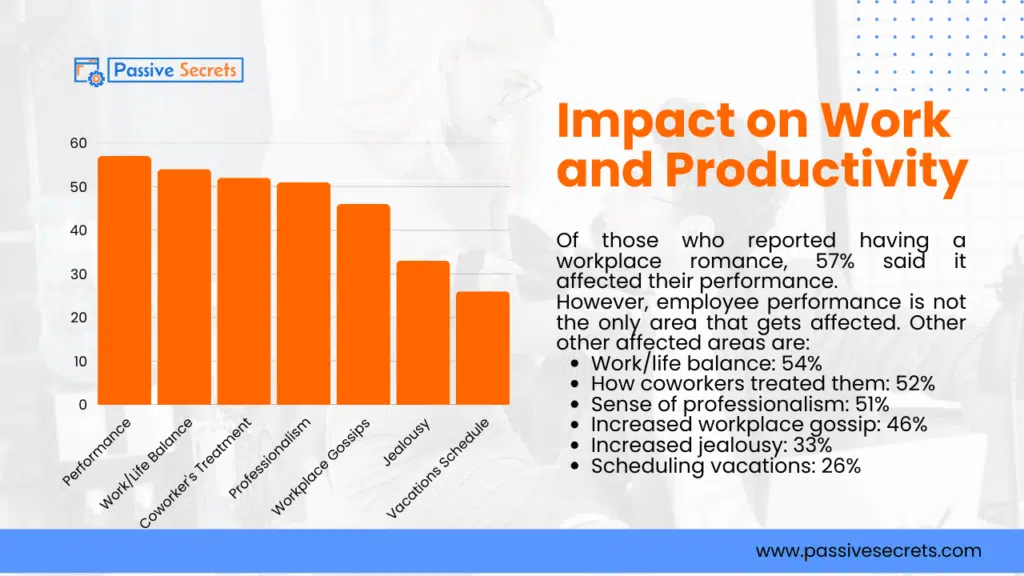
45. Of those who reported having a workplace romance, 57% said it affected their performance. (source)
However, employee performance is not the only area that gets affected. Other affected areas are:
46. 75% of employees surveyed claimed workplace romances cause favoritism, while 74% said they reduce productivity. (source)
47. 40% of U.S. workers believe workplace romances are unprofessional. (source)
48. The majority (87%) of U.S. workers in a workplace relationship said that work-related concerns had little or no impact on their breakup. However, 13% claimed work-related issues had a moderate or significant impact. (source)
49. 18% of U.S. workers who have been in a workplace romance say it negatively impacted their career. (source)
50. 66% of those who have had a relationship with a co-worker said it positively affected their work. Only 6% reported a negative effect, and 28% said it didn’t have an impact. (source)
51. Younger generations are more likely to credit their workplace romance with helping them advance their careers, with 10% of Gen Z and 9% of Millennials saying it led to a raise or promotion, compared to 4% of Gen X and 5% of Baby Boomers. (source)
52. Gen Z workers (33%) are more likely than Millennials (15%), Gen X (5%), and Baby Boomers (2%) to say their office romance negatively impacted their work-life balance. (source)
53. More than half of employees (57%) say they would choose to quit their job over ending a workplace romance. (source)
54. 91% of employees confess to using flirting or charm to get ahead in their career or gain favor with their superiors. (source)
Risks and Challenges
55. About 40% of employees in workplace relationships admitted to cheating on a current partner with a colleague. (source)
56. 41% of employees report feeling uncomfortable about public displays of affection (PDA) from their colleagues. (source)
57. About 50% of people believe workplace romance promotes favoritism. (source)
58. 67% of respondents stated they knew someone who cheated on their partner with another coworker. (source)
59. 19% of workers who had been in a relationship with someone at work stated they felt pressured to be part of a romantic relationship at work. (source)
60. Almost one in every two women and three in every ten men in Canada have reported workplace harassment or sexual assault. (source)
61. 55% of women, 44% of males, and 46% of nonbinary/GNC employees have experienced workplace sexism. Also, 54% of respondents reported having power inequalities in their relationships. (source)
62. According to a survey, 13% of men and 7% of women said it was acceptable to exhibit or display sexually explicit content in the workplace. (source)
63. 15% of males felt it appropriate to resume asking a coworker for a date after they had already declined, compared to 9% of females. (source)
64. More than a third (35%) of employees have received unwanted advances from a coworker, leaving them feeling uncomfortable. (source)
65. Many workers have experienced unrequited workplace romantic interests, with 43% reporting a coworker had feelings for them that weren’t reciprocated, and 28% admitting they had feelings for a coworker that weren’t returned. (source)
66. 28% of women and 21% of men say their biggest concern about workplace romances is the conflict of interest if one person holds a position of power. (source)

67. 88% of workers have witnessed conflicts or problems arise from romantic relationships in the workplace. (source)
68. One-third (33%) of respondents confess to having cheated on their partner with a coworker. (source)
Company Policies and Legal Considerations
69. 62% of employees admitted to telling HR about their romantic workplace relationship. (source)
70. 45% of surveyed respondents confirmed their company had some kind of policy on office romance. (source)
71. Although most people accept office romance, 43% of industry professionals believe that romances between colleagues at different levels are unacceptable. (source)
72. 49% of participants reported that their organization lacks a specific policy addressing workplace relationships. (source)
73. 41% of employees are not aware of their company’s office romance policy. (source)
74. 37% of workers hide love connections from HR at work. (source)
75. According to 71% of U.S. workers, their employer does not compel them to disclose if they participate in a workplace romance. (source)
76. Most employees (91%) think employers should ban romantic relationships between coworkers, and nearly as many (89%) believe employers should also prohibit romantic relationships between supervisors and their subordinates. (source)
77. A significant majority, 92%, admit that their workplace romance violated company policy. (source)
78. Employees are almost three times more likely to consider serious relationships (54%) between superiors and subordinates as acceptable, compared to one-night stands (18%) between the same. (source)
Conclusion

At the end of the day, workplace romance is something most people can relate to: whether they’ve experienced it themselves, watched it unfold among colleagues, or simply heard the office gossip.
These workplace romance statistics show just how common these relationships are, but they also remind us that the outcomes can go either way.
For some, an office romance becomes the start of a marriage; for others, it leads to awkward meetings, career setbacks, or even a sudden resignation.
What’s clear is that love doesn’t clock out when we walk into the office or log into Zoom. The real question is how we, and the companies we work for, handle it. Do we treat it as a natural part of human connection, or as a risk that needs to be tightly managed?
The truth probably lies somewhere in between. While policies and professionalism matter, so does the reality that people will always form bonds where they spend their time.
And sometimes, those bonds turn into something much bigger than just “another day at work”.
FAQs
Other Similar Statistics You Should Know:
- 30+ Powerful Team Building Statistics to Boost Workplace Performance
- 87+ Essential Training Industry Statistics & Trends for HR and L&D Professionals
- Global IT Outsourcing Statistics: Key Trends and Insights
- 90+ Interesting Marketing Jobs Statistics & Facts (Latest Report)
- Dating and Love Statistics & Facts: What the Numbers Reveal About Modern Relationships
- 80+ Employee Benefit Statistics: Insights and Trends
- The Most Important Wealth Management Statistics You Can’t Afford to Ignore
- Enterprise Data Management: Essential Statistics and Emerging Trends
- 93 Talent Management Statistics to Help You
- Top Reputation Management Statistics and Trends to Improve Your Brand
- 36 Helpful Social Worker Burnout Statistics To Know
- 100 Business Process Outsourcing Statistics & Facts
- Top HR Outsourcing Statistics and Trends Every Business Must Know
- The Top Outsourcing Statistics You Shouldn’t Ignore
- 47+ Shocking 4-day Work Week Statistics To Know
- 105+ Supply Chain Statistics & Facts You Can’t Ignore
- 50+ Interesting Employer Branding Statistics And Trends
- Job Seekers Statistics: Unemployment Rates, Preferences, Challenges
- 95 Interesting Job Interview Statistics and Huge Trends To Know
- 60+ Helpful Change Management Statistics & Facts
- 65+ Employee Performance Management Statistics & Trends
- Workforce Management Statistics: Trends, Insights, & Opportunities
- 73 Revealing Workplace Distraction Statistics
- 40+ Top Workplace Conflict Statistics You Should Know
- The State of Workplace Communication: Key Statistics and Trends
- 55 Workplace Collaboration & Teamwork Statistics
