

There are more millionaires alive today than there were people in Ancient Rome.
And yet, most of them don’t live the way you’d imagine. They’re not sipping champagne on yachts or collecting sports cars. In fact, the average millionaire is a 62-year-old who drives a Toyota, worked in a boring industry for decades, and still clips coupons.
The global millionaire population has exploded by 54% in just the last ten years. Every day, approximately 5,500 people cross the seven-figure threshold for the first time. But here’s what the headlines won’t tell you: where you live matters far more than how hard you work. A software engineer in Zurich has a 1-in-7 chance of becoming a millionaire. That same engineer in Mumbai? About 1-in-14,000.
The concentration is staggering. Just five cities—New York, Tokyo, San Francisco, London, and Singapore—hold more millionaires than the entire continent of Africa. Meanwhile, countries you’ve never associated with wealth are quietly minting millionaires faster than the United States.
This article is more than just about who has money. It’s about how wealth is reshaping geography, demographics, and opportunity on a scale we’ve never seen before. The numbers reveal patterns that challenge everything you thought you knew about getting rich…and staying there.
Top Millionaire Statistics (Editor’s Pick)
- There are up to 59 million millionaires worldwide.
- Globally, there are 41.3 million high-net-worth individuals (HNWIs) and 510,810 ultra-high-net-worth individuals (UHNWIs) worth $30M+, who hold 32.4% of HNWI wealth, despite being only 1.1% of HNWIs.
- The United States has the most millionaires, with nearly 22 million people, followed by China with over 6 million, and the United Kingdom in third place.
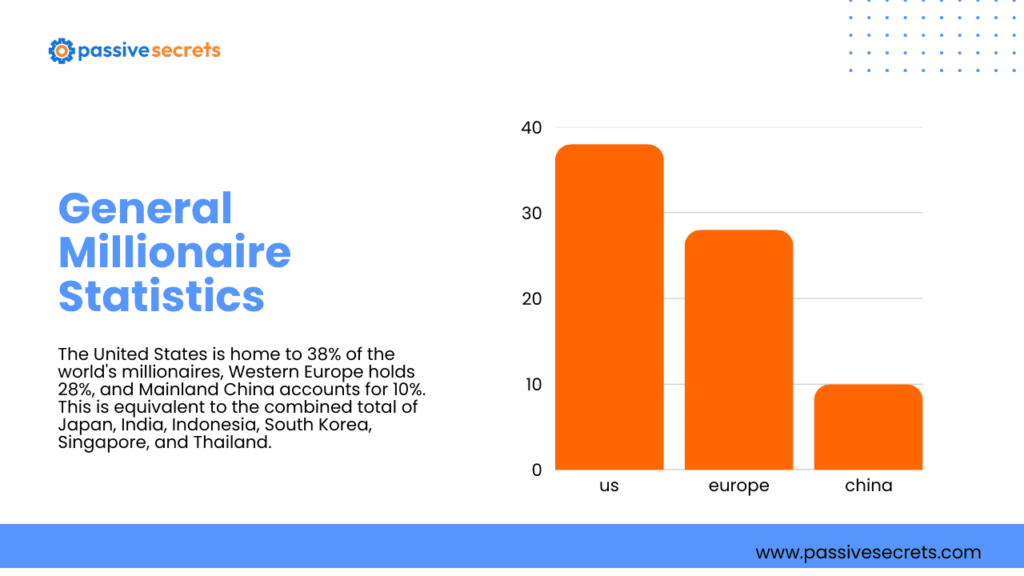
- The United States holds 38% of the world’s millionaires, Western Europe 28%, and Mainland China 10%.
- Global North countries control 69% of global wealth and 77% of billionaire wealth, despite representing only 21% of the global population.
- The number of billionaires rose to 2,769 in 2024, with their combined wealth increasing from $13 trillion to $15 trillion in one year.
- Billionaire wealth grew by $2 trillion in 2024, creating nearly four new billionaires every week.
- During the COVID-19 pandemic, 5.2 million new millionaires were created as stock and real estate values surged.
- Global wealth is projected to grow by 39%, reaching $583 trillion, while the number of millionaires could rise 50% to 84 million people.
- The global ultra-wealthy population is expected to reach 676,970 by 2030, up from about 510,810 in 2025.
- Women make up only about 13% of the world’s billionaires, highlighting a major gender gap in extreme wealth.
- About 24.9% of the world’s centi-millionaires attended just 20 universities, showing strong concentration among elite institutions.
- The banking and finance industry produces the most billionaires, while 20% of billionaires under 50 work mainly in technology.
- Africa’s millionaire population is expected to grow by 65% over the next decade.
- The number of U.S. households worth $1M–$5M grew 8.1% in one year, reaching 12.55 million households.
General Millionaire Statistics in 2026
1. Globally, there were 41.3 million high net worth individuals (HNWIs) with $1m+ wealth, including 510,810 ultra high net worth individuals (UHNWIs) with $30m+ fortunes. UHNWIs make up just 1.1% of HNWIs but hold 32.4% ($59.8tn) of their wealth. (Altrata)
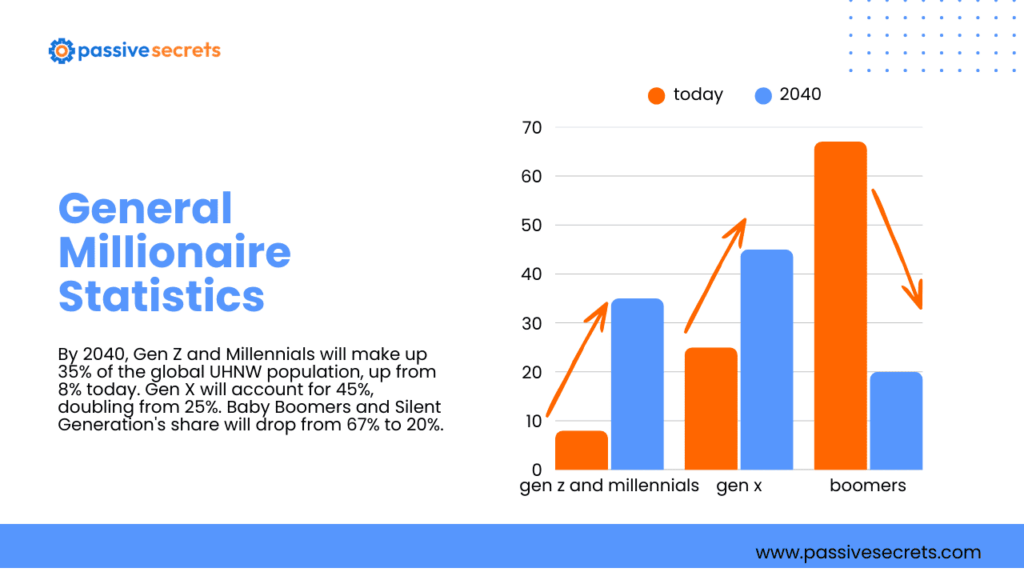
2. By 2040, Gen Z and Millennials will make up 35% of the global UHNW population, up from 8% today. Gen X will account for 45%, doubling from 25%. Baby Boomers and the Silent Generation’s share will drop from 67% to 20%. (Altrata)
3. The ultra wealthy are a key luxury market, making up 21% of luxury spend ($290bn) in 2024 despite their small numbers. They drive private jets, yachts, and fine wine sales, and dominate luxury car purchases. They’re also splashing $45bn on experiences like hospitality and fine art, which also serves as an investment. (Altrata)
4. According to recent research obtained by Fortune, almost 20% of American women with assets exceeding $1 million say they don’t plan to retire, a significantly higher proportion than men in the same category. The survey of over 1,000 U.S. high-net-worth investors found 18% of women (average age 60+) don’t plan to retire, compared to just 11% of men. (Fortune)
5. In 2024, the wealth of the world’s billionaires increased by $2 trillion (£1.64 trillion), growing three times faster than in 2023, which equates to $5.7 billion per day. (The Guardian)
6. As of late 2024, there are 59 million USD millionaires in the world. (UBS)
7. The combined wealth of the world’s 10 wealthiest individuals increased by nearly $100 million daily, and even if they were to lose 99% of their fortune overnight, they would still be billionaires. (The Guardian)
8. Alphabet, Amazon, and Meta are the top 3 companies making millionaires through online earning opportunities. (Yahoo Finance)
9. According to a report, Switzerland is the country with the most millionaires. (Insider Monkey)
Here is a table showing the countries with the most millionaires.
| Country | Population | Percentage of Millionaires | Total Millionaires | |
| 1. | Switzerland | 8.7 Million | 13.78% | 1.2 Million |
| 2. | Australia | 25.68 Million | 8.56% | 2.2 Million |
| 3. | Hong Kong | 7.41 Million | 8.52% | 632,000 |
| 4. | United States | 332.01 Million | 7.38% | 24.5 Million |
| 5. | New Zealand | 5.11 Million | 6.78% | 5.11 Million |
| 6. | Denmark | 5.86 Million | 6.57% | 385,000 |
| 7. | Netherlands | 17.53 Million | 6.27% | 1.1 Million |
| 8. | Canada | 38.23 Million | 6.02% | 2.3 Million |
| 9. | Sweden | 10.41 Million | 5.86% | 610,000 |
| 10. | Singapore | 5.45 Million | 5.48% | 299,000 |
| 11. | Norway | 5.41 Million | 4.37% | 236,000 |
| 12. | United Kingdom | 67.02 Million | 4.18% | 2.8 Million |
| 13. | France | 67.76 Million | 4.13% | 2.88 Million |
| 14. | Taiwan | 23.89 Million | 3.64% | 869,000 |
| 15. | Ireland | 5.03 Million | 3.49% | 176,000 |
10. In 2024, billionaire wealth surged by $2 trillion, or about $5.7 billion daily, growing three times faster than the previous year. On average, nearly four new billionaires were created every week. (Oxfam)
11. In 2024, the number of billionaires increased to 2,769, up from 2,565 in 2023. Their collective wealth skyrocketed from $13 trillion to $15 trillion in just one year. (Oxfam)
12. Global North countries hold 69% of the world’s wealth, control 77% of billionaire wealth, and are home to 68% of billionaires, despite representing only 21% of the global population. (Oxfam)
13. 60% of billionaire wealth is derived from crony or monopolistic sources or inherited. Specifically, 36% comes from inheritance, 18% from monopoly power, and 6% from crony connections. (Oxfam)
14. Around 68% of billionaires who inherited their wealth reported that they aim to build upon and grow what their predecessors established, whether in terms of business, brand, or assets. (UBS 2)
15. As billionaire entrepreneurs age, it’s anticipated that more than 1,000 of them will transfer over USD 5.2 trillion to their heirs in the next 20 to 30 years. (UBS 2)
16. The percentage of adults with less than USD 10,000 in wealth has nearly halved, dropping from over 75% in 2000 to under 40% in 2023. (UBS)
17. According to our analysis, the United States has the highest number of millionaires globally, with nearly 22 million people. Mainland China follows in second place with just over six million, while the United Kingdom ranks third. No other market has more than 3 million millionaires. (UBS)
18. As of February 2026, Elon Musk’s net worth is approximately $834.7 billion, cementing his position as the world’s richest person. The top 20 richest individuals are predominantly American, with Alice Walton and Françoise Bettencourt Meyers being the only women on the list. (Statista)
19. The United States is home to 38% of the world’s millionaires, Western Europe holds 28%, and Mainland China accounts for 10%. This is equivalent to the combined total of Japan, India, Indonesia, South Korea, Singapore, and Thailand. (UBS)
20. In 2023, the global billionaire population of 3,323 was dominated by men, with nearly half (50-70 years old) and over 40% above 70 years old. Only about 10% were under 50. (Statista)
21. Most wealth for billionaires under 50 is typically derived from public holdings. For those over 50, approximately 40% of their wealth is also from public holdings, with over 30% coming from private assets. (Statista)
22. In 2024, Switzerland topped the list with an average wealth of approximately $687,166 per adult, followed by the United States with $620,654, and Hong Kong SAR. However, these numbers don’t tell the whole story, as wealth distribution is uneven, highlighted by the Gini index. (Statista)
23. During the COVID pandemic, the disparity in global wealth increased, adding 5.2 million people to the world’s millionaires as the affluent benefited from rising stock and real estate values. (The Guardian)
24. For the first time in 2020, dollar millionaires made up over 1% of the world’s population. Data indicates that there were 56.1 million people with assets exceeding $1 million that year. (The Guardian)
25. It is projected that global wealth will increase by 39% in the next five years, reaching $583 trillion by 2024. Additionally, the population of millionaires is anticipated to grow by 50%, totaling 84 million people. (The Guardian)
26. The population of ultra-high-net-worth individuals is projected to increase by approximately 60%, totaling around 344,000 people by the year 2025. (The Guardian)
27. The 2025 Forbes list of global billionaires reports that there are 3,028 billionaires worldwide. (Forbes)
Personality Traits of Millionaires
28. The ultra wealthy have super valuable networks, knowing around 70 other UHNW individuals each, plus many more with big fortunes. They build these connections through business, boards, and social events. (Altrata)
29. Millionaires who inherited their wealth placed a higher value on the role of gifts, inheritances, or marriage in building their personal fortune than on entrepreneurship and self-employment. Conversely, self-made millionaires emphasized the significance of entrepreneurship and self-employment in growing their wealth over gifts or inheritances. (HSSC)
30. The development of a typical personality profile for millionaires revealed that they tend to exhibit high levels of extraversion, conscientiousness, openness, and narcissism while displaying lower levels of neuroticism and agreeableness. (HSSC)
31. Millionaires tend to be more open to taking risks, more outgoing, and more conscientious, yet they are generally less prone to neuroticism compared to the average person. (HSSC)
32. The average age of a billionaire is 66, with the oldest being 102 years old. (Forbes)
33. In the United States, Baby Boomers and older generations (born in 1964 or earlier) control $95.9 trillion of the total $147.1 trillion in household wealth, according to the Federal Reserve. (Forbes)
34. Millionaires who have earned their wealth independently typically exhibit distinct personality traits compared to those who have inherited theirs. Self-made millionaires tend to display a greater propensity for risk-taking, lower levels of neuroticism, and higher openness. (HSSC)
35. A total of USD 150.8 billion was inherited by 53 heirs, surpassing the combined wealth of 84 new self-made billionaires, which amounted to USD 140.7 billion. (UBS 2)
Millionaire Statistics By Gender
36. There are 43,457 female ultra-high-net-worth individuals. That is women whose individual wealth is U.S. $30m or more. (Julius Baer)
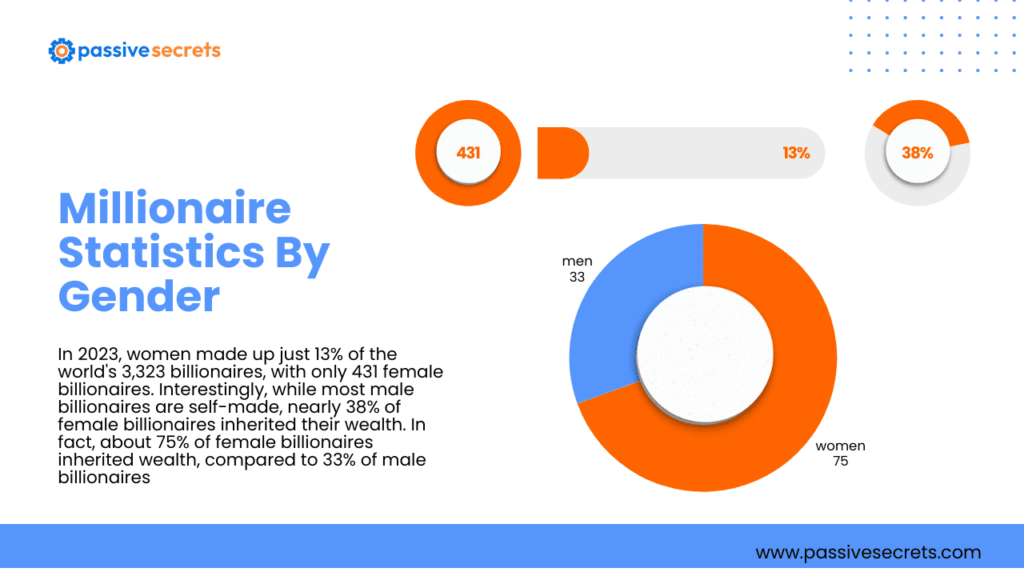
37. In 2023, women made up just 13% of the world’s 3,323 billionaires, with only 431 female billionaires. Interestingly, while most male billionaires are self-made, nearly 38% of female billionaires inherited their wealth. In fact, about 75% of female billionaires inherited wealth, compared to 33% of male billionaires. (Passive Secrets)
Millionaire Statistics By Industry
38. In 2023, the banking and finance sector was the primary focus of the world’s billionaires, regardless of age. Additionally, 20% of billionaires under the age of 50 spent most of their time in the technology industry. (Statista)
Millionaire Statistics Based on Choice of University
39. Studies indicate that approximately 24.9%, or nearly a quarter, of the world’s centi-millionaires attended just 20 universities. (Henley Global)
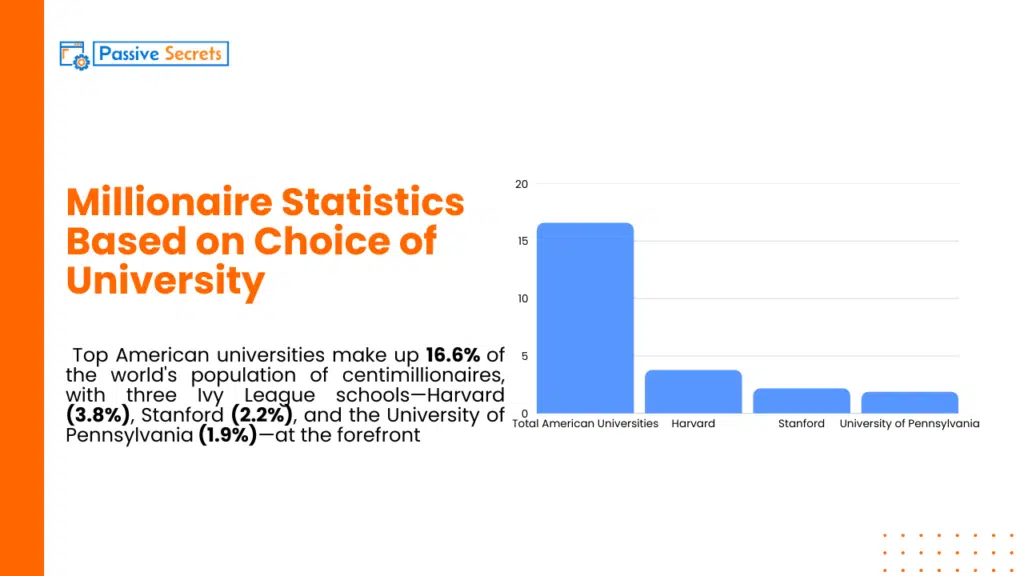
40. Top American universities make up 16.6% of the world’s population of centimillionaires, with three Ivy League schools—Harvard (3.8%), Stanford (2.2%), and the University of Pennsylvania (1.9%)—at the forefront. (Henley Global)
41. In the Top 10 global college rankings, the United States boasts seven institutions. Of these, 1.7% of the world’s centi-millionaires are alumni of both Yale University and Columbia University, with Columbia producing 1.4%, and Princeton University accounting for 1.2% of these wealthy graduates. (Henley Global)
42. The UK boasts four universities ranked in the top 20 globally, including two in the top 10, which together have produced 4.5% of the world’s centimillionaires. (Henley Global)
43. Approximately 1.7% of the world’s centimillionaires have attended the University of Oxford, while the University of Cambridge has educated 1.4% of global centimillionaires. (Henley Global)
44. Two London universities make it into the Top 20 Universities of centimillionaires: London School of Economics (0.8%) and London Business School (0.6%). (Henley Global)
45. France hosts two universities within the Top 20 globally, and their alumni constitute 1.5% of the world’s centimillionaires. (Henley Global)
46. China is home to two universities in the global top 20, located in Beijing, which together have produced 1.5% of the world’s centimillionaires. (Henley Global)
47. Beyond the USA, UK, France, and China, Japan is the only additional country that has a university ranked in the Top 20, specifically the University of Tokyo. (Henley Global)
48. Studies indicate that 36% of leading global CEOs have pursued education abroad, while 66% hold a master’s degree or doctorate. This suggests that an individual’s international educational experience can significantly impact their earning capacity. (Study. Eu)
Top 10% and 1% Millionaire Statistics
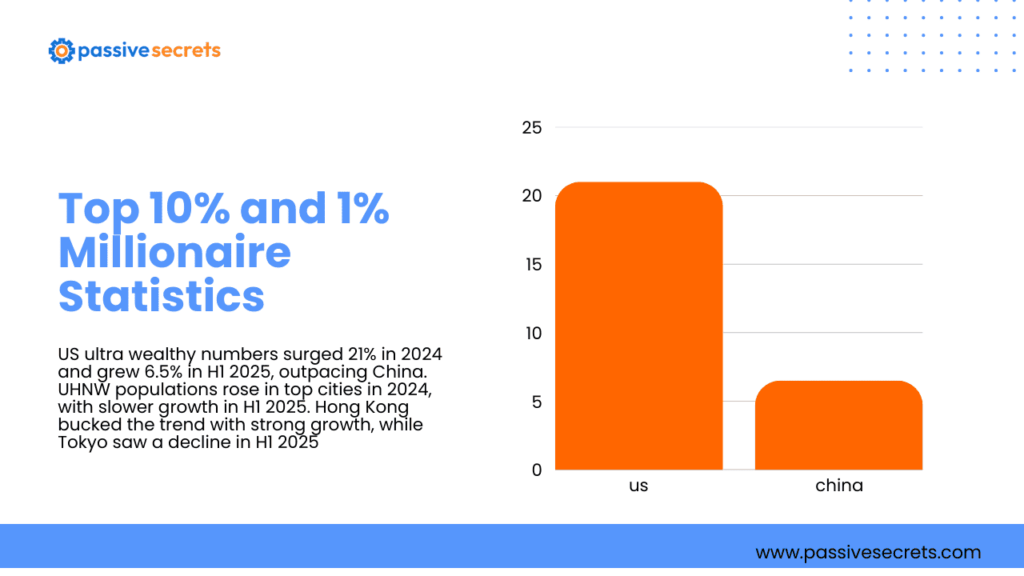
49. US ultra-wealthy numbers surged 21% in 2024 and grew 6.5% in H1 2025, outpacing China. UHNW populations rose in top cities in 2024, with slower growth in H1 2025. Hong Kong bucked the trend with strong growth, while Tokyo saw a decline in H1 2025. (Altrata)
50. The global UHNW population is forecast to hit 676,970 by 2030, up 166,160 from 510,810 in mid-2025. Asia’s UHNW population will grow fastest, but North America will stay at the top. India’s cities like Bengaluru and Mumbai will lead growth, while Florida, Utah, and Texas will boom in the US. (Altrata)
51. In 2021, the highest wage increases were observed among the wealthiest earners, with the top 1% seeing a 9.4% rise and the top 0.1% experiencing an 18.5% increase. Meanwhile, the bottom 90% of earners witnessed a slight decline in their real earnings by 0.2% from 2020 to 2021. Additionally, those between the 90th and 99th earnings percentiles also faced decreases in their real wages during the same period. (Economic Policy Institute)
52. In 2021, the highest-earning 1% received 14.6% of all wages, a significant increase from their 7.3% share in 1979. Conversely, the lowest-earning 90% took home only 58.6% of all wages, marking the smallest share ever recorded and a substantial drop from their 69.8% share in 1979. (Economic Policy Institute)
53. Between 1979 and 2021, wages for the top 1% and top 0.1% surged by 206.3% and 465.1%, respectively. In contrast, the bottom 90% saw only a 28.7% increase in their wages. (Economic Policy Institute)
54 Between 1979 and 2021, the annual wage growth for the bottom 90% was just 0.6%, while wages for the top 1% and top 0.1% grew at annual rates of 2.7% and 4.2%, respectively. (Economic Policy Institute)
55. In 2023, the wealthiest 1% in Global North countries such as the US, UK, and France extracted $30 million per hour from the Global South through the financial system. (Oxfam)
56. Over 44% of the wealth held by the top 1% is based in the United States and Canada, while Western Europe accounts for nearly a quarter of it. (UBS)
57. The U.S. leads the world with 813 billionaires worth $5.7 trillion, followed by China’s 473 billionaires at $1.7 trillion, despite a wealth decline. India ranks third with 200 billionaires. (Forbes)
Millionaire Statistics by Region
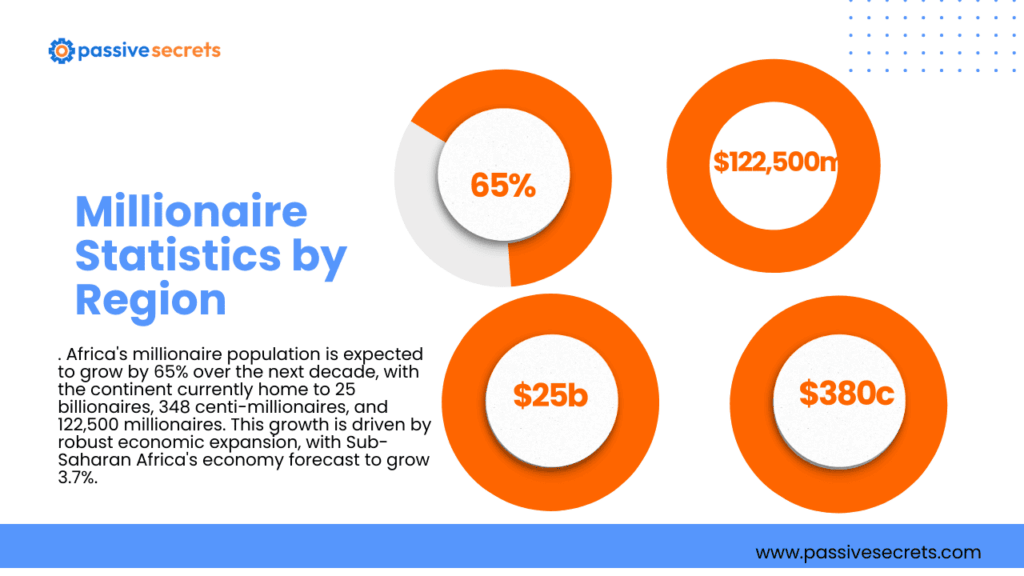
58. Africa’s millionaire population is expected to grow by 65% over the next decade, with the continent currently home to 25 billionaires, 348 centi-millionaires, and 122,500 millionaires. This growth is driven by robust economic expansion, with Sub-Saharan Africa’s economy forecast to grow 3.7%. (Henley&Partners: Africa)
59. South Africa leads Africa’s wealth stakes with 41,100 millionaires, accounting for 34% of the continent’s millionaires – roughly equal to Egypt, Morocco, Nigeria, and Kenya combined. These five countries (plus Egypt, Morocco, Nigeria, and Kenya) make up 63% of Africa’s millionaires and 88% of its billionaires. (Henley&Partners: Africa)
60. North America’s UHNW population grew 6.2% in H1 2025 to 208,090 individuals, boosting its global share to 41%. Asia’s UHNW population rose 6.4% to 129,100 individuals, showing resilience amid trade challenges. (Altrata)
61. Europe’s UHNW population grew 4.8% to 127,480 individuals by June 2025, below average. The region’s main markets (Germany, UK, France) struggled with a tough outlook, US trade policies, and internal challenges. (Altrata)
62. The Middle East’s UHNW population grew just 0.4% to 21,160 people in H1 2025, with total wealth up 2.4% to $3.5tn. Commodity price spikes and energy diversification efforts boosted hydrocarbon-exporting countries, while US dollar pegs and tourism helped portfolios. (Altrata)
63. In Latin America and the Caribbean, the number of ultra-high net worth individuals rose by 2.7% during the first six months of 2025, reaching a total of 14,830 individuals. The total wealth held by UHNW individuals in Latin America and the Caribbean also saw an increase of 1.7% in the first half of 2025, amounting to $1.8 trillion. (Altrata)
64. Mauritius is Africa’s fastest-growing wealth market, with a 63% surge in millionaires over 10 years, thanks to stability, investment-friendly rules, and its financial/lifestyle hub status. Morocco and Kenya, in the Top 5, also grew solidly, driven by infrastructure investment, growing consumer markets, and diversified economies. (Henley&Partners)
65. Billionaire wealth jumped by $2 trillion in 2024, increasing three times faster than the year before, while poverty levels have hardly improved since 1990. (Oxfam)
66. There are almost 24.5 million millionaires in the United States today. (Ramsey Solutions)
67. Across Africa, wealth is concentrated among a relatively small but significant group of high-net-worth individuals. In 2024, the continent has about 342 centi-millionaires (people worth at least $100 million) along with over 20 billionaires. In total, Africa is home to around 135,200 millionaires, and collectively the continent holds about $2.5 trillion in liquid investable wealth, highlighting the growing but still highly concentrated distribution of financial wealth across the region. (Henley Global)
68. South Africa, Egypt, Nigeria, Kenya, and Morocco are Africa’s ‘Big 5’ wealth markets, accounting for 56% of the continent’s millionaires and more than 90% of its billionaires. (Henley Global)
69. South Africa has more HNWIs than any other African country, with 37,400 millionaires, 102 centi-millionaires, and 5 billionaires. Egypt is in second place, with 15,600 millionaires, 52 centi-millionaires, and 7 billionaires. Nigeria ranks third with 8,200 HNWIs, followed by Kenya (7,200 millionaires), Morocco (6,800), Mauritius (5,100), Algeria (2,800), Ethiopia (2,700), Ghana (2,700), and Namibia (2,300), all of whom are in Africa’s top ten wealthiest countries. (Henley Global)
70. Mauritius, Namibia, Morocco, Zambia, Kenya, Uganda, and Rwanda are all anticipated to see more than 80% millionaire increase in the following decade (2033). (Henley Global)
71. Johannesburg is Africa’s wealthiest city, with 12,300 millionaires, 25 centimillionaires, and two billionaires. Cape Town is close behind with 7,400 millionaires, 28 centimillionaires, and one billionaire. Cairo (7,200 millionaires), Nairobi (4,400), and Lagos (4,200) are other significant metropolitan wealth hubs. (Henley Global)
72. In 2023, the United States had the highest number of dollar millionaires, totaling 22 million, which is 6.6% of its population. Following the U.S., China ranks second with 6 million millionaires, accounting for 0.4% of its population, and France is in third place with 2.9 million, making up 4.2% of its population. (Statista)
73. In 2022, Iceland had the highest proportion of millionaires globally, with over 20% of its adult population possessing assets exceeding $1 million. Luxembourg was second, where 16% of its residents were millionaires. (source)
74. As of March 2024, California topped the list of U.S. states with the highest number of billionaires, housing 197. Following it was New York with 139 billionaires. (Statista)
75. Wealth increased by 9% in nominal terms, rising from USD 11.0 trillion to USD 12.0 trillion, with Europe’s billionaires leading the way for the first time in the history of the study. (UBS 2)
76. The largest concentration of billionaire wealth is in North and South America, with 867 billionaires worth USD 5.0 trillion. However, their wealth grew just 2.7%, below inflation, and the number of billionaires increased by 12. (UBS 2)
77. In 2023, millionaires made up 1.5% of the adult population analyzed, with the United States having the highest number at nearly 22 million, representing 38% of the total. (UBS)
78. There are about 1.79 million African American millionaires in the U.S. (Forbes)
79. North America had the highest number of billionaires in 2024, with over 1,190, closely followed by Europe and Asia. The gap between these regions and the rest of the world is significant. (Statista)
Households’ Millionaire Statistics
80. Johannesburg is Africa’s wealthiest city with 11,700 millionaires, led by Sandton and Waterfall-Midrand. Cape Town’s got 8,500 HNWIs, but it’s crushing it with 35 centi-millionaires – the most on the continent! Cape Town’s also Africa’s prime real estate market at $5,800/m² and is set to overtake Johannesburg in total wealth by 2030. Cairo’s in third with 6,800 HNWIs and 5 billionaires, while Nairobi’s got 4,200 millionaires, almost half of Kenya’s wealth. (Henley&Partners: Africa)
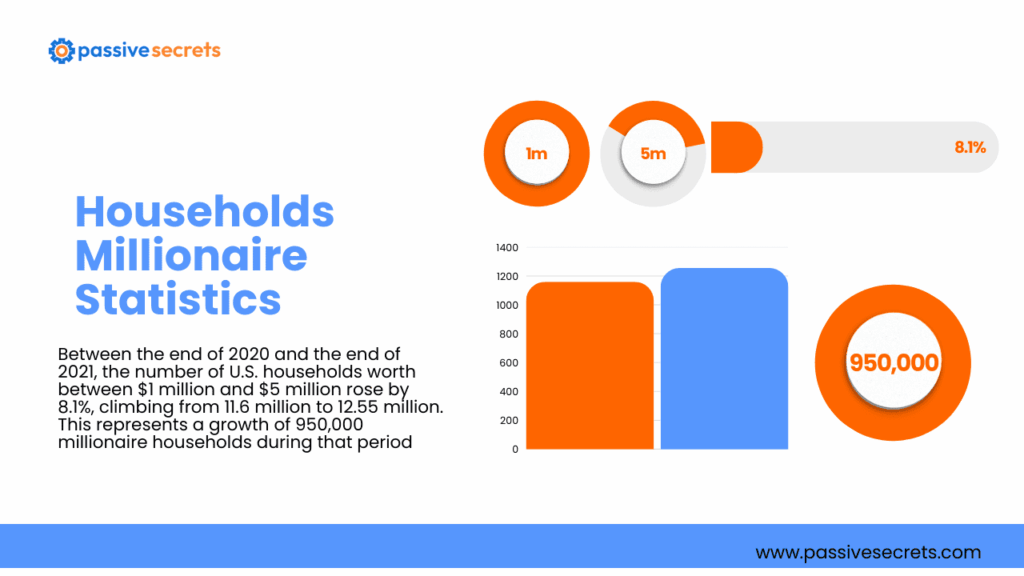
81. Between the end of 2020 and the end of 2021, the number of U.S. households worth between $1 million and $5 million rose by 8.1%, climbing from 11.6 million to 12.55 million. This represents a growth of 950,000 millionaire households during that period. (EIN Presswire)
82. From the end of 2020 to the end of 2021, the count of American households worth over $25 million grew from 214,000 to 252,000. This represents a 17.8% rise in the wealthiest Americans during 2021. (EIN Presswire)
83. The market for ultra-high-net-worth individuals (with assets ranging from $5 million to $25 million) grew from 1,630,000 to 1,800,000. This represents a 10.4% increase between December 2020 and December 2021. (EIN Presswire)
84. By the close of 2020, there were 32.3 million mass affluent households possessing a net worth ranging from $100,000 to $1 million. This figure rose to 33.1 million in 2021, driven by favorable market conditions. (EIN Presswire)
85. America’s millionaire population increased by 7.3% in 2023, reaching 7.43 million, with their total wealth rising 7% to $26.1 trillion. (CNBC)
86. The U.S. significantly outpaced the rest of the world in creating new millionaires last year, adding 500,000 and driving record wealth at the top. (CNBC)
FAQs
Other Wealth-Related Statistics You Should Know:
- Airbnb vs Hotels Statistics (2026): 36 Huge Facts to Compare
- 65+ Vital Leadership Statistics: Latest Trends and Insights
- Billionaire Statistics: Surprising Insights About The World’s Wealthiest
- Business Loan Statistics: Trends Reshaping Funding for Small Businesses
- 70+ AI in Education Statistics That Prove the Future Is Already Here
- Women in Leadership Statistics: Insights into Gender Representation
- Soft Skills Statistics: Key Data on Demand, Training, and Impact
- 95+ Fascinating Gift Industry Statistics to Surprise and Delight
- Top Business Coaching Statistics & Trends Every Leader Should Know
- How Much Are People Saving? Personal Savings Statistics Explained
- 40+ Useful Procrastination Statistics To Help You
- 50+ Latest Life Coaching Statistics And Huge Trends
- Useful Real Estate Photography Statistics and Trends You Need to Know
- Data-Driven Decision-Making Statistics: Trends, Benefits & Challenges
- 54 Incredible Goal-Setting Statistics To Help You
- 80+ Franchise Statistics and Facts You Should Know
- 90+ Interesting Film Industry Statistics (NEW Report)
- Ultimate Creator Economy Statistics Report: Trends, Tools, and Income
- 125+ Interesting Airbnb Statistics by Country (Deep Insights)
- Important Wealth Management Statistics You Can’t Afford to Ignore
- 45+ Interesting Communication Skills Statistics & Huge Trends
- Body Language Statistics & Facts To Boost Your Communication Skills
- 35 Interesting Public Speaking Fear Statistics & Fun Facts
- 25+ Most Interesting Emotional Intelligence Statistics & Fun Facts

