(New data reveals how millions worldwide still struggle to afford basic menstrual care)
Every month, more than 1.8 billion people around the world menstruate, yet for millions of them, something as simple as a pad or tampon remains out of reach.
Imagine missing school, skipping work, or feeling ashamed simply because you couldn’t afford a basic necessity.
That’s the harsh reality of period poverty — a silent global crisis hiding in plain sight.
From bustling cities in the U.S. to rural villages in India and Africa, period poverty cuts across borders, age, and income levels. It’s not just about the cost of menstrual products; it’s about dignity, education, equality, and the right to live without shame.
Behind every statistic lies a story of a student missing class, a mother making impossible choices between food and hygiene, or a worker losing income because of stigma and silence.
In this article, we break down the most recent and eye-opening period poverty statistics from around the world, revealing how deeply this issue affects lives in 2026. These numbers aren’t just data points; they’re a wake-up call to end the taboo, demand change, and ensure that no one is left behind for simply having a period.
Key Period Poverty Statistics & Facts (Editor’s Pick)
- 1.8 billion people menstruate every month worldwide — meaning over 800 million are on their periods every day.
- $9.6 billion is lost annually due to missed workdays caused by periods.
- 78% of people with disabilities struggle to afford period products, showing a major accessibility gap.
- About 16.9 million U.S. women live in poverty, with two-thirds unable to afford menstrual products in the past year.
- 24% of U.S. teens struggle to afford period products, and 39% say financial constraints affect their ability to buy them.
- 45% of U.S. teens wear period products longer than recommended due to lack of access.
- 33% of U.S. teens miss class due to lack of products, and 39% feel unable to do their best schoolwork.
- 19 U.S. states still tax period supplies as “luxury goods.”
- People with periods use over 9,000 pads or tampons in their lifetime.
- 58% of women in the U.S. say they feel ashamed of their periods, showing stigma persists even in high-income countries.
- 63% of schools in Indian villages do not educate girls about menstruation.
- Only 49.8% of Indian women use hygienic period protection; 22.7% use unsanitary methods.
- In Japan, 30% of women say they experience period poverty, often due to high product costs or family unwillingness to buy them.
- In China, women spend $160 annually on sanitary pads, with a 13% sales tax.
- In Lao PDR, 31.8% of girls skip school because of menstruation.
- Over 37 million Nigerian girls and women live in period poverty.
- 1 in 10 girls in Sub-Saharan Africa misses school during their period.
- In Ghana, women spend up to 1/7 of their income on sanitary pads — and pads are taxed as luxury items.
- One-third of South African girls (ages 9–18) miss school for several days every month due to menstruation.
- In Rwanda, up to 20% of girls miss work or school because of the high price of period products.
- 21% of menstruating people in the UK experience period poverty — that’s 2.8 million people.
- Scotland became the first country in the world to make period products free for everyone (2020).
- In France, 49.4% of women experiencing period poverty report symptoms of depression.
- Belgium reduced VAT on menstrual products from 21% to 5% and pledged funding to make them more accessible.
- 77% of Australian students struggle to afford period products, with 36% wearing them longer than recommended.
- 69% of women in Tasmania struggle to afford products.
- 83% of Indigenous Australian people face challenges affording period products.
General Period Statistics
1. 78% of people with disabilities struggle to afford period products, highlighting a significant need for accessible and affordable menstrual care. (source)
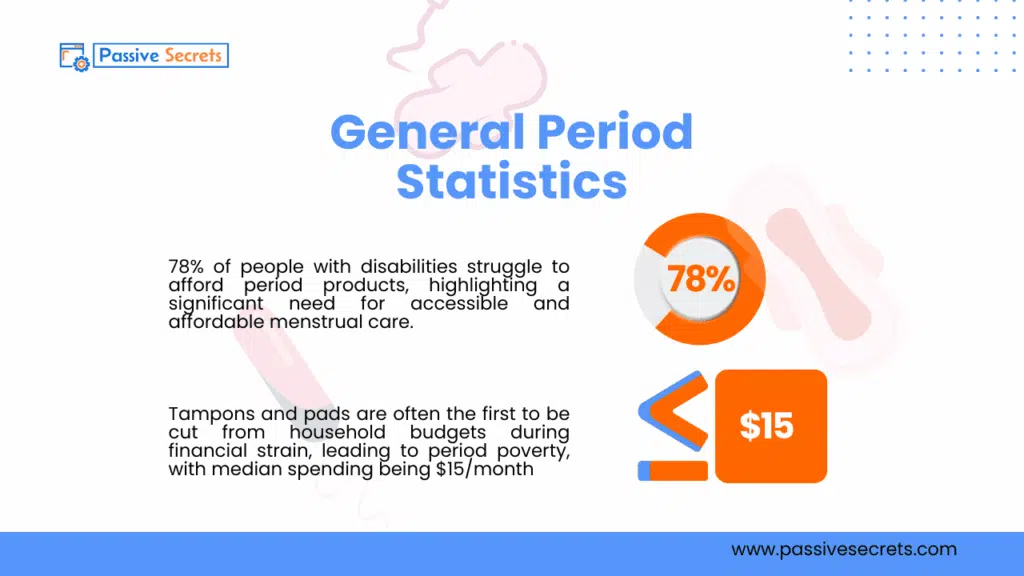
2. Tampons and pads are often the first to be cut from household budgets during financial strain, leading to period poverty, with median spending being $15/month. (source)
3. Every month, approximately 1.8 billion people around the world menstruate. This means that every day, over 800 million people have their periods. Periods are very sensitive to women because they affect both their physical and mental health. (source)
4. About 16.9 million menstruating women in the U.S. live in poverty. Worse, two-thirds of these women couldn’t afford menstrual products and hygiene facilities in the last 12 months. Additionally, over half of them had to choose between menstrual products and food. (source)
5. World Menstrual Hygiene Day is on May 28th of every year. It is held every year to raise awareness of the stigma and challenges women and girls face during their periods. (source)
6. In 2025, 24% of US teens struggle to afford period products, and 39% say financial constraints impact their ability to buy them. (source)
7. 45% of teens wear period products longer than recommended due to lack of access, with higher rates among low-income (53%) and Hispanic teens (52%). 64% of teens have had a “Code Red” moment, asking friends for products due to inadequate access, up from 2023. (source)
8. 45% of Black teens in the US say their family’s economic situation impacts their ability to buy period products. (source)
9. Period poverty affects academics: 33% of teens miss at least 15 minutes of class due to lack of products, and 39% feel unable to do their best schoolwork, impacting learning and academic equity. (source)
10. 2/3 of teens say menstrual symptoms affect their classroom performance (66%) and cause them to miss class time (65%). 93% experience negative impacts on sports/extracurricular activities due to symptoms, yet 53% still participate despite not feeling their best. (source)
11. About 1/3 of US teens feel uncomfortable asking for period accommodations in public (34%), at school (32%), or at work (32%). (source)
12. 77% of teens hide period products when walking to the bathroom, with higher rates among Black (83%) and lower-income (82%) students, due to period shame. (source)
13. In a US survey, 30% of respondents admitted to having difficulty accessing menstrual hygiene products during the pandemic due to the quarantine. 29% struggled to purchase period products, and 18.5% struggled to afford any products at all. (source)
14. Period poverty is a worldwide dilemma, affecting many countries worldwide. Women around the world are victims of period stigma, especially when they cannot afford the bare period care essentials. (source)
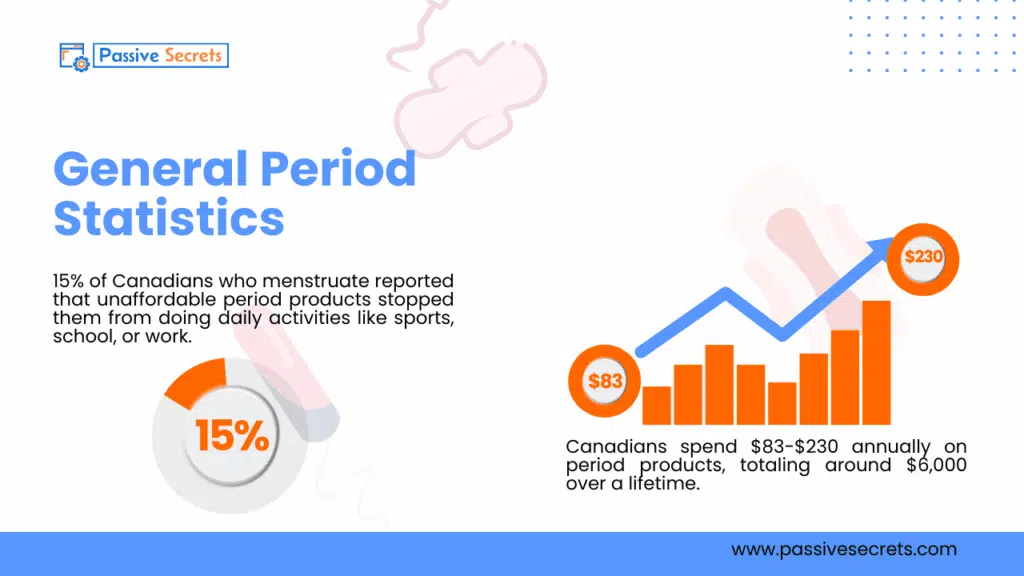
15. 15% of Canadians who menstruate reported that unaffordable period products stopped them from doing daily activities like sports, school, or work. (source)
16. Canadians spend $83-$230 annually on period products, totaling around $6,000 over a lifetime. (source)
17. 83% of Indigenous people and 78% of people with disabilities face difficulties affording period products. (source)
18. $9.6 billion is lost annually due to missed workdays caused by periods, emphasizing the need for better support systems. (source)
19. The social stigma of periods also affects women in advanced countries like the U.S. 58% of women admitted they are ashamed of their periods. Sadly, men contribute to the stigma. 51% of surveyed men say it is wrong and unethical to discuss periods at work. (source)
20. During the COVID-19 lockdown, period poverty worsened worldwide as suppliers and distributors stopped operating. This made period products very scarce, especially in rural areas. (source)
21. Lack of clean water or proper spaces for period management has caused women to wear sanitary pads for more extended periods. Unfortunately, prolonged use of menstrual products without changing and cleaning up properly can cause health risks like infections and bacteria. (source)
22. Period poverty also involves a lack of education about periods, which is also one of the leading causes of period stigma. (source)
23. People with periods use over 9,000 sanitary pads in their lifetime. (source)
24. Women are forced or persuaded to have transactional sex, where they exchange sex for sanitary pads. This transactional sex can come with consequences such as unwanted pregnancies or even slavery. (source)
25. In 2025, about 1 in 4 US teens struggled to afford menstrual hygiene products due to financial constraints, with 45% wearing products longer than recommended. While these numbers slightly increased from 2023, fewer teens reported a lack of free products in public bathrooms. (source)
26. 40% of US teens couldn’t do their best schoolwork due to a lack of period products, with 1/3 missing class time. Meanwhile, 2/3 said menstrual symptoms impacted their school performance. (source)
27. Another very recent survey in the U.S. showed that nearly one in five (18.7%) menstruating college students have experienced period poverty. They have felt compelled to choose between purchasing menstrual products and meeting other personal expenses. However, 81.3% of respondents said they haven’t experienced period poverty. (source)
28. Almost half (47.6%) of college students in the U.S. either know someone or have personally struggled with accessing proper period products. (source)
29. 19 US states still apply sales tax to period supplies, with Tennessee, Indiana, and Mississippi having the highest rate at 7%. These states classify period products as “luxury goods” even though they are just bare essentials. (source)
Period Poverty Statistics by Country
In India
30. 63% of schools in Indian villages do not educate young girls about periods. (source)
31. There is a religious belief in India that a woman on her period is “impure” and “unclean.” (source)
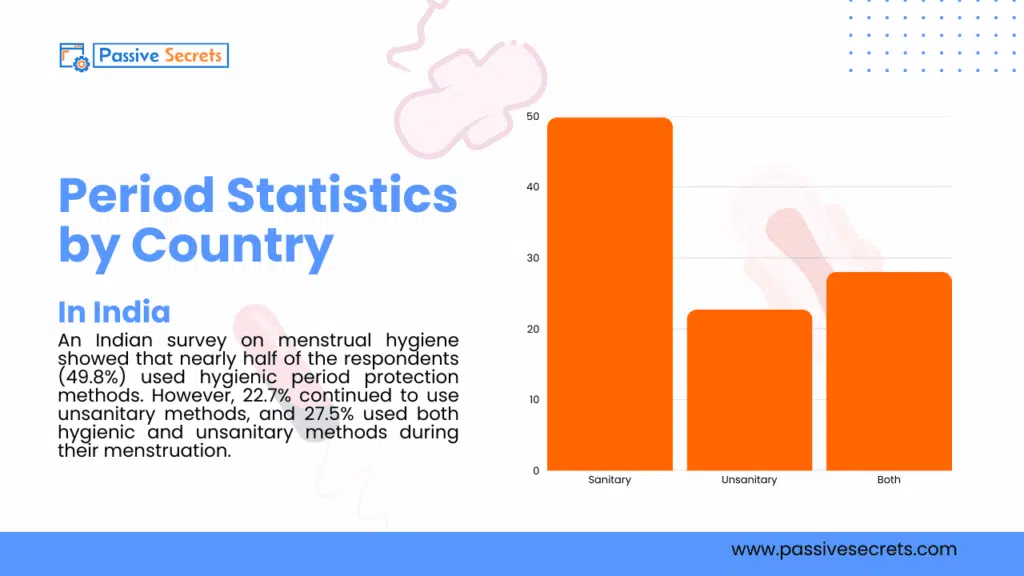
32. An Indian survey on menstrual hygiene showed that nearly half of the respondents (49.8%) used hygienic period protection methods. However, 22.7% continued to use unsanitary methods, and 27.5% used both hygienic and unsanitary methods during their menstruation. (source)
In East Asia
33. The price of sanitary pads increased by 500%, thus increasing cases of period poverty in the country. (source)
34. Plan International collaborated with Modibodi, a sustainable period brand, to empower over 5000 Asian women and girls on proper period management. The collaboration campaign provided up to 1000 “reusable and sustainable menstrual underwear” to over 333 women and girls. About three-quarters of the participating ladies said the program made them feel more confident in period management. (source)
35. In Lao PDR, a study showed that 31.8% of young girls skipped school due to menstruation. Some of them were absent due to their very young age, menstrual anxiety, using painkillers for menstrual pain, etc. (source)
36. In Japan, periods are seen as taboo or embarrassing. Hence, it is rarely talked about. (source)
37. 30% of surveyed Japanese women say they experience period poverty. This means that they can’t purchase period care products or are hesitant due to their low income or the expensive products. These women also cited low income and parents’ unwillingness to get sanitary pads as other reasons. (source)
38. In China, women spend about $160 on sanitary pads yearly, with a 13% sales tax. Sanitary pads are costly in China, which can financially burden many people — especially those earning $154 per month. (source)
39. The period poverty in China is worsened by the poor quality of sanitary pads and the lack of education on period management. (source)
40. In Indonesia, about 22% of women in a survey lacked access to proper period hygiene management. The period poverty the women experience is both from unavailable period products and a lack of education about periods. Some areas have minimal infrastructure, like toilets and running water. (source)
41. Malaysia’s period poverty issue is due to overcrowding in the country. Hence, women lack privacy for proper period management. Women are forced to share communal toilets and bathrooms with other individuals, even with poor facilities like water. (source)
In Africa
42. Recent reports show that over 37 million Nigerian girls and women are living in period poverty. (source)
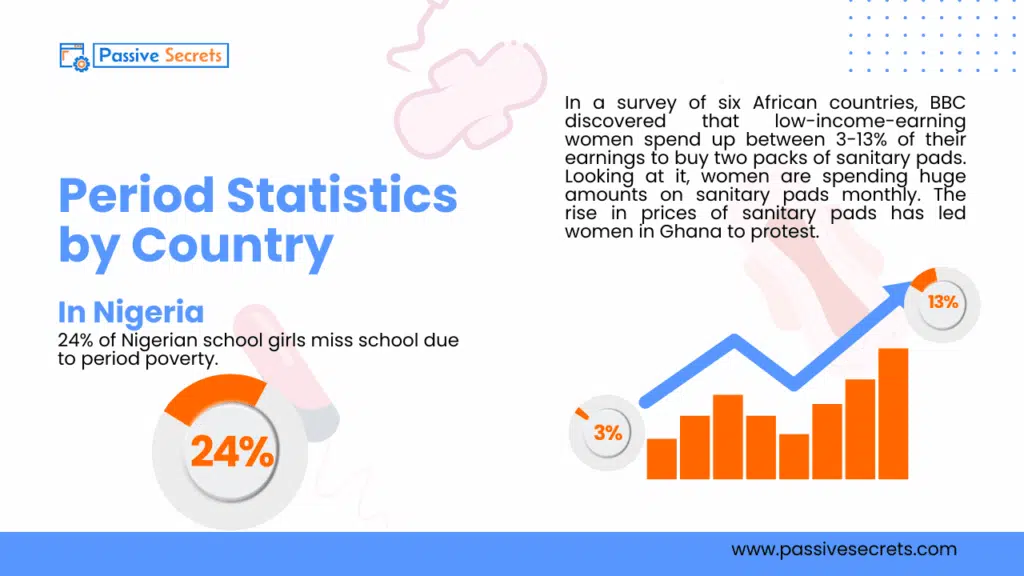
43. 24% of Nigerian school girls miss school due to period poverty. (source)
44. According to BBC research, women earning the minimum wage in Ghana have to spend one out of every seven dollars on sanitary pads. (source)
45. In a survey of six African countries, BBC discovered that low-income-earning women spend up between 3-13% of their earnings to buy two packs of sanitary pads. Looking at it, women are spending huge amounts on sanitary pads monthly. The rise in prices of sanitary pads has led women in Ghana to protest. (source)
46. In Kenya, the price of sanitary pads has fallen significantly to 50 Kenyan shillings. This is approximately 35 U.S. cents or 27 UK pence. (source)
47. A U.N. report showed that in Sub-Saharan Africa, one in every ten girls misses school during their period and eventually drops out. (source)
48. The price of sanitary pads has drastically increased in Africa. In Zimbabwe, the cost of a packet of pads has risen by 117%, while in the Democratic Republic of Congo, it has increased by 50%. Sanitary pads have more than doubled in price, rising from 5 cedis to 12 Ghanaian cedis ($1.43), and Ghana has increased its VAT on pads. The Ghana Revenue Authority classifies them as luxury items. (source)
49. One-third of South African girls between the ages of 9 and 18 are unable to attend school for several days every month during their menstrual period. (source)
50. As the Ghana Revenue Authority sees menstrual pads as luxury items, the country’s government imposed an import tax of 20% and an additional 12.5% VAT on these pads. (source)
51. In Rwanda, 15.2% of girls miss school due to menstruation, and 23.3% of women and girls miss out on economic opportunities. (source)
52. At least 20% of Rwandan schoolgirls, particularly in rural areas, miss up to 50 school days annually. Unfortunately, menstrual limitations can result in a loss of US $215 per woman annually, totaling US $115 million in Rwanda. (source)
53. As the price of period products in Rwanda is very high, 18% of women and girls are forced to miss work or school because of period poverty. Period products in Rwanda cost between Rwf 800 (approximately $0.77) and Rwf 1200 (roughly $1.15). (source)
54. The Zambian government gave free sanitary products to girls in rural areas. (source)
In Europe
55. 36% of young girls in the UK between 14 and 21 years struggled to access menstrual hygiene products during the pandemic. This is equivalent to over 1 million girls in the UK who are experiencing period poverty. 73% of those without any money to afford pads used toilet paper as an alternative. (source)
56. 30% of girls who found it challenging to afford menstrual products but still bought them said they gave up food just to afford them. 23% cut back on soap and toothpaste. And 39% cut down on clothing. (source)
57. About 49.4% of females experiencing period poverty in France showed symptoms of depression. This is more compared to the 28.6% of women who hadn’t experienced period poverty. (source)
58. Within a year, period poverty in the U.K. skyrocketed from 12% to 21%. About 21% of menstruating people in the U.K. are experiencing period poverty. That is about 2.8 million people in the U.K. with a lack of access to period hygiene products. (source)
59. In a survey on period poverty, 41% of people experiencing it say they keep the period sanitary pads or tampons on for longer than recommended. 8% said they reuse disposable pads. Both practices are very unhealthy and can lead to severe infections. (source)
60. 37% of women experiencing period poverty in the U.K. say they used tissues or cotton wool as alternatives to sanitary pads. 13% admitted to using socks, and 9% used paper or newspaper. (source)
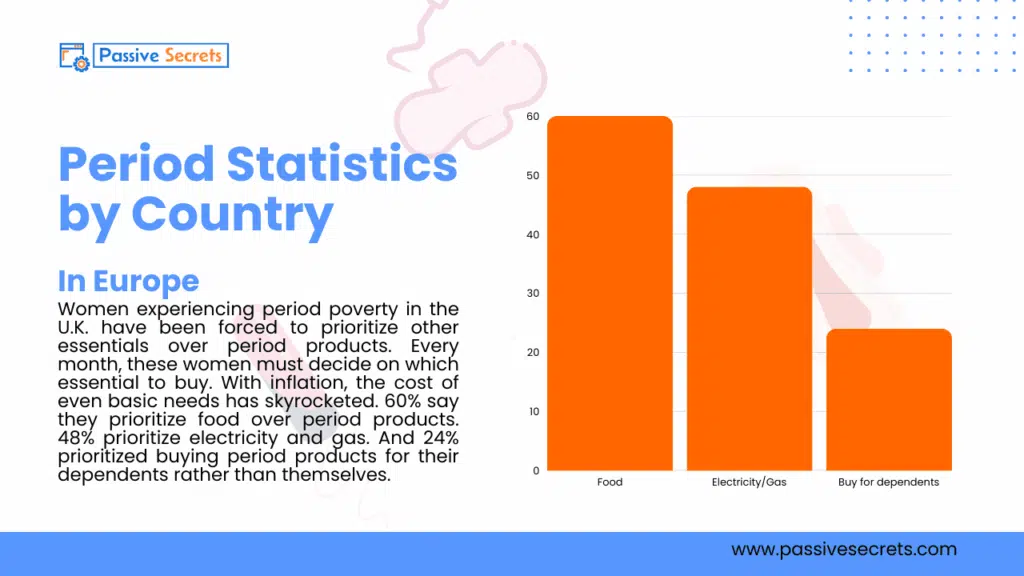
61. Women experiencing period poverty in the U.K. have been forced to prioritize other essentials over period products. Every month, these women must decide on which essential to buy. With inflation, the cost of even basic needs has skyrocketed. 60% say they prioritize food over period products. 48% prioritize electricity and gas. And 24% prioritized buying period products for their dependents rather than themselves. (source)
62. 22% of young women between 18 and 24 years in the UK say they feel embarrassed during their periods. Over half (58%) say it’s because they feared having bloodstained clothes. (source)
63. Scotland is the first country to give period products for free. In 2020, Scotland became the first country to ensure all period products are free and available to all.
(source)
64. Also, Ireland is the only European country with no tampon tax. (source)
65. Belgium distributed over 300,000 free menstrual pads and tampons to 500+ female prisoners. (source)
66. Women in Europe spend an average of €27,000 on menstrual hygiene products in their lifetime. (source)
67. Belgium reduced the VAT on menstrual products from 21% to 5%. However, some other countries classify menstrual products as luxury items and charge high VAT on them. (source)
68. To fight period poverty in 2020, the Belgian government pledged €200,000 to make menstrual products more available. (source)
69. The French government pledged about €1 million to provide free period products in schools. (source)
70. Additionally, the French government declared that from 2024, sanitary products will become free for people below 25 years old. (source)
71. In 2022, a survey showed that 30% of young women in France between 18 and 24 years old couldn’t afford sanitary products due to financial difficulties. (source)
In Australia
72. Tasmania has high period poverty rates, with 69% struggling to afford period products and 31% wearing the same tampon/pad for over 4 hours due to cost. (source)
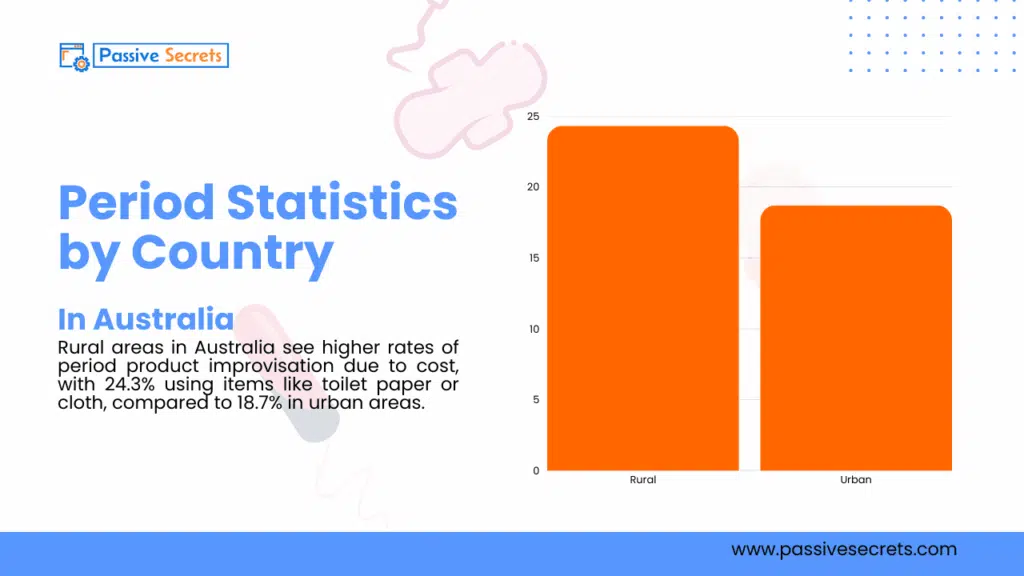
73. Rural areas in Australia see higher rates of period product improvisation due to cost, with 24.3% using items like toilet paper or cloth, compared to 18.7% in urban areas. (source)
74. 83% of Indigenous Australian people face challenges affording period products, leading some to improvise with other items or wear products for extended periods. (source)
75. Over 77% of Australian students struggle to afford period products, with 36% wearing tampons/pads for over 4 hours due to cost. (source)
76. Period products in Australia have increased by 7% in a year, with the average price now $9.75, adding to financial strain. (source)
FAQs
Other Statistics Posts:
- Single Moms Vs. Single Dads Statistics: Key Facts and Trends
- 40+ Incredible Single Father Statistics You Have to Know
- Holiday Spending Statistics: How Much Americans Spend & Shopping Trends
- Black Consumer Spending Statistics: $2.1 Trillion Buying Power Brands Can’t Ignore
- The Battle of the Sexes: Male Vs. Female Spending Statistics
- 110+ Shocking Income Inequality Data You Need to Know in 2025
- Gender Inequality Statistics: 160+Insights Across Regions
- The $1 Trillion Industry: Sharing Economy Stats That Prove It’s Just Getting Started
- Millennials on Social Media Statistics: Data Brands Must Know
- How Much Are People Really Saving? Personal Savings Statistics
- 40+ Useful Procrastination Statistics To Help You
- Gen Z vs Millennial Spending Statistics: Income, Shopping Habits, and Trends
- Gen Z and Social Media: Key Statistics, Trends, and Insights
- Intriguing Born Into Poverty Stay In Poverty Statistics
- Gentle Parenting Statistics: Is This Parenting Style Worth It?
- Dating and Love Statistics & Facts: What the Numbers Reveal About Modern Relationships
- Relationship Statistics That Reveal How Love, Dating, and Marriage Are Changing