Key Outsourcing Statistics (Editor’s Pick)
- 72% of C-suite leaders have outsourced before, with nearly 50% outsourcing finance, accounting, or IT functions.
- Over 40% of companies not currently outsourcing plan to consider it within the next year, signaling continued market expansion.
- 83% of small businesses plan to maintain or increase outsourcing spending, highlighting strong SMB-driven demand.
- 93% of companies that outsource report being satisfied with the results, reinforcing outsourcing’s effectiveness.
- 78% of CFOs say outsourcing frees internal teams to focus on strategic, value-added work rather than routine operations.
- The global software outsourcing market is projected to grow from $585.5 billion in 2024 to $897.9 billion by 2031.
- The IT outsourcing market is expected to reach $806.55 billion by 2030, growing at a 6.5% CAGR.
- The global logistics outsourcing market is forecast to reach $2.09 trillion by 2034, reflecting outsourcing’s massive economic scale.
- The data analytics outsourcing market is set to surge from $10.89 billion in 2025 to $47.65 billion by 2030, with a 34.3% CAGR.
- The engineering services outsourcing market is projected to grow from $2.3 trillion in 2023 to $10.73 trillion by 2032.
- The offshore software development market will expand from $122 billion in 2024 to $283 billion by 2031, driven by global talent demand.
- 34% of companies are likely to outsource CTO roles, while 30% may outsource CIO or CISO positions, signaling a shift in leadership outsourcing.
- 96% of executives rely on outsourcing providers to enhance data and analytics capabilities, underscoring outsourcing’s role in digital transformation.
- 58% of global business services (GBS) organizations are starting or planning GenAI initiatives, primarily in finance and IT outsourcing.
- Mexico has entered the top three global GBS locations, while Portugal reached the top 10 in 2025, reflecting rapid shifts in outsourcing destinations.

Outsourcing has changed the way businesses operate, allowing companies to streamline processes, reduce costs, and boost efficiency. But just how prevalent is outsourcing in today’s economy?
Businesses outsource tasks to cut costs and improve productivity.
Companies are no longer outsourcing just to “do more with less.” They’re outsourcing to access scarce talent, move faster than competitors, and adopt emerging technologies like AI without rebuilding their entire organization from scratch. That’s why satisfaction rates are soaring, global markets are hitting trillion-dollar valuations, and entirely new outsourcing hubs are rising across the world.
In this article, we break down the most important outsourcing statistics shaping 2026: the numbers that reveal where businesses are investing, which functions are being handed off, and why outsourcing is now a growth engine rather than a last resort.
If you want to understand where outsourcing is headed next and what it means for your strategy, these are the stats you can’t afford to ignore.
General Outsourcing Statistics
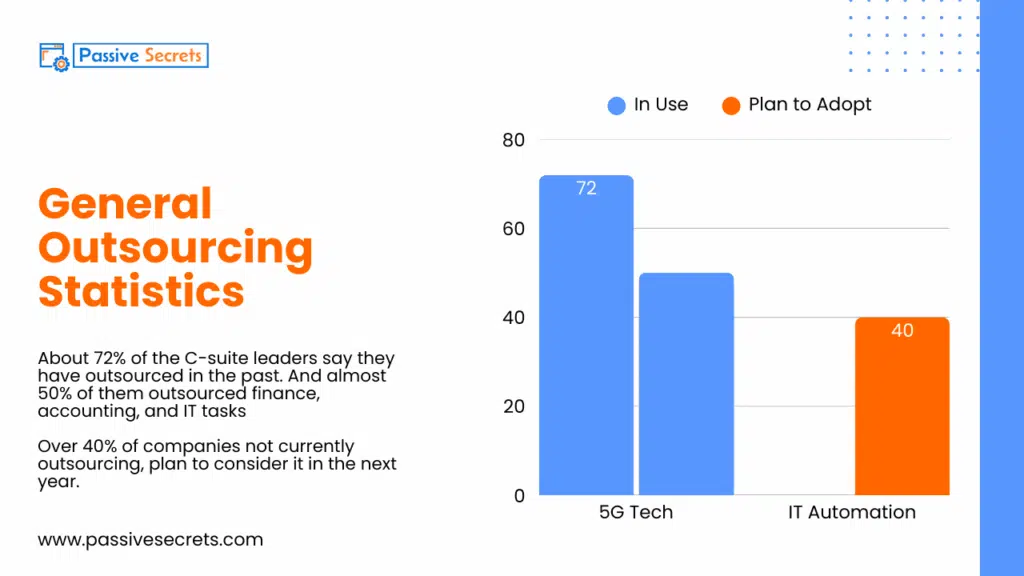
1. About 72% of the C-suite leaders say they have outsourced in the past. And almost 50% of them outsourced finance, accounting, and IT tasks (source).
2. Over 40% of companies not currently outsourcing plan to consider it in the next year (source).
3. 58% of GBS organizations are starting or planning their GenAI journey, focusing on Finance and IT, with use cases like chatbots, invoice management, and analytics. GenAI is also used in contract management, covering setup, drafting, reviews, and leakage assessment (source).
4. 61% of companies opt for outsourcing financial tasks and other business processes (source).
5. In 2024, 46% of UK companies outsourced marketing, with 50% of B2B and 41% of B2C companies relying on external partners (source).
6. In 2024, 84% of companies in Poland outsourced data security to external providers, up from the previous year (source).
7. Between 2021 and 2025, most US facility managers in cleaning/janitorial services rejected outsourcing, while a smaller group considered it but ultimately decided to keep services in-house (source).
8. 83% of small businesses planned to keep or increase outsourcing spending in 2023 (source).
9. 28% of marketers in UK companies outsource digital marketing tasks, with 10% specifically outsourcing social media marketing (source).
Outsourcing Benefits Statistics
10. A 2024 UK survey of 3,000+ marketers found that 50% outsourced marketing due to skill gaps, while 14% did so to cut costs (source).
11. 93% of companies that outsourced reported being satisfied with the outcome (source).
12. 71% of organizations prefer outsourcing accounting because it allows for greater flexibility and adaptability (source).
13. 78% of CFOs report that outsourcing has freed up their teams to focus on strategic, value-added activities (source).
Outsourcing Market Statistics
14. The U.S. Outsourced Sales Services Market is expected to experience significant growth, expanding from $1.2 billion in 2024 to $1.97 billion by 2031. This represents a compound annual growth rate (CAGR) of 6.95% over the forecast period of 2024-2031 (source).
15. The IT Outsourcing market is indeed on a growth spurt, and was expected to hit $588.38 billion by 2025, with a projected CAGR of 6.51% from 2025 to 2030, reaching $806.55 billion by 2030. To put that into perspective, the average spend per employee is forecasted to be around $156.92 in 2025 (source).
16. The data entry outsourcing market is expected to grow by $206.8 million from 2024 to 2029, with a 6% annual growth rate (source).
17. The data analytics outsourcing market is projected to skyrocket from $10.89 billion in 2025 to $47.65 billion by 2030, growing at a massive 34.33% CAGR (source).
18. The document outsourcing market is set to grow by $19.5 billion from 2024 to 2029, with a 5.7% annual growth rate, as organizations aim to reduce costs, streamline operations, and improve customer communication by outsourcing document management services (source).
19. Europe is estimated to contribute 37% to the growth of the global document outsourcing market from 2023 to 2028 (source).
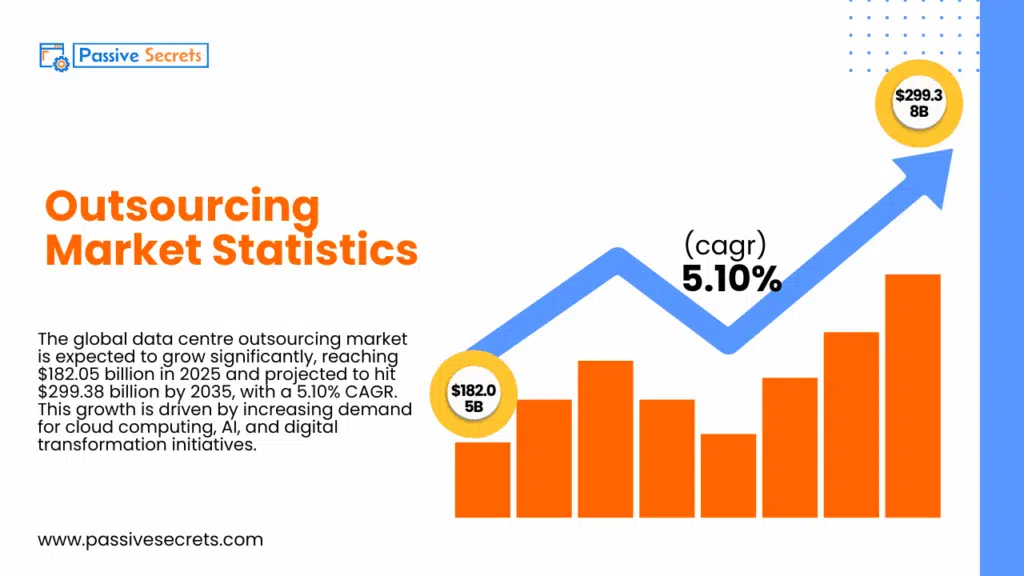
20. The global data centre outsourcing market is expected to grow significantly, reaching $182.05 billion in 2025 and projected to hit $299.38 billion by 2035, with a 5.10% CAGR. This growth is driven by increasing demand for cloud computing, AI, and digital transformation initiatives (source).
21. The Public Sector Outsourcing Market is set to hit $800 billion by 2033, growing at 6.5% CAGR from 2026, driven by cost savings of up to 20% and demand for improved services. This involves governments contracting private providers for functions like healthcare and transportation (source).
22. The CRM outsourcing market is expected to grow by $27.7 billion, at a 5.82% annual rate, from 2023 to 2028. This rise is due to the need for large-scale client management, the importance of data-driven insights, and the benefits of flexibility and cost savings, making it an attractive option for businesses to enhance customer engagement (source).
23. The Desktop Outsourcing Market was worth $61.76 billion in 2023 and is expected to reach $67.36 billion in 2024, growing at a 10.25% annual rate to $122.28 billion by 2030. The market is driven by the need for external services such as desktop infrastructure support, software management, and technical support (source).
24. The payroll outsourcing services market is expected to grow by $5.99 billion, at a 4.79% annual rate, from 2023 to 2028. During this period, North America is projected to contribute 55% to the growth of the global market (source).
25. The Service Desk Outsourcing Market is expected to grow from $88.55 billion in 2024 to $130.66 billion by 2032, at a 5.09% CAGR (2026-2032) (source).
26. The Game Outsourcing Services Market is projected to grow from $697.96 million in 2024 to $1,075.25 million by 2030, with a 7.46% CAGR. The market is driven by the demand for external vendors to provide specialized game development services like art creation, animation, programming, and quality assurance (source).
27. The global legal process outsourcing market is expected to grow from $25.5 billion in 2024 to $157.1 billion by 2033, at a 21.76% CAGR, driven by cost optimization, cross-border trade, focus on core competencies, and tech integration (source).
28. The global Contact and Call Centre Outsourcing market is valued at $105.18 billion in 2024 and is expected to grow at an 8% annual rate from 2024 to 2031 (source).
29. The US engineering services outsourcing market is expected to grow by $187.62 billion, at a remarkable 32.14% annual growth rate, from 2023 to 2028 (source).
30. The human resource outsourcing (HRO) market is expected to grow by $13.3 billion, at a 5.28% annual growth rate, from 2023 to 2028, with North America driving 42% of the global market’s growth during this period (source).
31. The recruitment process outsourcing market is expected to grow by $11.41 billion, at an impressive 18.68% annual growth rate, from 2023 to 2028 (source).
32. The knowledge process outsourcing market is expected to grow by $141.26 billion, at a rapid 19.51% annual growth rate, from 2023 to 2028. This is primarily driven by digital transformation in industries like banking and financial services, which are leading the expansion (source).
33. The US Business Process Outsourcing Services market has grown at a 1.7% annual rate over the past five years, reaching $73.0 billion in revenue in 2024 (source).
34. The Global Telecom Outsourcing Market is projected to grow from $22.01 billion in 2024 to $28.99 billion by 2030, at a 4.7% annual growth rate, from 2024 to 2030 (source).
35. The global marketing technology outsourcing market will grow from $44.04 billion in 2024 to $86.20 billion by 2030, at a 10.2% annual growth rate. Digital marketing and IT & Telecom segments led with 32% and 20% shares, respectively. North America accounted for 38% of the market. The US market will grow at 8.1% CAGR, while Europe’s will grow at 9.7% CAGR from 2024 to 2030 (source).
36. The Offshore Software Development Market is expected to grow from $122 Billion in 2024 to $283 Billion by 2031, at a 10.13% annual growth rate (source).
37. The Laboratory Outsourcing Market is expected to grow from $38.54 Billion in 2023 to $69.24 Billion by 2030, at an annual growth rate of 8.23% from 2024 to 2030 (source).
38. The global laboratory products and services outsourcing market is set to grow at an 8.17% CAGR from 2025 to 2030, driven by the need to reduce costs through outsourcing product manufacturing and services, with the market valued at $41.81 billion in 2024 (source).
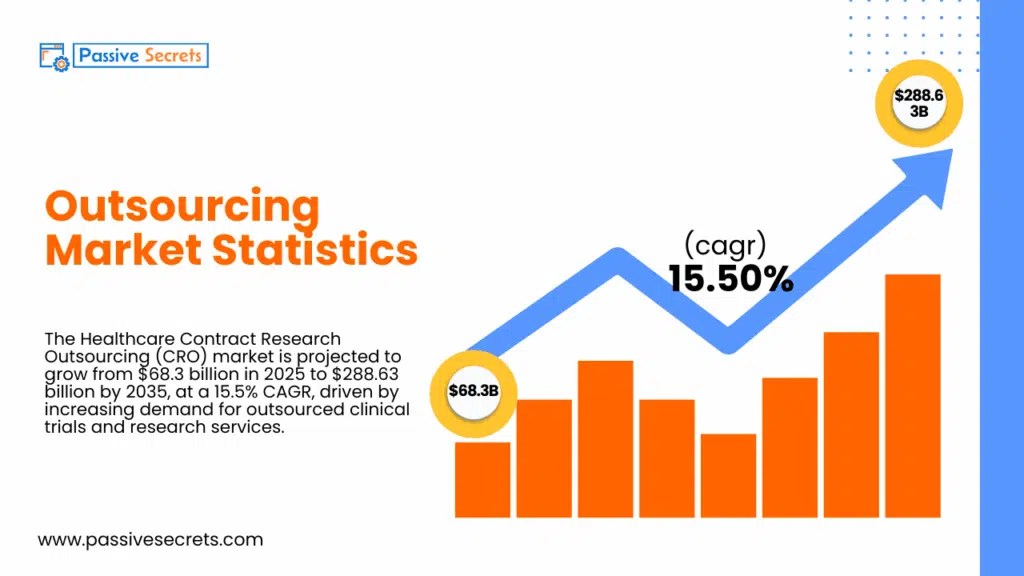
39. The Healthcare Contract Research Outsourcing (CRO) market is projected to grow from $68.3 billion in 2025 to $288.63 billion by 2035, at a 15.5% CAGR, driven by increasing demand for outsourced clinical trials and research services (source).
40. The global logistics outsourcing market grew from $1.32 trillion in 2024 to $1.38 trillion in 2025 and is expected to reach $2.09 trillion by 2034, expanding at a 4.70% CAGR from 2024 to 2034 (source).
41. The US Logistics Outsourcing Market is expected to grow from $256.5 billion in 2024 to $378.5 billion by 2033, at a CAGR of 4.4% (source).
42. The global Logistics Business Outsourcing market is expected to grow from $1.45 billion in 2024 to $2.18 billion by 2031, expanding at a compound annual growth rate (CAGR) of 6% (source).
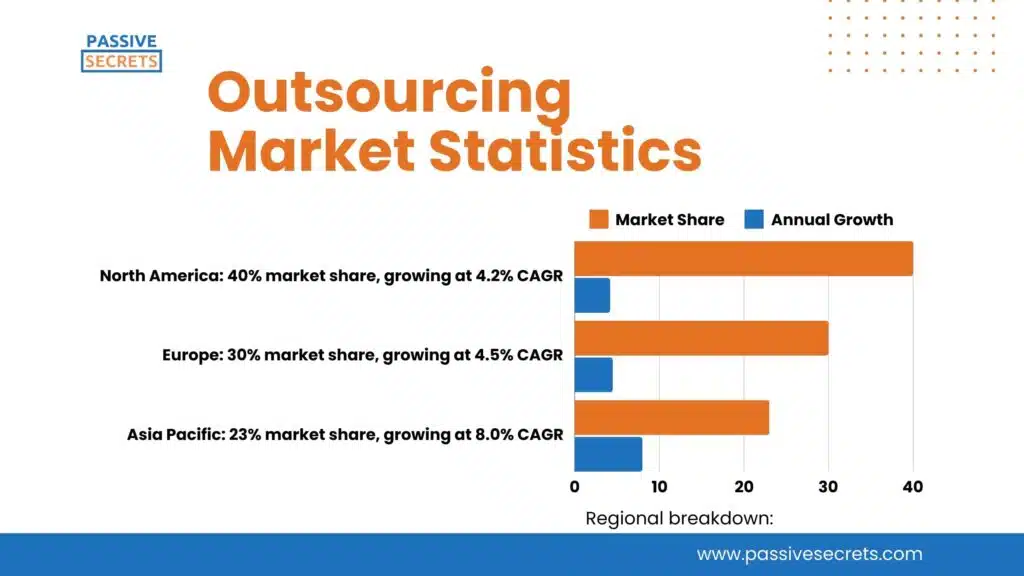
Regional breakdown:
43. The Accounts Receivable Outsourcing Service market is expected to grow from $4776 million in 2024 to $7248 million by 2031, at a 6.2% CAGR (source).
44. The customer experience outsourcing services market is expected to grow from $79.4 billion in 2023 to $205.1 billion by 2032, expanding at an 11.1% CAGR from 2024 to 2032 (source).
45. The global internal audit outsourcing market is expected to grow from $14.2 billion in 2023 to $26.8 billion by 2032, expanding at a 7.5% CAGR from 2024 to 2032 (source).
46. The global help desk outsourcing market was worth $9.7 billion in 2024 and is expected to reach $17.4 billion by 2032, growing at a 7.29% CAGR from 2024 to 2032. This growth is driven by factors such as expanding enterprises, demand for cost-efficient customer support, and the need for efficient customer services (source).
47. The global outsourced sales service market is expected to grow from $2.734 billion in 2023 to $3.96 billion by 2032, expanding at a 4.2% CAGR during the forecast period (source).
48. The U.S. Outsourced Sales Services Market is expected to grow from $1.209 billion in 2024 to $1.971 billion by 2031, expanding at a 6.95% CAGR. The expected growth is driven by the need for effective sales strategies to generate new business opportunities and build sales pipelines (source).
49. The Global Software Outsourcing Market is expected to grow from $585.5 billion in 2024 to $897.9 billion by 2031, expanding at a 5.49% CAGR. There is an increased demand for third-party vendors and service providers to create, maintain, and support software systems and projects (source).
50. The global healthcare BPO market is expected to grow from $293.25 billion in 2023 to $713.20 billion by 2031, expanding at an 11.75% CAGR from 2024 to 2031 (source).
51. The global healthcare IT outsourcing market is predicted to reach $87.8 billion by 2033, growing at a 5.9% CAGR, driven by the adoption of low-cost third-party tech services in emerging countries (source).
52. The global healthcare BPO market is set to grow from $417.68 billion in 2025 to $694.35 billion by 2030, at a 10.7% CAGR, fueled by the need to reduce healthcare costs and outsourcing trends in pharmaceuticals and biopharmaceuticals (source).
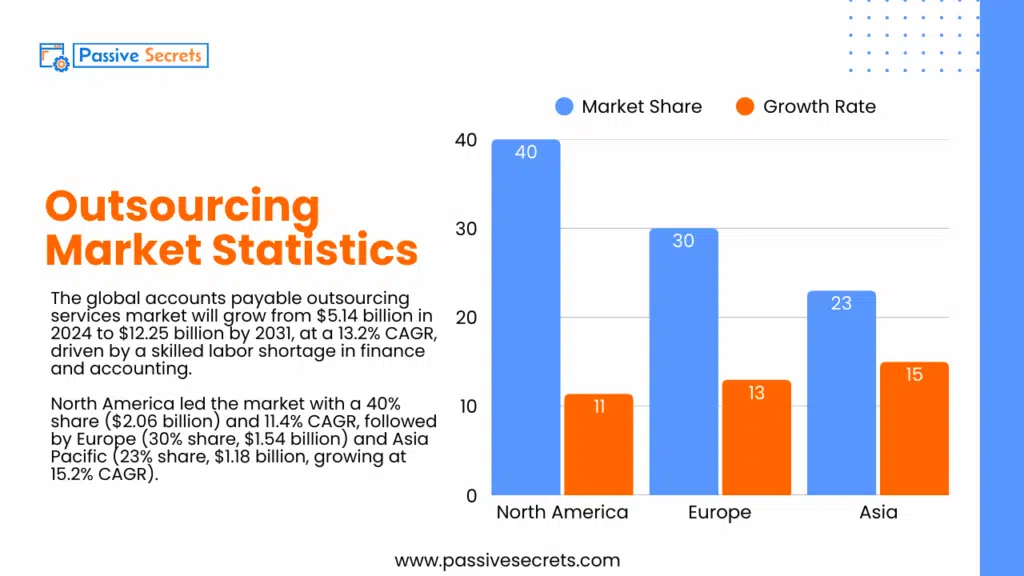
53. The global accounts payable outsourcing services market will grow from $5.14 billion in 2024 to $12.25 billion by 2031, at a 13.2% CAGR, driven by a skilled labor shortage in finance and accounting.
North America led the market with a 40% share ($2.06 billion) and 11.4% CAGR, followed by Europe (30% share, $1.54 billion) and Asia Pacific (23% share, $1.18 billion, growing at 15.2% CAGR) (source).
54. The global hospital outsourcing market was valued at $381.7 billion in 2024 and is expected to grow at a 10.3% CAGR from 2025 to 2030.
In 2024, clinical services led the market with a 21.5% share, while private hospitals accounted for 72.8% of the market. North America dominated the global hospital outsourcing market, capturing a 69.9% revenue share (source).
55. The global outsourcing beauty market is expected to grow from $22.5 billion in 2023 to $40.8 billion by 2032, at a 6.8% CAGR, driven by increasing demand for beauty products, innovation, and cost-effective outsourcing services. The market includes services like manufacturing, packaging, R&D, quality assurance, and more (source).
56. The global medical affairs outsourcing market is estimated to bevalued at USD 2.60 billion in 2025 and is expected to reach USD 5.93 billion by 2032, exhibiting a compound annual growth rate (CAGR) of 12.5% from 2025 to 2032 (source).
57. The global medical device outsourcing market was valued at $128.8 billion in 2023 and is expected to grow at a 12.8% CAGR from 2024 to 2030. The contract manufacturing segment led the market in terms of service, accounting for 54.4% of global revenue in 2023.
The cardiology segment held the largest share (21%) in terms of application, while general and plastic surgery device outsourcing will see the fastest growth (14.3% CAGR) (source).
58. Class II medical devices dominated the global medical device outsourcing market(81.34% share) and will register the fastest CAGR (14%). And Asia Pacific held the largest revenue share (41.3%) in 2023 (source).
59. The Intellectual Property Outsourcing Services Market is projected to grow to $65.19 billion by 2029, at a 12% CAGR from 2022 to 2029 (source).
60. The customer care BPO market is expected to grow from $24.29 billion in 2023 to $43.33 billion by 2031, at a CAGR of 7.5% during the forecast period (source).
61. The global Engineering Services Outsourcing Market was worth $2.3 trillion in 2023 and is projected to reach $10.73 trillion by 2032, growing at an annual rate of 18.7% from 2024 to 2032 (source).
62. The global pharmaceutical R&D outsourcing market was worth $81.23 billion in 2023 and is projected to reach $187.80 billion by 2032, growing at a CAGR of 9.76% from 2024 to 2032 (source).
63. The global source-to-pay outsourcing market is expected to grow from $34.5 billion in 2024 to $88 billion by 2033, at a 10.42% CAGR. S2P outsourcing involves companies delegating their procurement and purchasing tasks to third-party service providers (source).
64. The global finance and accounting outsourcing market was valued at $60.31 billion in 2023 and is projected to reach $110.74 billion by 2030, growing at a CAGR of 9.1% from 2024 to 2030 (source).
65. The offshore software development market was valued at $122 billion in 2024 and is expected to reach $283 billion by 2031, growing at a CAGR of 10.13% from 2024 to 2031. This market involves outsourcing software development to remote teams in different countries (source).
66. The global sales and marketing BPO market was valued at $28.65 billion in 2022 and is expected to grow at a 9.4% CAGR from 2023 to 2030, driven by the rising adoption of cloud computing, which has significantly contributed to the industry’s expansion (source).
67. The global sales and marketing BPO market is projected to reach $49.2 billion by 2028, growing at a CAGR of 9.5% from 2022 to 2028 (source).
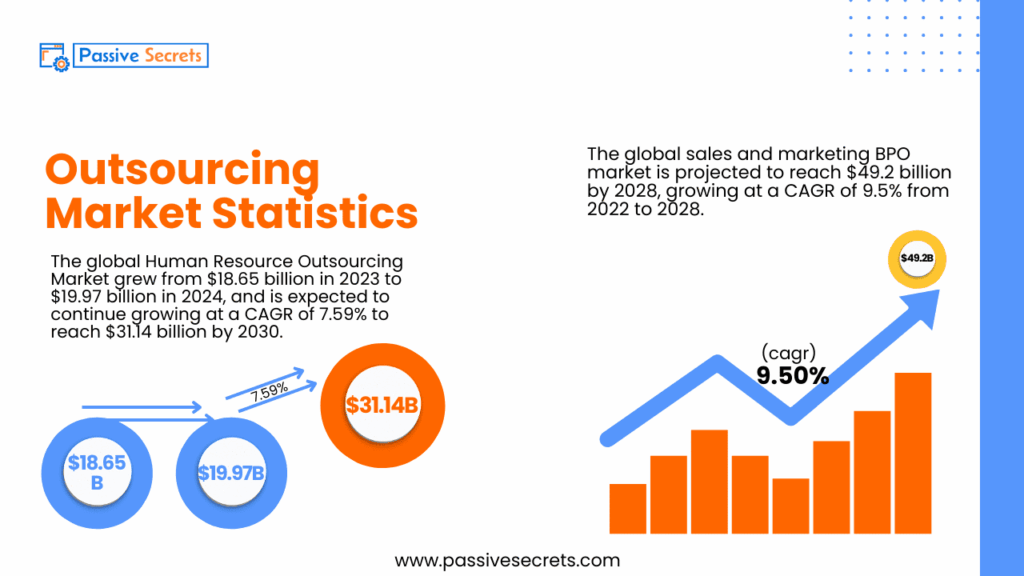
68. The global Human Resource Outsourcing Market grew from $18.65 billion in 2023 to $19.97 billion in 2024, and is expected to continue growing at a CAGR of 7.59% to reach $31.14 billion by 2030 (source).
69. India’s IT outsourcing market is projected to reach $11.04 billion in 2024 and grow at a CAGR of 13.52% to reach $20.81 billion by 2029 (source).
70. The global Application Outsourcing market is expected to grow steadily, increasing by $5.9 billion (4.99%) from 2024 to 2029, reaching a record high of $124.07 billion in 2029. This marks the ninth consecutive year of growth, continuing the segment’s upward trend (source).
Global Outsourcing Statistics
71. The UK and Ireland’s CXM outsourcing market was flat in 2024, staying between $7 billion and $9 billion, reflecting global trends, with the worldwide market valued at $113-115 billion and showing slow growth (source).
72. The UK contact centre outsourcing sector has around 170,000 frontline roles and 280,000 jobs total, making up nearly 1% of the UK workforce and a quarter of the country’s contact centre professionals (source).
73. Portugal rose to the top 10 GBS locations in 2025, while Costa Rica dropped out due to rising costs. Mexico jumped into the top 3 spots, thanks to its tech, talent, scalability, and competitive pricing (source).
74. Firms are increasingly outsourcing accounting services, with global spending up 40% and interest rising 20% over the past five years (source).
75. Poland surpassed Ukraine in 2021 as a leading destination for software development outsourcing, earning the top spot as a nearshore and offshore hub. Additionally, Poland ranks third worldwide for software development services (source).
76. In 2023, small businesses sought new outsourced providers in marketing (27%), followed by IT services (22%), and design (21%) (source).
77. China’s service outsourcing industry employed 15.87 million people in 2023, with around 895,000 new hires that year. Employment numbers have been relatively stable since 2016 (source).
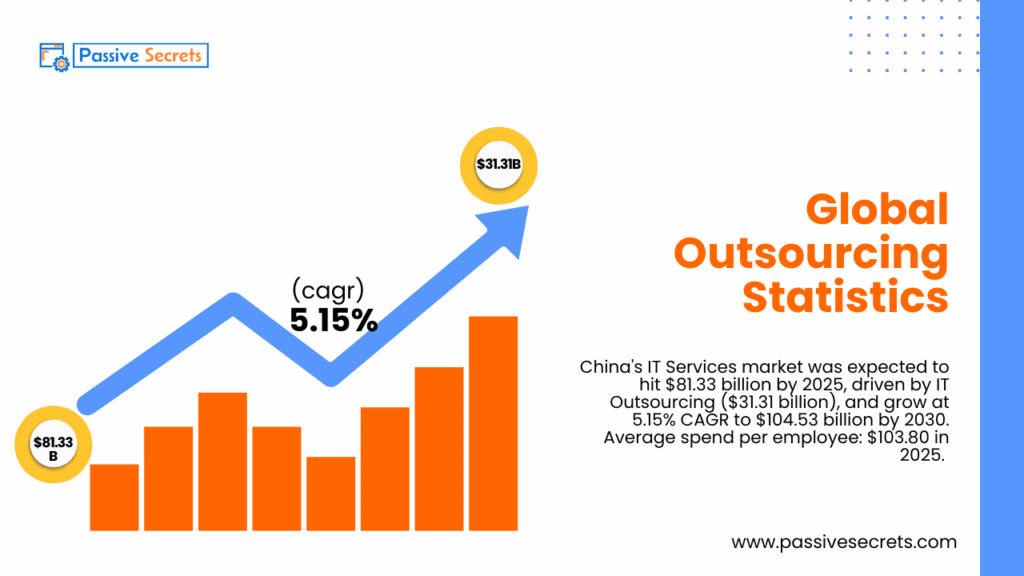
78. China’s IT Services market was expected to hit $81.33 billion by 2025, driven by IT Outsourcing ($31.31 billion), and grow at 5.15% CAGR to $104.53 billion by 2030. Average spend per employee: $103.80 in 2025 (source).
79. China is the global leading country for manufacturing outsourcing and IT outsourcing (source).
80. There was a 19% increase in Google searches for “accountancy outsourcing” in 2023 (source).
Industry-Specific Outsourcing Statistics
IT Outsourcing Statistics
81. Companies are considering outsourcing top tech roles, with 34% likely to outsource CTO, 30% CISO, and 30% CIO positions within the next year (source).
82. In 2024,50+% of EU companies outsourced some cybersecurity tasks, while 65% of Luxembourg organizations relied on external firms for cybersecurity (source).
83. Internal Audit departments faced a 15% increase in capability shortfalls and skill misalignment between 2021 and 2024. Leaders responded by leveraging internal resources (18% rise) and external resources (26% annual increase) to address these gaps (source).
84. In 2024, organizations increased outsourcing of OT cybersecurity training by 5% and vulnerability management by 3%, but decreased outsourcing of other services like managed detection and response, and data privacy services, compared to 2023 (source).
Pharmaceutical Outsourcing Statistics
85. The global pharmaceutical market’s in-house spending share is expected to decline from 66.3% in 2014 to 51% in 2023, indicating a shift towards outsourcing services (source).
86. 87% of biopharmaceutical manufacturers outsource analytical testing and bioassays, making it the top category for outsourcing among such companies, as of 2022 (source).
87. 35% of biopharma executives prefer the full-service outsourcing model for clinical development work, making it the most popular choice among surveyed companies worldwide (source).
88. 34% of biopharma executives currently use the full-service outsourcing model for clinical development, with small and mid-sized companies (40%) using it more frequently than large companies (35%) (source).
89. 73% of biopharma executives say it’s extremely likely or very likely that their company will outsource patient recruitment in the next 2 years (source).
90. In 2024, 75% of biopharma executives say their company will likely outsource patient recruitment for clinical trials within 2 years, showing a growing trend in outsourcing drug development (source).
Outsourcing Challenges and Concerns
91. 56% of C-suite leaders cite lack of financial resources as the reason they don’t outsource. However, 63% say they didn’t outsource because there was no current need to outsource, or they were concerned about the quality of work (source).
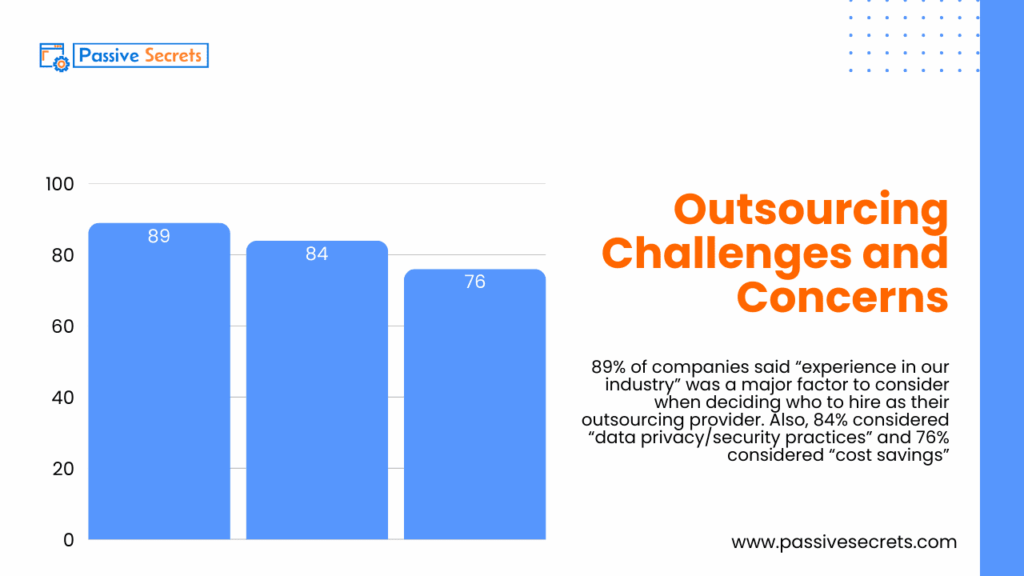
92. 89% of companies said “experience in our industry” was a major factor to consider when deciding who to hire as their outsourcing provider. Also, 84% considered “data privacy/security practices” and 76% considered “cost savings” (source).
93. 81% of executives cite cybersecurity as a major external concern, and 96% rely on outsourcing providers to enhance data and analytics capabilities, underscoring the crucial role of outsourcing in addressing emerging security threats (source).
94. Half of executives cite talent acquisition as a major internal challenge in achieving their organization’s strategic objectives (source).
FAQs

Other Related Statistics You Should Know:
- 30+ Powerful Team Building Statistics to Boost Workplace Performance
- 87+ Training Industry Statistics & Trends for HR and L&D Professionals
- Global IT Outsourcing Statistics: Key Trends and Insights
- 90+ Interesting Marketing Jobs Statistics & Facts (Latest Report)
- 80+ Employee Benefit Statistics: Insights and Trends
- The Most Important Wealth Management Statistics You Can’t Afford to Ignore
- Enterprise Data Management: Essential Statistics and Emerging Trends
- 93 Talent Management Statistics to Help You
- Top Reputation Management Statistics and Trends to Improve Your Brand
- 36 Helpful Social Worker Burnout Statistics To Know
- 100 Business Process Outsourcing Statistics & Facts
- Top HR Outsourcing Statistics and Trends Every Business Must Know
- 47+ Shocking 4-day Work Week Statistics To Know
- 105+ Supply Chain Statistics & Facts You Can’t Ignore
- 50+ Interesting Employer Branding Statistics And Trends
- Job Seekers Statistics: Unemployment Rates, Preferences, Challenges
- 95 Interesting Job Interview Statistics and Huge Trends To Know
- 60+ Helpful Change Management Statistics & Facts
- 65+ Employee Performance Management Statistics & Trends
- Workforce Management Statistics: Trends, Insights, & Opportunities
- 73 Revealing Workplace Distraction Statistics
- Workplace Romance Statistics: How Common Is Workplace Romance?
- 40+ Top Workplace Conflict Statistics You Should Know
- The State of Workplace Communication: Key Statistics and Trends
- 55 Workplace Collaboration & Teamwork Statistics