
Your most productive hours are slipping away and you probably don’t even notice it happening. It happens before you’ve finished your first coffee. A Slack notification. An unexpected email. A colleague stopping by your desk with “just a quick question.”
By 10 AM, you’ve been interrupted so many times that the focused work you planned for the morning feels impossible.
But here’s what most managers don’t realize: this isn’t a personal failure or a lack of discipline. It’s a systemic problem that’s quietly bleeding out billions in lost productivity across companies worldwide.
The 2026 workplace distraction statistics are in, and it’s worse than we thought. The average knowledge worker loses nearly 4 hours per day to distractions and task-switching. That’s more than just lost time; it’s lost revenue, missed deadlines, and burnout waiting to happen.
What’s particularly alarming is that 68% of employees report being distracted almost constantly during their workday. Yet, most organizations still treat this as an individual productivity issue rather than what it actually is: a structural problem that demands real solutions.
In this article, we’ll break down the latest statistics, explore why workplace distractions have become an epidemic, and most importantly, reveal what forward-thinking companies are doing to reclaim their teams’ focus—and their bottom line.
Key Workplace Distractions Statistics (Editor’s Pick)
- Up to 92% of employers say distraction is a major issue in their organizations.
- Almost 80% of employees report being unable to focus for a full hour without getting distracted.
- The average worker experiences 15 interruptions per hour, meaning a distraction every four minutes.
- 79% of employees feel distracted on a typical workday.
- 75% of employees believe that working remotely reduces distractions.
- 84% of Gen Z and Millennial workers say they are easily distracted on video calls or meetings.
- 92% of employees consider meetings to be costly and unproductive.
- Over 70% of U.S. employees cite interruptions from colleagues as the top distraction preventing task completion.
- The average worker checks email 36 times an hour and needs 16 minutes to refocus after each interruption.
- Employees attend about 62 meetings per month, and 91% say they daydream during them.
- 60.6% of employees rarely or never get 1–2 hours of uninterrupted focused work daily.
- Employers estimate up to 25% of the workweek is lost to distractions.
- 58% of employees spend 30–60 minutes of their workday on non-work activities.
- UK workers lose up to 15 hours per week due to workplace distractions.
- Businesses across America lose over $650 billion annually due to distracted employees.
Defining Workplace Distractions
Workplace distractions are interruptions or disruptions that divert an employee’s focus from their tasks or responsibilities, reducing productivity and efficiency.
These distractions can come from various sources, including technology, the work environment, personal issues, or interactions with colleagues. They are often cited as a significant barrier to achieving workplace goals and maintaining consistent performance.
Workplace distractions can either be internal (stress, anxiety, procrastination, or fatigue) or external (noise, interruptions from colleagues, or technology).
General Workplace Distraction Statistics
1. Up to 92% of employers say distraction is a major issue in their organizations (Insightful Report 2025).
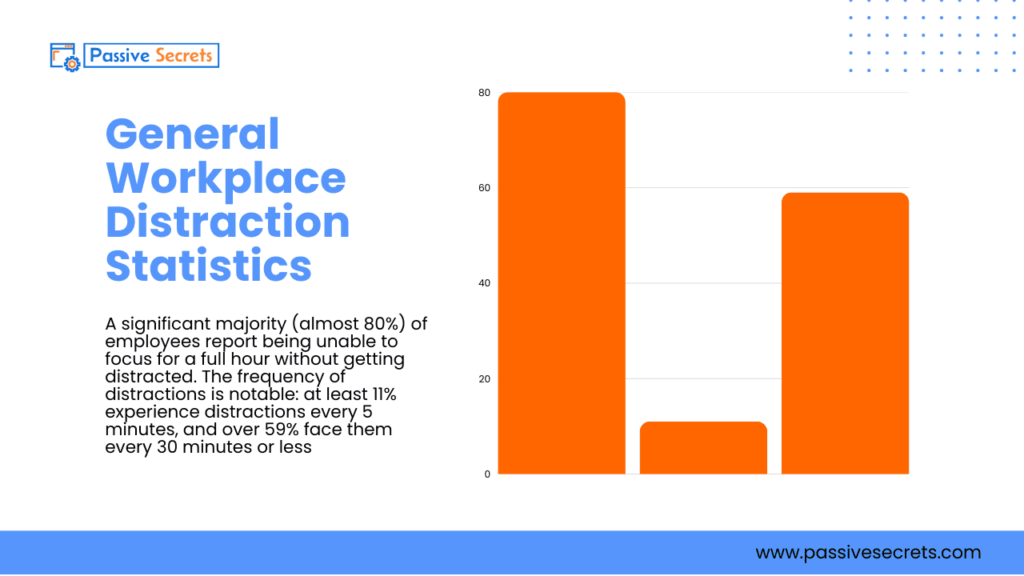
2. A significant majority (almost 80%) of employees report being unable to focus for a full hour without getting distracted. The frequency of distractions is notable: at least 11% experience distractions every 5 minutes, and over 59% face them every 30 minutes or less (Insightful Report 2025).
3. Most US workers (79%) get distracted within an hour, and nearly 6 in 10 (59%) can’t focus for even 30 minutes without getting sidetracked (Yahoo Finance).
4. 67% of UK workers admit to getting distracted during the workday. Also, 15% of UK workers are distracted for 2 hours/day, and 7% for 3 hours/day (15 hours/week) (PPL PRS).
5. Most people struggle to focus both at work (68%) and at home (62%). A significant portion (31%) can only concentrate for 10 minutes or less before getting distracted, and only 3 in 5 can maintain focus for 20 minutes or less (Crucial Learning).
6. 92% of employers see lost focus as a major organizational problem (Insightful Report 2024).
7. Over four-fifths (81%) of employees report being frequently distracted while working in the office (Insightful Report 2024).
8. The average worker experiences 15 interruptions per hour worked, which means they are getting distracted every four minutes (Quiet Workplace).
9. Almost two in three employees say they struggle with productivity, time, and energy due to multiple meetings and email bloat (CNBC).
10. Over half (58%) of surveyed employees say they find it challenging to brainstorm in a virtual meeting. 57% say they find it difficult to follow a meeting if they arrive late. Another 55% say that if the action items are unclear, they find it difficult to follow the meeting (CNBC).
11. Recently, Shopify revamped its meeting policies and banned unnecessarily long meetings. Hence, the company expects teams to increase productivity on completed projects by 25% (CIO DIVE).
12. Between January and February, Shopify reduced the time spent on meetings by 33% (CIO DIVE).
13. 40% of knowledge workers do not have a single opportunity to focus for a continuous 30-minute period during their workday (Quiet Workplace).
14. 79% of employees feel distracted on a typical workday (PR Newswire).
15. 75% of employees believe that working remotely reduces distractions (Totara).
16. Prime time for distraction hits at midday, with 46% answering that noon to 3 pm is their most distracted period (CEO).
17. A recent study conducted by Poly found that 99% of employees say they are distracted from their tasks sometime during their workday (Flexjobs).
18. Udemy and Toluna report that 80% of people report being distracted by chatty coworkers, the number one office place distraction (CEO).
19. Gen-Z and Millennials are the most distracted at work. 84% of Gen-Z and Millennial workers say they are easily distracted on video calls or meetings (Showpad).
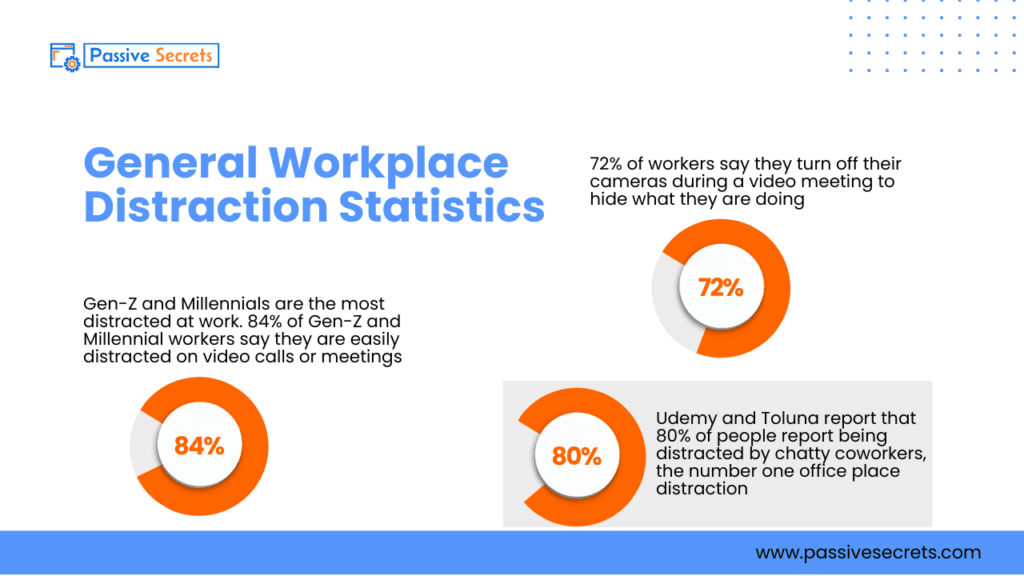
20. 72% of workers say they turn off their cameras during a video meeting to hide what they are doing (Showpad).
21. 78% of workers believe in-person meeting etiquette has worsened since the COVID pandemic (Showpad).
The Most Common Workplace Distractions
22. Some common distractions include meetings (17% of employees), frequent manager check-ins (22%), and personal device use. Many employees frequently check their devices: 42% do so up to 5 times a day, and 37% check 5-10 times daily (Insightful Report 2025).
23. Over half (53%) of employees confess to regularly posting selfies or updates on social media during work hours, and another 41% admit to doing it from time to time (Resume Now).
24. 4 in 10 employees (41%) feel like they attend pointless meetings daily, while 47% blame workplace tools like Slack and email for eating into their productivity (Resume Now).
25. 41% of employees attend meetings daily that feel like a waste of time, with another 42% experiencing this on a weekly basis. The biggest culprit behind meeting time-wasting is late attendees, cited by 41% of respondents (Resume Now).
26. Gen Z workers are guilty of streaming on the job, with 50% admitting to doing so while working from home, and 48% lying about it to their bosses (Tubi).
27. According to a recent Microsoft survey, the number 1 workplace distraction is inefficient meetings. These meetings affect productivity and cause employees stress. An inefficient meeting is a meeting that causes unnecessary stress to the employees. They don’t have a clear purpose and are often long (CNBC).
28. Over 70% of US employees cite interruptions from colleagues as the top distraction preventing them from completing tasks. 62% say phone notifications are their major distractions (Yahoo Finance).
29. 92% of employees consider meetings to be “costly and unproductive.” (HBR).
30. Office workers are more focused than remote workers, with 33% distracted for 30 minutes or less. Remote workers’ top distraction is their phone (27%), while office workers are most distracted by colleagues’ conversations (38%) (PPL PRS).
31. Colleagues’ chatter (41%) is the top workplace distraction, but nearly 2 in 5 (37%) admit to distracting themselves by socializing with others while working (PPL PRS).
32. Most UK employees (77%) find workplace digital tool notifications distracting, with 31% experiencing distractions every 15 minutes, resulting in approximately 160 weekly distractions (People Management).
33. 45% of employees say workplace digital notifications are irrelevant to their jobs (People Management).
34. Employees admit to checking their devices for personal reasons frequently, with 42% doing so up to 5 times a day and 37% doing so 5-10 times a day, highlighting a significant distraction at work (Insightful Report 2024).
35. 71% of employees blame their coworkers as the primary source of distraction, causing them to lose focus and struggle to concentrate on their work (Insightful Report 2024).
36. Employees spend an average of 40 minutes daily in non-work-related chat conversations at the workplace (Nulab).
37. 30% of employees are distracted by the internet (Clockify).
38. 26% of U.S. workers say distractions from world events make it difficult to care about their jobs (PR NEWSWIRE).
39. The average worker checks their email 36 times an hour and takes 16 minutes to refocus after handling a new email (Business News Daily).
40. Employees attend about 62 meetings per month, in which 91% of workers say they daydream. And it takes most employees two hours per day to recover from interruptions from co-workers (Business News Daily).
41. Employees spend about 32% of their workdays on Facebook (Apollo Technical).
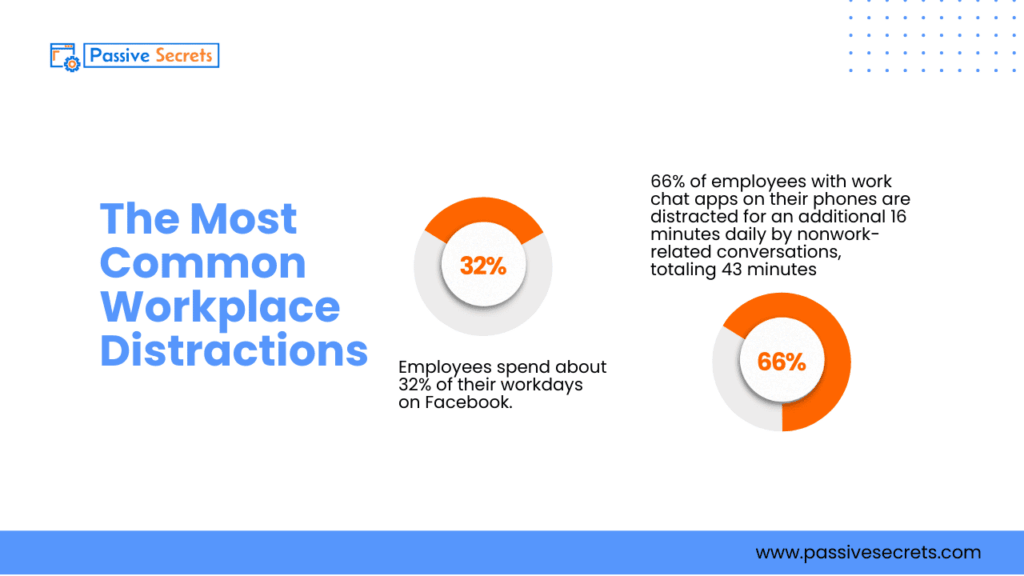
42. 66% of employees with work chat apps on their phones are distracted for an additional 16 minutes daily by non-work-related conversations, totaling 43 minutes (Nulab).
43. Of all the office distractions, meetings are among the most apparent examples of losing productivity (Team Stage).
44. Specifically, 51% of workers stated that it was harder for them to conduct phone calls, and 93% said office distractions made it hard to conduct video calls (Flexjobs).
45. 48% of employees said that office distractions made focusing difficult (Flexjobs).
46. Meetings (60%) and social media (56%) complete the spots of job distractors with positions four and five (CEO NA).
47. Employees were asked to rate social media sites and communication tools in terms of their distraction prowess. Facebook came in first (65%), followed distantly by Instagram (9%), Snapchat (7%), and Twitter (7%) (CEO NA).
48. 60% of people view meetings as distractions interrupting their work and preventing them from completing tasks (CEO NA).
49. Millennials and Gen Z are also the most likely age group to describe themselves as distracted at work (CEO NA).
50. Over a third of millennials and Gen Z (36%) spend two hours or more checking their smartphones at work. That adds up to at least 10 hours weekly when they do something outside their responsibilities (CEO NA).
51. Among millennials and Gen Z, 74% admit to being distracted, with 46% feeling unmotivated and 41% experiencing stress (CEO NA).
52. A massive 40 million Americans deal with anxiety in the workplace almost every day, and many things can trigger it (Team Stage).
53. Only 24% of employees report never checking email after hours. That leaves a whopping 76% of employees checking work emails after hours (Business News Daily).
54. 76% of U.S. employees say they get more distracted on video calls than in in-person meetings (Showpad).
Impact Of Workplace Distraction On Productivity
55. The productivity loss is more significant according to 15% of leaders, who estimate 11-15 hours are lost per week, and 9% who say 16-20 hours are lost. This means a quarter of leaders believe between 25-50% of the average workweek is unproductive (Insightful Report 2025).
56. Managers point to lack of focus as the main challenge with younger workers (64%), and nearly half (49%) say Gen Z workers lack motivation (Insightful Report 2025).
57. Up to 68% of employees have experienced burnout over the past year (Insightful Report 2025).
58. 54% of employers believe remote work has boosted productivity, with just 26% saying it hurts focus (Insightful Report 2025).
59. Most employees (60.6%) rarely or never have a 1-2 hour block of uninterrupted, focused work daily. Additionally, 72.5% admit to being present in meetings but not fully engaged or paying attention (Crucial Learning).
60. The Udemy study found that 84% of employees believe they can refocus on their tasks within 30 minutes of an interruption. Additionally, 60% of baby boomers believe they can refocus on their tasks in less than five minutes (Flexjobs).
61. Managers see lack of focus (64%) and motivation (49%) as top issues with Gen Z workers (Insightful Report 2024).
62. 48% of workers believe that office distraction prevents them from focusing effectively on their job (Cubo).
63. When distracted at work, 51% find it harder to manage phone calls, and 93% say office distractions make managing video calls more challenging (Cubo).
The Cost Of Workplace Distraction
64. Employers estimate significant time is lost: 36% say 1-5 hours/employee/week, and 34% say 6-10 hours. That’s up to a quarter of a typical 40-hour workweek (Insightful Report 2025).
65. Up to 58% of employees spend between 30 to 60 minutes of their workday on activities that are completely unrelated to their job. And another 33% waste anywhere from 1 to 2 hours on workplace distractions (Clockify).
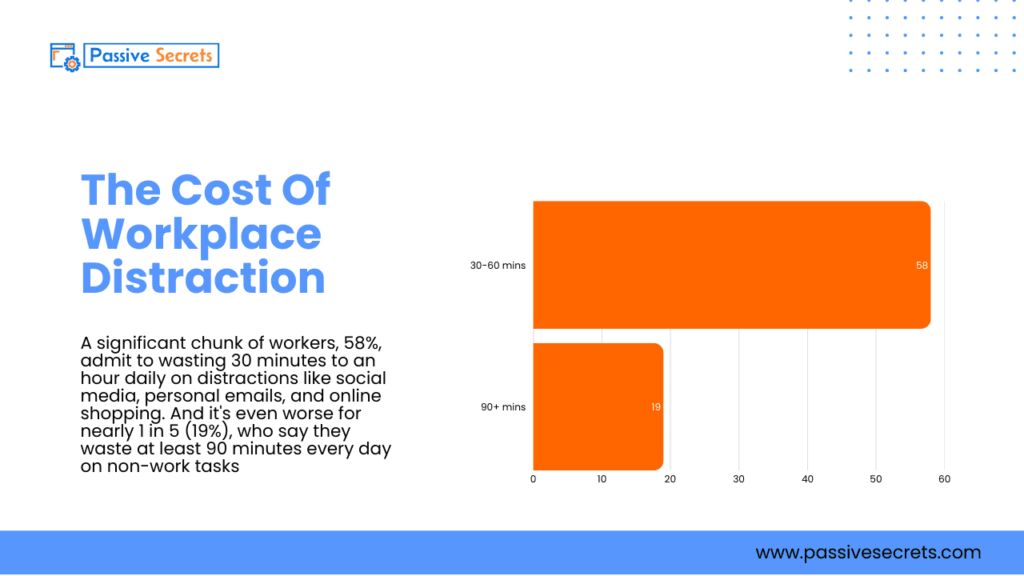
66. A significant chunk of workers, 58%, admit to wasting 30 minutes to an hour daily on distractions like social media, personal emails, and online shopping. And it’s even worse for nearly 1 in 5 (19%), who say they waste at least 90 minutes every day on non-work tasks (Resume Now).
67. Employers estimate that distractions cost them significant time, with 1/3 saying 5 hours/week are lost, and another 1/3 estimating 6-10 hours/week (up to 25% of the workweek) in lost productivity (Yahoo Finance).
68. Think Tank ascertained from figures that when added together, interruptions cost companies globally around €58 billion per year (TLDV).
69. UK workers lose up to 15 hours/week (74 days/year) due to distractions (PPL PRS).
70. Workplace distractions cost Australian workers 600 hours/year in lost productivity (HRM Online).
71. Almost 36% of employers say one to five hours are lost each week per employee, while 34% say six to ten hours are lost per employee. In other words, up to a quarter of the typical 40-hour work week (Insightful Report 2024).
72. 15% to 24% more time is added to the task for every single interruption, depending on the complexity. Taking it at 15%, that’s an average of three full working days a month lost purely to interruptions (TLDV).
73. The average worker wastes 60 hours monthly due to workplace distractions. The distractions can come from various sources, including colleagues, phone notifications, and meetings. Workplace distractions can lead to reduced productivity, increased stress, and even financial losses (Talkbox Booth).
74. Interruptions cause employees to take 27% more time to complete a task, commit up to 2x as many errors, and experience 2x the anxiety (Talkbox Booth).
75. Businesses across America lose upwards of $650 billion annually due to distracted employees during work hours (Business News Daily).
Solutions To Minimize Workplace Distractions
76. 93% of surveyed managers acknowledge that work-life balance is a top priority in their organization. In terms of measures to prevent burnout, 75% of managers stated that they make it a point to regularly check in with their team members to assess their job satisfaction and overall well-being (Insightful Report 2025).
77. In terms of managing workloads, 53% of employers use productivity or workforce management software, while 56% rely on internal systems like spreadsheets or project management tools to assign tasks (Insightful Report 2025).
78. When it comes to improving focus, 43% of employees think flexible work hours would make a difference, while 49% believe that increased compensation would enhance their ability to concentrate (Insightful Report 2025).
79. Some workers try to compensate for lost time by working harder later (29%), while 21% think taking breaks from work actually helps them avoid burnout (Resume Now).
80. Music improves concentration for 80% of UK employees, and 63% say its impact varies depending on the task at hand (PPL PRS).
81. 43% of employers use software to curb digital distractions (Insightful Report 2024).
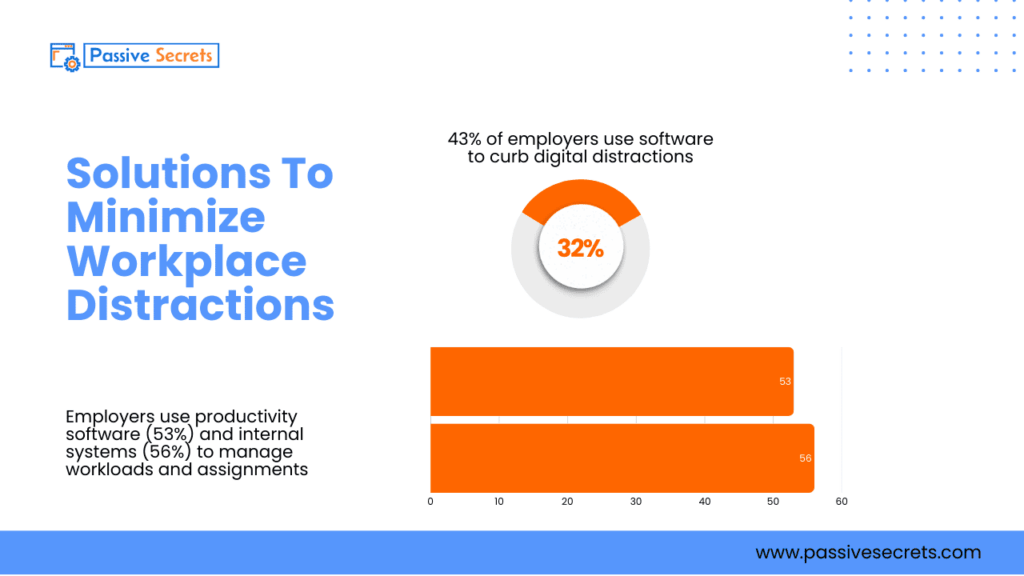
82. Employers use productivity software (53%) and internal systems (56%) to manage workloads and assignments (Insightful Report 2024).
FAQs on Workplace Distraction Statistics
Other Workplace Statistics Articles You Should Know:
- 30+ Powerful Team Building Statistics to Boost Workplace Performance
- 87+ Essential Training Industry Statistics & Trends for HR and L&D Professionals
- Global IT Outsourcing Statistics: Key Trends and Insights
- 90+ Interesting Marketing Jobs Statistics & Facts (Latest Report)
- 80+ Employee Benefit Statistics: Insights and Trends
- The Most Important Wealth Management Statistics You Can’t Afford to Ignore
- Enterprise Data Management: Essential Statistics and Emerging Trends
- 93 Talent Management Statistics to Help You
- Top Reputation Management Statistics and Trends to Improve Your Brand
- 36 Helpful Social Worker Burnout Statistics To Know
- 100 Business Process Outsourcing Statistics & Facts
- Top HR Outsourcing Statistics and Trends Every Business Must Know
- The Top Outsourcing Statistics You Shouldn’t Ignore
- 47+ Shocking 4-day Work Week Statistics To Know
- 105+ Supply Chain Statistics & Facts You Can’t Ignore
- 50+ Interesting Employer Branding Statistics And Trends
- Job Seekers Statistics: Unemployment Rates, Preferences, Challenges
- 95 Interesting Job Interview Statistics and Huge Trends To Know
- 60+ Helpful Change Management Statistics & Facts
- 65+ Employee Performance Management Statistics & Trends
- Workforce Management Statistics: Trends, Insights, & Opportunities
- Workplace Romance Statistics: How Common Is Workplace Romance?
- 40+ Top Workplace Conflict Statistics You Should Know
- The State of Workplace Communication: Key Statistics and Trends
- 55 Workplace Collaboration & Teamwork Statistics

